Sectional drafting vs single prompt writing for long-form posts
Paragraph 14 is where long AI drafts fall apart â not the headline. The voice flattens, two sections make the same point in different words, and the drift is invisible until an editor reads the published page. The real decision isn't sectional drafting vs single prompt writing as a feature comparison; it's which workflow your review capacity can actually absorb.
You already know the symptom. One prompt, one 2,000-word output, then forty minutes of repair edits that leave the piece technically clean and tonally foreign. The good news is that the choice between these two methods is decidable rather than a matter of taste. Below you'll get a four-factor decision rule, an honest look at where each method wins, a failure-mode map showing which approach triggers which defect, and the specific conditions under which a single prompt beats a pipeline. There is a threshold line â a point where the answer flips from one method to the other â and it appears in the comparison table, not in the conclusion.
Short answer: Sectional drafting is usually the better choice for posts above roughly 1,500 words that carry a specific brand voice and fact-dense sections, because each section is briefed and reviewed on its own. Single prompt writing is fine for short posts built on one clear argument, provided one editor reads the entire piece before it ships. Length, voice specificity, factual density, and review capacity decide which side of that line you sit on.
Two working definitions, so the comparison stays concrete:
- Sectional drafting is an outline, then a per-section brief, then a per-section draft, then an assembly edit that reconciles transitions and repeated claims.
- Single prompt writing is one instruction, one complete output, and one read of the finished draft.
Sectional Drafting vs Single Prompt Writing Compared Side by Side
Neither method wins on every post: sectional drafting trades setup time for consistency, and a single prompt trades consistency for speed, with the cost reappearing as repair work.
The table below is a decision rule, not a measured benchmark. Score your next post across the four factors and let the threshold line choose the workflow.
| Factor | Single prompt writing | Sectional drafting | Threshold â where the answer flips |
|---|---|---|---|
| Article length | Holds together while the post carries one continuous argument | Holds structure across many independent sections | Past roughly 1,500 words, small drifts compound faster than an editor can catch them |
| Voice specificity | Voice depends entirely on how well the opening prompt is worded | Voice is re-injected from a persistent context file for every section | When the brand voice has rules a reader would notice being broken |
| Factual density | Claims sit inside flowing prose, which makes verification slower | Per-section briefs keep each claim traceable to its section | When checkable claims outnumber what one reviewer can verify in a single pass |
| Review capacity | Demands one long, uninterrupted read | Allows per-section acceptance gates that spread the load | When no single reviewer can hold the whole draft in their head at once |
| Threshold line: once a post clears roughly 1,500 words, carries voice rules a reader would notice, stacks claims that need checking, and has no reviewer with time for a full read, sectional drafting starts to pay for its setup cost. | |||
Best for single prompt writing: solo operators and founders shipping short posts where the argument is single-threaded and one editor genuinely reads the whole thing before publishing.
The second table maps the four failure modes to the method that triggers each one, and to the review checkpoint where it surfaces.
| Failure mode | Triggered by | Where it surfaces in review |
|---|---|---|
| Voice drift | Single prompt on long drafts, as instructions lose influence deeper into the output | Mid-document, when the tone turns generic or reverts to default phrasing |
| Structural collapse | A single prompt with no outline; also sectional drafting run without a shared outline | Section transitions and overlapping headings |
| Factual drift | Any method lacking a brief, worst in a single prompt where one wrong claim propagates | Claim-by-claim comparison against sources |
| Repetition loop | Sectional drafting without per-section briefs, so sections re-argue the same angle | Two or three sections opening on the same point |
Best for sectional drafting: publishing teams running voice-specific, fact-dense cluster posts where several sections must survive independent fact-checks.
Worth stating plainly: length is not the goal. Google's people-first helpful content guidance frames word count as a byproduct of covering a topic properly, not a target â which is why the decision above hinges on voice specificity and factual density rather than a hard number alone. Each section also benefits from a written SEO content brief that names the question it answers before drafting starts.
If you want the sectional workflow without assembling it by hand, BloGoose crawls your site, extracts brand-voice rules from published pages, and drafts section by section against that context before publishing to WordPress or your own API.

When Does Single Prompt Writing Work Best?
Single prompt writing is one instruction that produces one complete draft in a single pass, which makes it the fastest route from idea to readable page when the piece is genuinely simple. Think of it like asking a contractor for one finished room in a single walkthrough rather than a room-by-room plan â fine when the room is small and you'll inspect it yourself.
Here is the mechanism behind the mid-draft voice problem. A model drafting in one pass has to keep your voice rules, structure, and facts in play simultaneously across thousands of words, and the original instructions carry less influence the deeper the output runs. Nothing about that is a measured rate; it is simply how a single continuous generation behaves. The visible result lands around the middle sections, where tone flattens and structure loosens, and the readability check rarely catches it because sentences still parse cleanly.
Single prompt writing wins in four concrete situations: posts short enough to hold one argument, topics with low brand-voice specificity, drafts with few checkable claims, and workflows where one editor can read the whole piece in one sitting. The review step is exactly that â one editor, one full read, then repair edits concentrated on whatever drifted. Effort shifts from setup to repair, which is the first half of the review-cost inversion that makes pipelines look expensive until a long post needs three revision rounds.
When the post outgrows those conditions, the workflow has to change â which is the case sectional drafting was built for.
How Does Sectional Drafting Keep Long Posts on Track?
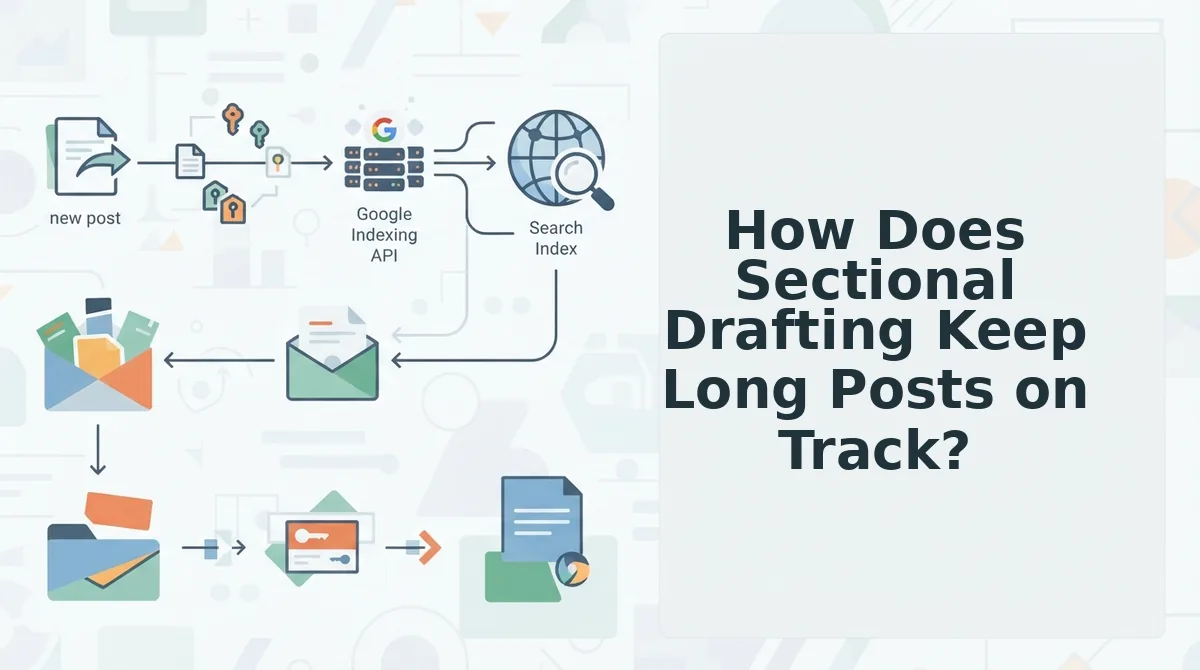
Sectional drafting keeps a long post on track by re-sending the same voice rules and site context with every section, so section 12 is written under the same constraints as section 1.
Prerequisites: a research outline, three to five voice rules written as testable statements, and one editor with roughly 90 minutes for a 2,000-word post. A plain document can hold the context block, or a pipeline such as the automated SEO content workflow can store it for you.
- Build the outline from research (20â30 min). Write each H2 as a claim the post must prove. You should end with 5â9 headings and one stated job per heading.
- Write a per-section brief (10 min per section). Type the claim, the evidence you have, and the answer passage that must stand alone. You should read each brief in under 30 seconds.
- Load the persistent context (5 min, once). Paste voice rules, audience, and banned phrases into a block that travels with every section. You should be able to point at the rule behind any sentence.
- Draft one section at a time (5â10 min each). Generate against the brief and reject output that drifts from it. You should see every draft stay inside its assigned claim.
- Gate each section (3â5 min each). Approve or reject on voice, evidence, and length before starting the next one. You should carry no unresolved issue forward.
- Run the assembly pass (15â20 min). Read top to bottom for transitions, repeated claims, and headings that no longer match their sections. You should catch repetition here rather than in a rewrite.
Context re-injection means voice rules and site context are re-sent with every section instead of decaying across one long output. The assembly pass is a single top-to-bottom read for transitions and repetition that only becomes possible once discrete sections exist.
That is the second half of the review-cost inversion: effort moves from rewriting to approving. Gating six sections at four minutes each costs 24 editor minutes, while one full revision round on a 2,000-word draft costs hours. Multiply revision rounds by editor hours per round and the arithmetic favors the pipeline on every post long enough to need a second round.
BloGoose documents that same sequence end to end: it reads your site, extracts brand voice into context files, plans a 30-day calendar, drafts section by section, and publishes to WordPress or a custom API. The mechanism is the workflow, not a single prompt.
What Sectional Drafting Will Not Fix (Including in BloGoose)
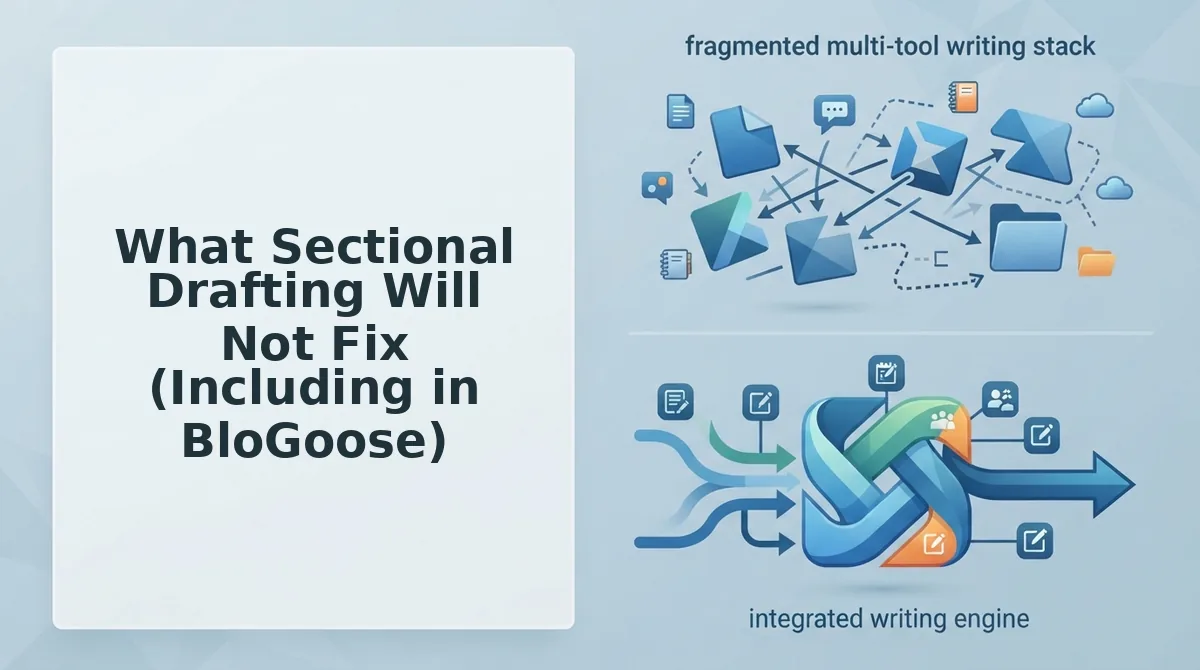
Sectional drafting reduces voice drift and structural collapse; it does not remove editorial judgment from publishing. These limits hold for any sectional pipeline, this one included.
- A human editor still makes the final call. No acceptance gate decides whether a claim deserves to ship. Gates let an editor sort drafts faster; they do not replace the person doing the sorting.
- Unsupported claims get flagged, not resolved. A pipeline can mark a sentence with no source behind it. It cannot produce the source, so factual review stays a human task with a human deadline attached.
- The assembly pass can still miss repetition. One top-to-bottom read catches most echoed claims, not all of them. Posts with overlapping headings need a second read before they go out.
- Setup overhead is wasted on short posts. Building voice rules and a section-by-section outline takes an hour that a 600-word post never recovers. Below roughly 1,200 words, the pipeline costs more than it saves.
- Shipping at scale without review invites scaled content abuse. High volume plus no editorial gate is the exact pattern search policies target. Your review capacity, not your drafting speed, is the real ceiling on output.
Any performance conclusion from a sectional workflow stays open until a human reads the finished piece.
Questions About Sectional and Single Prompt Drafting
Does one prompt work for a 2,000-word article?
Rarely, without repair. A single prompt can generate 2,000 words, but attention across one long output tends to drift on voice, repeat points, and lose structure past the midpoint. It holds up when the article makes one argument across a handful of sections.
Does sectional drafting cost more?
It costs more editorial time up front and less on revision. Per-section briefs add roughly ten minutes each, while acceptance gates replace full rewrite rounds with minutes-long approvals. The trade pays off only when a post is long enough to need multiple revision rounds otherwise.
Can you mix both methods in one content cluster?
Yes, and most teams should. Use a single prompt for short supporting posts that make one point, and sectional drafting for the pillar page carrying the cluster's main argument. Matching method to length keeps setup overhead where it earns a return.
Does the drafting method affect whether AI answer engines cite the post?
Indirectly. Citation depends on self-contained answer passages and clean structure, not on which tool drafted the text. Per-section briefs let you schedule those passages deliberately, which is the practical link between sectional drafting and AEO content optimization.
The decision comes down to length, voice specificity, and how much review time you actually have.
So Which One Should You Run?
Run a single prompt below the threshold â short post, one argument, an editor who reads the whole thing â and sectional drafting above it, where length, voice specificity, and fact density outrun your review hours. That is the rule in one line.
Score your next post on four factors before you write a word:
- Length, voice specificity, source density, and review capacity â score each honestly.
- Write your brand voice rules into one reusable context file instead of re-explaining them per draft.
- Set per-section acceptance gates so a drifting section fails before it propagates.
Our recommendation: sectional drafting for long-form cluster content, a single prompt for short single-argument posts, and a human editor in both cases.
That workflow is what BloGoose's AI SEO content engine exists to run end to end â crawl, voice extraction, calendar, section-by-section drafting, publish â so a 2,000-word post arrives reading as one voice rather than twelve.
The drafting method was never the point; matching it to your review capacity is.