How SERP Content Gap Analysis Shapes Citation Ready Outlines

Your guide satisfies every target keyword in an optimization tool, yet organic rankings slide while AI Overviews bypass your page entirely. Sifting through dozens of rival tabs triggers operational analysis paralysis, a frustration practitioner Josiah Roche frequently highlights during manual page teardowns. Standard domain keyword intersection reports in Ahrefs surface shared terms, but they cannot perform the granular page-level semantic auditing required for modern answer engines.
Capturing top positions requires entity completeness rather than phrase repetition. Deploying an AI SEO content engine bridges this divide by translating SERP content gaps into citation-ready outlines. You will learn how live search signals reveal unaddressed user intent, including one counterintuitive outline structure that prevents AI chatbots from discarding your answers.
Here is how structural gap analysis resolves this bottleneck:
- Situation: A publisher updates an informational guide, but legacy tools fail to reveal why rival URLs earn search engine citations.
- Action: The team executes live SERP queries to isolate competitor coverage gaps, converting missing semantic subtopics into distinct outline prompts.
- Outcome: The finalized outline organizes factual claims into direct-answer blocks, establishing relevance without manual prompt engineering or spreadsheet coordination.
To streamline your workflow, use an automated system that conducts live SERP topic research directly from your site structure.
Prerequisites and Expected Outcomes of a Modern SERP Audit
A modern SERP audit requires clean environment isolation, query intent mapping, and entity extraction protocols before analyzing competitor layouts to produce an outline engineered for organic rankings and answer-engine citations. When conducted systematically, this audit delivers a baseline structure covering verified search intent alongside proprietary gaps that trigger AI quotation.
A modern SERP audit is a structured evaluation of live search engine result pages to identify mandatory topical entities, formatting conventions, and unanswered subtopics for a target keyword. Rather than scraping dozens of low-ranking pages, search teams inspect the top three organic URLs and active answer features. Think of a SERP audit like reviewing municipal building codes before drafting architectural blueprints; you must know the exact structural requirements inspectors expect before adding unique custom design elements. Establishing this benchmark guarantees your outline satisfies core ranking requirements while uncovering vertical information gain opportunities.
Scraping twenty competitors produces redundant noise and stack sprawl. Analyzing the top three organic results alongside active SERP features yields far clearer ranking signals with zero wasted effort.
Executing an effective audit requires three sequential prerequisites:
- Incognito browser profiling: Neutralizing geographic bias, user history, and localized personalization to view unskewed result layouts.
- Search intent classification: Categorizing the query as informational, commercial, or transactional by evaluating ranking features like video carousels, comparison matrices, and direct answer snippets.
- Entity extraction protocols: Identifying core technical nouns, process steps, and semantic relationships shared across the highest-performing pages.
The primary expected outcome is satisfying the 80/20 baseline for search visibility. Passing this threshold ensures your content matches what algorithms expect while providing the novel insights language models pull into synthesis blocks.
Instead of manually compiling these requirements across fragmented SEO subscriptions, teams can review how automated live SERP analysis extracts competitive gaps and intent signals automatically to ground every outline in verifiable search data.
Keyword Gap vs Content Gap and What Teams Get Wrong
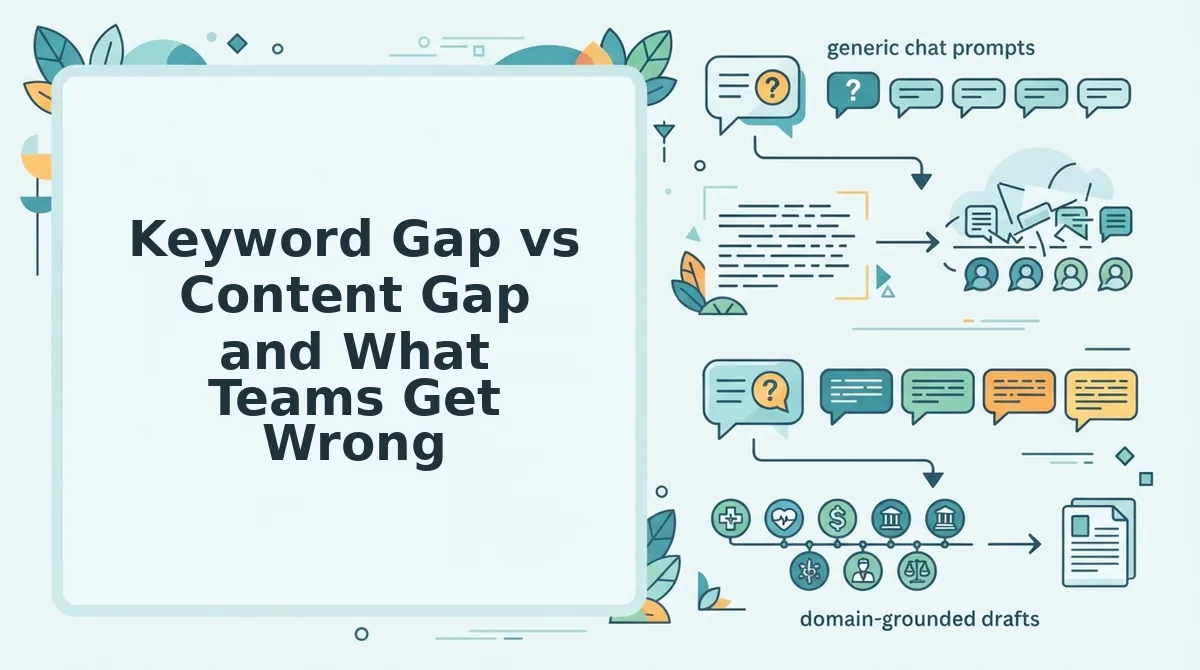
A keyword gap reveals which search queries your competitors rank for that your domain misses entirely, whereas a content gap pinpoints the specific functional questions, tactical depth, and contextual steps missing from an individual page. Teams fail when they confuse domain-level keyword intersections with page-level semantic requirements, producing bloated outlines that target search terms without satisfying intent.
Why does your domain rank for thousands of secondary keywords while your primary pillar page fails to answer the searcher's core functional problem?
The issue stems from conflating site breadth with informational utility. A domain keyword gap analysis queries competitive URL sets to identify ranking differentials across whole indexes. In contrast, a content gap evaluates the top-ranking URLs on a live results page to map missing semantic entities, unresolved sub-intents, and unaddressed reader friction points.
A content gap is the informational void between what top-performing search results explain and what a searcher requires to complete a real-world task.
To fix this disconnect, evaluate outlines against the Dual-Vector SERP Gap Matrix:
- Horizontal Gaps: These encompass coverage breadth, industry vocabulary, and People Also Ask variations across the search landscape.
- Vertical Gaps: These represent tactical depth, operational friction points, and concrete, reproducible execution steps.
| Dimension | Domain Keyword Gap | Page-Level SERP Content Gap |
|---|---|---|
| Core Scope | Broad site-wide ranking overlap | Granular, single-URL intent resolution |
| Primary Data Source | Competitive search database indices | Live SERP document parsing and entities |
| Impact on Outlines | Produces arbitrary keyword checklists | Structures logical, citation-ready sections |
| Optimization Tooling | Traditional rank intelligence suites | Real-time NLP and on-page analyzers |
Both disciplines serve distinct publisher needs depending on organizational maturity and software stacks.
Tools like Jasper excel at broad creative copywriting and multi-channel campaign drafts, making them best for corporate marketing teams managing omni-channel promotions. Platforms like Surfer SEO specialize in real-time NLP scoring and entity densities, making them best for hands-on copywriters optimizing individual text editors manually.
Choose domain keyword analysis if your team is planning an annual editorial calendar from scratch or identifying new topical categories. Choose page-level SERP gap analysis if your primary pages rank on page two and require immediate structural improvements to satisfy search engines and capture AI answer engine citations.
Our recommendation is to prioritize page-level SERP content gaps before expanding domain keyword volume. A comprehensive outline that directly resolves vertical execution friction generates authority, captures citation answers, and ranks sustainably, whereas surface-level keyword stuffing leaves search intent unfulfilled.
How to Conduct a SERP Content Gap Analysis in Four Steps
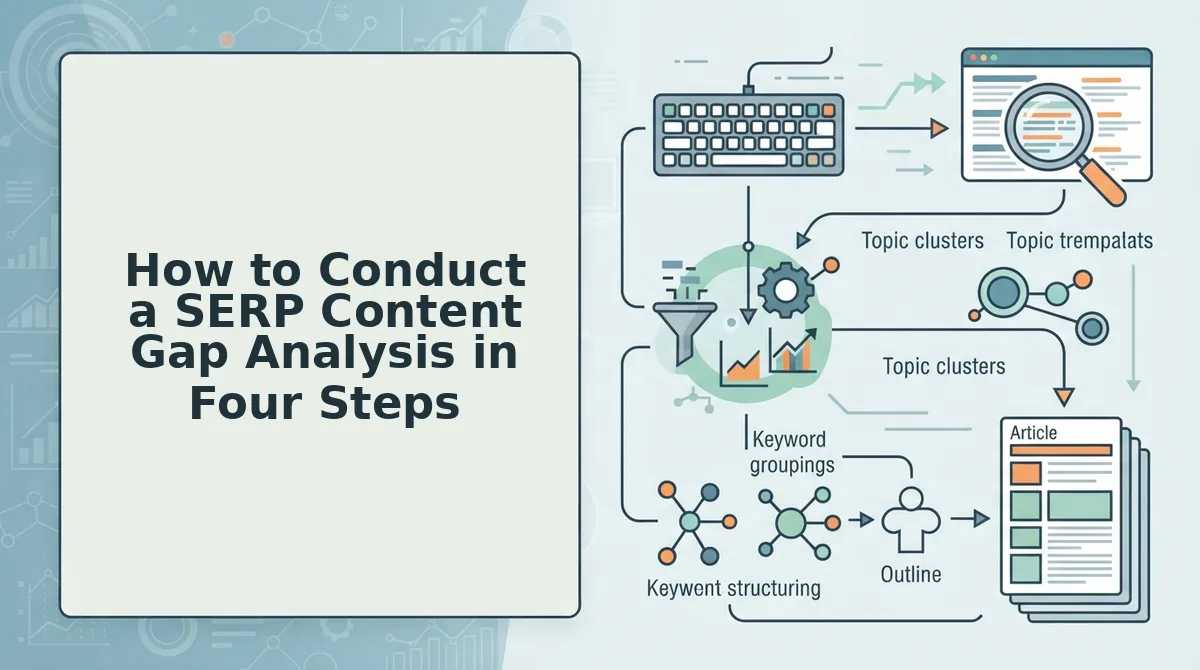
Conducting a SERP content gap analysis requires reverse-engineering the top organic results to identify baseline topic consensus, extract neglected entity queries, and structure unique answers into a crawlable outline. This diagnostic process establishes the factual foundation necessary for search rankings and answer engine citations.
SERP content gap analysis is the practice of evaluating competitor search coverage and algorithm features to find unaddressed user intents and missing semantic entities. Before starting, gather your primary keyword, an active browser tab, and a clean outline document (estimated completion time: 30 minutes).
- Extract the consensus 80% via heading hierarchy: Open the top 3 to 5 organic search results for your primary query and record their H2 and H3 structures in your document. You should see an overlapping baseline of core concepts that search engines treat as mandatory for search intent coverage. (Estimated time: 8 minutes)
- Mine SERP features for entity relationships: Expand the People Also Ask modules and inspect the featured snippet blocks on the search results page to record related questions. You should see a cluster of semantic entities and sub-queries that clarify how search algorithms connect your topic to adjacent concepts. (Estimated time: 7 minutes)
- Calculate the vertical information gain layer: Review the competitor outlines to identify generic claims, surface-level explanations, and questions that existing articles hand-wave. You should produce a distinct list of proprietary workflow steps, technical constraints, or concrete mechanisms that competitors omitted. (Estimated time: 10 minutes)
- Structure direct declarative answers: Write your outline sections by placing complete, standalone answers within the first 40 words below every planned H2 heading. You should see a modular outline ready for passage indexing that answers core search questions immediately before elaborating on mechanics. (Estimated time: 5 minutes)
Why does early answer placement matter so much for modern visibility? When search engines parse pages for passage indexing and generative snapshots, they extract self-contained text blocks that resolve user questions without requiring context from adjacent paragraphs. Outlines that front-load exact definitions, numbers, and operational outcomes within those initial sentences provide clear boundaries for retrieval models. Structuring your outline around these standalone answers is essential if your goal is learning how to get cited in AI answers and chatbots.
Performing manual SERP deconstruction across dozens of target terms often creates administrative friction and stack sprawl. Rather than running manual audits for every topic, you can deploy an autopilot SEO content engine like BloGoose to automatically crawl competitor footprints, map live SERP gaps, and deliver citation-optimized articles straight to your CMS.
Worked Example of a Citation-Ready Outline Architecture
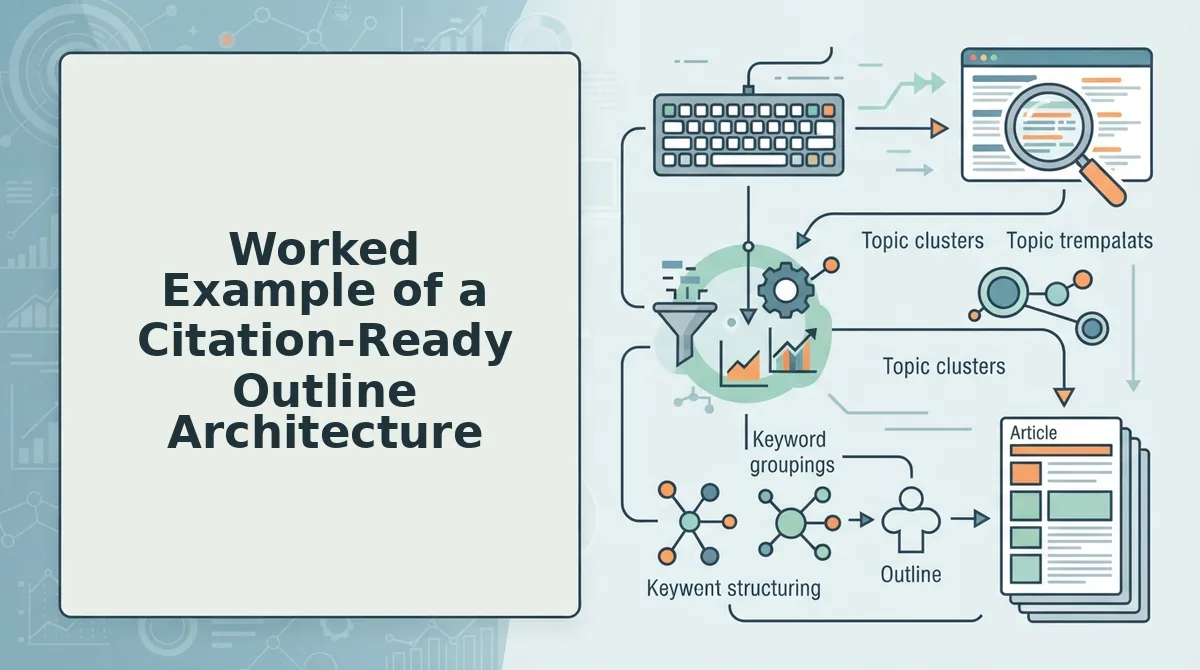
A citation-ready outline architecture translates identified SERP content gaps into modular semantic headings that directly answer user queries before delivering procedural guidance. Standard competitor parity outlines merely reproduce existing search results, producing commodity drafts that search engines demote in favor of structured answers. Citation-ready architecture is a hierarchical content framework designed to present discrete, self-contained factual answers directly under section headers for automated extraction. Structuring sections with immediate definitions and sequential lists ensures answer engines parse the underlying text for conversational citations and passage indexing.
- Direct-Answer Lead Placement: Position a direct factual answer immediately beneath the primary H2 instead of opening with conversational throat-clearing. This satisfies algorithmic passage indexing because search evaluators prioritize explicit initial definitions over narrative setup. Write the opening sentence using the exact syntax of the target search query before expanding into technical specifics.
- Explicit Entity Definition Block: Insert a self-contained entity statement that resolves conceptual ambiguity directly following the lead answer. This ensures search engines categorize your subject within its broader topical cluster rather than mistaking it for generic advice. Format the entity using a concise definition template within the first sixty words of the section.
- Numbered Execution Sequences: Convert broad explanatory paragraphs into ordered execution steps that address procedural information gaps missing from competing articles. This gives search engines structured step-by-step sequences suitable for featured snippet extraction and AI overview cards. Structure each action item with a bold imperative phrase followed by concrete execution instructions.
- Annotated Comparative Contrast: Incorporate explicit side-by-side differentiators rather than compiling simple lists of competing features. This fills critical evaluation gaps where standard search results offer superficial descriptions without addressing specific trade-offs or operational boundaries. Detail the exact operational divergence between legacy manual workflows and automated content workflows.
- Factual Boundary Clarification: Define specific constraints and technical limitations directly within secondary subheadings instead of burying them in concluding summaries. This establishes authoritative depth because answer engines favor sources that delineate clear operational parameters over generic claims. Write explicit boundary conditions explaining where a methodology applies and where technical prerequisites prevent deployment.
Consider a publishing team whose legacy articles matched competitor word counts but failed to earn AI citations or search snippets. The team used BloGoose to inspect their domain sitemap, generate brand context files, and run live SERP gap queries across target topics. Instead of writing long-form narrative drafts, the engine generated modular outline blueprints with direct-answer leads, bold entity definitions, and ordered execution steps directly beneath each heading. This structural overhaul eliminated conversational filler, producing clear outlines that search engines indexed as definitive passage answers.
How to Verify That Your Outline Closes Every Search Gap
You verify that an outline closes every search gap by auditing its headings against live search results, semantic entity coverage, and answer engine extraction standards before drafting body text. An outline successfully eliminates content gaps when its H2 and H3 headings answer targeted search queries independently without relying on supporting body prose.
An outline audit is a pre-flight content evaluation process that scores draft heading structures against competitor search engine result pages and AI extraction benchmarks. Executing this review guarantees that your article addresses overlooked user problems and earns authoritative visibility across both traditional search results and AI overviews.
Before starting this 10-minute pre-publish audit, open your working outline alongside your SERP competitor analysis and entity map. This process confirms you hit full topical depth before writing a single sentence.
- Validate Query Intent Alignment (2 minutes): Compare your sequential H2 layout against the top three ranking SERP results to ensure every informational and commercial search intent is addressed in logical sequence. You should see your outline mirror the core intent path while resolving search sub-tasks that rival pages ignore.
- Audit Entity Depth (3 minutes): Cross-reference your H3 subheadings against the missing semantic entities and technical concepts identified during your SERP gap crawl. You should see every critical entity mapped directly into a dedicated structural heading rather than buried inside generic paragraphs.
- Evaluate Answer Engine Quotability (3 minutes): Test whether each heading and immediate lead concept can resolve user queries independently without surrounding context. Apply this standalone heuristic across every subsection. You should see self-contained, fact-first phrasing that AI chatbots and search engines can parse directly as citation-ready answers.
- Confirm Structural Uniqueness (2 minutes): Audit the structure to ensure it introduces original workflow steps and technical frameworks before you queue automated publishing or ask Google to crawl new posts. You should see differentiated sections that deliver clear information gain over ranking rivals.
Can a visitor solve their problem using only your outline? Read your headings in isolation from top to bottom. If the primary solution remains ambiguous without the prose, refine your subheadings before drafting.
Frequently Asked Questions About SERP Content Gap Audits
SERP content gap audits reveal missing entities, answering angles, and structural formats needed to win primary search rankings and AI citations.
Can you identify semantic SERP gaps without paid enterprise SEO subscriptions?
Yes, you can manually uncover semantic gaps by scraping Google's People Also Ask drawers, Related Searches, and competitor headings. Reviewing these elements alongside live AI Overviews exposes the exact entities top pages omit, allowing solo publishers to build comprehensive outline structures using only native search result pages and browser developer tools.
How frequently should you re-run SERP gap analysis on existing ranking URLs?
Audit your critical ranking pages every 90 days or immediately following major core search updates. Organic results fluctuate continuously as search engines introduce new direct-answer modules and competitors update their depth. Re-running your audit quarterly ensures your content reflects fresh search intent shifts before impressions begin to decay.
How do Google AI Overviews change the way outlines should be formatted?
AI Overviews require outline sections to lead with modular, factual summary definitions before providing deeper analysis. Structure every subtopic with clear informational headers, followed by 40-to-60-word standalone answer blocks. This architecture allows retrieval-augmented generation systems to lift clean, authoritative text extracts directly into generated summaries without needing synthesis.
What is the difference between a topical gap and a format gap?
A topical gap represents missing subject matter, whereas a format gap represents an ineffective delivery structure:
- Topical gap: Omitting crucial sub-queries, entities, or troubleshooting steps that searchers demand.
- Format gap: Publishing walls of generic text when the SERP rewards structured comparison tables or concise step-by-step lists.
Next Steps to Scale Gap-Free Publishing Pipelines
Scaling citation-ready content requires replacing disconnected SERP spreadsheets with an integrated pipeline that continuously surfaces omissions before drafting begins. Manual search gap audits reveal the exact structural flaws search engines penalize, but executing audits by hand for dozens of pages quickly stalls production.
Put these findings into immediate production through two operational steps:
- Apply structured SERP gap audits to your next three cluster articles to validate how addressing missing comparative entities impacts ranking speed.
- Establish a workflow that integrates brand context extraction from your sitemap directly with CMS delivery, eliminating manual formatting bottlenecks.
When you automate live competitive extraction, your content shifts from guessing search intent to systematically answering the queries your rivals ignore. Review our tier options to test 3 free articles and turn structural search research into rank-ready drafts published directly to your site.
True search authority does not come from publishing more words, but from building outlines that eliminate information voids before answer engines even have to look.