How to Turn SERP Research Into a Validated Article Brief
You have a dozen SERP tabs open, a few People Also Ask screenshots, and a Reddit thread bookmarked, but still nothing a writer could draft from. That is the moment you need to turn SERP research into article brief fields, not more notes.
To turn SERP research into a validated article brief, classify search intent, separate table-stakes topics from noise, map each gap to a claim and a source, rank evidence by confidence, and build an answer-first outline. Then run the brief through a validation gate before anyone starts drafting.
Raw research can mislead you quickly. In the research run behind this guide, the word "article" pulled in academic intent: 4 of 5 YouTube results covered converting dissertations into journal articles, not SEO briefs. That makes filtering by intent your first action.
This guide walks through a 6-step workflow, from intent classification to an outline where every H2 opens with a direct answer. Pay close attention to the final step. It is the one most briefs skip, and it decides whether the draft ships or gets rewritten.
What Must an Article Brief Contain Before You Start?
An article brief is the document that turns research into drafting instructions. It needs five fields, and your research must produce each one rather than copy it from a template.
- Classified search intent: the goal behind the query, read from live results.
- Keywords with placement: which terms go in the H1, the H2s, and the first 100 words.
- Answer-first outline: every H2 opens with a direct answer.
- Sources with confidence tags: each claim marked by its origin.
- Meta: the title tag and meta description.
The outline covers every table-stakes topic, meaning a subtopic most ranking pages share. It also adds information gain, meaning the value your page offers that those pages lack.
A brief needs three inputs: the top 10 SERP results for your keyword, the People Also Ask and social questions real users post, and your site context, including brand voice, existing pages, and product facts. Order matters because downstream readers, human or model, truncate long briefs, and anything past their limit is lost. Put intent, outline, and sources first, the way you pack a carry-on with essentials on top.
Our SEO content brief guide covers the template. BloGoose builds the site-context input for you by crawling your sitemap and extracting brand voice rules.
How to Turn SERP Research Into an Article Brief Step by Step
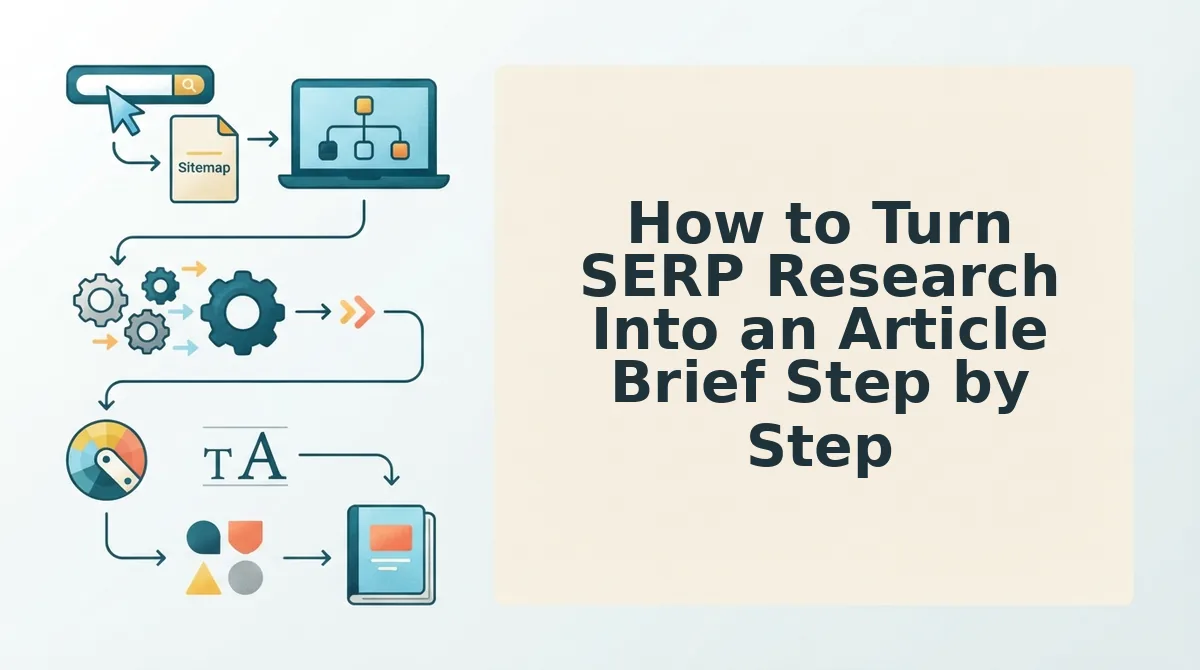
You can turn SERP research into an article brief in five steps: classify intent, filter table-stakes topics from noise, map gaps to claims and sources, rank evidence by confidence, and build an answer-first outline. Each step converts one pile of raw research into one brief field.
Before you start, gather the top 10 organic results for your keyword, the People Also Ask questions, relevant forum or Reddit threads, and your site context. A spreadsheet or shared doc is the only tool you need.
- Classify search intent first (about 10 minutes). Open each top-10 result and label it informational, commercial, transactional, or navigational. If the SERP is mixed, treat that as an opening, because no single format owns the query yet. When you finish, you should have one dominant intent written at the top of your brief.
- Separate table-stakes topics from noise (about 20 minutes). List every subtopic the results cover. Apply the 3-of-10 rule: any topic covered by 3 or more of the top 10 results is table stakes. Subtract before you add by removing off-intent results before you count. In this research run, the dissertation-to-journal-article videos matched the keyword "article" but answered an academic question, so they were discarded. You should end up with a short, clean must-cover list.
- Turn gaps into claims (about 20 minutes). Treat PAA and social questions that the top results ignore as gap signals. Log each one in a ledger:
When this step is done, every gap in the ledger has a claim and a source, or it has been removed.
Gap Claim Source PAA question the top results skip An H2 that answers it directly Live SERP or PAA snapshot Recurring complaint in social threads A claim that addresses the pain point Linked social thread Gap with no documented answer A claim based on model knowledge Tag it [est.] or cut it - Rank evidence by confidence (about 10 minutes). Order your sources on the confidence ladder: live SERP data first, social research second, model knowledge last. Tag any claim that rests only on model knowledge with [est.] so the writer knows to verify or soften it. Each claim should now show a visible confidence level.
- Build an answer-first outline (about 15 minutes). Write each H2 as a question, then add a direct answer of 80-120 words beneath it. These How Do You Validate an Article Brief Before Drafting?
Validate an article brief with a six-question pass/fail gate before drafting begins. Any single "no" sends the brief back for revision. Most competitor workflows skip this step entirely.
How to validate an article brief: treat validation as a pre-draft checklist, not a formality. A brief passes only when its intent is classified and served by every H2, every table-stakes topic is covered, every claim maps to a source or an [est.] tag, every H2 opens with a direct answer, missing metrics read "unknown," and planner-critical fields sit at the top. This gate catches thin, guessed, or off-intent outlines before they become drafts that miss helpful content standards.
- Is intent classified, and does every H2 serve it? Label the intent first, then cut any H2 that answers a different query. Off-intent sections dilute relevance.
- Is every table-stakes topic covered? Compare the outline against topics most ranking pages share. A missing basic signals an incomplete answer.
- Does every claim map to a source or carry an [est.] tag? Trace each figure to its origin. Untagged guesses become published errors.
- Does every H2 open with a direct answer? Write the first sentence under each heading inside the brief. Answer engines quote openings, not buildup.
- Are metrics with no data marked "unknown"? Record gaps instead of guessing. Invented numbers distort prioritization.
- Do planner-critical fields come first? Put keyword, intent, and outline at the top. Downstream tools and editors may truncate the rest.
Worked example: in this research run, primary keyword volume, CPC, and difficulty all came back unknown. The brief records "unknown" for all three instead of inventing numbers, and it still passes the gate.
Article Brief FAQ
These answers address the brief-building questions the sections above leave open.
How long should an article brief be?
An article brief should be short enough that its planner-critical fields survive truncation. Place the primary keyword, intent, and approved H2 outline first, then supporting notes. If a downstream tool or editor reads only the top section, the draft should still match intent and structure.
Can you validate an article brief without live SERP data?
Yes. Tag every estimated figure or inferred topic with [est.] and lower the brief's stated confidence level. Intent, coverage, direct answers, and field order can all pass the gate without live data, while missing metrics stay marked "unknown."
How is an AEO content brief different from a standard SEO content brief?
An AEO content brief specifies an answer-first passage of 80 to 120 words for each H2 and lists the quotable statements the draft must include. A standard SEO brief covers keywords, headings, and topics. The AEO version also plans what answer engines can extract and cite.
Should every popular competitor H2 appear in my outline?
No. Apply subtract-first: drop competitor H2s by default and keep one only when it is table stakes and serves your classified intent. Copying every popular heading produces a bloated outline that mirrors the SERP instead of adding information gain.
Run the Workflow by Hand or Let It Run Itself
Either path works, as long as the brief passes the validation gate before drafting starts. The discipline matters more than the tooling.
Three rules carry the whole process: filter by intent before collecting topics, give every claim a source or an [est.] tag, and never draft until the brief passes the six-question gate. That gate is the step most workflows skip, and it catches weak briefs while fixes are still cheap.
The light option is to run all six steps by hand on your next topic, from SERP pull to pass/fail check. Track how much time goes into tab-switching and copy-pasting.
The strong option is to replace the 12-tab content stack with BloGoose, the AI SEO content engine that handles research, brief, and draft in one workflow, then publishes to WordPress or your custom API. Drop in your domain, and your next validated brief becomes a scheduled article instead of another open tab.