
How to Set Up Writing Examples from Your Own Posts

Your AI drafts read like a committee wrote them, flat, safe, and forgettable, because the model has no anchor to your actual voice. The fix isn't better prompts; it's teaching the AI from your own best work. When you set up writing examples from your own posts, you give every future draft a concrete reference point for tone, structure, and vocabulary that generic instructions can't match.
You're right to be frustrated with the copy-paste-prompt loop. BloGoose solves this by generating a writing-examples.md file automatically from your sitemap crawl, one of the brand context files it builds before drafting anything. In this guide, you'll learn what a writing examples file actually is, how to select the right posts with a 4-point rubric, and how to extract excerpts that teach rather than just show. Stick around: the selection rubric includes one criterion most publishers overlook, and skipping it quietly sabotages every AI draft you publish.
What Is a Writing Examples File and Why Does It Matter?
A writing examples file is a Markdown document that stores short excerpts from your best-performing posts, each annotated with the specific voice rule it demonstrates, tone, sentence rhythm, transition style, or vocabulary choice. It gives an AI writer concrete patterns to imitate instead of vague adjectives like "friendly" or "professional."
Think of it like a style guide for a new editorial hire, except instead of reading a 20-page PDF, the hire studies five annotated paragraphs from your archive. The annotations matter more than the excerpts themselves: a raw paragraph shows what you wrote, but the annotation explains why it works.
BloGoose treats this file as one of the brand context files it generates automatically from your sitemap. The platform crawls your published pages, identifies voice patterns, and assembles the examples file without manual copy-pasting. For publishers running multi-author sites or agencies managing client voices, this removes the single biggest bottleneck in AI content quality: the absence of a durable, reusable voice anchor.
Here's the part most guides skip: a writing examples file also improves answer engine optimization (AEO). When AI drafts consistently match your established voice, search engines and AI answer engines can more reliably attribute content to your brand, a signal that compounds with every post you publish.
Step 1: Pick the Right Posts with a 4-Point Selection Rubric
Selecting source posts is the highest-leverage decision in building a brand voice writing examples file. Use this 4-point rubric: performance, voice purity, format diversity, and recency. Aim for 5-8 posts minimum and 10-15 ideal, spanning at least 3 different content formats.
Before you start, gather your analytics dashboard and your published post list. You'll need access to traffic data, engagement metrics, and the full text of each candidate post.
- Open your analytics and sort posts by organic traffic over the last 90 days. Select posts that rank in the top 20% of your archive. These are proven resonators, the AI should learn from what already works. You should see a shortlist of 15-25 candidates.
- Read each candidate and score voice purity on a 1-5 scale. Ask: does this post sound like us on our best day, or does it drift toward generic industry-speak? Keep only posts scoring 4 or higher. Expect to cut roughly a third of your shortlist here.
- Check format diversity across your remaining picks. You need at least one listicle, one how-to guide, one opinion or analysis piece, and one narrative or story-driven post. This teaches the AI how your voice adapts across structures. If a format is missing, go back to your archive and find a strong example, even if its traffic is slightly lower.
- Verify recency by filtering for posts published or updated within the last 18 months. Voice drifts over time. Older posts may reflect a style you've outgrown. Discard anything older unless it's your only strong example of a required format.
Success looks like a folder of 8-12 posts that collectively cover at least 3 formats, all published within 18 months, all ranking in your top tier. That's your source material for Step 2, where you'll learn to extract excerpts that teach the AI why a passage works, not just what it looks like.
Step 2: Extract Excerpts That Teach, Not Just Show
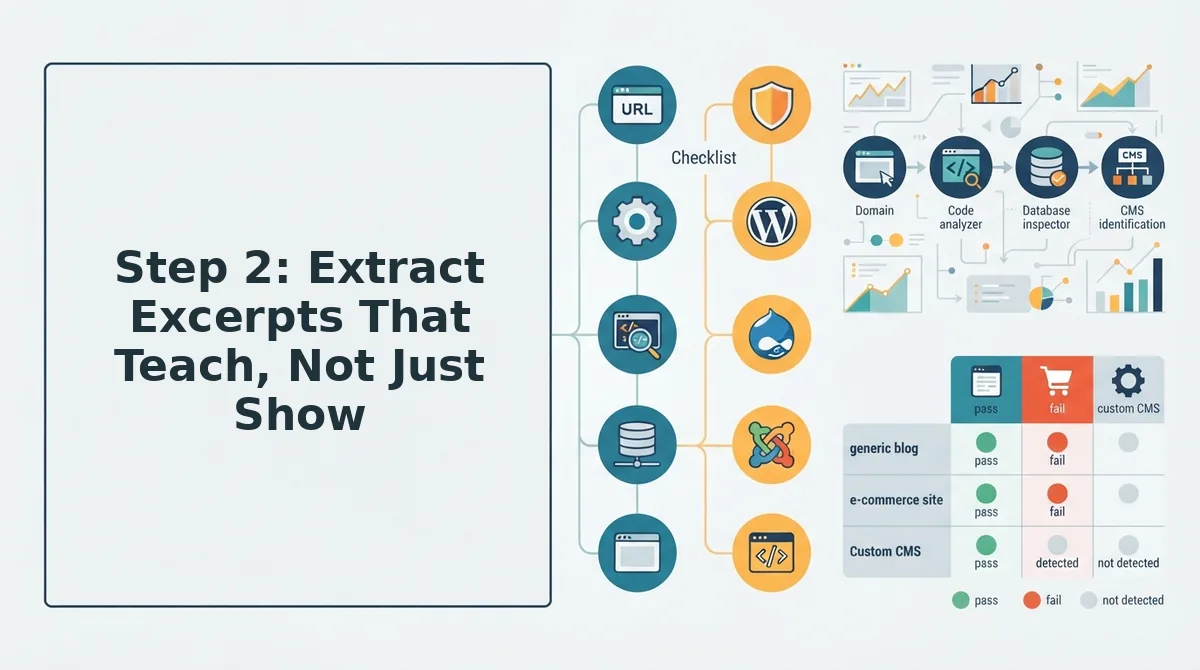
Copy 300-500 word excerpts from each selected post that demonstrate structure, transitions, and tone, not just polished intros. A teaching excerpt shows the writer's decision-making, not just the finished sentence.
Prerequisites: Your 3-5 selected posts from Step 1, a plain-text editor, and 15-20 minutes per post.
- Open the first selected post in your CMS or a plain-text viewer. Locate a middle section, roughly 30-50% into the article, where the writer is developing an argument or explaining a process. Skip the introduction and conclusion; they rarely carry transferable voice signals. Expected outcome: You identify a passage with at least one transition between ideas and one concrete example.
- Select a continuous block of 300-500 words. Include the paragraph before and after the core passage so the excerpt preserves context. Cut any bulleted lists, screenshots, or embedded media unless the surrounding prose explains them. Expected outcome: A self-contained excerpt that reads coherently without the rest of the post.
- Copy the excerpt into a new file named
writing-examples.md. Add a header line above each excerpt with the source post title and URL. Expected outcome: You should see each excerpt clearly separated and traceable to its origin. - Repeat for all 3-5 selected posts, aiming for one excerpt per post. Budget 15-20 minutes per post. Expected outcome: A file containing 3-5 excerpts totaling roughly 1,500-2,500 words, enough signal for an AI to learn patterns without bloating your prompt context.
Full posts bury the signal in noise. Random snippets strip context. A 300-500 word excerpt from the body of a post captures how the writer actually builds an argument, links ideas, and modulates tone under real conditions.
Step 3: Annotate Each Excerpt with Voice Rules
Annotations convert raw excerpts into explicit instructions an AI can follow. For each excerpt, extract three observable rules covering sentence length, transition style, and vocabulary choices, then document 3-5 signature patterns as your voice anchor.
Prerequisites: Your writing-examples.md file from Step 2 and 10-15 minutes per excerpt.
- Open the first excerpt and read it once without taking notes. Then re-read it and count the words in five consecutive sentences. Expected outcome: You determine the dominant sentence length, short (under 12 words), medium (12-22), or long (22+).
- Identify every transition word or phrase (however, so, because, in practice, the result). Note whether the writer favors causal transitions, contrast transitions, or additive ones. Expected outcome: A one-line rule such as "Uses 'because' and 'so' to link cause and effect; avoids 'moreover' and 'furthermore.'"
- List 8-10 vocabulary choices that stand out: concrete nouns, verbs with specific weight, or recurring phrases. Flag any jargon, contractions, or first-person usage. Expected outcome: A vocabulary rule like "Prefers 'ship' over 'deploy,' uses contractions, avoids passive voice."
- Write the three rules directly beneath the excerpt in
writing-examples.md, each on its own line prefixed withRule:. Expected outcome: Each excerpt now carries three actionable, testable instructions. - Define your voice anchor: 3-5 signature phrases or sentence patterns that appear across multiple excerpts. Examples include a recurring opener ("The short answer is…"), a preferred clause order, or a characteristic rhetorical question. Document these at the top of the file under a
Voice Anchorheading. Expected outcome: A compact reference block any AI content engine can apply to new drafts.
Here is a worked example. Excerpt: "The short answer is that internal linking matters more than most teams assume. Because search engines crawl from page to page, a post with no inbound links sits in a dead end. So we link every new article to three existing pages before publishing." Extracted rules: (1) Sentence length averages 15-18 words, mixing one short opener with longer follow-ups. (2) Transitions are causal, "because" and "so" carry the logic. (3) Vocabulary is direct and operational: "crawl," "dead end," "link," "publish", no abstract nouns. Voice anchor: "The short answer is…" opener, first-person plural "we," and a concrete consequence stated after each claim.
If you want a faster path, BloGoose can generate a Markdown style guide from your website automatically, extracting voice rules from your existing pages without manual annotation.
Step 4: Load the File into Your Content Engine
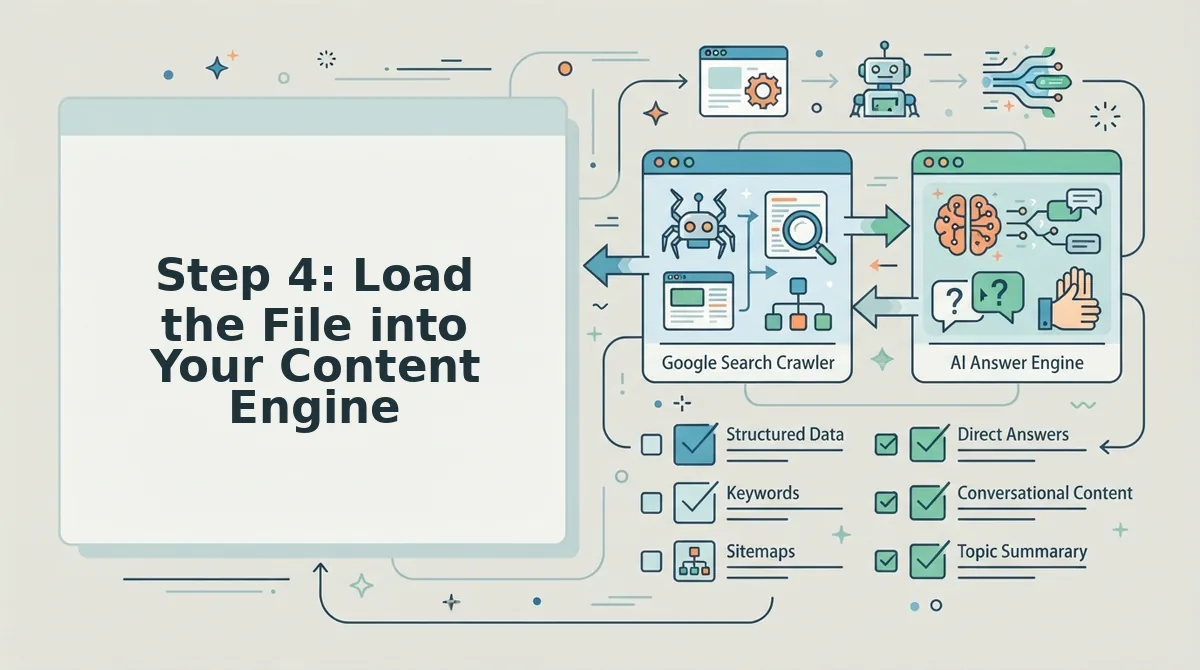
Your annotated writing-examples.md file becomes the voice layer for your content engine. Upload it once, then every generated draft inherits the rules you documented.
Prerequisites: A completed writing-examples.md file from Step 3 and access to your content engine's settings.
- Open your content engine dashboard and navigate to Settings, then Voice & Style or the equivalent section. Expected outcome: You see an upload field or file picker for custom writing examples.
- Upload
writing-examples.mdand confirm the file parses without errors. Expected outcome: A success message or green checkmark appears, confirming the file loaded. - Run a test draft on any topic. Expected outcome: The output mirrors your sentence length, transitions, and vocabulary rules within the first two paragraphs.
BloGoose auto-generates writing-examples.md from your sitemap crawl, so you can skip Steps 1-3 entirely and load a ready-made voice file into the AI SEO content engine in under a minute. Next, test whether your examples actually steer output the way you expect.
Step 5: Test and Refine Your Writing Examples File
A writing examples file is iterative, not set-and-forget. You need a working file loaded into your content engine before you start this step.
- Generate a test draft using your content engine with the examples file attached. Pick a topic you have not written about before. Expected outcome: a draft that reads like your best posts within 5-10 minutes of generation.
- Read the draft aloud and mark every sentence that sounds off-brand. Compare each flagged sentence against your annotated excerpts. Expected outcome: you identify 3-5 specific voice rules the engine missed or over-applied.
- Edit the annotations in your examples file, not the draft itself. Tighten vague rules like "conversational" into concrete patterns like "opens paragraphs with a question." Expected outcome: the next draft fixes the same issues without manual prompting.
- Run a second test draft on a different topic and repeat the read-aloud check. Expected outcome: flagged sentences drop by half or more, taking roughly 15-20 minutes per review cycle.
- Set a review trigger for the file itself. Update it when you rebrand, bring on a new author, or deliberately shift voice. Expected outcome: the file stays current instead of silently drifting from your published content.
Signs your examples file is working: drafts match voice on the first pass, and your edit count per article drops noticeably within two to three test cycles.
Frequently Asked Questions About Writing Examples Files
A writing examples file is a curated set of annotated excerpts from your own published posts that teaches an AI content engine your brand voice. Below are the questions publishers ask most often when building one.
How many posts do I need for a writing examples file?
Use 5-8 posts minimum, with 10-15 being ideal. Fewer than five posts gives the engine too narrow a sample to learn consistent patterns. More than fifteen adds redundancy without meaningfully improving output quality.
Can I use posts from multiple authors?
Yes, but pick the posts that performed best or the voice you want to standardize on. Mixing authors with conflicting styles confuses the engine. If you have multiple voices, build separate files per voice.
Why does my AI draft sound inconsistent even with examples loaded?
Inconsistent output usually means your excerpts are too short or your annotations too vague. Use 150-300 word excerpts and replace abstract rules like "friendly tone" with specific patterns like "uses contractions and second person."
Should I use full posts or just excerpts?
Use excerpts, not full posts. A 150-300 word excerpt per post is enough for the engine to learn sentence rhythm, vocabulary, and structure. Full posts dilute the signal with topic-specific content that does not transfer.
How often should I update my writing examples file?
Update the file when your voice changes, not on a fixed schedule. Triggers include a rebrand, a new primary author, a shift in audience, or a measurable drop in draft quality across three or more consecutive articles.
What if my posts have no consistent voice yet?
Pick your three highest-performing posts and treat them as the voice you are standardizing on. Annotate what they share in common, then use that file to train all future content until the voice becomes consistent across your site.
Your Writing Examples File Is a Living Asset, Not a One-Time Setup
Most publishers treat brand voice as a static document. The teams that win treat it as a feedback loop: publish, test, refine, repeat. Your examples file should evolve every time your content strategy does.
Start small today: run the 4-point selection rubric on three of your existing posts and extract one annotated excerpt from each. That 30-minute exercise gives you a working file you can load into any content engine immediately.
When you are ready to scale, BloGoose's autopilot SEO content platform crawls your sitemap and auto-generates all eight brand context files, including your writing examples, so every draft ships in your voice without manual annotation.
The brands that get quoted in AI answers are not the ones with the most content. They are the ones whose voice is consistent enough to be recognized, cited, and trusted at scale.