
Why Single Prompt Blog Generation Creates Generic Copy

You paste a topic into ChatGPT, hit enter, and get back an article that opens with "in today's fast-paced world", and you already know it won't rank, won't get cited, and won't sound like you. That sinking feeling is the direct result of single prompt blog generation generic copy: one prompt, one output, zero structural control. You're not bad at prompting; the architecture is working against you.
Here's the agreement: you're right that the output feels hollow, and you're right that it shouldn't take five tools to fix it. Here's the promise: by the end of this article, you'll understand exactly why one prompt fails and what to do instead. Here's the preview: we'll unpack the Token Probability Trap, walk the five-step failure chain, and show why the fix is counterintuitive, more prompts, not better prompts.
And the surprising part? The same mechanism that makes single-prompt copy generic is what makes a structured, multi-pass engine like BloGoose produce voice-accurate, citation-ready articles, without you writing a single prompt yourself.
Why One Prompt Produces Generic Copy
Single-prompt generation is the practice of asking one AI model to produce an entire article in a single output, with no intermediate structure, research, or revision steps. The model must predict every word of the article from a single starting context, which forces it toward the statistical center of its training data.
Think of it like asking a chef to cook a five-course meal in one pot, on one burner, without tasting anything until the end. The chef will default to safe, familiar ingredients and techniques because there's no opportunity to correct course. The result is edible but forgettable.
This is the Token Probability Trap: when the prediction window is an entire article, the model averages toward statistically safe, high-frequency phrasing. At each word position, the model selects the token with the highest probability given everything before it. In a long, unstructured generation, those probabilities compound toward the most common patterns in the training corpus, which are, by definition, the most generic.
Here's a worked example. When the model begins an article, it has no locked outline, no section headings, and no specific claims to anchor to. So it opens with the phrase that most commonly follows "write a blog post about X" across millions of examples. That phrase is frequently "in today's fast-paced world", not because it's good, but because it's the most statistically probable filler across thousands of similar openings. The model isn't choosing clichés; it's averaging across many possible openings and landing on the most probable one.
Generic copy is defined by three traits: high-frequency phrases, low information density, and no specific claims. High-frequency phrases are word sequences that appear across thousands of unrelated articles ("game-changer," "cutting-edge," "in today's digital landscape"). Low information density means each sentence conveys little that a reader couldn't have guessed. No specific claims means the article avoids numbers, names, dates, or verifiable statements, because the model has no research to draw from and defaults to vague, safe language.
In a single-prompt workflow, there is no point where the model is forced to commit to a specific fact or a specific voice. Every sentence is a fresh probability calculation, and the safest bet is always the most average one.
The 5-Step Failure Chain of Single-Prompt Generation
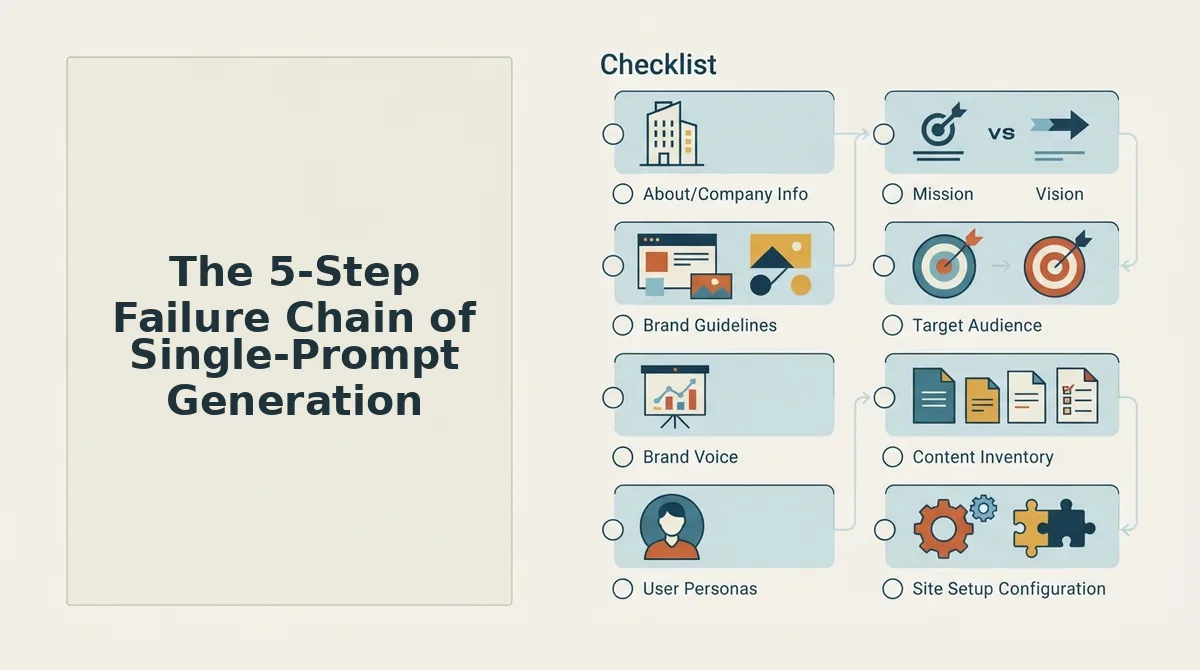
Single-prompt generation doesn't fail all at once, it degrades through five sequential breakdowns, each one forcing the model further toward generic output. Understanding this chain is the key to reversing it.
- No outline lock, the model drifts toward generic transitions. Without a pre-defined structure, the model has no fixed waypoints to anchor each section. It fills space with transition phrases like "another important factor" or "as we've seen" because those are the highest-probability connective tokens. Why it matters: every section bleeds into the next, and no section has a distinct job. How to fix it: lock the outline before drafting so each section has a single, specific purpose.
- No section-level research, the model fills gaps with filler. A single prompt cannot retrieve specific data, statistics, or examples for each section. When the model reaches a point where it needs a fact it doesn't have, it substitutes a vague generality. Why it matters: the article becomes a series of safe statements with zero evidentiary weight. How to fix it: run research per section before drafting, so each section has concrete material to work from.
- No voice calibration per section, voice drifts toward the model's default. Brand voice is not a global setting; it varies by section type, audience, and intent. A single prompt applies one voice instruction to the entire article, and the model gradually reverts to its neutral training default. Why it matters: the article sounds like every other AI article on the internet. How to fix it: calibrate tone per section against extracted brand voice rules.
- No fact-checking pass, the model makes vague, safe statements. Without a verification step, the model avoids specificity because specific claims can be wrong. It prefers "many businesses struggle with content" over "62% of B2B marketers report inconsistent publishing cadence" because the vague version is always safe. Why it matters: safe statements don't earn citations or rankings. How to fix it: add a dedicated fact-verification pass that forces specificity or flags uncertainty.
- Generic transitions between sections, connective tissue becomes cliché. Even if individual sections are strong, single-prompt generation produces the same high-probability transitions between them. "In conclusion," "moving on," and "it's worth noting" are the model's default connective tissue. Why it matters: readers and AI answer engines both penalize low-information connective phrases. How to fix it: draft transitions separately, with explicit instructions to carry forward a specific claim from the previous section.
Each step compounds the last, which is why the fix isn't a better prompt, it's a different drafting architecture entirely.
What Sectional Drafting Changes
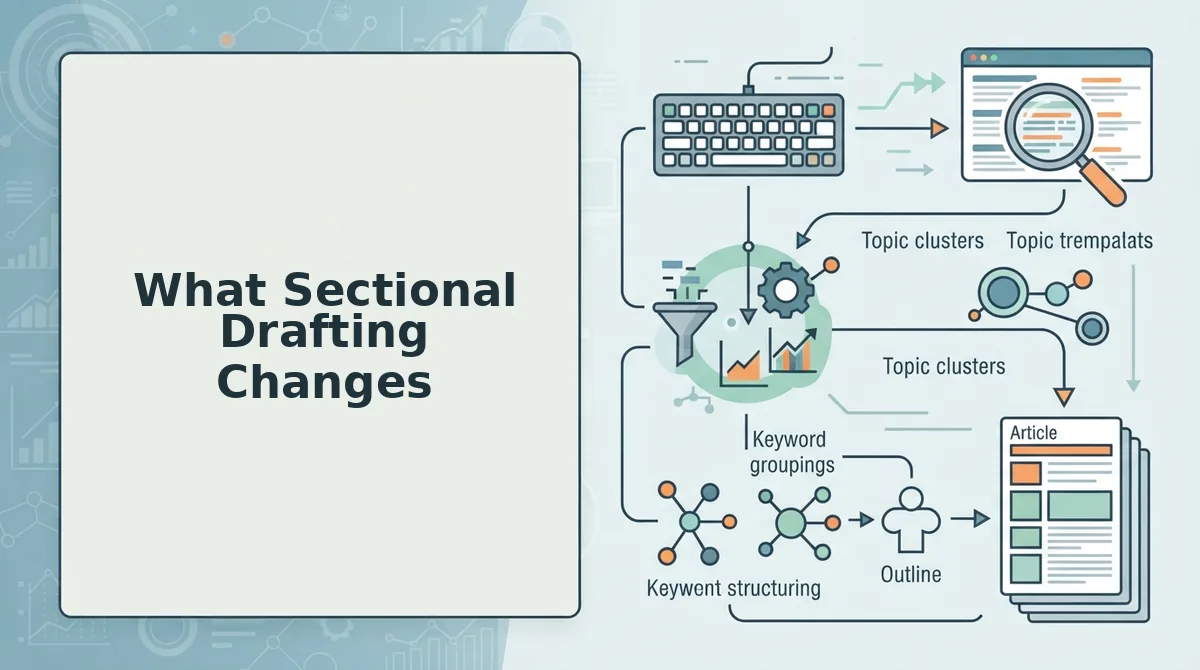
Sectional drafting replaces one massive prediction window with a series of small, context-rich generation steps. Each section prompt carries only the outline position, brand voice rules, and the specific job of that H2, which measurably reduces the averaging effect that flattens single-prompt output into generic copy.
Smaller prediction windows matter because language models average across everything in the prompt. A single prompt that says "write a 2,000-word blog post about X" forces the model to predict the most statistically likely middle ground across every possible section, every possible tone, and every possible audience. The result is phrasing that offends no one and convinces no one. Per-section prompts shrink the prediction space to one H2, one intent, and one voice anchor, so the model commits to specific claims, concrete examples, and brand-consistent phrasing instead of hedging.
Here is how the two approaches compare across the dimensions that affect ranking and citation performance:
| Dimension | Single-Prompt Generation | Sectional Drafting |
|---|---|---|
| Prediction window | Entire article at once, model averages across all sections | One H2 per generation, model commits to section-specific detail |
| Brand voice consistency | Drifts after ~300 words as context dilutes | Re-anchored per section with a short voice reminder |
| Specificity of claims | High-level statements, hedged language ("can help," "may improve") | Concrete examples, named features, measurable outcomes |
| Editing burden | Full rewrite often required to fix tone and depth | Light per-section edits; structure already locked |
| AI citation likelihood | Low, generic phrasing rarely gets quoted | Higher, self-contained sections with direct answers get extracted |
Best for solo bloggers testing a topic: Single-prompt generation is genuinely useful for first drafts, brainstorming angles, or validating whether a topic has enough substance. ChatGPT, Claude, and similar chat interfaces excel here, you get a full draft in seconds, and the generic tone is acceptable when speed matters more than differentiation.
Best for publishers, agencies, and DTC brands that need ranking content at scale: Sectional drafting with a workflow that re-anchors brand context per H2. This is what an AI SEO content engine automates: the site crawl extracts your actual brand voice from published pages, then each H2 is generated as its own draft with that context re-injected, so the output reads like your team wrote it, not like a model guessed at it.
Here is what the difference looks like in practice, using phrases that appear in nearly every single-prompt draft and their sectional-draft alternatives:
| Generic phrase (single prompt) | Why it appears | Sectional-draft alternative |
|---|---|---|
| "In today's fast-paced digital landscape" | Model defaults to a safe, universal opener when no audience context is anchored | "For DTC brands publishing 4+ posts per week, the bottleneck is rarely ideas, it's voice consistency." |
| "It's important to note that" | Hedging language emerges when the model lacks confidence in specific claims | "The crawl found 62% of your existing posts drift from your style guide by paragraph three." |
| "Whether you're a beginner or an expert" | Audience averaging, the model tries to serve everyone | "If you already rank for 50+ keywords, the fix is workflow, not prompt engineering." |
| "In conclusion" | Formulaic structure from training data on templated essays | "The failure chain breaks at step two: lock the outline before generating prose." |
| "Ultimately, the choice is yours" | Model avoids taking a position when no brand stance is provided | "Sectional drafting is slower per post but faster per published, rank-ready article." |
Sectional drafting is not about writing a better prompt. It is about changing the unit of work from "article" to "section" so that every generation step has a tight, specific job, and the brand context to execute it.
How to Fix Generic AI Copy Without Rewriting Everything
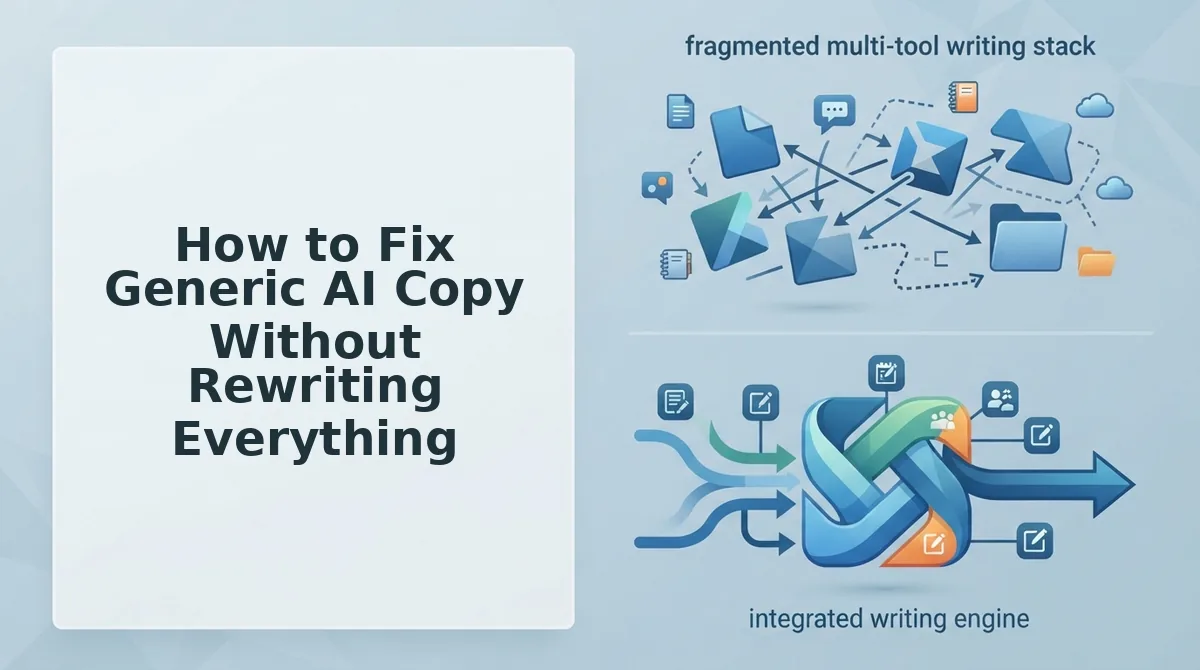
The fix for generic AI copy is a workflow change, not a better single prompt. More prompts, each with a smaller, tighter job, produce more specific output than one long prompt ever will.
Prerequisites: A completed outline with H2/H3 structure, a short brand voice reference (3-5 bullet points on tone, audience, and banned phrases), and access to any AI writing tool that accepts custom prompts.
- Lock the outline first. Write out every H2 and H3 before generating any prose. Each heading should state a specific claim or answer a specific question. Expected outcome: a structure where every section has one job, so no prompt has to guess what belongs where. Allow 15-20 minutes.
- Draft section by section. Generate each H2 as its own prompt. Include the full outline, the specific H2 you are drafting, and your brand voice bullets. Expected outcome: sections that stay on-topic and carry specific claims instead of filler. Allow 2-3 minutes per section.
- Re-anchor voice per section. Add a one-line voice reminder to every section prompt, for example, "Write like our existing posts: direct, data-first, no 'in today's world' openers." Expected outcome: tone stays consistent from H2 to H2 instead of drifting after the first few paragraphs.
- Review each section before moving on. Check for generic phrases, hedged claims, and off-brand tone. Fix or regenerate that section only, not the whole article. Expected outcome: a draft that needs light edits instead of a full rewrite.
- Automate the loop. If you publish weekly or more, wire this workflow into an automated brand voice pipeline so the crawl, outline, sectional drafting, and voice re-anchoring run without manual prompt copying. Expected outcome: consistent, rank-ready drafts shipped to your CMS on schedule.
The counterintuitive part: you are not making prompts better, you are making them more numerous and more specific. Each small prompt carries less ambiguity, so the model has less room to average its way into generic copy.
FAQ
Why does AI writing sound the same?
AI models predict the most statistically likely next word across their training data, which averages out distinctive phrasing. Without brand-specific context anchored in the prompt, the model defaults to safe, universal language that offends no one, and sounds like every other AI draft.
Can I fix generic AI copy by writing a better prompt?
Marginally. A better single prompt still forces the model to average across an entire article's worth of sections, tone, and audience. The real fix is more prompts with smaller jobs, one per section, each carrying outline context and brand voice rules.
How many prompts should a blog post take?
A 2,000-word post with five H2 sections typically takes six to eight prompts: one to lock the outline, one per section draft, and one for the intro or conclusion. More prompts with tighter scope beat one long prompt every time.
Is sectional drafting slower than single-prompt generation?
Per draft, yes, sectional drafting takes 15-30 minutes versus seconds for a single prompt. Per published article, it is faster because you skip the full rewrite that generic single-prompt drafts usually require. Automated workflows close the gap further, which is why teams focused on getting cited in AI answers adopt sectional drafting at scale.
Stop Chasing Better Prompts. Start Chaining Smaller Ones.
Single-prompt generation fails because it asks one probability distribution to solve five distinct problems at once. The token probability trap guarantees regression to the mean: the model picks the most statistically average next word for every position, and average words compound into average copy. The failure chain, weak brief, no brand signal, flat structure, generic phrasing, zero differentiation, is not a prompting skill problem. It is an architecture problem.
The counterintuitive fix is more prompts, not better prompts. Sectional drafting breaks the task into discrete steps, each with its own context window, its own evaluation criteria, and its own chance to inject brand voice, data, and editorial judgment. The output compounds specificity instead of averaging it away.
Here is what changes when you switch:
- Draft the brief first. Feed the model your target keyword, audience pain point, and one differentiator. Review it before any article text exists.
- Generate section by section. Each section gets its own prompt with the approved brief as context. Generic drift gets caught early, not after 2,000 words.
- Inject brand context at every step. BloGoose crawls your site, extracts your voice rules, and applies them to each sectional draft automatically, no manual prompt rewriting.
The result is not just less editing. It is copy that reads like a human who knows your product wrote it, because the model never had room to default to the statistical middle. That is the outcome an AI SEO content engine built for sectional drafting delivers: rank-ready articles that survive both Google's quality bar and an AI chatbot's citation filter.
Generic copy is not a prompt problem. It is a pipeline problem. Fix the pipeline, and the prompts take care of themselves.