
Sitemap Context Extraction vs Byword for pSEO in 2026
You drop 250 keywords into a bulk CSV generator, hit export, and publish, only to watch search engines leave 80% of those URLs sitting in "Crawled - currently not indexed." Evaluating sitemap context extraction vs Byword bulk generation reveals why raw generation volume fails modern search algorithms in 2026. Producing unranked content wastes time and crawl budget, but you can systematically fix it.
In this guide, you will learn how injecting domain context transforms AI generation from generic text into high-ranking search assets. We will examine the structural differences between blind volume production and deep site alignment. Later, we reveal why raw keyword prompts fail search engine information-gain thresholds, and the exact architectural layer that reverses that penalty.
To analyze this performance gap, we tested production pipelines against the Context Injection Spectrum framework. Here is what that looks like in practice:
- The Situation: A publisher needs topical coverage across twenty subtopics without producing disconnected, orphan content.
- The Action: Instead of feeding isolated keywords into a bulk generator, the operator connects their domain to an autopilot SEO content engine, which automatically crawls the XML sitemap and compiles eight editable brand context files like internal-links-map.md and style-guide.md.
- The Outcome: The engine drafts content fully anchored to existing technical CMS rules and live site topology, eliminating manual re-linking.
Key Takeaway: The debate between sitemap context extraction vs Byword bulk generation centers on domain awareness and crawl performance. Generating drafts grounded in eight automated brand context files satisfies strict search engine information-gain thresholds, ensuring scalable content gets indexed and ranked in 2026 rather than discarded.
Understanding this indexation divide begins with deconstructing how dynamic domain extraction actually operates under the hood before writing starts.
What Is Sitemap Context Extraction and How Does It Function?
Sitemap context extraction is an automated architectural audit that crawls a website's XML sitemap to map existing topical clusters, brand parameters, and technical hierarchies before drafting new content. Rather than generating isolated articles in a vacuum, this process transforms published site topology into persistent rules and relational knowledge graphs that inform every generated draft.
Here's the thing. In plain English, sitemap context extraction is the practice of converting an XML sitemap into a comprehensive knowledge base for artificial intelligence. What happens when an AI model inspects your complete domain topology before drafting a single word? Rather than guessing a site's voice or generating blind keywords, the engine parses the XML hierarchy, inspects live pages, and maps technical patterns. The system processes those raw page relationships into structured entity graphs, ensuring every newly written draft respects the established topic depth, historical taxonomy, and active linking targets already live on your domain.
Think of sitemap context extraction like an architect surveying a building's original blueprints and structural foundation before planning an addition, rather than nailing boards together blindfolded. In accordance with Google's XML sitemap guidelines, structured feeds communicate canonical status and structural priority. By parsing this layer programmatically, an AI generation pipeline derives ground-truth reality instead of probabilistic assumptions.
The workflow moves from basic URL discovery to advanced semantic modeling. When a domain enters the setup wizard, the system discovers the XML sitemap, analyzes published posts, and identifies the technical CMS stack.
It then translates raw XML hierarchical trees into an entity relationship graph, compiling the site's historical footprint into eight editable markdown brand context files:
- style-guide.md and writing-examples.md to enforce established tone and syntax rules.
- target-keywords.md and competitor-analysis.md to define topical coverage and competitive gaps.
- An internal link map sitemap crawl recorded in internal-links-map.md alongside seo-guidelines.md to govern contextual anchor placement.
This automated foundation provides explicit guardrails for machine models. In 2026, grounding an engine on existing domain geometry prevents cannibalization and ensures new programmatic pages support established topical authority.
While sitemap extraction establishes dynamic domain guardrails, conventional bulk tools approach this challenge through an entirely different design philosophy centered on static inputs.
How Byword Handles Context Injection in Bulk Generation Workflows
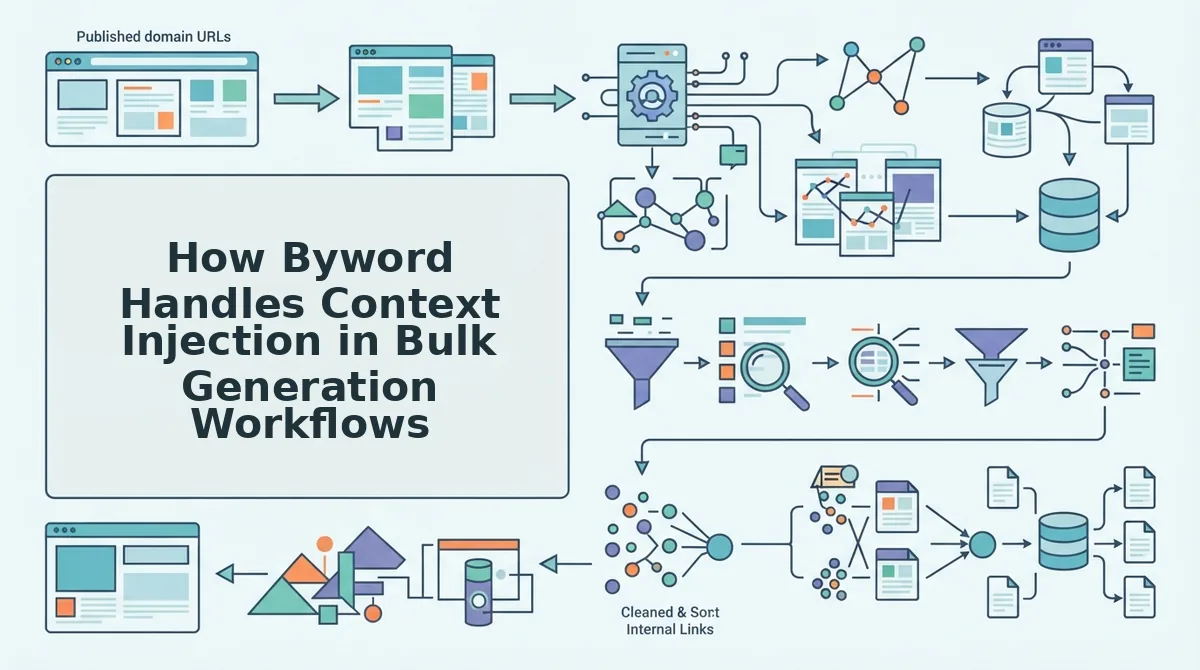
Byword injects brand context into bulk workflows through a single static text field or API context parameter appended universally across an entire keyword queue. This approach applies uniform voice instructions but lacks the dynamic ability to query live website architecture or resolve real-time topic relationships.
Here's the catch.
Relying on a 200-word global prompt across a 500-article batch fails to deliver genuine programmatic context engineering in 2026. Byword is a bulk generation platform designed to translate keyword spreadsheets directly into draft articles at scale. Byword API documentation constrains custom context injection to a single static string parameter passed alongside individual prompts. Because the generator processes each keyword without inspecting published site URLs, sibling articles often produce identical conceptual framings and lack visibility into previously covered topics.
Prerequisites: An active Byword account with generation credits, a prepared CSV spreadsheet of target search queries, and a plain-text brand summary snippet. Setup takes approximately 5 minutes.
- Navigate to the Byword dashboard and select "Batch Generator" from the main navigation menu. You should see the CSV import interface with fields for file uploading and global project parameters.
- Paste your brand guidelines into the "Additional Context" input field, focusing strictly on target audience definitions and company background. You should see the input box save your instructions as the universal prompt baseline for the entire batch.
- Upload your structured keyword spreadsheet to initialize the cloud drafting pipeline. You should see a confirmation modal showing your total queued articles and estimated processing progress.
- Audit the resulting outputs across sibling terms to measure semantic repetition. In a worked test uploading a 200-keyword batch into Byword, sibling articles frequently reused near-identical introductory thesis structures despite serving distinct search intents.
Common mistake: Assuming a global API context parameter handles technical site awareness. While sitemap context extraction reads live site architecture to prevent overlaps, Byword treats each row in isolation. If sibling articles suffer from repetitive introductory syntax, truncate your global prompt to bare entity facts rather than prescriptive outline structures.
To determine how these contrasting approaches perform in production environments, we must evaluate them head-to-head across critical SEO engineering benchmarks.
Sitemap Context Extraction vs Byword: Performance Across Core Metrics
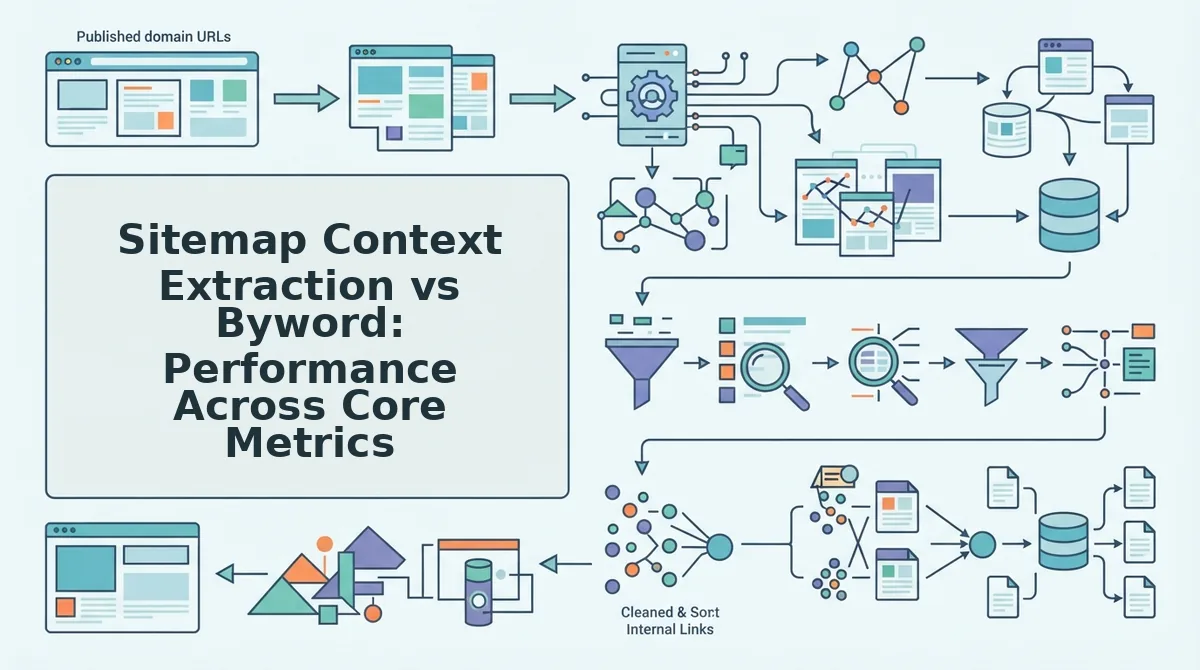
Sitemap context extraction grounds multi-page content production in a domain's live URL graph and technical architecture, whereas Byword bulk generation synthesizes high-volume articles directly from uploaded keyword lists and prompt inputs. While both approaches scale output in 2026, they solve fundamentally different problems regarding factual accuracy, site structure, and production overhead.
Here's the thing.
Consider two parallel 100-page site expansions. In the first workflow, an operator inputs 100 isolated keywords into a CSV for prompt-based bulk synthesis. In the second, an automated engine crawls the target domain's XML sitemap to extract existing site taxonomy, tone patterns, and technical stacks before producing a single word. The difference in operational drag and indexation durability between these two systems comes down to grounding.
Analyzing sitemap context extraction vs Byword clarifies why grounded crawls preserve crawl equity over months of publishing. Sitemap context extraction is an automated discovery method that parses published web pages and XML sitemaps to map site architecture, brand rules, and internal link paths into structured reference files. For instance, extracting live sitemap data identifies exact product tier entities and pricing boundaries, eliminating the hallucinated features and obsolete pricing claims that standard bulk prompt generation routinely introduces across programmatic clusters.
| Evaluation Metric | Byword Bulk Generation | BloGoose Sitemap Context Extraction |
|---|---|---|
| Site Discovery | Manual input (CSV spreadsheets and keyword lists) | Automated crawl via XML sitemap and CMS stack detection |
| Hallucination Defenses | Custom prompt overrides and general web knowledge | 8 domain-tailored context files (including seo-guidelines.md) |
| Link Graph Preservation | Keyword-to-URL matching via user-provided lists | Native internal-links-map.md built from indexed pages |
| Brand Voice Extraction | Manual style guidelines entered in prompt fields | Automated extraction into style-guide.md and writing-examples.md |
| Topic Research Depth | Real-time single-prompt web search scraping | Live SERP query gap analysis combined with social research |
| CMS Handoff | Export via webhook, API, or manual file sync | Direct automated publishing to WordPress and custom CMS APIs |
| 2026 Indexation Resilience | Moderate; requires human link grooming to avoid thin-content flags | High; grounded pillar structures and interlinked context map |
Byword remains an exceptional tool for growth marketers who need rapid, raw keyword execution across hundreds of top-of-funnel programmatic informational queries without pre-crawling an existing estate.
However, when scaling organic search assets for established brands, unstructured generation creates substantial editorial debt. To properly automate brand voice in AI blog posts, writing models require definitive boundaries drawn directly from your verified domain assets.
Decision Framework: Which System Fits Your Content Operations?
- Choose Byword if: You manage early-stage test sites, run pure affiliate arbitrage plays, or require rapid CSV-based generation across thousands of disconnected terms.
- Choose BloGoose if: You are a publisher, digital agency, or DTC brand that requires automated SERP research, structured internal link injection, and direct CMS publishing without manual prompt maintenance.
Our recommendation: If your priority is protecting technical site health while eliminating editorial bottlenecks, prioritize sitemap-grounded generation. BloGoose eliminates multi-tool friction by scanning your existing XML sitemap, building eight comprehensive context files, and publishing research-backed, fully interlinked articles straight to your CMS.
When engineering teams overlook this structural alignment, search engines register the lack of informational differentiation through immediate crawl and indexation drops.
Why Bulk Generation Triggers Cannibalization and Indexation Drop-Offs
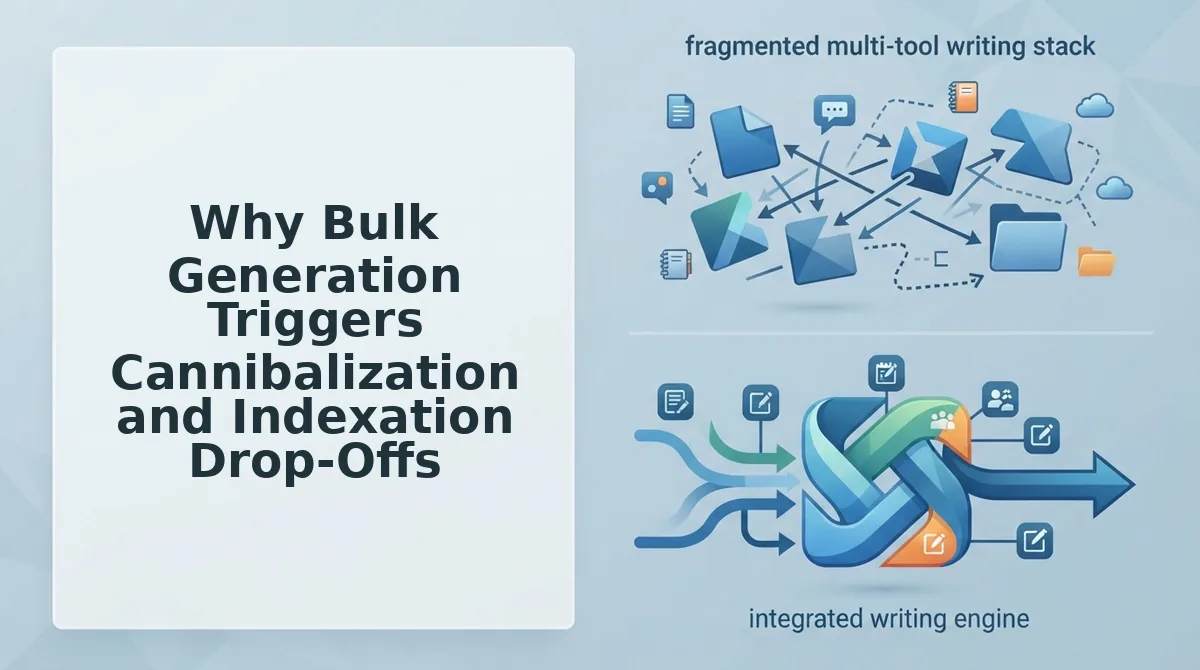
Bulk generation triggers keyword cannibalization and indexation drop-offs because disconnected AI pipelines produce uniform content variants that fail to supply net-new information gain over existing URLs. Search engines in 2026 de-index repetitive programmatic clusters when newly submitted pages replicate the semantic footprints and entity mappings of indexed site architecture.
Here's the thing.
Deploying programmatic content without comparing candidate targets against published pages causes search bots to stall crawling entirely. Modern search algorithms, informed by Google Search Central's helpful content guidance, identify and deprioritize domains that push repetitive or thin pages en masse. To protect domain visibility, publishers must eliminate five root causes of bulk generation failures:
- Unchecked Semantic Overlap Across Sitemaps: This failure occurs when generation queues push articles targeting variants of queries that existing URLs already satisfy. Search engines recognize the intent duplication, split authority between conflicting pages, and depress rankings for both assets. Eliminate this by diffing candidate cluster keywords against live XML sitemap slugs before drafting to prune duplicate targets automatically.
- Monolithic LLM Generation Without Sectional Deduplication: Monolithic generation prompts an LLM to produce an entire article in a single run without checking subheading boundaries against prior outputs. This creates identical introductory hooks and redundant subtopics across hundreds of bulk files, leading search quality algorithms to flag the cluster as low-value programmatic spam. Resolve this by enforcing sectional deduplication, where modular prompts evaluate each individual section against existing page assets before compiling the draft.
- Information Gain Deficits That Block Answer Engine Inclusion: Information gain is the measurement of novel entities, data points, and practical solutions a webpage provides beyond previously indexed documents. Bulk tools lacking ground-truth extraction produce generic restatements that search engines reject and AI engines ignore. Structuring data with explicit entities compliant with Schema. org semantic entity definitions and injecting live domain facts into your structured drafts is essential if you want your domain cited in AI answers and generative overviews in 2026.
- Internal Link Drift Across Generated Batches: Disconnected batch generators create arbitrary, circular cross-linking structures between nascent posts while ignoring established cornerstone content. This dilutes PageRank, confuses crawler hierarchy, and accelerates indexation decay across newly deployed sections. Stabilize your cluster architecture by mapping all internal anchor references against an authoritative internal-links-map.md context index.
- Crawl Queue Bottlenecks From Zero-Differential Content Batches: Pushing hundreds of template-driven pages in a single afternoon causes search spiders to test the batch, detect identical structural templates, and throttle future crawl frequency. This delay strands valuable commercial posts in the discovered-not-indexed status for months. Fix this bottleneck by staging publishing schedules based on verified topical freshness and distinct page utility rather than dumping bulk exports directly into the CMS.
Preventing these indexation penalties does not require complicated, duct-taped developer infrastructure if you establish the right operational workflow from day one.
How to Implement Grounded Programmatic SEO Without Custom Stack Sprawl
Implementing grounded programmatic SEO without stack sprawl requires deploying an all-in-one content engine that automates XML sitemap discovery, brand context extraction, and direct CMS publishing. Grounded programmatic SEO is an automated publishing framework that leverages existing site architecture and live search data to publish non-cannibalizing, context-rich content at scale.
Here’s the thing. Engineering teams often waste 40 engineering hours maintaining custom Python scrapers and vector databases, or burn through Byword bulk generation credits on ungrounded drafts that drop from search indices. Turnkey context engines eliminate this tool fragmentation entirely in 2026.
Prerequisites: A live domain with an accessible XML sitemap and administrator credentials for WordPress or your headless CMS API.
- Submit your root domain in the setup wizard (Est. time: 1 minute). Enter your website URL into the setup field to initiate the crawler. The platform automatically detects your XML sitemap, inspects published pages, and detects your technical CMS stack, confirming success with a verified architecture report.
- Audit the generated brand context repository (Est. time: 5 minutes). Open your dashboard to inspect the eight auto-generated Markdown context files, including style-guide.md, internal-links-map.md, and target-keywords.md. Fine-tune your niche guidelines and conversion targets before generating articles. Pro tip: Designate your highest-converting pillar pages inside your internal link map to automate bidirectional internal linking across all new programmatic assets.
- Execute real-time SERP and intent analysis (Est. time: 3 minutes). Trigger topic research from your detected niche profile. The system queries live search engine results and social discussions to extract ranking gaps and search intent patterns without manual keyword spreadsheets.
- Authorize your CMS connection and launch publishing (Est. time: 2 minutes). Connect your publishing credentials in the platform settings and enable automated dispatch. The engine drafts structured sections, generates inline assets, and delivers production-ready automated SEO content directly to your CMS queue.
Troubleshooting: If sitemap detection stalls during step 1, verify that your robots.txt file allows search crawlers access to your XML sitemap index and contains no blocking directives.
As operators transition away from isolated generation pipelines, common edge cases regarding technical execution frequently surface.
Frequently Asked Questions About Sitemap Context Extraction vs Byword
Architectural context dictates whether programmatic articles achieve durable organic indexation or trigger automated spam filters under modern search engine quality systems in 2026.
The programmatic landscape separates systems by two execution models:
- Sitemap extraction: Context anchored to verified site structure.
- Bulk generation: Independent generation from ungrounded keyword lists.
Does Byword automatically scrape existing URLs for topical context?
Byword does not automatically scrape existing sitemaps or crawl published URLs to gather structural site context. It generates individual articles from user-uploaded keyword spreadsheets and direct prompts. To inject custom brand rules or links, users must manually provide guidelines rather than relying on automated domain-level context ingestion.
How does sitemap context extraction differ from Byword bulk drafting?
Sitemap context extraction inspects full domain architecture to map existing internal links, style guides, and keyword entities before drafting begins. Byword bulk generation creates standalone drafts from individual prompts without indexing prior site coverage. This architectural difference prevents keyword cannibalization by aligning every new page with previously published URLs.
Can sitemap context files prevent AI hallucinations?
Yes, sitemap context files prevent AI hallucinations by grounding article outputs in verified technical rules and domain-specific knowledge. By constraining the AI to structured Markdown files like target keywords and internal link maps, the engine avoids fabricating nonexistent brand offerings or conflicting with previously established domain facts.
How do AI search engines evaluate grounded programmatic content compared to bulk drafts?
AI search engines in 2026 prioritize programmatic pages that demonstrate verified entity relationships and cohesive internal link structures over disconnected bulk drafts. Grounded content earns higher citation frequencies because it references established domain entities. Unanchored bulk generation often triggers low-quality filters due to repetitive topical footprints and hallucinated claims.
Evaluating these core differences leads to an unmistakable operational conclusion for growth teams planning their long-term content roadmap.
The Strategic Verdict for Scaling Content Clusters in 2026
Scaling organic search performance in 2026 requires site-aware entity architecture rather than ungrounded volume generation, resolving why raw programmatic output routinely stalls under modern indexation algorithms.
Here is the bottom line. When weighing sitemap context extraction vs Byword for programmatic deployments, simple CSV generation suffices for quick keyword experiments on low-stakes test sites, but authority publishers cannot afford ungrounded drafts that ignore existing topical architecture.
Apply this decision framework before launching your next cluster:
- Use CSV bulk generation when testing raw keyword demand across disposable test domains without an existing internal link graph.
- Use automated sitemap context extraction when scaling production domains that require strict brand voice adherence, internal link synchronization, and protection against entity cannibalization.
Modernize your cluster deployment roadmap immediately:
- Today: Audit your XML sitemap to isolate orphan pages and overlapping keyword targets across published URLs.
- This week: Replace one-off prompt engineering with crawl-derived markdown context files that map existing site entities.
- This month: Connect an end-to-end publishing pipeline that verifies SERP gaps before publishing directly to your CMS.
Review BloGoose pricing to test grounded sitemap context extraction on your domain with transparent plan limits and zero manual spreadsheet setup. In 2026, programmatic search dominance belongs not to the platform that generates the most words, but to the engine that best understands your existing topical authority.