Why Social Topic Research Matters for AI Search Engines
Traditional keyword metrics trail actual searcher intent by a 60-to-90-day volume latency window. Relying solely on historical search data leaves your content invisible to generative models that prioritize fresh, conversational consensus.
You spend weeks planning editorial calendars around lagging search volumes, only to find modern chatbots citing fresher community discussions instead. An agile AEO optimization strategy requires capturing real-time audience problems before traditional database trackers record their first blip. Deploying an AI SEO content engine bridges this gap by converting live discourse into structured, rankable answers.
Why does this operational blind spot hurt modern publishers?
- Chatbots synthesize live community sentiment and technical forums long before monthly volume thresholds register.
- Static keyword tables miss the exact phrasing, friction points, and follow-up prompts real buyers use.
This guide outlines how to extract raw conversational topics and translate them into citation-ready pillar assets. You will discover the structural shifts needed to satisfy algorithmic evaluators, including a counterintuitive formatting nuance that dictates whether an AI engine quotes your page or bypasses it. This framework applies specifically to indexable, crawl-accessible websites and will not bypass baseline technical crawl restrictions.
What Is Social Topic Research and Why Do Volume Metrics Fail You?
Social topic research is the practice of extracting emerging user problems and discussions directly from active online communities before search tools register monthly volume. Traditional volume metrics fail because historical keyword databases lag behind real-time community dialogues where new AI search queries actually originate.
Social topic research is the continuous analysis of unstructured community discussions, forums, and social threads to uncover unresolved questions and terminology before they register in historical search databases. While legacy SEO platforms rely on historical clickstream logs that take months to reflect new interest, modern retrieval-augmented generation systems and large language models scour live web crawls and natural discussions to answer user queries immediately. By mapping the questions practitioners ask each other in real time, publishers can create focused technical resources that address zero-volume queries, securing prime placement when AI engines synthesize answers for technical topics.
Think of keyword databases like last year's printed census report, while social topic research is like listening to the daily conversations happening on the town square right now.
The Volume Lag Framework explains this breakdown. Traditional search tools require thousands of recorded searches over trailing monthly cycles before assigning a metric to a keyword phrase. AI search engines operate on semantic retrieval rather than aggregate search volume, actively hunting for authoritative, context-dense explanations that match conversational user prompts.
- Historical clickstream data: Shows what users typed into search bars six months ago.
- Social topic threads: Reveal exact edge cases, phrasing, and workflow friction users experience today.
Consider a publishing team evaluating a newly released framework update. When conventional SEO tools showed zero search volume for emerging configuration errors, the team initiated real-time SERP and social research rather than abandoning the topic. They deployed an autopilot content engine to analyze live search engine result pages alongside community discussion patterns, identifying distinct competitive gaps and unaddressed user intent. The engine structured factual content targeting the exact friction points, enabling the publisher to secure citations in conversational AI summaries well before search tools registered the topic.
Monitoring live discussions ensures your content calendar directly targets the natural language patterns that search engines reference first. Reviewing real-time community conversations alongside search engine result pages protects your publishing workflow from the blind spots of lagging keyword metrics.
Social Listening vs Social Topic Research: What Competitors Confuse
Competitors confuse social listening with social topic research by treating defensive brand reputation monitoring as a replacement for forward-looking topical entity discovery. While social listening tracks historical brand sentiment and reactive PR mentions, social topic research extracts recurring user problems, natural language phrases, and semantic relationships directly from online discussions to fuel search rankings.
Social topic research is the systematic extraction of conversational themes, question patterns, and entity relationships from community discussions to inform structured search engine indexing. Platforms designed purely for listening log sentiment scores to protect brand equity. In contrast, topic research surfaces the exact conceptual gaps answer engines need to resolve user intent.
Why do marketing teams dedicate dozens of hours each month to cataloging vanity sentiment graphs while their organic footprint remains invisible in AI responses? Monitoring mentions tells you how people reacted to yesterday's campaign; research reveals the informational voids your site must address tomorrow.
| Comparison Vector | Social Listening | Social Topic Research |
|---|---|---|
| Scope | Brand-centric monitoring across brand tags, campaign hashtags, and direct executive mentions. | Niche-centric discovery across conversational pain points, emergent problems, and industry trends. |
| Primary Metric | Share of voice, sentiment polarity scores, and operational mention volume. | Information gain potential, entity density, and addressable topical depth. |
| Output Format | Defensive crisis alerts, PR escalation reports, and historical sentiment dashboards. | Structured editorial outlines, semantic entities, and indexable topic clusters. |
| AEO Search Impact | Minimal; creates zero informational assets that answer engines can ingest or cite. | High; feeds search models exact question-and-answer pairs required for AI citations. |
Choosing the Right Approach
- Choose social listening if: You manage enterprise communications, mitigate brand reputational crises, or handle customer support complaints at scale. Best for: Public relations directors and corporate brand managers.
- Choose social topic research if: You need to uncover non-obvious audience questions, capture organic traffic, and secure authority in modern search systems. Best for: Growth leads, founders, and technical SEO practitioners.
Our recommendation is straightforward: deploy listening tools for defensive operational monitoring, but never rely on them to direct your editorial roadmap. If your primary objective is sustainable search acquisition and conversational citation, dedicate your resources to social topic research that actively populates your content engine with real-world user intent.
How to Execute the Social-to-Search Translation Framework Step by Step
Executing the social-to-search translation framework requires running a four-stage pipeline. Listen, Filter, Cluster, and Publish, to convert raw audience chatter into verified, citation-optimized search content. This continuous workflow captures real user problems before legacy search databases log query volume.
A direct answer block is an authoritative, 40-word factual summary positioned at the start of a section to resolve search intent immediately. AI search engines extract these concise blocks verbatim when generating synthetic responses.
Before starting, verify you have your live XML sitemap URL, access to your brand context guidelines, and your connected CMS credentials.
- Select your core domain niche in your research dashboard and initiate a live crawl across search engine results and social forums (Estimated time: 2 minutes). You should see an unfiltered stream of active community discussions, unanswered troubleshooting questions, and recurring bug reports.
- Filter conversational noise by isolating recurring operational failure states from casual feedback (Estimated time: 5 minutes). You should see a refined queue of unaddressed technical issues that lack dedicated search documentation.
- Cluster the filtered issues into centralized topic pillars mapped directly against your site structure (Estimated time: 5 minutes). You should see related long-tail problems grouped under primary architectural categories without topic cannibalization.
- Format every draft with clear step-by-step instructions and lead each heading with an exact 40-word definition block to master how to get cited in AI answers and chatbots before pushing live (Estimated time: 3 minutes). You should see your formatted article ship directly to your WordPress or API endpoint ready for indexation.
Why waste hours juggling disconnected spreadsheets when user problems are already defined in public?
Worked Example: An enterprise integration team noticed recurring forum threads about silent authentication failures occurring after custom webhook updates. Rather than assembling a 12-tab manual research spreadsheet, the publisher routed the bug complaint through this automated translation pipeline. The engine isolated the core error, grouped related API queries, and structured an authoritative troubleshooting guide featuring an immediate direct-answer solution. The finalized guide ranked organically for the unindexed issue and became the reference cited by AI chatbots answering the technical query.
Replace disjointed research tools and manual prompt engineering with BloGoose. BloGoose crawls your sitemap, extracts live social search gaps, and publishes citation-ready articles directly to your CMS.
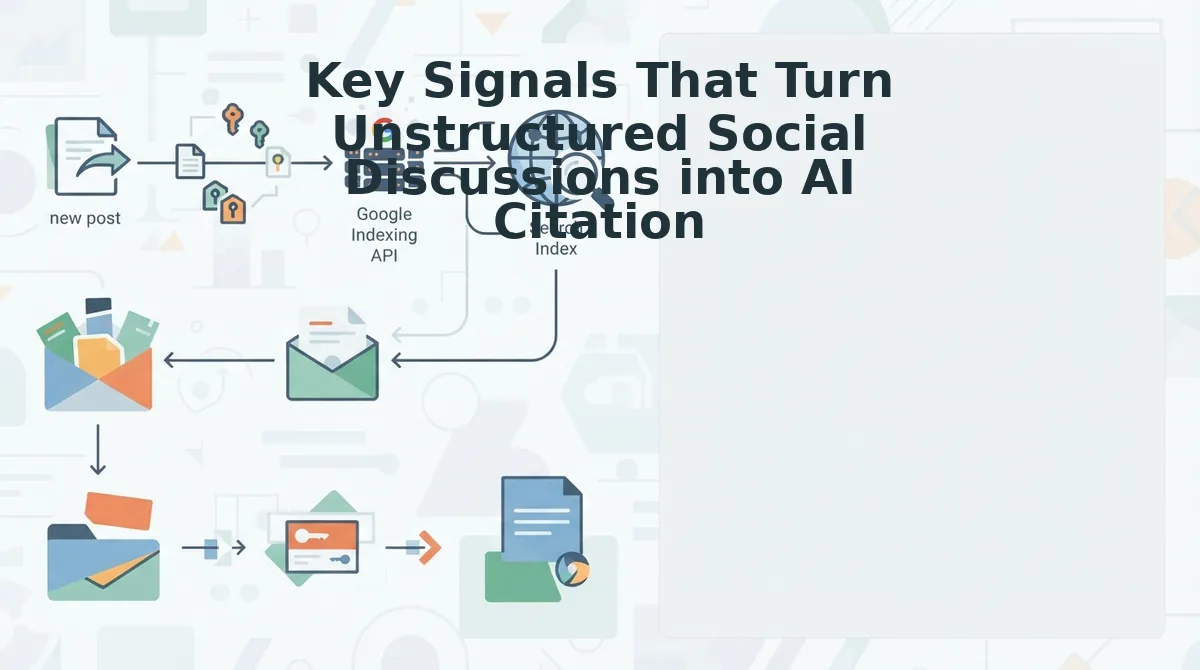
Key Signals That Turn Unstructured Social Discussions into AI Citations
AI search engines turn unstructured social discussions into citations by analyzing community consensus patterns, conversational natural language, and recurring validation signals across peer threads. When an answer engine encounters dozens of practitioner threads affirming the exact same solution, it extracts that agreement as verified factual evidence rather than isolated opinion.
Imagine an enterprise developer debugging a persistent database latency spike: while standard documentation offers abstract definitions, Reddit and GitHub issues show twenty engineers corroborating an identical config fix. Modern LLMs do not simply match formal keyword strings; they parse these synthesized consensus markers to corroborate real-world validity before referencing a source.
To capture citations in AI answers and chatbots, structure your published editorial content around these distinct social signals:
- Synthesized Community Consensus: This signal occurs when multiple independent practitioners independently recommend the same solution or workflow across forums. Answer engines treat repeated peer validation as verifiable proof of accuracy rather than marketing claims. Action step: Monitor active communities to extract verified resolutions, cite the prevailing consensus in your guide, and then use BloGoose to publish and ask Google to crawl new posts immediately via API integration.
- Natural Conversational Syntax: Conversational syntax is user phrasing structured as complete spoken thoughts rather than rigid, comma-separated search terms. Large language models map user queries directly to long-form, conversational explanations that mirror natural peer discourse. Action step: Scrape question phrasing verbatim from comment sections, then map those exact speech patterns directly into your H2 and H3 subheadings.
- Long-Tail Failure Modes: Users turn to social channels specifically when standard documentation fails to resolve edge-case errors. Capturing these niche operational pitfalls positions your domain as the primary source for diagnostic troubleshooting queries. Action step: Collect exact terminal error outputs and unusual edge-case symptoms from public threads, then answer them within dedicated FAQ accordions.
- Contrarian Practitioner Pushback: This unexpected signal emerges when expert users openly reject traditional industry best practices in favor of pragmatic alternatives. LLMs track these nuanced debates to present balanced, multi-perspective summaries for comparative search prompts. Action step: Document both sides of a contentious industry workflow debate and publish objective benchmarks that settle the disagreement.
- Recurring Vocabulary Drift: Slang, acronyms, and community shorthand reflect real-time shifts in practitioner vocabulary long before standard SEO tools capture the volume. Incorporating these emergent entities establishes semantic freshness within vector embeddings. Action step: Audit forum discourse for emerging terminology, define each term upon first mention, and embed the vocabulary throughout your technical teardowns.
How to Validate and Check That Your Social Research Generates Search Visibility
To validate that social topic research generates search visibility, audit early Google Search Console impression trends on unlisted long-tail queries and inspect answer engine responses for direct attribution citations. This validation confirms that search engines and AI models recognize newly surfaced social discussions weeks before legacy keyword rank trackers capture search volume.
Answer engine optimization is the practice of structuring content so generative AI models extract and cite it as an authoritative source in real-time answers. A regular seo content audit helps verify baseline performance metrics across your entire site before executing this verification protocol.
Are your newly published posts registering with modern search engines before commercial rank-tracking databases update? You need verified access to Google Search Console and an active browser session with major AI search platforms before starting.
- Filter Search Console for emerging query impressions: Click Performance, select Search results, and add a page filter matching your newly published article URL (Time estimate: 2 minutes). Inspect the Queries tab to measure impression gains on unlisted, long-tail phrases. You should see impression counts climbing for conversational phrases even while click numbers remain in single digits.
- Track referral traffic from answer engines: Open your analytics dashboard, select Acquisition, and click Traffic acquisition to inspect your referral sources (Time estimate: 3 minutes). Apply a filter for sessions originating from AI search engines and chatbot domains. You should see new referral sessions logging under external AI platform referrers rather than traditional organic search alone.
- Verify AI overview source citations directly: Type the exact social prompts and conversational questions into generative search engines (Time estimate: 5 minutes). Review the footnote links and source carousels displayed inside the synthesized overview. You should see your URL cited directly inside the AI answer block as a supporting reference.
Frequently Asked Questions About Social Topic Research
Social topic research surfaces real-time user intent and unaddressed industry pain points before traditional search tools log measurable query volume.
How often should you conduct social topic research?
Review fast-moving niche communities weekly to detect emerging conversational trends, while auditing evergreen verticals monthly or quarterly. Rapidly evolving sectors experience vocabulary shifts within days, whereas established technical industries maintain stable problem patterns that require less frequent baseline recalibration.
What is the difference between research for social feeds and search indexing?
Social feed research prioritizes fleeting viral hooks designed for ephemeral timeline engagement, whereas research for organic search indexing targets durable informational gaps that satisfy sustained retrieval intent. Index-focused research maps unstructured community discussions into structured semantic concepts that both web crawlers and answer engines can cite persistently.
Why do AI search engines rely on social discussions for answers?
AI answer engines analyze community discussions because unstructured peer dialogues reflect fresh, authentic solutions absent from outdated web indexes. Parsing active message boards provides conversational models with firsthand validation, colloquial query phrasing, and immediate sentiment data that static algorithmic scraping often misses.
How do you convert social threads into structured search content?
Extract recurring audience problems from message boards and translate conversational friction into clear informational headings. Structure your answers around three core steps:
- Identify unresolved peer questions.
- Map conversational phrases to core entities.
- Publish direct factual definitions.
Take Action on Emerging Search Demand Before Search Tools Catch Up
Capturing emerging search demand requires publishing authoritative answers directly from live conversational signals weeks before legacy SEO platforms register search volume. Traditional keyword databases document historical queries, but generative answer engines prioritize real-time community discussions to synthesize answers for complex user prompts. Relying on lagging volume metrics guarantees you enter the topic only after competitor citations are already locked into generative models.
Why let delayed search estimates dictate your editorial calendar when audience demand is already active?
- Extract conversational patterns: Surface real-time questions across niche communities instead of waiting for search volume tools to catch up.
- Capture generative citations: Publish factual, structured answers early so answer engines cite your domain as the definitive source.
- Connect research to publishing: Enter your domain into BloGoose to extract brand voice context and stream rank-ready articles directly to WordPress or your custom API.
Closing the gap between social trend discovery and automated production ensures your site answers questions before the broader market even knows to target them. Generative answer models reward the publishers who resolve emerging conversational problems first, turning real-time social consensus into permanent search visibility.