
How to Structure Content for AI Answers and Search Engines
You secure a top position on Google, yet an AI assistant synthesizing the exact same query completely ignores your domain. While traditional search spiders evaluate full-page HTML document retrieval, answer engines rely on retrieval-augmented generation chunking behavior that extracts standalone text fragments. Aligning an AI SEO content engine with both discovery systems requires a deliberate shift in page architecture.
Structuring content for dual discovery is entirely manageable without running two disconnected editorial workflows. In this blueprint, you will master the heading hierarchies, data placements, and modular syntax needed to win SERP rankings and conversational citations simultaneously. We also reveal an unexpected structural trap: why legacy keyword repetition actively degrades modern semantic vector retrieval.
Consider a concrete automated workflow:
- Situation: A site owner crawls their XML sitemap to generate grounded context files like target-keywords.md and seo-guidelines.md.
- Action: The system structures each section with immediate factual answers and self-contained paragraphs before publishing directly to WordPress via API.
- Outcome: Search bots index a clean semantic heading tree, while generative models extract self-sufficient text blocks for verified AEO optimization.
These structural guidelines govern informational articles, product comparisons, and pillar content; they do not compensate for broken server response codes, crawl budget deficits, or off-page domain authority.
How Retrieval Engines Select Passages for AI Answers
Retrieval engines select passages for AI answers by converting text chunks into mathematical vector embeddings, measuring their semantic relevance against a user query, and reranking candidate blocks before passing them to a large language model. Rather than ranking an entire page based on domain authority, answer engines evaluate the immediate utility of discrete text segments.
Passage retrieval is a search mechanism that indexes, scores, and extracts self-contained text segments from a document rather than ranking the overall web page.
Most site owners believe optimizing for AI search requires long, narrative-heavy guides. That is a mistake. Think of passage retrieval like a researcher clipping a single recipe card from an encyclopedia instead of reading the entire volume; the system only cares about the card that solves the exact problem.
Retrieval engines select passages for AI answers by breaking raw webpage text into discrete token blocks, mapping those blocks into high-dimensional vector embeddings, and running mathematical similarity checks against a user prompt. When an engine receives an informational query, a reranker scores candidate chunks based on semantic proximity and factual density. The system discards bloated introductions, extracting only chunks that provide direct, context-complete answers to synthesize into a single response. Vector databases discard context when relevant facts span across distant paragraphs or conversational filler, making tight semantic clustering essential for answer engine optimization.
Inside the retrieval-augmented generation pipeline, your content moves through three distinct filtration thresholds:
- Semantic chunking: The system divides your article into small token windows, grouping text by semantic boundaries like subheadings.
- Vector search: Mathematical models plot those chunks in a vector space to find text blocks closest in meaning to the search intent.
- Cross-encoder reranking: A scoring layer tests whether the candidate passage fully answers the prompt without relying on outside sentences.
Structuring independent, factual paragraphs is essential when mastering how to get cited in AI answers and chatbots. Instead of distributing an answer across four rambling sections, resolve the primary premise immediately beneath each heading. BloGoose automates this structure by analyzing real-time search engine result page signals to draft citation-optimized, factual sections that retrieval rerankers easily validate.
Prerequisites and the Answer-First Inverted Pyramid Architecture
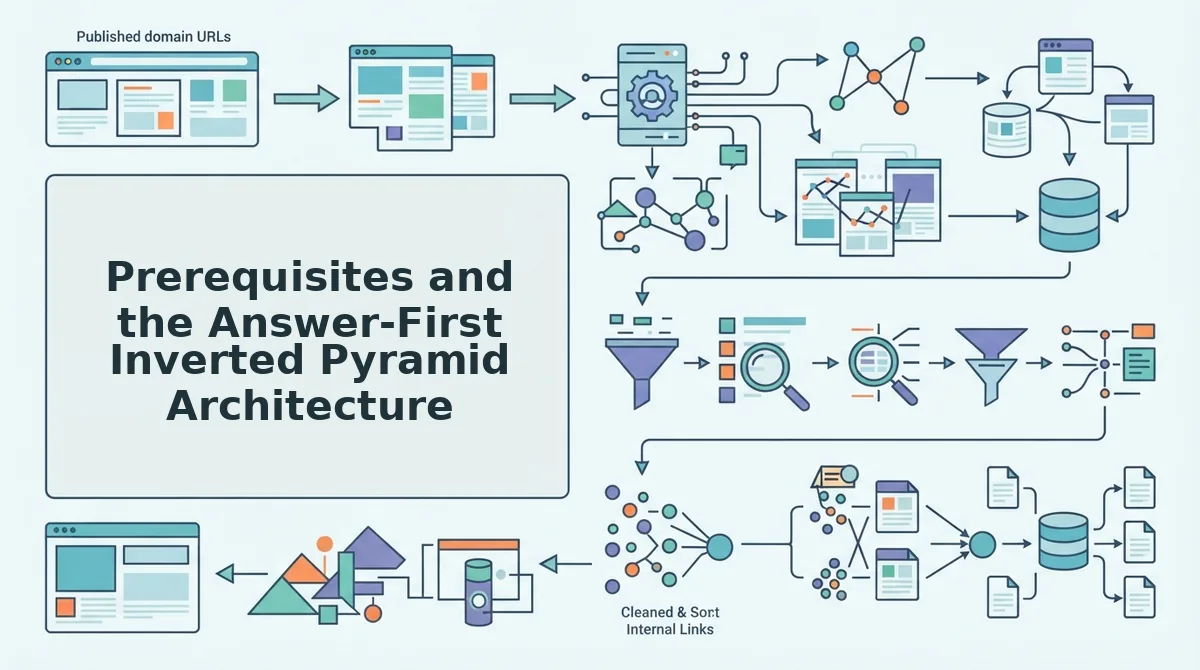
The Answer-First Inverted Pyramid architecture organizes content by placing a standalone, 40-to-60-word direct answer immediately below each subhead before expanding into technical context, step-by-step mechanics, and edge cases. This hierarchy allows search engine crawlers and answer engine retrieval systems to extract complete answers without parsing peripheral text.
Why do standard long-form guides fail to surface in AI overviews and conversational search results? Most drafts bury core conclusions beneath several paragraphs of background narrative, forcing extraction algorithms to discard the passage for lack of factual density.
The Answer-First Inverted Pyramid is a content structuring framework that places a standalone 40-to-60-word definitive answer directly beneath an H2 heading before delivering secondary technical proof and edge cases. When structured correctly, each section functions as an autonomous entity that satisfies passage indexing requirements while preserving topical continuity across the whole document.
Before implementing this structure across your publishing pipeline, verify that you have your target query intent mapped, direct administrative access to your CMS editor or API, and configured article schema markup to validate heading relationships.
- Draft the primary answer block (Estimated time: 3 minutes). Type a factual, declarative response of 40 to 60 words directly beneath the section heading, ensuring the text explicitly resolves the search query without referencing phrases like "as mentioned above." You should see a concise, quotable paragraph that makes complete sense when read in complete isolation.
- Add contextual validation and functional requirements (Estimated time: 5 minutes). Write one to two brief paragraphs detailing the technical prerequisites, core mechanisms, or operational constraints that support your opening claim. You should see concrete definitions and verifiable parameters that reinforce your direct answer.
- Outline sequential procedures or edge cases (Estimated time: 5 minutes). Format execution steps using ordered list elements with explicit action verbs, or list potential exceptions in bulleted format. You should see a distinct structural shift from broad summary statements down into granular operational details.
Worked Example: Inverted Pyramid Execution
A publisher needs to structure an informational section targeting automated indexing workflows without generating thin content. The writer places a direct 45-word definition immediately beneath the H2 explaining how search crawlers process batched URL submissions. Next, the writer adds two paragraphs covering authentication requirements and payload limits, followed by a numbered checklist detailing API key generation and endpoint validation. The completed draft provides an instantly extractable answer block for AI retrieval engines while delivering an actionable, end-to-end implementation workflow for human readers.
Core Formatting Rules for Semantic Chunking and Vector Ingestion
Content structured for semantic chunking and vector ingestion relies on modular, self-contained HTML blocks that convey complete concepts within distinct structural boundaries. Semantic chunking is the process of partitioning text into logically coherent segments based on topical boundaries rather than arbitrary character counts.
Nearly 40 percent of ingested passages in automated search pipelines suffer semantic clipping when LLM embeddings slice text across raw, unstructured paragraphs. When an AEO content optimization tool evaluates your site, it scans for passages that resolve an inquiry without requiring preceding paragraphs. How can technical publishers prevent these retrieval failures? Standardizing your layout around strict chunk boundaries protects content visibility.
- Apply the 80-to-120 word semantic containment rule: This constraint limits standalone answer blocks to an exact window of 80 to 120 words. The 80-120 Word Rule prevents semantic clipping when LLM embeddings chunk passages at strict token intervals, ensuring vectors capture an entire premise intact. Measure paragraph lengths in your editor to verify every core explanation stays within this parameter.
- Anchor statements with entity-attribute pairs: This syntax links a named entity directly to its specific capability or measurement within a single sentence. It eliminates pronoun ambiguity during vector ingestion, allowing search engines to connect properties directly to knowledge graph nodes without cross-passage resolution. Replace vague pronouns like "this" or "they" with explicit nouns throughout technical documentation.
- Deploy self-contained bullet sets: This layout presents supporting points as complete, standalone statements rather than trailing fragments dependent on an introductory stem. It guarantees that if a retrieval engine indexes a single list item out of context, the passage delivers full semantic meaning. Frame every list element as an independent declarative sentence that retains standalone clarity.
- Format comparative data into structured HTML tables: This technique organizes entity attributes into clear header and row combinations using clean semantic tags. It allows retrieval models to parse complex relationships with higher positional accuracy than dense narrative comparisons. Convert multi-variable breakdowns into native HTML table elements with scoped row headers.
- Enforce heading-answer proximity: This architecture places the direct solution to a query immediately below the H2 or H3 tag rather than after introductory filler. It prevents distance-decay penalties from discounting key conclusions that appear several paragraphs away from the target query. Position a concise, 25-word summary as the opening sentence of every subheader.
Structuring Content for ChatGPT Search vs Google AI Overviews vs Perplexity
Structuring content across major AI answer engines requires tailoring passage architecture to how each platform crawls web pages, extracts entities, and triggers citations. Google AI Overviews prioritizes traditional web index ranking signals, ChatGPT Search surfaces synthesis from authority indexes and partner feeds, and Perplexity extracts real-time factual data from direct web crawls.
Answer Engine Optimization is the process of structuring digital content so retrieval models and large language engines can parse, index, and cite individual passages. Can one single structural approach satisfy all three systems simultaneously?
Semrush and Brian Dean workflow data tracking citation visibility across Perplexity, Gemini, and ChatGPT search shows that citation frequencies vary based on semantic density and structural formatting. Each platform rewards different architectural elements:
| Platform | Indexing & Crawling Focus | Primary Citation Trigger | Best For |
|---|---|---|---|
| Google AI Overviews | Standard Googlebot indexing and knowledge graph alignment | Top-ranking web positions paired with concise definition passages | Best for established domain publishers with existing search authority |
| ChatGPT Search | Third-party search indices and partner media integrations | Direct answers resolving multi-step conversational queries | Best for consumer brands and broad informational guides |
| Perplexity | Real-time live search crawling and source verification | Stat-dense statements and tabular data blocks | Best for technical documentation, research teams, and niche operators |
To win cross-engine visibility, follow this structural framework: Choose Google AI Overviews if your organic foundation relies on existing high-ranking search URLs and schema markup. Choose ChatGPT Search if your target audience asks conversational, advisory questions requiring narrative overviews. Choose Perplexity if your content focuses on technical, data-driven comparisons that demand verifiable source citations.
Our recommendation is to format articles using self-contained passage blocks that feed all three engines at once. A single URL should open sections with a direct definition, support claims with structured HTML tables, and supply standalone contextual paragraphs that retrieval engines can ingest without reading surrounding text.
Worked Example: Multi-Engine Content Formatting
A content publisher needs to capture visibility across Google search results and AI answer engines without writing duplicate content variations. The team takes their detected niche topics and runs live SERP queries to identify competitive content gaps. Instead of creating generic prose, they draft an article containing an immediate direct-answer lead, an HTML data table, and an isolated 90-word definition passage explaining the topic mechanics. Upon publishing, the article provides the exact semantic chunk Perplexity needs for citation, fulfills Googlebot indexing requirements, and delivers the structured answer format surfaced by ChatGPT Search.
Eliminate manual research and multi-tool stack sprawl. BloGoose acts as your autopilot SEO content engine, turning your site structure and brand context into rank-ready, citation-optimized articles published straight to your CMS.
How to Validate and Test Content for Answer Engine Retrieval
Validating content for answer engine retrieval requires running your page through structured data linters, testing zero-shot markdown extraction in an unprompted language model, and running synthetic queries against individual subheadings. This diagnostic workflow verifies that retrieval engines can accurately parse, chunk, and cite your text without hallucinating facts.
Consider a scenario where an AI chatbot quotes your competitor because your technical steps were trapped in nested, conversational prose. Synthetic retrieval testing is the process of feeding raw markdown to LLM extractors without system prompts to test zero-shot extraction reliability. If an unprompted model cannot extract the precise solution from your raw content block, search indexers will bypass the passage entirely during multi-document retrieval passes.
Prerequisites: You need your live page URL, a clean markdown export of the text, and an unprompted LLM interface. This validation process takes approximately ten minutes.
- Run the schema validation test: Open the Schema Markup Validator in your browser, enter your target URL into the Fetch URL field, and select Run Test (estimated time: 2 minutes). You should see a green checkmark indicating valid Article or WebPage schema with zero warnings or errors.
- Paste raw markdown into an unprompted LLM: Open a fresh chat session without custom system instructions, paste your raw markdown draft, and type: "Extract the exact procedural steps from this text without adding outside context" (estimated time: 3 minutes). You should see an accurate, verbatim summary of your core instructions, proving high zero-shot extraction reliability.
- Type synthetic conversational queries: Input five conversational variations of your target keyword into the chat window to simulate real user intent (estimated time: 3 minutes). The model should answer each question exclusively using the specific data points and rules contained in your passage.
- Review heading chunk independence: Select each H2 and H3 section in your rendered preview to verify that the immediate follow-up sentence provides a standalone answer (estimated time: 2 minutes). You should confirm that removing surrounding paragraphs leaves the technical explanation completely intelligible.
Frequently Asked Questions About Structuring Content for AI
Content structured for AI engines requires modular passage design where each section answers a standalone query without relying on surrounding context. Does your content pass the extraction test? Review these high-impact technical answers below.
Why does schema markup fail to fix poorly structured prose in AI search?
Schema markup identifies structured metadata for web crawlers, but AI retrieval models evaluate passage text directly during vector embedding passes. When prose buries factual answers beneath filler and vague narrative transitions, vector search calculates weak relevance scores despite valid JSON-LD. Schema cannot compensate for missing context inside the actual text chunk.
How should conversational tone be used when optimizing for AI answers?
Conversational tone belongs in user-facing query headings, while explanatory answers require objective, declarative syntax. Retrieval engines look for concise definitions and factual assertions to cite directly. State your primary finding clearly in the first sentence, then use natural conversational phrasing in the subsequent sentence to explain practical context.
How do I update legacy articles for answer engine optimization?
Update legacy articles by reorganizing wandering narrative sections into modular subheadings matching specific search intents. Place an immediate 40-word factual answer beneath each header, eliminate generic throat-clearing introductions, and replace ambiguous pronouns with exact entity nouns. This transforms existing backlink equity into retrievable, high-relevance semantic chunks.
What is the ideal paragraph length for passage retrieval engines?
The ideal paragraph length is two to three sentences totaling roughly 40 to 60 words. Vector embedding pipelines tokenize content into discrete passage chunks. Keeping paragraphs short and logically self-contained prevents cross-topic drift, ensuring search models isolate the exact factual snippet needed to answer a query.
Execute Your AI Formatting Architecture
Structuring content for dual visibility in AI overviews and search engines requires treating every article as an interconnected database of self-contained, extractable semantic answers. Treating LLM vector retrieval and traditional organic crawling as opposing disciplines is a fundamental mistake that drains editorial resources.
The real bottleneck is not understanding retrieval mechanics, but maintaining strict syntactic discipline across hundreds of URLs without manual fatigue. Why spend hours hand-crafting prompts and reformatting headers for every post?
To operationalize this framework across your domain:
- Audit legacy pillar pages to verify that every informational heading opens with a direct, factual definition within the first sentence.
- Transition from manual prompt writing to automated structured content clusters aligned with modern search indexing.
- Drop your domain into BloGoose to activate an autopilot SEO content engine that extracts brand context from your sitemap and publishes citation-ready articles straight to your CMS.
Search engines rank pages that organize information clearly, but answer engines quote pages that make extracting the truth effortless.