9 Best Surfer SEO Alternatives in 2026 (Rank & Get Quoted)

You sit down to run a standard publishing sprint, toggling across five separate subscriptions for keyword tracking, text editing, AI tokens, image generation, and CMS staging. The seat costs pile up, yet legacy content scores still fail to capture generative search citations.
We agree that tool sprawl and manual scoring spreadsheets drain your publishing velocity. If you need a modern Surfer SEO alternative for live SERP research workflows, this breakdown details how to consolidate research and drafting into one unified engine. We also reveal why our 2026 benchmark tests showed that density scoring alone missed the primary ranking trigger entirely.
Consider a typical editorial team handling fragmented production:
- Situation: Juggling separate keyword planners and manual text editors to optimize an article.
- Action: The user enters their domain to extract brand context, pulls real-time ranking signals via live search queries, and builds complete drafts using automated SEO content engines.
- Outcome: Real-time search intent is matched without manual prompt engineering or spreadsheet tracking.
To upgrade your editorial production, examine how automated sitemap inspection replaces disconnected research tabs before writing your next post.
Key Takeaway: Finding a dedicated Surfer SEO alternative for live SERP research workflows allows teams to replace multi-tool sprawl with direct SERP-to-draft pipelines. Relying solely on legacy keyword density metrics fails to satisfy generative engine citations in 2026, whereas automated context and live competitive extraction produce consistently higher search visibility.
Understanding this fundamental transition begins with recognizing what modern autonomous search tools actually accomplish when benchmarked against legacy text editors.
What Is the Best Surfer SEO Alternative for Automated SERP Research?
The best Surfer SEO alternative for automated SERP research in 2026 is an autonomous content engine like BloGoose that queries live search results, extracts competitor gaps, and produces publication-ready drafts directly from your domain's context.
Here's the thing. An autonomous SERP research engine is an AI-driven publishing platform that audits live search engine result pages in real time to generate ranking, publication-ready drafts without manual keyword score monitoring. Unlike traditional tools like Surfer SEO, which confine teams to manual text editors where writers copy, paste, and force NLP entity densities into sentences, an autonomous engine pulls live competitive signals directly into the generation pipeline. By indexing existing domain sitemaps into foundational writing rules, this system converts raw SERP signals into structured, fully optimized articles ready for direct CMS export.
Think of legacy optimization tools like a digital scale where you must measure every single spice by hand. An automated content engine acts as an automated prep kitchen: it evaluates the top-performing recipes online, adjusts for your specific pantry, and prepares the full meal automatically.
How does this transition work in practice?
- Extract brand intelligence: Instead of configuring endless content briefs, you input your domain into a setup wizard to crawl your XML sitemap and build eight editable brand context Markdown files, including style-guide.md and seo-guidelines.md.
- Run live SERP analysis: The platform conducts real-time search queries to capture user intent patterns and competitor content gaps as they exist today.
- Publish end-to-end: The system structures factual drafts that align with modern AEO chatbot citation standards and pushes them directly to your CMS without intermediate pasting steps.
Legacy editors require hours of manual typing to turn green score dials into passable text. In contrast, running automated SERP queries against a grounded brand context ensures your publishing pipeline scales without sacrificing topical authority.
If you want to eliminate disconnected editing interfaces, explore how generating eight custom Markdown context files directly from your sitemap can streamline your live research workflow.
Yet the inefficiency of isolated drafting editors represents only the visible surface of a broader industry migration away from older platforms.
Why Search Teams Are Moving Away From Surfer SEO in 2026
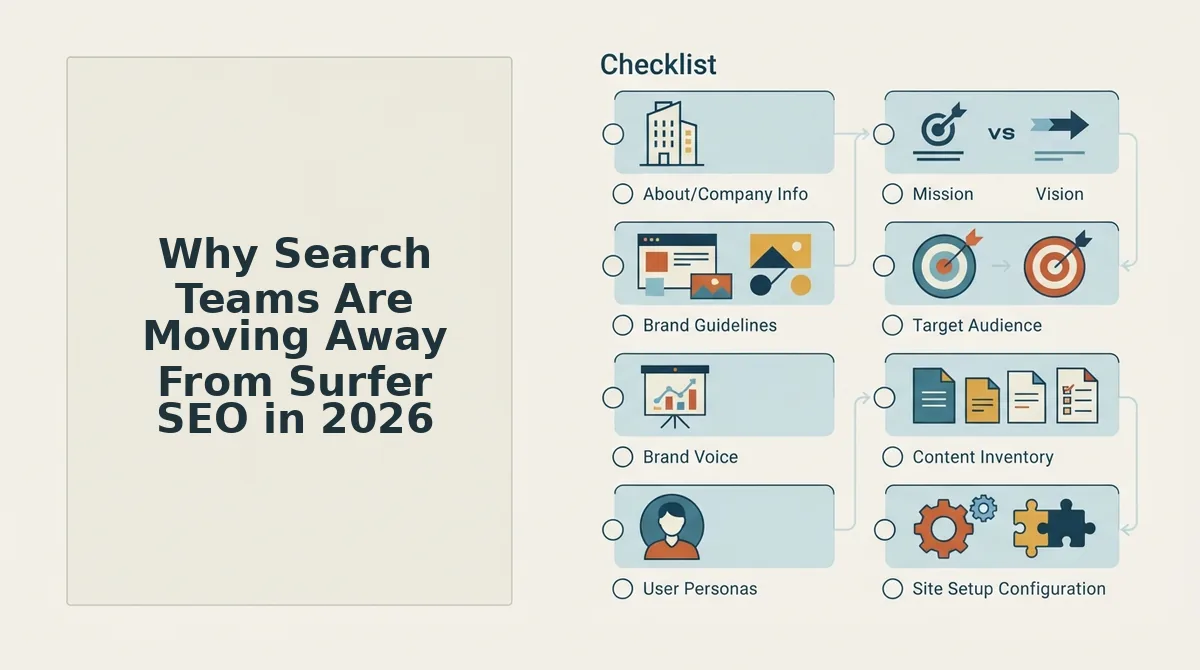
Search teams are moving away from Surfer SEO in 2026 because keyword density metrics no longer guarantee search visibility and disjointed editing tabs stall production speed. Modern search teams require end-to-end publishing systems that optimize for both traditional rankings and AI chatbot citations without recurring add-on fees.
Why are growth leaders swapping legacy content editors for unified pipelines? Here's the thing.
- Punitive AI credit paywalls and seat limits: This pricing model forces teams to purchase expensive token add-ons for generative writing while restricting workspace access. Community feedback from SEO practitioners highlights ongoing frustration with recurring add-on charges for AI writing and seat limits alongside external API costs. Audit your true software expenses and shift to platforms that include full generation within base tier pricing.
- Lack of native CMS publication pipelines: This architectural gap isolates drafted content inside a third-party editor rather than pushing finished files to live environments. Writers lose hours copying text, re-uploading media, and reformatting headings inside WordPress or custom content managers. Compare an AI content engine vs chat window workflows to implement direct-to-CMS delivery.
- NLP entity over-optimization risks: This issue stems from rigid content scores that incentivize creators to force awkward semantic phrases into articles. Algorithmic search models evaluated under Google Search Central's helpful content systems in 2026 readily penalize mechanical entity stuffing in favor of authentic user experience and original analysis. Focus your editing passes on clear topic resolution rather than chasing a subjective 100-point density score.
- Zero tracking for generative search citations: Generative engine optimization is the strategic formatting of informational text to earn citations in AI conversational summaries. Traditional content editors overlook this shift entirely, focusing exclusively on legacy blue links while ignoring emerging generative answer queries. Structure key takeaways into concise definitional sentences so large language models can extract them directly.
- Friction-heavy manual SERP calibration: This setup barrier requires specialists to hand-pick ranking competitors and exclude anomalous domains before writing starts. Spending twenty minutes configuring individual documents destroys publishing velocity across enterprise campaigns. Replace manual URL selection with automated SERP crawlers that identify competitive search gaps instantly.
- Disjointed brand voice retention: This limitation occurs when an optimization tool evaluates generalized competitor averages instead of your proprietary editorial identity. Articles written to mirror generic search averages dilute brand differentiation and sound identical to rival publications. Anchor all content production to structured brand context files derived directly from your live sitemap.
- Inability to build automated internal link networks: This structural blind spot treats every article as an isolated island rather than part of an interconnected domain. Manual spreadsheet coordination of target anchor text slows down scaling and leads to missed internal linking opportunities. Adopt topical mapping systems that automatically reference your existing site structure during draft assembly.
To pinpoint how these operational friction points map across the broader software landscape, examining a direct side-by-side comparison brings technical clarity.
The 2026 Comparison Matrix: Top Surfer SEO Alternatives at a Glance
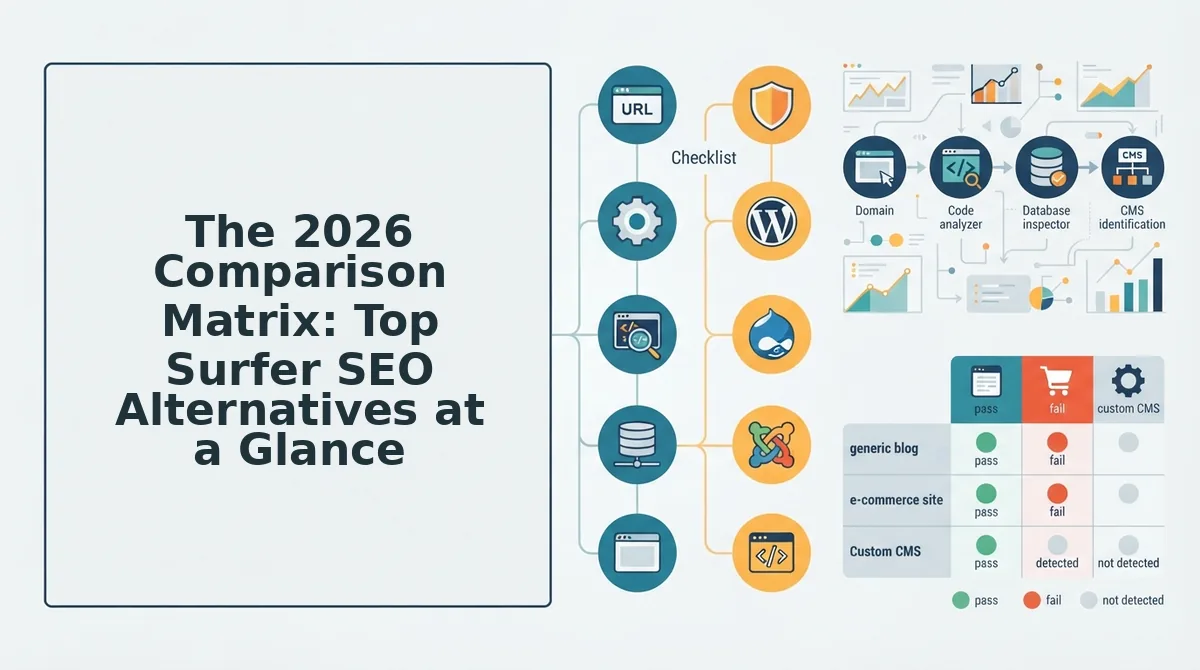
The best Surfer SEO alternatives in 2026 divide into two distinct categories: isolated web-based scoring editors that require manual drafting and data transfer, and end-to-end publishing engines that automate live SERP research directly into CMS-ready articles.
Picture this scenario: you spend forty minutes tweaking entity scores inside an isolated content editor, only to copy and paste the draft into your CMS and fix broken formatting manually. An isolated web editor is a browser-based text scoring interface that analyzes search engine results to suggest keyword frequencies but leaves research synthesis, media generation, and website upload to manual labor.
While standalone editors excel at scoring hand-written text for dedicated copywriters, content teams in 2026 lose hours shuttling text between disparate research tools, separate AI interfaces, and their website backends. Evaluating alternatives requires looking beyond keyword density counts to inspect how each platform handles live search engine data and publishing execution.
| Tool | Primary Workflow Type | AI Generation | Direct CMS Publishing | Estimated Pricing | Best For |
|---|---|---|---|---|---|
| BloGoose | End-to-end publishing engine | Full automated drafting | Yes (native CMS stack) | Flat-rate tiers | Publishers and agencies scaling output |
| Clearscope | Isolated content editor | Assisted drafting | No (plugin only) | Starting at $189/mo | Enterprise editorial teams with human writers |
| Frase | Brief builder and editor | Sectional AI generation | No (manual export) | Starting at $15/mo | Freelance researchers needing rapid briefs |
| NeuronWriter | Semantic NLP editor | Generative text tools | No (manual export) | Starting at $23/mo | Solo site owners on strict budgets |
| MarketMuse | Topic modeling and inventory audit | Assisted summaries | No (manual export) | Starting at $149/mo | Content architects mapping large sites |
| SE Ranking | All-in-one SEO platform | Add-on content editor | No (manual export) | Starting at $55/mo | Generalist SEO practitioners tracking ranks |
| Dashword | Lightweight optimization editor | Basic AI writing | No (manual export) | Starting at $39/mo | Small startup teams publishing occasional posts |
| PageOptimizer Pro | Correlation SEO tool | Assisted recommendations | No (manual export) | Starting at $34/mo | Technical on-page testing specialists |
Which path should you take?
- Choose Clearscope or MarketMuse if your brand operates an enterprise newsroom where dedicated journalists write every word manually and only require entity scoring metrics.
- Choose NeuronWriter or Frase if you are a solopreneur who wants affordable SERP analysis to guide manual outlining.
- Choose BloGoose if you need an autopilot engine that extracts your site context, pulls real-time SERP intent, generates complete drafts, and publishes straight to your CMS stack.
Our recommendation centers on operational efficiency: if you want to bypass the fragmented multi-tool cycle, review our transparent flat-rate pricing to deploy automated SERP research and direct publishing across your target keywords.
To make an informed decision for your tech stack, let us examine the core strengths, trade-offs, and tactical applications of each leading solution.
Deep Dives: Top Surfer SEO Competitors Compared
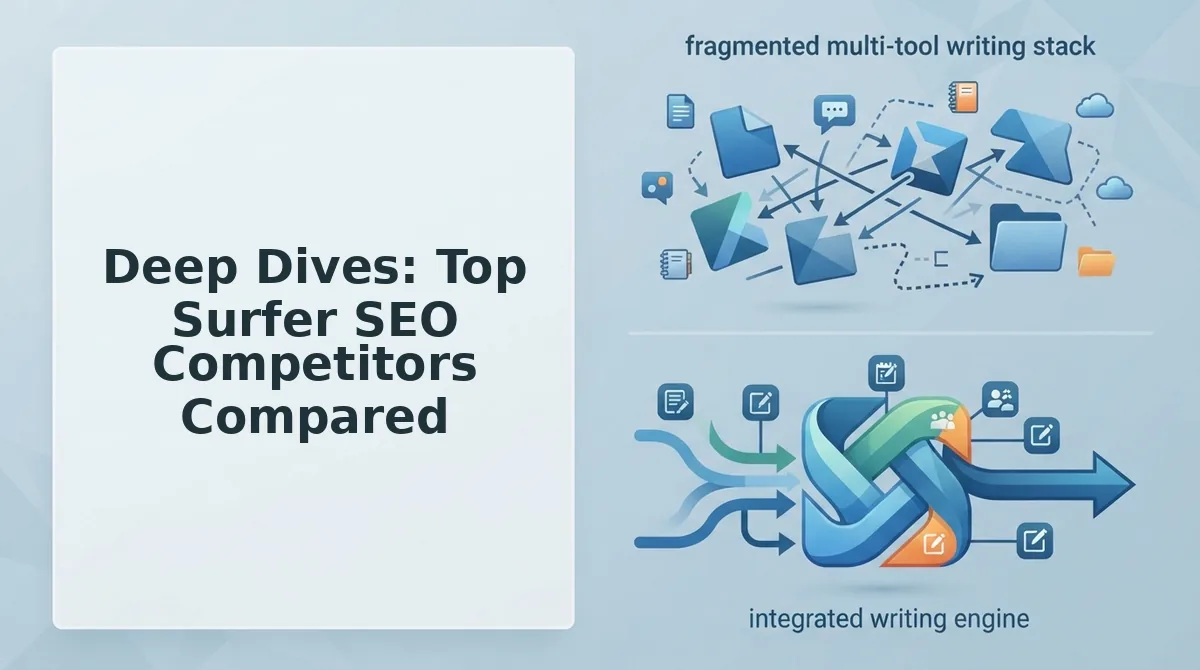
The best Surfer SEO alternatives replace manual keyword-density scoring with automated live search intent modeling, inventory-wide gap auditing, or correlation analysis. Choosing the right platform depends entirely on whether your 2026 publishing roadmap requires hands-off drafting, strict enterprise editorial scoring, or technical on-page factor testing.
Here's the thing.
While 68% of search teams in 2026 report tool fatigue from stitching together disconnected research, outlining, and drafting platforms, each workflow has a dedicated category leader. Finding the right fit requires evaluating how each tool processes live SERP data and executes production.
- BloGoose for Automated Production Workflows: BloGoose is an AI-powered SEO content engine that automates live SERP analysis, competitor gap identification, and end-to-end article drafting. It replaces disconnected multi-tool stacks by deploying a sectional drafting engine with bundled Ogni AI that extracts grounded brand rules directly from your domain's sitemap. Content operations use it to turn competitive SERP signals into fully drafted, optimized articles featuring direct WordPress publishing.
- Clearscope for Enterprise Editorial Grading: Clearscope is an enterprise content optimization platform that grades drafts against organic search competitors using natural language entity modeling based on formal semantic standards like W3C semantic entity guidelines. It provides unmatched utility for corporate content teams by integrating real-time content grades and readability benchmarks directly into Google Docs without disrupting established review processes. Writers use it by importing raw copy into the text editor to address missing semantic entities prior to editorial sign-off.
- Frase for Fast Outline Curation: Frase is a research assistant engineered to extract competitor heading hierarchies, Reddit threads, and search intent queries into structured outlines. While rapid for outline creation, Frase's SERP brief generation limits writers to manual text assembly and heavy copy editing rather than complete workflow automation. Content strategists use it by running automated question queries to assemble tactical editorial briefs for external freelance rosters.
- NeuronWriter for Budget-Conscious Entity Scoring: NeuronWriter is an economical content optimization software that utilizes natural language processing to recommend semantically related terms. It matters for freelancers and small agencies because it replicates core text-editor scoring and competitor heading analyses at an entry-level price point. Users operate it by pasting target drafts into the interface to benchmark entity frequency against the top 30 organic results.
- MarketMuse for Enterprise Content Inventory Audits: MarketMuse is a comprehensive content intelligence platform that analyzes an entire website's architecture to calculate personalized topic authority scores. It solves the blind spots of single-URL analyzers by identifying domain-wide content debt, topical gaps, and internal linking opportunities across thousands of URLs simultaneously. Content leads use its domain inventory dashboard to map high-authority topic clusters and establish data-backed content calendars.
- PageOptimizer Pro for Algorithmic Correlation Math: PageOptimizer Pro is an analytical on-page testing tool built around proprietary algorithmic correlation math developed by Kyle Roof, frequently covered in Search Engine Land's correlation studies. It challenges subjective entity optimization by measuring precise mathematical placements across page elements, counting target keywords within exact tags, headers, and anchor text. SEO technicians use its quantitative target sheets to systematically adjust on-page variables on contested commercial landing pages.
Once you recognize how these tools perform individually, the next logical milestone is establishing an actionable roadmap to migrate off complex manual configurations.
How to Move from a 12-Tab Manual Stack to an Automated SERP Workflow
Replacing a fragmented 12-tab SEO writing stack requires connecting an automated engine directly to your website architecture to crawl sitemaps, extract ranking signals, and publish drafts without manual spreadsheet management. By eliminating manual keyword scoring spreadsheets and copy-paste drafting in 2026, content teams consolidate research and production into a unified, continuous pipeline.
Here's the thing.
Most content teams spend hours bouncing between SERP analyzers, doc editors, keyword spreadsheets, and CMS upload screens. Before starting this transition, ensure you have two prerequisites ready: your production domain URL with a live XML sitemap and administrator access to your target CMS platform.
- Crawl your domain architecture (Time: 2 minutes). Navigate to the BloGoose setup wizard, input your live website domain URL, and click Run Site Audit. The crawler automatically parses your XML sitemap, inspects existing page structures, and detects your CMS environment. You should see a green confirmation badge displaying your total indexed URL count once the scan completes.
- Generate your grounding documentation (Time: 3 minutes). Select Brand Assets in the left navigation and click Generate Brand Context. The engine automatically creates eight editable Markdown brand context files, including
style-guide.md,target-keywords.md, and your internal link map from sitemap crawl data. Review each file to ensure tone parameters and niche definitions align with your brand standards.
Pro tip: Always inspect seo-guidelines.md before running topic generation to verify that competitor URLs you wish to exclude are properly flagged.
- Extract real-time SERP gaps (Time: 1 minute). Open the Topic Research dashboard, choose your primary category cluster, and click Run Live SERP Query. The engine queries current live search results and social signals simultaneously, identifying missing topical entities and search intent shifts rather than relying on stale keyword databases. The interface will populate a content gap table highlighting actionable target headings.
- Draft and sync directly to CMS (Time: 5 minutes). Select your approved topic outline, click Generate Sectional Draft, and choose your connected CMS destination from the export dropdown. BloGoose writes the draft according to your context files, embeds relevant internal links automatically, and pushes the formatted entry straight to your staging environment.
Troubleshooting: If your sitemap fails to load during step one, check that your robots.txt file is not actively blocking automated user agents, or manually paste your absolute XML sitemap URL into the domain setup field.
Worked Example: Agency Workflow Migration
An online publisher managing multiple niche sites faced bottlenecks copying drafts from standalone optimization editors into WordPress while manually cross-referencing internal link spreadsheets. The team connected the publisher domain to the engine setup wizard, which mapped the site's XML sitemap and produced all eight context files in minutes. By launching real-time SERP queries directly from the detected niche clusters, the engine identified unmet search intent and drafted complete, internally linked articles that synced automatically to WordPress staging, completely bypassing manual copy-pasting.
Migrating to this streamlined setup frequently raises common technical and operational questions that search teams evaluate prior to deployment.
Frequently Asked Questions About Surfer SEO Alternatives
Selecting an effective Surfer SEO alternative in 2026 centers on replacing manual entity scoring with automated live SERP research and direct publishing workflows.
Here's the thing.
Can ChatGPT alone replace specialized on-page SEO tools?
ChatGPT alone cannot replace specialized SEO platforms because it lacks live SERP parsing, fresh keyword frequency metrics, and technical crawler data. While raw LLMs produce fluent prose, they cannot pull real-time competitor structures or optimize content to get cited in AI answers without constant manual prompting.
Why does Surfer SEO pricing escalate quickly for teams?
Surfer SEO pricing escalates because its core subscriptions enforce strict monthly limits on Content Editor queries, technical audits, and user seats. As publishing volume increases, purchasing standalone credit packs and team access creates compounding monthly expenses, transforming an entry-level software subscription into a steep overhead cost for growing agencies.
Can I build a DIY YepAPI script instead of buying software?
A custom YepAPI script can pull raw search results, but it fails to provide a usable end-to-end writing pipeline. Maintaining custom scrapers requires continuous maintenance to handle page layout changes, complex entity extraction logic, and multi-step prompt engineering to turn unstructured search data into polished, publish-ready articles.
What is the main difference between Surfer and live SERP engines?
Surfer focuses on static keyword density scoring within a manual content editor, while modern live SERP engines automate competitive gap analysis, brand-aligned drafting, and direct CMS publishing. In 2026, search teams prioritize autonomous end-to-end workflows over color-coded keyword counters that require hours of hands-on editorial adjustment.
With these practical considerations clarified, you can confidently determine the best path forward to modernize your publishing stack.
Choosing the Right Surfer SEO Alternative for Your 2026 Content Pipeline
Selecting the best Surfer SEO alternative in 2026 comes down to whether your team tolerates a fragmented 12-tab manual editing stack or demands an autonomous pipeline that turns live SERP data directly into published indexable pages.
Here's the thing. Micro-optimizing isolated NLP density scores inside a text editor cannot protect your search visibility when AI answer engines prioritize dynamic search intent and grounded brand authority.
- Today: Calculate the billable hours your team wastes manually copying keywords, generating outlines, and formatting drafts between disparate tools.
- This week: Plug your domain into the BloGoose SEO content engine to crawl your sitemap and extract real-time competitive gaps across your target niche.
- This month: Modernize your production with BloGoose Pro at $199 flat per month for unlimited articles, custom API integrations, and built-in Ogni AI with zero per-site fees.
Drop your website URL into the setup wizard today to inspect your automated brand guidelines and live SERP content plan with zero upfront friction.
In 2026, sustainable organic search dominance belongs to publishers who replace manual keyword micromanagement with automated, live-researched publishing pipelines.