Surfer SEO vs BloGoose for writing long-form drafts by section

The draft is finished. Eleven browser tabs are not. The editor scores it, the SERP tab argues with the editor, the image library stalls, the CMS fights the formatting, and the brief sits open in case the argument needs a tiebreak. The writing took an afternoon; the handoffs will take two more days.
That gap is what most surfer seo vs blogoose long-form writing comparisons skip past. Surfer SEO is a content editor: it grades a draft you supply. BloGoose is an AI SEO content engine: it drafts section by section, illustrates, and pushes finished articles to WordPress or a custom API. Both are legitimate tools aimed at different halves of the same job.
You already suspect that a higher content score doesn't shorten the publishing queue. So this won't be a feature count. It splits a long-form article into six production passes â research, outline, draft, optimize, illustrate, publish â and names who does the work, who reviews it, and where a human has to step back in. Somewhere in that map sits the one pass neither tool's marketing names out loud, and it's where most of the rework actually hides.
What does each tool actually own in a long-form draft?
Surfer SEO owns the optimize pass â it grades a draft a human already wrote. BloGoose owns draft, optimize, illustrate and publish â the engine writes section by section, then ships to your CMS. The split is about who holds the pen at each pass, not which feature list is longer.
Four terms carry the comparison. Content editor score is a diagnostic number estimating how well a draft covers the terms and structure its target page needs â it grades input, it does not produce it. NLP term coverage is the share of related terms and phrases the tool expects a page to mention. Sectional drafting means writing one H2 block at a time against its own sub-brief instead of firing a whole article out of a single prompt. AEO (answer engine optimization) is structuring passages so assistants like ChatGPT, Perplexity and Google's AI overviews can lift a clean, self-contained answer.
| Production pass | Surfer SEO | BloGoose | Where a human re-enters |
|---|---|---|---|
| Research | Separate step; target terms pulled into the editor | Included â crawls your sitemap and builds a pillar-focused calendar | Choosing the angle actually worth writing |
| Outline | Included â H2 structure built from target terms | Included â section-by-section plan per article | Approving H2 order and scope |
| Draft | Manual â you write every paragraph | Included â engine drafts each section | Voice and fact edits |
| Optimize | Included â editor score and term coverage | Included â SEO and AEO baked into the draft | Accepting or rejecting term suggestions |
| Illustrate | Separate tool or manual sourcing | Included â images created with the article | Brand and accuracy check |
| Publish | Manual â copy into the CMS | Included â WordPress or a custom API | Final approval before it goes live |
Read the table down a pass, not across a row. Surfer's strength is the middle of the workflow: a writer who already produces clean paragraphs gets fast, specific feedback on coverage and structure, which is what a good editor is for. BloGoose's strength is the two ends â it removes the blank page at the front and the copy-paste at the back, which is precisely where weekly publishing schedules break.
Best for writer-led teams: Surfer SEO, when in-house writers own the voice and you need a diagnostic layer rather than a drafter. Best for publishing teams without spare writing capacity: BloGoose, when the engine has to draft, review, illustrate and publish on a schedule.
Recommendation: choose Surfer when a human writes every draft; choose BloGoose when the workflow has to run without one. Neither replaces the editorial judgment sitting at the re-entry points above.
Setup reflects that difference â BloGoose starts from a domain, not a prompt, reading the live site to extract voice rules before the first section is drafted.

Surfer SEO: does it write the draft or grade the one you bring?
Surfer SEO grades the draft you bring; it does not write it. The content editor scores text you paste in and returns term and structure feedback, so every paragraph it evaluates was produced somewhere else first.
Does Surfer SEO write the article? No. Surfer is described on its own product pages as a content editor: you supply the draft, and it returns a score with term-coverage and structure feedback against your target keyword. Nothing in that loop generates prose. That distinction matters for planning, because the tool shortens the revision cycle but not the production cycle â a 2,000-word draft still has to be written, and a team publishing three posts a week still needs someone at the keyboard for all three. Judge it as a diagnostic layer on top of a writer, not a replacement for one.
- The content editor score is a diagnostic proxy for term coverage and structure, not an outcome measure. A strong score says the page mentions what the model expects and is organised the way comparable pages are; it says nothing about whether the page ranks. Use it to flag gaps, then fix the underlying section rather than rewording a sentence until the number moves.
- NLP term coverage is the list of related phrases the editor expects to see. It is the most useful part of the product and the easiest to abuse, because sprinkling terms without answering the query produces a page that reads like a keyword audit. Treat each missing term as a missing subtopic and write the subtopic properly.
- The brief and outline layer is where you define target terms and H2 structure before drafting. Feeding it a real brief instead of a bare keyword is the difference between a specific outline and a generic one â this guide to an SEO content brief covers what belongs in one.
- The human dependency is structural: every paragraph the score grades has been produced elsewhere. Section by section, that means the writer plans, drafts and self-edits before the tool sees a word, which is why Surfer users typically pair it with something else for the drafting itself.
Where Surfer SEO is the right choice
Writer-led teams with a strong in-house voice, an editorial calendar that already ships, and a review process that works. If your problem is inconsistency rather than volume, a diagnostic closes the gap faster than another drafting engine will.
If the missing paragraph is the problem rather than the inconsistent one, the next question is how an engine drafts section by section and still publishes.
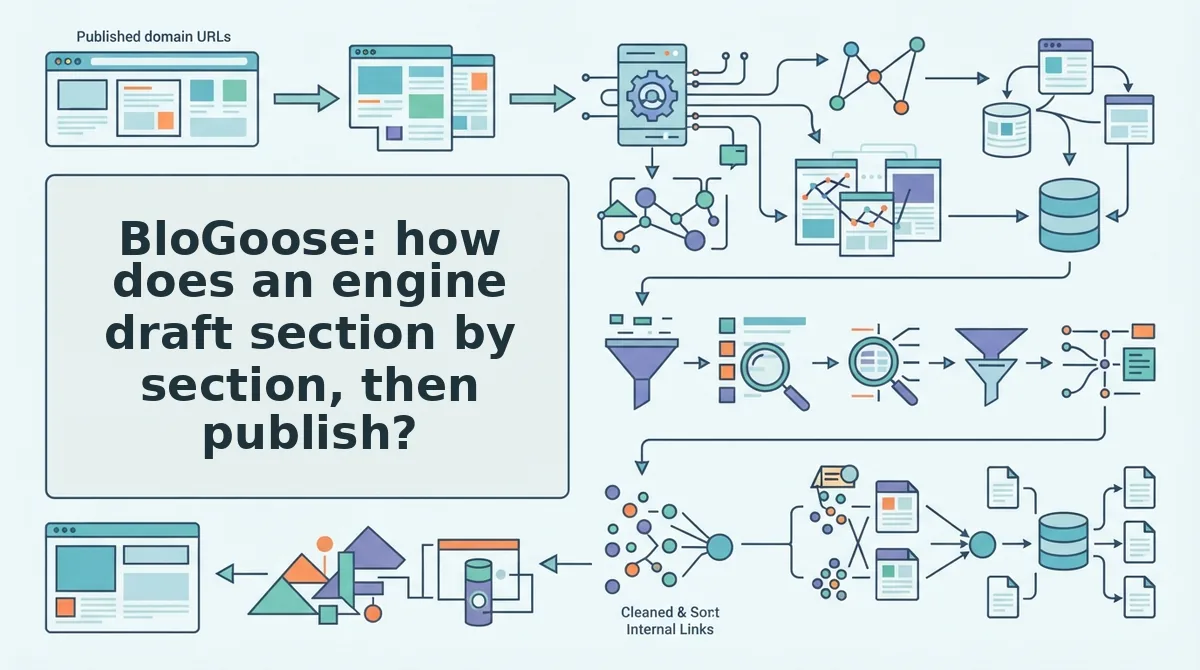
BloGoose: how does an engine draft section by section, then publish?
BloGoose runs one pipeline from sitemap to published URL: crawl, brand-context extraction, live SERP research, sectional drafting, a review pass, inline images, then a direct publish to WordPress or a custom API. Budget 25â40 minutes of human review per article; the machine passes run between your clicks.
Before you start: you need a live site with a discoverable XML sitemap, CMS access (WordPress credentials or a custom API endpoint), and one approved topic. No prompt library, spreadsheet, or second AI subscription is required.
- Type your domain into the Setup wizard (2 minutes). BloGoose locates the XML sitemap and inspects your published pages. You should see the URL list populate and the crawl status move to complete.
- Open Brand Context and review the eight Markdown files. The crawl distills eight Markdown brand context files â voice, audience, structure, and terminology rules taken from your own pages. Edit any rule that reads wrong; this is the voice-consistency mechanism for every later draft. You should see each file saved with your edit retained.
- Select a pillar topic in Calendar. Approve one article from the 30-day plan. You should see the topic move into production with a target and a word count.
- Click Run research (5â10 minutes). A live SERP pass collects ranking pages, required terms, and the questions the draft must answer. You should see a brief with a mapped outline.
- Approve the outline, then draft section by section. Each H2 is generated against its own intent and term set, so you can regenerate a single section without touching the rest. You should see every section carry its assigned terms on the first pass.
- Run the review pass. The system flags missing terms, thin sections, and unsupported claims. You should see a clean checklist before publishing is enabled.
- Generate inline images. Filenames, alt text, and placement are set to match the section topic â see inline image SEO for why that matters.
- Open Settings, then API Keys, and click Publish. The article posts to WordPress or your custom endpoint with canonical and metadata attached. You should see a live URL returned inside the tool.
The honest constraint: this is a pipeline, not a blank page. If you want to write every sentence yourself and have a tool grade it afterward, you are not the buyer. For the wider sequence, see automated SEO content.

Why does scoring after drafting cost more than drafting with constraints?
A rework loop is a drafting cycle where text is written first and graded second, so every correction becomes a rewrite of sentences that already exist. It costs more than constraint-first drafting because a score can only react to prose â it cannot shape the prose before it exists.
Simple: the score arrives after the words
An editor score evaluates a document that already exists. The first draft is therefore produced blind to the term profile it will later be measured against, and the measurement is the first time anyone sees the gap.
Intermediate: the loop, step by step
The score flags missing terms and thin coverage. You fix the flags by rewriting paragraphs that are already written, which shifts the term profile, which moves the score, which surfaces new gaps. Each pass buys a smaller correction than the one before it.
A content score is a diagnostic proxy, not a ranking guarantee â it measures term coverage, not whether Google or an AI answer engine will cite you.
Advanced: constraints set before paragraph one
Constraint-first drafting inverts the order. Required terms, section structure, and section intent are fixed before the first sentence, so the draft lands inside the profile on its first pass and the review becomes verification rather than repair. That is also the difference between writing for a keyword and optimizing for AI answers, where a section must survive being quoted on its own.
Think of it like an inspector who only arrives after the drywall is up: the fixes are demolition, not adjustment.
Which should you pick for a 1,500â2,500 word article?
Pick Surfer SEO if a writer already produces the drafts and you need a grader to tighten them. Pick BloGoose if you need the draft itself produced under constraints and published without a copy-paste handoff. For a section-by-section long-form draft, BloGoose owns more of the sequence.
| Production pass | Surfer SEO | BloGoose |
|---|---|---|
| Research | Included | Included |
| Outline | Included | Included |
| Draft | Not drafted â graded | Drafted section by section |
| Optimize | Score applied after drafting | Constraints set before drafting |
| Illustrate | Separate or manual | Inline image pass included |
| Publish | Not stated in supplied material | WordPress or custom API |
Worksheet: rebuild that table yourself, one row per pass and one column per tool, marking each cell included, separate, or manual. The count of separate and manual cells is your real stack and your real labour â audit it before you renew anything.
For a 1,500â2,500 word article built section by section, BloGoose is the faster path because the term set and section intent exist before the first paragraph, so the review pass verifies instead of triggering rewrites. Surfer SEO remains the stronger choice when a skilled writer is already in the loop and wants term-level feedback on prose they control. Neither tool is the wrong buy; they sit at different points in the same production line.
- Already hire a writer and need a grader: Surfer SEO.
- Need a finished draft by Thursday: BloGoose.
- Publishing weekly at volume: BloGoose, for the publish pass.
- Already paying for four subscriptions: fill in the worksheet first.
What cannot be verified here: current pricing for either tool, any ranking outcomes, and Surfer's publishing handoff â none of it appears in the supplied material, so treat those cells as blank rather than assumed.
Map your passes before you renew anything â automated SEO content shows how much of that sequence one pipeline can absorb.
That leaves the split in two sentences, and what to do next.
The split in two sentences, and what to do next
Surfer SEO grades the long-form draft you already wrote. BloGoose researches, drafts section by section, and ships the finished article to WordPress or your custom API.
That split answers the question the intro opened. The real cost of a long-form post is the number of rewrite passes between first draft and publish, not the editor's price.
You can measure that cost before committing to either workflow. Pick one door:
- Run a sitemap crawl. Drop your domain into the BloGoose setup wizard. Let it read your sitemap and published pages, then compare its drafted version of a topic you already cover against your live post.
- Score your next draft and count the passes. Write it, grade it, and tally every rewrite it takes to clear the target. That number shows where your hours actually go.
Either test gives you a number instead of a feature list.
A content score measures how far a draft is from done; drafting with constraints from the start is what closes that distance.