Topic Research Mistakes That Produce Briefs Which Never Rank
Your team builds a brief from last quarter's keyword export, assigns it, and never re-checks the SERP. The brief looks complete, with a target keyword, a volume figure, and a tidy outline. The article ships and ranks nowhere.
That frustration is fair, and it rarely means the writer failed. Most topic research mistakes for blog briefs happen before anyone drafts a sentence. A strong SEO content brief starts with research you can verify.
This guide shows you how to build a brief that holds up against the live SERP. You need three things: live SERP results for the keyword, your existing brief or keyword export, and a list of your site's published pages.
First, you will see seven mistakes mapped to the brief fields they corrupt. Then you will fix each one step by step. One of those mistakes hides inside the AI tools you already use.
Key Takeaway: Most blog briefs fail before writing starts, through stale data, misread intent, or copied outlines. Re-verify against live SERP data at brief time, and label every estimate.
What Topic Research Mistakes Cause Blog Briefs to Fail?
Blog briefs fail when a research mistake corrupts a specific brief field before writing starts. There are seven common mistakes: stale keyword data, misread intent, copied outlines, AI guesses treated as data, missing user language, orphan briefs, and no answer-engine targets. Each one produces a predictable ranking symptom.
A content brief is the document that tells a writer what to cover, for whom, and in what format. Search intent is the goal behind a query. Information gain is the new value a page adds beyond what ranking pages already say.
| Mistake | Brief Field Corrupted | Ranking Symptom |
|---|---|---|
| Stale keyword data | Target keyword, volume, difficulty | The page targets demand or SERP features that have since shifted |
| Misread intent | Intent line and planned format | The page format doesn't match what the SERP rewards |
| Copied outlines | H2 outline | The page repeats the consensus and adds no information gain |
| AI guesses treated as data | Volume and statistics fields | The writer publishes unsourced numbers as fact |
| Missing user language | Questions and FAQ list | Headings miss how readers actually phrase questions |
| Orphan briefs | Cluster, pillar, internal links | The page lacks topical support and inbound links |
| No answer-engine targets | Heading format and passage plan | AI answers and snippets have no clean passage to extract |
Why do briefs built with good keyword tools still fail? Keyword tools are genuinely strong at surfacing demand, grouping related terms, and estimating difficulty, and no brief workflow should skip them. Their limit is timing and scope. An export captures one moment and cannot tell you whether today's top results are tutorials, videos, or listicles. It also has no view of what your own site has already published. The brief inherits those blind spots in specific fields, such as the intent line, the format, and the internal links. That is why a correct keyword can still produce a page that never ranks.
- Best for solo operators: Fix stale data and misread intent first. They cost the least time to correct.
- Best for growth leads: Fix orphan briefs and answer-engine targets, because both compound across a whole cluster.
- Best for agencies and publishers: Fix AI guesses treated as data, since one unsourced number can spread across many client articles.
Avoiding these mistakes is the practical core of helpful content. BloGoose builds briefs from a crawl of your published pages, so cluster gaps show up before drafting begins.
How to Fix Each Research Mistake Step by Step
Fix each mistake by re-checking the brief field it corrupts against live evidence, one step per mistake. Before you start, open the live SERP for your keyword, your current brief or keyword export, and a list of your published pages.
- Pull keyword and SERP data at brief time. Replace numbers from old exports with a fresh pull. Volume, difficulty, and SERP features drift, so follow a re-check rule: re-pull every value on the day you assign the brief, whatever its age. Success: every data field carries the brief's date. (About 10 minutes.)
- Compare the dominant SERP format to your planned format. List the format and audience of each top result. For this topic, 2 of the 5 top videos target academic research, not blog briefs: Grad Coach's "The Research Topic Mistakes That Will DESTROY Your Project" and Charlotte Fraza's "How to Research Any Topic - Deep-Dive like a PhD Student." A brief that copied that SERP would serve the wrong reader. Success: your intent line names one audience and one format. (About 10 minutes.)
- Treat consensus H2s as the floor. Keep the headings most top pages share. Then add at least one information-gain element, such as a contrarian take. Success: at least one H2 covers ground no ranking page does. (About 15 minutes.)
- Apply the Source Confidence Hierarchy. This is the mistake hiding in your AI tools, because they fill data gaps with confident guesses. Rank your sources in this order: live SERP, then social research, then LLM knowledge. Tag any value that comes only from LLM knowledge with [est.]. Success: every number has a source or an [est.] tag. (About 10 minutes.)
- Mine real user language for questions only. Pull phrasing from forums, comments, and social threads to write headings and FAQs. Never cite a thread as proof of a claim. Success: your question list uses readers' own words. (About 15 minutes.)
- Map the brief to a cluster and pillar. Check your published pages and assign the brief to a pillar within your topic clusters. List the internal links pointing in and out. Success: no brief ships as an orphan. (About 10 minutes.)
- Set answer-engine targets. Phrase key headings as questions and plan a self-contained 80-120 word passage under each, following AEO content optimization practice. Success: every question heading has a planned passage. (About 10 minutes.)
How do AI estimates become false facts in a published article? Picture a brief that lists a search volume with no source attached. The writer has no reason to doubt it, so the number appears in the introduction as a stated fact. Nobody checked whether it came from a live tool or from an AI model's guess, and now it sits on a public page under your brand. The Source Confidence Hierarchy prevents this. Every value is traced to live SERP data or social research, or it carries an [est.] tag. Writers then know which numbers they can quote and which they should leave out.
BloGoose runs live SERP and social research at brief time and separates sourced values from estimated ones. That removes steps 1 and 4 from your manual workload.
Next, confirm your brief is ready before it goes to a writer.
How to Check Your Brief Is Ready Before It Goes to a Writer
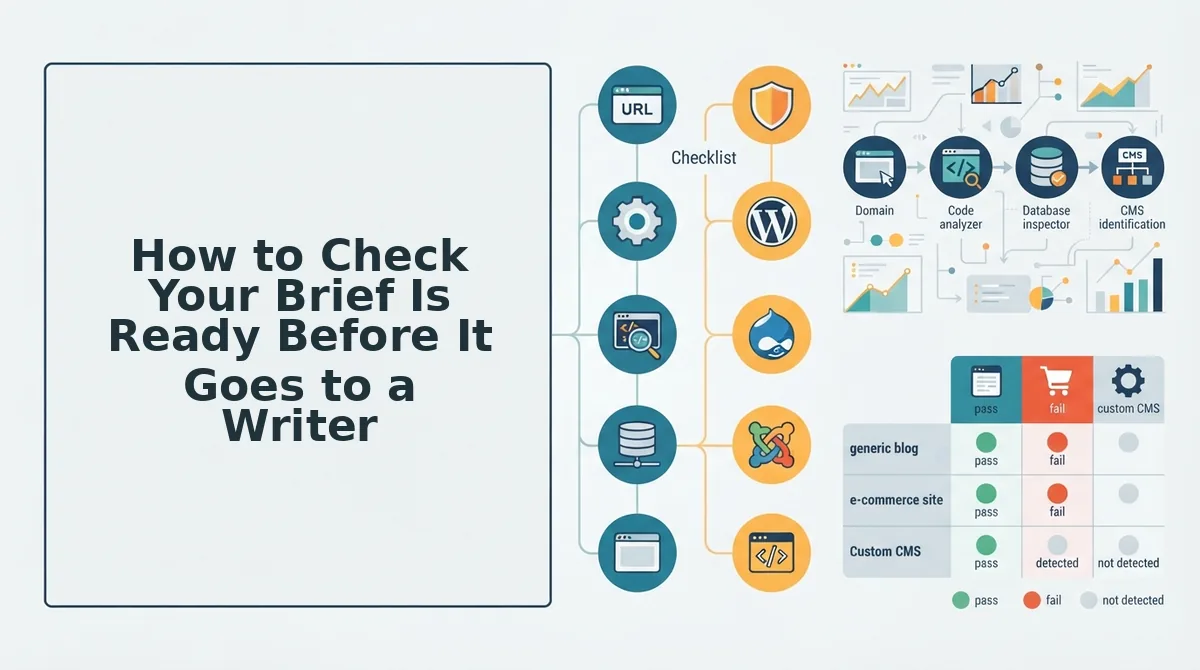
A brief is ready when it passes the Brief Pre-Flight Checklist: seven pass/fail tests, one for each research mistake, run before handoff. A single fail sends the brief back to research, because a writer cannot fix wrong data, intent, or format.
- Freshness test. Pass if volume, difficulty, and the SERP snapshot were re-pulled the day the brief was written. Stale exports describe a results page that may no longer exist.
- Intent-match test. Pass if the stated intent matches what page one actually serves. Check the live results manually, and fail the brief if they disagree with your plan.
- Sourcing test. Pass if every number links to a source or carries an [est.] tag. Unsourced figures erode trust with readers and AI engines, so apply your rules for citing sources before handoff.
- Format test. Pass if the planned format matches the dominant SERP format. Count list, guide, and comparison pages in the top ten, then follow the majority.
- Information-gain test. Pass if the outline adds at least one element competitors lack. Label it in the outline so the writer protects it.
- Cannibalization test. Pass if no existing page targets the same primary keyword. Search your sitemap first, because overlap means updating, not briefing.
- Audience test. Pass if the brief names the reader, their expertise, and their core question. Without it, writers default to generic beginner copy.
Worked example #3: Run the checklist on the export-based brief from the intro. It fails freshness because the data predates the current SERP. It fails intent match because page one shifted formats, and it fails sourcing because its volume figures carry no source or [est.] tag. Three fails send it straight back to research.
Frequently Asked Questions About Content Brief Mistakes
Most brief failures trace back to unchecked data and copied structure, not to weak writing.
How old can keyword data be before a brief is unreliable?
No safe day count exists, so re-verify keyword data and the live SERP at the moment you write the brief. Rankings, SERP features, and AI answer panels shift between exports. Treat pulled data as a lead to confirm, not as a fact to trust.
Is it bad to copy the H2s from the top 10 results?
Copying them is not bad, but it only sets the floor. Consensus headings are table stakes that prove basic coverage. Outranking existing pages requires information gain on top, such as original data, a worked example, or a framework the current results lack.
Does academic topic research advice work for SEO briefs?
It works only partly. Much of the topic research advice on YouTube targets academic papers, and its depth methods transfer well. However, it skips search intent and SERP checks, so you must add those steps yourself.
Build Your Next Brief on Live Data
Briefs that never rank rarely fail at the writing stage. They fail because they were researched from a snapshot, as the intro's export-based brief showed by failing three tests at once.
Treat every brief as a three-action pipeline. Diagnose it with the matrix, fix each mistake with the step-by-step method, and gate every handoff with the Pre-Flight Checklist.
To skip the manual loop, drop your domain into the setup wizard of the AI SEO content engine. BloGoose crawls your sitemap, builds Markdown context files from your brand voice, and runs live SERP research on your next topic. Every brief then starts from the search results as they stand today.