
How to Build a Topic Validation Workflow With Social Research

You spent six hours writing a post that got twelve pageviews and zero shares. The keyword had volume, the outline looked solid, and the content was genuinely useful, yet it sank without a trace. That is the exact failure mode a topic validation workflow with social research exists to prevent.
Most publishers skip validation entirely. They rely on keyword research alone, which shows demand but not resonance, people might search for a topic, but that does not mean they will read, share, or quote what you write about it.
You are right to be frustrated. The fix is not more keyword data; it is a repeatable validation process that checks whether a topic will actually earn attention before you commit hours to it. This guide walks you through a 5-point scorecard, shows you how to combine live SERP analysis with social listening, and gives you hard kill criteria for abandoning weak topics. Along the way, you will see how an autopilot SEO content engine can automate the research-heavy parts of this workflow, and one scoring rule that surprises nearly every publisher who tries it.
What Is the 5-Point Topic Validation Scorecard?
The 5-Point Topic Validation Scorecard is a pass/fail rubric that scores a potential article topic across five criteria, search demand, social signal, competition gap, brand fit, and AEO quotability, before any drafting begins. A topic must pass at least 4 of 5 criteria to be worth writing.
Think of the scorecard like a pre-flight checklist for a pilot. You would not take off with three of five systems unchecked, and you should not publish content with three of five validation signals missing. Each criterion gets a binary pass or fail, which forces a decision instead of a vague "maybe this could work."
Here is how each criterion works, with a worked example for the topic "AI content detection tools for publishers":
- Search demand (pass/fail): Does the topic have consistent monthly search volume and a clear intent? Pass if the primary keyword shows stable volume and the SERP contains at least three results updated in the last 12 months. Fail if volume is seasonal, declining, or dominated by irrelevant intents.
- Social signal (pass/fail): Is the topic actively discussed on social platforms, forums, or communities? Pass if you find at least five substantive discussions, not just link drops, in the last 90 days. Fail if social conversation is silent or purely promotional.
- Competition gap (pass/fail): Can you realistically outrank or differentiate from the current top 10 results? Pass if at least three ranking pages have clear weaknesses, thin content, outdated examples, no original data, or poor readability. Fail if the SERP is dominated by authoritative domains with comprehensive, recently updated content.
- Brand fit (pass/fail): Does the topic connect to your product, service, or editorial mission in a way readers will recognize? Pass if you can name the specific audience segment and the action they should take after reading. Fail if the topic is adjacent but not actually relevant to what you offer.
- AEO quotability (pass/fail): Can your article earn a citation in an AI answer engine? Pass if the topic lends itself to a concise, extractable definition, statistic, or numbered list that an AI can quote directly. Fail if the topic is purely narrative or opinion-based with no extractable facts.
For the worked example: search demand passes (stable volume, clear tool-comparison intent), social signal passes (active threads in SEO and publishing communities about detection accuracy), competition gap passes (several ranking posts are outdated and lack test data), brand fit passes for a content tool audience, and AEO quotability passes because the topic supports a quotable definition and comparison table. Score: 5/5, write it.
A topic that scores 3 or lower should be deprioritized or reworked. This scorecard also feeds directly into how you structure topic clusters, because validated topics become pillar candidates while borderline topics become supporting posts, or get cut entirely.

SERP Research vs. Social Research: What Each One Tells You
SERP research reveals what people search for, how competitive the ranking landscape is, and what format Google currently rewards; social research reveals the language people actually use, the pain points they complain about, and the contrarian takes that spark engagement. Each method answers a different half of the validation question.
Using only one source leads to either ranking without resonance or resonance without ranking. A topic can have strong search volume but zero social conversation, meaning people search for it out of obligation, not interest. Conversely, a topic can be trending on social platforms but have no search demand, which means you will get shares but no compounding organic traffic.
| Dimension | SERP Research | Social Research |
|---|---|---|
| Primary signal | Search volume, keyword difficulty, SERP features | Conversation volume, sentiment, language patterns |
| What it reveals | Demand, competition, format expectations | Pain points, objections, contrarian angles |
| Data sources | Google SERPs, keyword tools, live SERP queries | Reddit, X, LinkedIn, niche forums, YouTube comments |
| Best for | SEO managers and content strategists prioritizing rankings | Founders and community-led brands prioritizing resonance |
| Blind spot | Shows what people search, not what they care about | Shows what people discuss, not what they search |
The merge logic is what most publishers miss. SERP data tells you the topic is worth ranking for; social research tells you the angle that will make people read past the headline. When both signals align, you have a validated topic. When they conflict, dig deeper before committing.
If you are a solo publisher or small team, running both research tracks manually is the bottleneck. An automated content engine that crawls your site, extracts brand voice, and builds validated topic calendars removes the spreadsheet coordination without removing the judgment calls, the scorecard still requires a human decision, but the data gathering becomes a background process.
Next, the hard part: knowing when to walk away from a topic you already love.
The Kill Criteria: When to Abandon a Topic
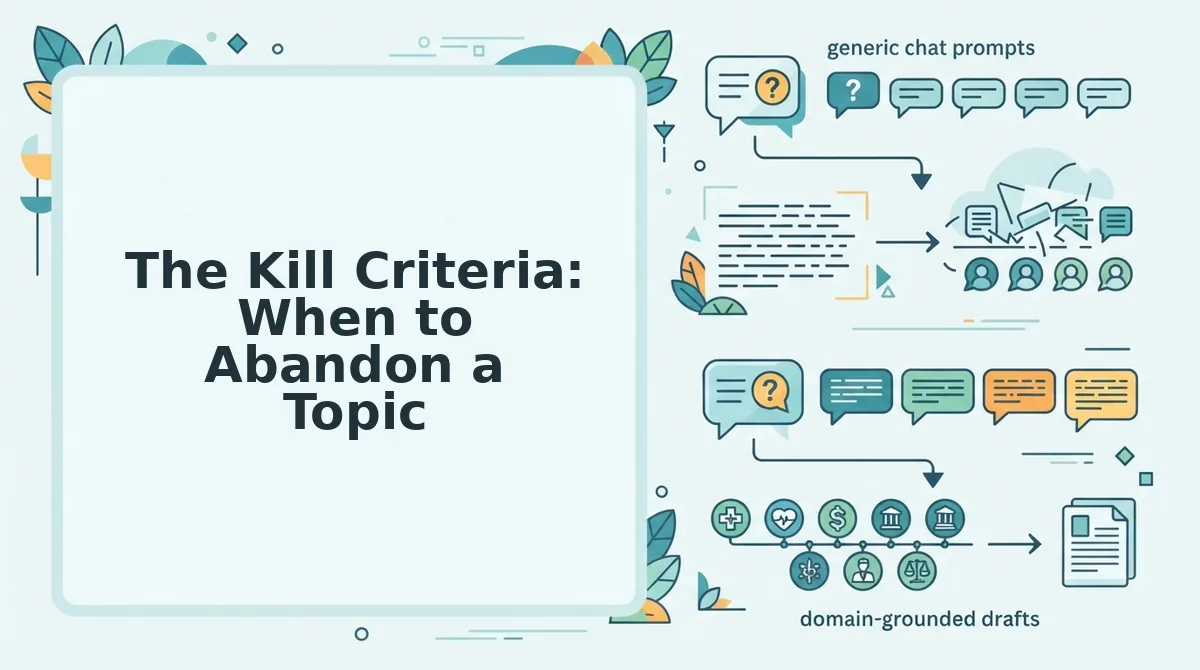
Most topic validation workflows fail because they only teach you what to pursue, not what to stop pursuing. The kill criteria below are ordered by severity, and the two-strike rule applies: if a topic fails two or more of these checks, abandon it immediately and move to the next candidate.
- SERP domination by three or more authority domains. When the first page of Google is occupied by sites with domain ratings above 80, think major publishers, government sites, or enterprise brands, your realistic chance of ranking in the top five within 12 months is near zero. Use this criterion by checking the top five results for your target keyword and counting how many belong to domains you cannot realistically outrank. If three or more qualify, the topic is dead.
- Zero questions or complaints in social feeds. A topic with search volume but no social conversation signals that people search for it passively but never discuss it, share it, or argue about it. Use this criterion by searching your topic across Reddit, X, LinkedIn, and niche communities for at least 15 minutes. If you find no questions, no complaints, and no debates, the audience has no emotional stake in the topic, which means no backlinks, no shares, and no AI citation potential.
- Search intent mismatch with your content format. If the SERP shows only product pages, calculators, or video results while you planned a blog post, the intent does not match your asset. Use this criterion by examining the dominant content type in the top ten results. If your planned format does not match at least six of ten results, kill the topic or change the format.
- Social sentiment is overwhelmingly negative toward the topic itself. Some topics attract conversation, but the conversation is toxic, outdated, or dominated by complaints about the subject rather than engagement with solutions. Use this criterion by reading the top 20 social posts for your topic. If more than half are rants, warnings, or dismissals, your content will inherit that sentiment and struggle to earn trust.
- Your brand has no credible angle or unique data. If every competitor already covers the topic with similar depth and you have no proprietary data, case study, or contrarian position to add, you are producing duplicate content. Use this criterion by listing the top five ranking articles and asking what you can say that none of them say. If the answer is "nothing," the topic fails.
- Topic conflicts with your existing content cluster. A topic that cannibalizes an existing high-performing page splits your authority and confuses search engines. Use this criterion by running a quick content audit to check for overlapping keywords. If the new topic targets the same intent as a page already ranking in the top ten, consolidate instead of creating.
- No clear monetization or conversion path. Traffic without a next step is vanity. Use this criterion by defining the action a reader should take after consuming the content, subscribe, request a demo, buy a product, or click an affiliate link. If you cannot name that action in one sentence, the topic does not serve your business.
Apply the two-strike rule ruthlessly. Killing a weak topic in 20 minutes saves you 20 hours of writing, optimizing, and waiting for a page that will never perform.
How to Automate the Workflow: From Crawl to Validated Brief
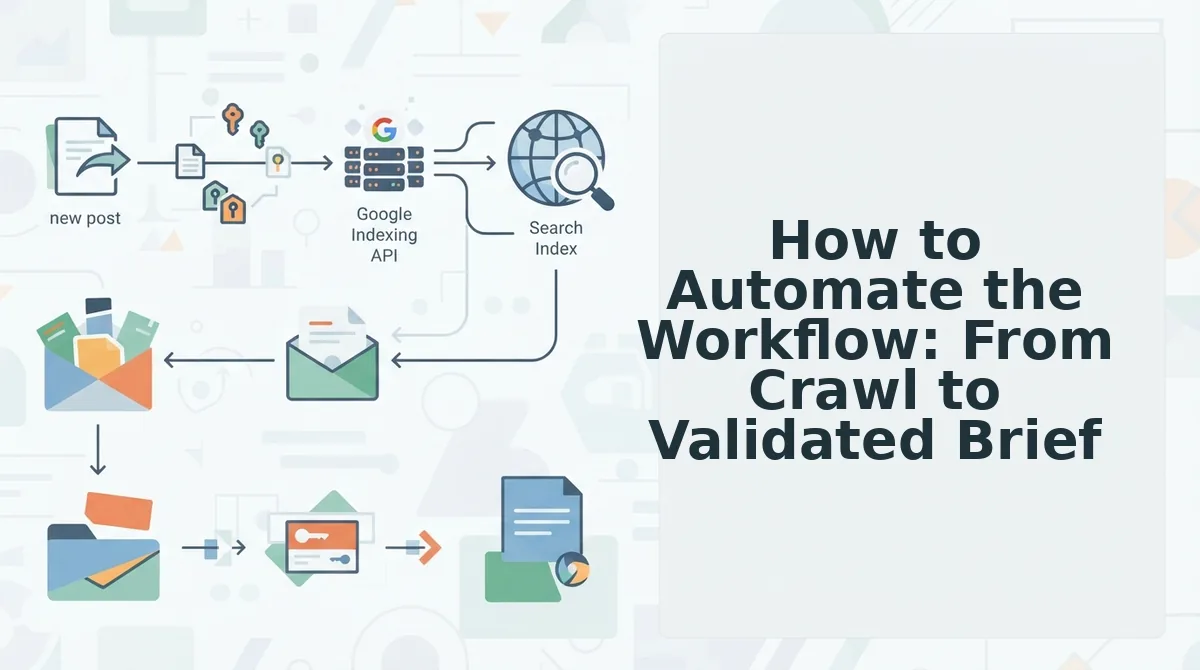
You can run the entire topic validation workflow manually, but automation compresses a 4-hour research process into roughly 15 minutes. The pipeline below uses BloGoose to crawl your site, query live SERPs, pull social signals, and generate a validated brief with the scorecard already applied.
Prerequisites: A BloGoose account, your website domain, and a list of 10-20 seed topics or keywords you want to validate.
- Enter your domain in the setup wizard. Open the BloGoose dashboard and type your website URL into the setup field. Click Start Crawl. BloGoose locates your XML sitemap, inspects your published pages, and extracts your brand voice rules, existing content clusters, and technical context. You should see a crawl completion summary listing page count, detected categories, and extracted tone guidelines within 2-3 minutes.
- Upload your seed topic list. Navigate to the Topics tab and paste your 10-20 candidate keywords or headlines. Click Validate. BloGoose runs live SERP queries for each topic and returns a ranking difficulty score, the top ten competing domains, and the dominant content format for each query. You should see a difficulty badge. Low, Medium, or High, next to every topic within 60 seconds.
- Review the social research panel. Open any topic to view the social signals BloGoose pulled from Reddit, X, and niche communities. The panel shows question frequency, sentiment distribution, and the most common complaints or requests. Topics with high question volume and neutral-to-positive sentiment pass the social proof check automatically. You should see a green checkmark next to Social Proof for qualifying topics.
- Apply the kill criteria filter. In the Filters menu, enable the two-strike rule. BloGoose flags any topic that fails two or more scorecard criteria. SERP domination, zero social questions, intent mismatch, negative sentiment, no unique angle, cluster cannibalization, or no conversion path. Flagged topics appear in red with the specific failed criteria listed. Delete or archive them in one click.
- Generate the validated brief. Select the surviving topics and click Generate Briefs. BloGoose produces a topic brief for each one that includes the target keyword, recommended H2 structure, social questions to answer, entities to cite, and the scorecard results. You should see a brief preview with a Validated status badge. From there, you can send the brief to the automated SEO content pipeline for drafting and publishing.
Success looks like a queue of validated briefs where every topic has passed at least five of seven scorecard criteria and carries a clear conversion path. The entire crawl-to-brief workflow should take under 15 minutes for a batch of 20 topics.
Validation Is a Funnel, Not a Checklist
The scorecard works because it treats topic selection as a funnel: you start with 20 ideas, kill the weak ones fast, and publish only the handful that clear both search demand and social proof. A valid topic needs both signals. SERP opportunity without social conversation produces traffic that never converts, while social buzz without search volume produces engagement that never compounds.
The workflow scales in two stages. Start manual: run the five-point scorecard and kill criteria by hand on your next three topics to internalize the judgment calls. Then automate the crawl-to-brief pipeline with BloGoose so every future topic gets validated in minutes instead of hours.
Your next step is to enter your domain and run your first batch of seed topics through the validator. The topics you kill today are the ranking pages your competitors will waste months writing.