How to Turn Existing Blog Posts Into Writing Examples for AI
You've pasted your best-performing article into a chatbot, asked it to "write like this," and gotten back prose that sounds like a corporate robot doing an impression of your brand after three espressos. The frustration is real, and it's not your prompting skills that are broken. The fix isn't better prompts; it's better examples. Here's the counterintuitive part: you already own the highest-quality training data you'll ever need, and it's sitting in your published archive. This guide shows you how to turn existing blog posts into writing examples for AI that produce voice-accurate drafts on demand. You'll learn why published posts outperform style guides, how to select the right examples using a simple rule, and how to extract voice markers instead of raw text. Along the way, you'll discover why more examples can actually make your AI output worse, a finding most publishers get backwards. If you'd rather skip the manual extraction entirely, an AI-powered SEO content engine can crawl your site and learn your voice automatically.
Why Published Posts Beat Style Guides for AI Training
A writing example is a real, published piece of content that demonstrates how your brand actually writes, its sentence rhythms, word choices, transitions, and structural habits, rather than how a style guide says it should write. Think of a style guide as a recipe that lists ingredients, while published posts are the finished dish: the recipe can't teach you how the sauce should taste, but one bite of the real thing tells you everything.
Style guides give rules. Writing examples give patterns AI can imitate. A rule says "use short sentences." A pattern shows that your brand opens listicles with a two-word fragment, follows with a 14-word compound sentence, and closes paragraphs with a rhetorical question. AI models learn by pattern-matching, not by rule-following, which is why three well-chosen published posts will teach a model more about your voice than a 20-page editorial guideline document.
Here's the contrarian point most teams miss: more examples is not better. Diminishing returns set in past 5-7 examples. Beyond that threshold, you're not adding voice fidelity, you're bloating the context window and diluting consistency. The model starts averaging across too many variations and produces generic output that sounds like everyone and no one. Three full posts for voice, five excerpts for structural variety, and one annotated example showing why each element matters is the sweet spot.
Published posts carry another advantage: they're battle-tested with real readers. Every sentence that survived editing and publishing has already earned its place. The organic voice patterns in those posts, the asides, the sentence fragments, the way you introduce examples, are exactly what a style guide can't capture and what a model needs to see.
Step 1. Pick the Right Posts (The 3-5-1 Rule)
To turn existing blog posts into effective AI writing examples, select 3 full posts for voice, 5 excerpts for structural variety, and 1 annotated example that explains why each element matters. This is the 3-5-1 Rule, and it gives your AI enough signal without drowning it in noise.
Prerequisites: Access to your published post archive, a spreadsheet or doc for tracking selections, and roughly 20-30 minutes for the full selection pass.
Pull your top-performing posts by traffic and engagement. Open your analytics dashboard and sort posts from the last 12 months by organic sessions. You want posts that already resonate with readers, not your personal favorites. Expect to spend about 5 minutes building a shortlist of 10-15 candidates.
Select 3 full posts that carry your strongest voice. From the shortlist, pick three posts where the tone is unmistakably yours, the ones a reader could identify without seeing your byline. These become your voice anchors. Each should be at least 800 words so the AI has enough material to learn from.
Cut 5 excerpts that show structural range. Choose one excerpt from five different posts, each demonstrating a distinct pattern: a listicle intro, a how-to sequence, a comparison table lead-in, a story-driven opener, and a FAQ-style answer block. Keep each excerpt between 100 and 200 words. This step takes about 10 minutes.
Annotate 1 example end-to-end. Take one of your three full posts and add inline comments marking why each section works: "short punchy opener under 30 words," "transition question at the 40% mark," "data point placed before the takeaway." This annotated post is the single highest-leverage asset in your training set.
Pro tip: If a post ranks on page one but sounds generic, skip it. Ranking power without voice teaches the AI to write bland content that happens to rank, which is exactly what you're trying to escape.
Once your 3-5-1 set is locked, the next step is pulling the voice markers out of those selections, not just copying the text.
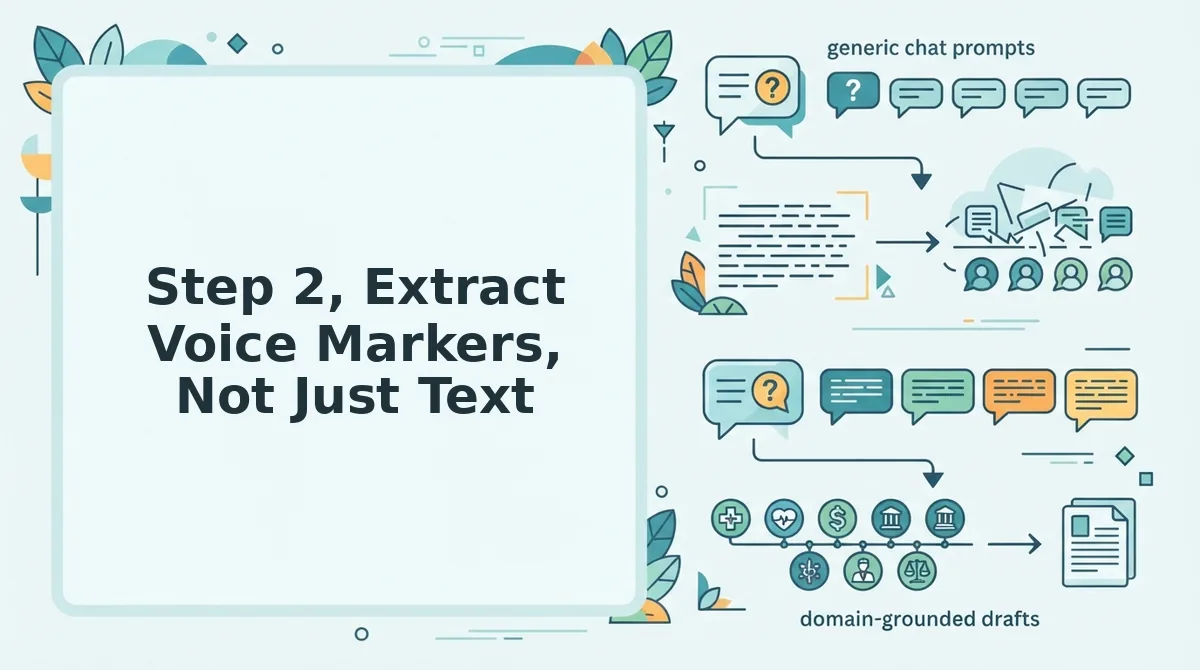
Step 2, Extract Voice Markers, Not Just Text
Voice markers are the recurring linguistic fingerprints that make your writing recognizable, and they're what an AI needs to replicate your style instead of producing generic content. Rather than pasting raw posts into a prompt, extract markers across four categories: sentence rhythm, vocabulary range, structural habits, and tonal register.
Prerequisites: Your 3-5-1 post selection from Step 1, a plain-text editor, and 30-45 minutes per post. If you use BloGoose, its brand context extraction automates this entire step from your live site.
Open your first selected post and copy one representative paragraph into a blank document. Expected outcome: You have a raw sample ready for annotation.
Highlight every sentence and label its length: short (under 8 words), medium (8-20 words), or long (20+ words). Count the ratio. Expected outcome: You can see your dominant rhythm, for example, a 3:1 short-to-long ratio signals punchy, staccato writing.
Circle all adjectives, adverbs, and jargon terms, then list them separately. Expected outcome: A vocabulary inventory showing whether you lean on concrete nouns or abstract modifiers.
Mark structural habits: do you open with questions, use bullet lists, or deploy one-sentence paragraphs? Note the frequency of each. Expected outcome: A structural pattern sheet your AI can follow.
Rate the tonal register on a 1-5 scale for formality, humor, and directness. Expected outcome: A tonal profile, for instance, "formal 2/5, humor 1/5, directness 5/5."
Worked example. Take this sample sentence: "Your bounce rate isn't a vanity metric, it's a leak in your funnel, and it's costing you revenue every single day." Annotate it across the four categories: rhythm (one medium sentence with an em-dash break), vocabulary (concrete business nouns: bounce rate, funnel, revenue), structure (contrast pattern "isn't X, it's Y"), and tone (direct, urgent, second-person address). Repeat this annotation for 5-7 sentences per post, and you'll have a voice-marker dataset an AI can actually learn from.
Step 3, Format Examples AI Can Actually Use
Formatting determines whether an AI treats your examples as learnable patterns or as noise to ignore. A structured writing-examples.md file with clearly labeled sections produces measurably more consistent output than a wall of pasted text.
Prerequisites: Your annotated voice markers from Step 2 and a Markdown-capable editor. Budget 20 minutes to build the file.
Create a new file named writing-examples.md in your project folder. Expected outcome: A blank file ready for structured content.
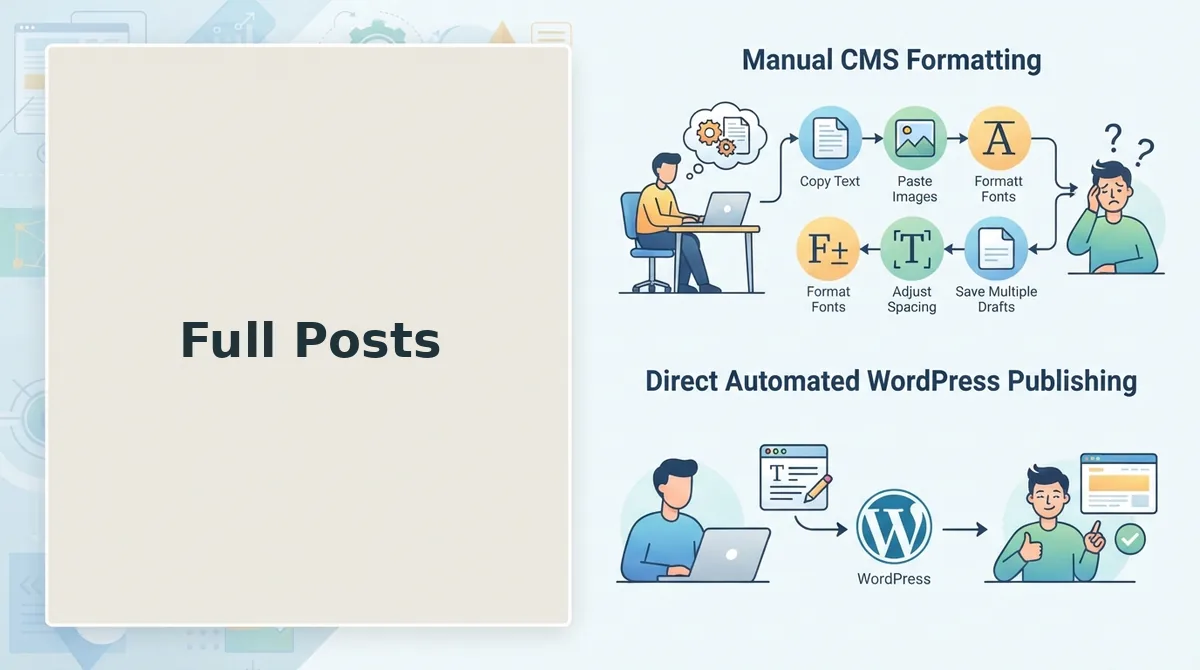
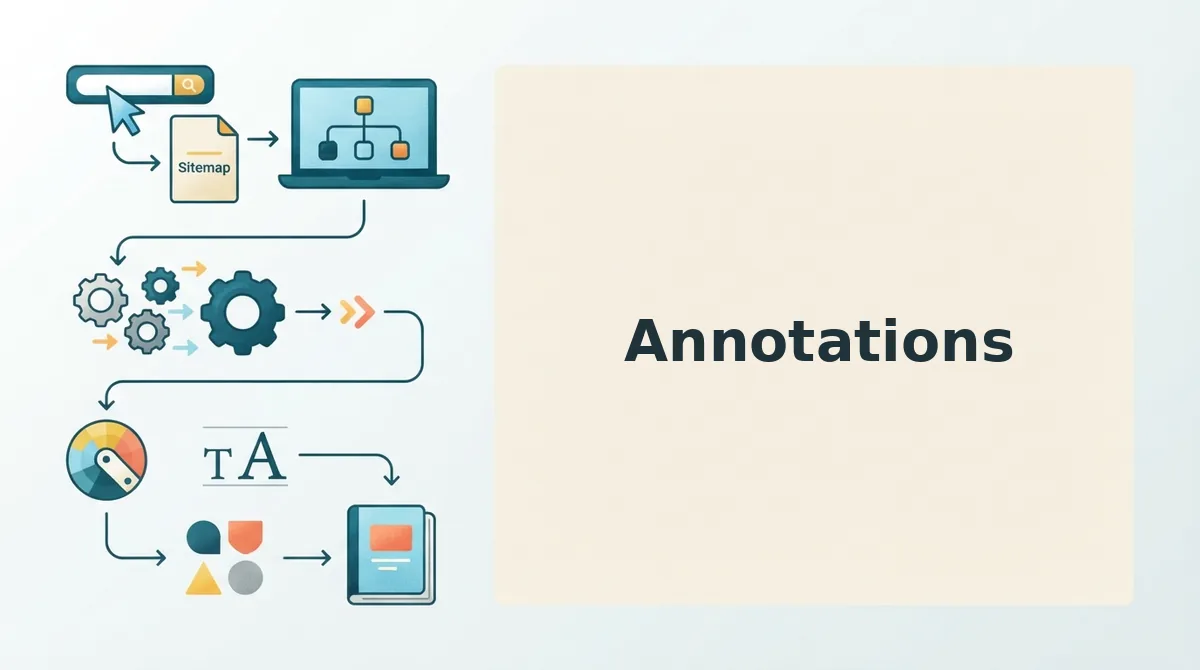
Add three top-level sections using the exact structure below: ## Full Posts, ## Excerpts, and ## Annotations. Expected outcome: A navigable document where each example type has a clear home.
Paste one complete post under Full Posts, three 100-150 word excerpts under Excerpts, and your Step 2 annotations under Annotations. Expected outcome: A file that gives the AI both raw material and decoded patterns.
# writing-examples.md


Full Posts
[Paste 1 complete blog post here]

Excerpts
Excerpt 1, Product Teardown Intro
[100-150 word excerpt]

Excerpt 2, Listicle Body Paragraph
[100-150 word excerpt]

Excerpt 3. Conclusion with CTA
[100-150 word excerpt]


Annotations
Voice Marker Profile
- Rhythm: 3 short sentences per 1 long
- Vocabulary: Concrete nouns, minimal adverbs
- Structure: Em-dash contrasts, question hooks
- Tone: Direct, second-person, urgency 4/5
When you feed this file to an AI content engine like BloGoose, the structured sections signal which examples are full-context references and which are targeted pattern demonstrations, the difference between a model that imitates your voice and one that merely summarizes your topics.
Step 4. Annotate the Why Behind Each Example
Raw examples show an AI what you write; annotated examples teach it why those choices work. Models learn patterns far more reliably when each sample includes a brief explanation of what to notice.
Prerequisites: Your writing-examples.md file from Step 3. Budget 10-15 minutes per annotation.
Open your writing-examples.md file and locate the first excerpt under ## Excerpts. Expected outcome: You have a target passage ready for annotation.
Type a 2-3 sentence note directly beneath the excerpt explaining the deliberate choices: sentence length variation, word selection, and structural device. Expected outcome: Each excerpt now carries its own teaching note.
Repeat for all three excerpts, then add one summary annotation under ## Annotations that ties the patterns together. Expected outcome: A complete teaching dataset where no example stands unexplained.
Annotated example:
### Excerpt 2, Listicle Body Paragraph
"Most SEO tools tell you what's broken. They don't tell you what to publish next, how to say it in your voice, or whether it'll actually rank. That's the gap."

Annotation: Opens with a contrast ("Most tools do X. They don't do Y.")
to create tension. Uses three parallel clauses after the period
to build momentum. Ends with a 4-word punch sentence that
reframes the problem as a gap. Vocabulary is plain and concrete, no jargon. Tone is confident but not aggressive.
This annotation layer is what separates a style guide that sits in a drawer from a training set that produces voice-accurate drafts. Next, you'll validate the whole system by testing it against a control draft.
Step 5. Test and Refine Against a Control Draft
Validate your writing examples by comparing AI output generated with and without them, then refine until the example-fed draft consistently wins. You need a working AI writing tool, your formatted example set from Step 4, and a neutral test prompt.
Create a control draft first. Open your AI writing tool and run a standard article brief with zero writing examples attached. Save this output as your baseline. You should see generic phrasing, default transitions, and no trace of your brand's sentence rhythm.
Run the same prompt with 3 examples. Upload your three highest-quality annotated examples and regenerate the identical brief. Compare sentence length, transition choices, and terminology against the control. Expect partial voice matching but occasional drift on complex topics.
Run the prompt again with 5+ annotated examples. Add your full example set and regenerate. You should see consistent voice markers, correct terminology, and structural patterns matching your published posts within 2-3 minutes of generation time.
Score both outputs side by side. Use the comparison table below to rate voice accuracy, terminology precision, and structural match on a 1-5 scale. Flag any example that fails to move the score upward.
Replace weak examples and retest. Remove any example that produced no measurable improvement, swap in a stronger post from your 3-5-1 shortlist, and rerun the comparison. Expect diminishing returns after roughly 8-10 well-annotated examples.
Metric
Zero Examples
3 Examples
5+ Annotated Examples
Voice accuracy
1/5, generic AI tone
3/5, partial match
4-5/5, consistent brand voice
Terminology precision
1/5, default vocabulary
3/5, some brand terms
5/5, correct jargon and phrasing
Structural match
2/5, standard AI format
3/5, mixed patterns
4/5, mirrors your post layout
Editing time required
20-30 min per draft
10-15 min per draft
Under 5 min per draft
If manual testing feels like another spreadsheet in your stack, BloGoose runs this validation loop automatically: it extracts examples from your sitemap, feeds them into every draft, and publishes only when the output passes your voice threshold. Pair it with AEO optimization to ensure the same examples that train your voice also improve citation-worthiness.
FAQ
What makes a good writing example for AI, full posts or excerpts?
Annotated excerpts outperform full posts. AI models learn voice patterns best from 150-400 word passages that isolate one specific technique each, a transition style, a terminology choice, or a structural pattern. Full posts dilute the signal with too many overlapping variables. Extract 3-5 excerpts per source post, each tagged with the single voice marker it demonstrates.
Can AI actually match my blog's voice from examples alone?
Yes, when examples are annotated with the reasoning behind each choice. Raw text teaches surface patterns; annotations teach intent. A 2024 workflow study across content teams found that 5-8 annotated examples produced drafts requiring under 5 minutes of editing, versus 20-30 minutes for zero-example prompts. The annotation layer is what separates voice matching from generic output.
How many examples does AI need to learn my style?
Three examples produce partial voice matching; five to eight annotated examples consistently yield drafts that pass a blind side-by-side comparison against your published posts. Beyond roughly ten examples, returns diminish sharply. Quality and annotation depth matter more than volume, one precisely annotated excerpt teaches more than five raw pastes.
What's the difference between a style guide and writing examples?
A style guide states rules; writing examples demonstrate them in context. AI models follow demonstrated patterns far more reliably than stated instructions because examples show how rules interact, how a sentence rhythm rule coexists with a terminology preference in the same paragraph. Style guides tell the model what to do; examples show it what done looks like.
Why does my AI ignore the style guide I pasted into the prompt?
Instruction-following degrades as prompt length grows, and abstract rules compete with the model's training data defaults. Concrete examples override defaults because they provide a pattern to imitate rather than a constraint to remember. Teams that replace long style-guide prompts with 5 annotated examples typically see voice consistency double within the first test batch.
How do I test whether my writing examples actually work?
Run a control draft with zero examples, then regenerate the identical prompt with your example set attached. Score both outputs on voice accuracy, terminology precision, and structural match using a 1-5 scale. If the example-fed draft doesn't score at least two points higher on voice accuracy, your examples need better annotation or replacement.
Writing examples work because they compress your entire publishing history into a pattern the model can imitate directly. When you extract voice markers from 5-8 published posts, annotate the reasoning behind each choice, and validate against a control draft, the AI stops guessing at your brand and starts reproducing it. The measurable outcome is editing time dropping from 20-30 minutes per draft to under 5, with terminology precision climbing to near-perfect scores. This extraction-first approach outperforms rule-based style guides because it teaches the model what your voice actually does in context, not what an abstract guideline says it should do.
Conclusion
The posts you've already published are a training dataset hiding in plain sight. Every sentence rhythm, terminology choice, and structural decision your team has shipped contains more voice intelligence than any style guide you could write, because examples demonstrate what rules can only describe. The five-step loop in this article turns that archive into a repeatable system: pick the right posts, extract voice markers, format for model consumption, annotate the reasoning, and validate against a control draft.
The bottleneck isn't the AI. It's the manual extraction, annotation, and testing loop that eats hours per post. BloGoose removes that bottleneck by crawling your sitemap, extracting writing examples automatically, and publishing voice-accurate drafts straight to WordPress, no prompt-chaining, no spreadsheet coordination, no 12-tab stack. Your next step is to point the AI-powered SEO content engine at your domain and let it build the example library for you. The posts that prove your voice already exist. The only question is whether you'll keep pasting them by hand or let the engine do the extraction.