How User Intent Patterns Drive Direct Answers in AI Search
Traffic declines are rarely caused by thin content; they happen because search engines dynamically change how they classify user intent patterns while teams remain locked in static spreadsheets. Modern search engines and LLMs evaluate intent through dynamic prompt routers and Agentic RAG systems rather than the static keywords of traditional ten-blue-link SERPs. Relying on an advanced AI SEO content engine bridges this gap by structuring direct answers for retrieval engines.
You already know the fatigue of stack sprawl across disconnected research subscriptions, standalone chat prompts, and manual CMS uploading loops. In this guide, you will discover how dynamic intent routing governs chatbot answers and how to structure your publishing pipeline to win citations. Later, we expose the exact architectural trigger that prompts answer engines to bypass high-authority legacy pages.
Consider this standard deployment workflow:
- Situation: An operator manages fragmented tools and struggles to surface within generative summaries.
- Action: The publisher implements AEO optimization by feeding an XML sitemap into an engine that extracts brand rules and targets live SERP intent clusters.
- Outcome: Fully structured, citation-ready drafts ship directly to WordPress without manual prompt homework.
This architectural framework applies specifically to informational and commercial search queries, excluding transactional or closed-database checkout paths.
What Are User Intent Patterns in Modern Search?
User intent patterns are recurring behavioral and semantic signals that reveal what an information seeker aims to accomplish across their search journey. Modern retrieval engines evaluate these patterns to determine whether to display standard blue links, execute a transaction, or extract a direct answer for an AI snapshot.
A user intent pattern is the structural combination of pre-click query syntax and post-click behavioral interaction flows that reveals an information seeker's exact task to a search system. Rather than treating search as a static keyword category, intent patterns evaluate the exact phrasing, syntax modifiers, and navigation sequences a searcher uses. In modern AI search, retrieval models process these signals to determine whether an engine should serve an interactive tool, cite a step-by-step tutorial, or synthesize a direct conversational answer. By identifying these recurring linguistic configurations, search systems map the contextual problem space before delivering targeted answers.
Consider a searcher evaluating software: typing “ what is an AI SEO content engine” indicates an educational research phase, whereas typing “ AI SEO content engine with search indexing” signals an active trial search. Think of intent patterns like customer behavior in a physical hardware store. A visitor asking “ what is a miter saw?” needs an educational conversation at the counter, while someone asking “ where are the 10-inch sliding saws?” wants an immediate path to the checkout register.
To interpret these queries accurately, search systems apply Philipp Lackner's technical paradigm separating explicit intent from implicit intent:
- Explicit Intent: The stated command or raw query syntax directly submitted by the user.
- Implicit Intent: The contextual background goal, including the format, technical depth, and unstated problem the user actually needs solved.
AI answer engines prioritize content that solves both layers simultaneously. When structuring your domain's topic clusters, mapping these patterns ensures every post directly answers the implicit questions an LLM looks to quote. BloGoose crawls your sitemap and runs live SERP research to surface these precise intent gaps automatically before drafting.
Search Intent vs UX Behavioral Intent: The Dual-Layer Architecture
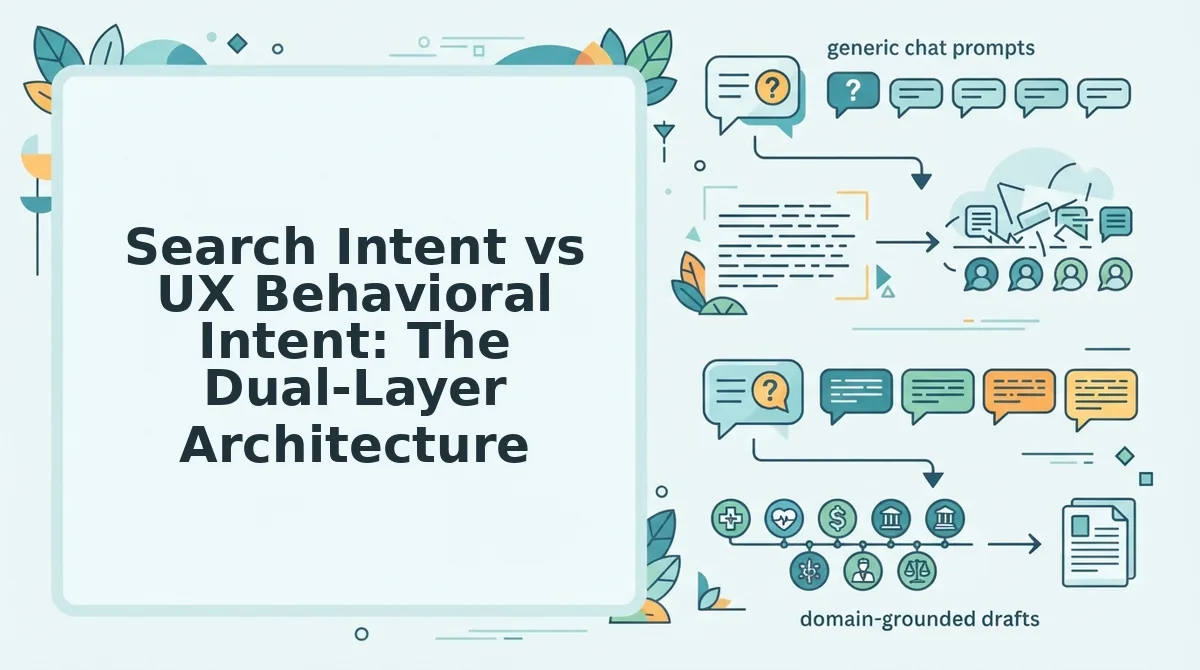
Search intent classifies pre-click query tokens to trigger direct answers, while UX behavioral intent governs post-click task resolution that validates content relevance. Winning AI answer citations requires synchronizing both layers so retrieval systems recognize both entity relevance and complete task delivery.
Traditional search optimization focuses on query taxonomy, mapping informational or commercial keywords to surface relevant passages. However, search engines evaluate algorithmic query reformulation mechanics against downstream session termination signals. When an answer engine surfaces your snippet but the user immediately reformulates their prompt, algorithms register dissatisfaction. Session termination is a search quality signal where a user ceases active searching because their underlying objective was fully resolved on the host page.
| Optimization Model | Primary Mechanism | Algorithmic Measurement | Best For |
|---|---|---|---|
| Search Intent Classification | Pre-click syntactic parsing of SERP keywords and entity types | Click-through rates and passage extraction eligibility | Solo bloggers targeting rapid definition queries |
| UX User Intent Framework | Post-click task completion and contextual next-step design | Scroll progression, path continuity, and dwell depth | Product managers optimizing app-based conversion flows |
| Dual-Layer Architecture | Direct factual lead sentences paired with sequential workflow blocks | Prompt satisfaction and clear session termination signals | Growth leads building citation-optimized content hubs |
Choose Search Intent Classification if your immediate bottleneck is qualifying for snippet visibility across top-of-funnel informational queries. Choose UX User Intent Framework if your traffic is already stable but users drop off before completing core transactional steps.
Our recommendation is implementing the Dual-Layer Architecture. Tools like Surfer SEO excel at entity density scoring, while Jasper handles volume drafting, but neither framework natively resolves the gap between snippet extraction and down-funnel retention. Teams should perform a systematic content audit to pinpoint where existing articles satisfy initial definitions yet fail on interactive workflows. Placing a quotable factual summary above the fold satisfies retrieval bots, while organizing downstream steps eliminates query reformulation loops entirely.
How AI Search Engines and Agentic RAG Classify Query Patterns
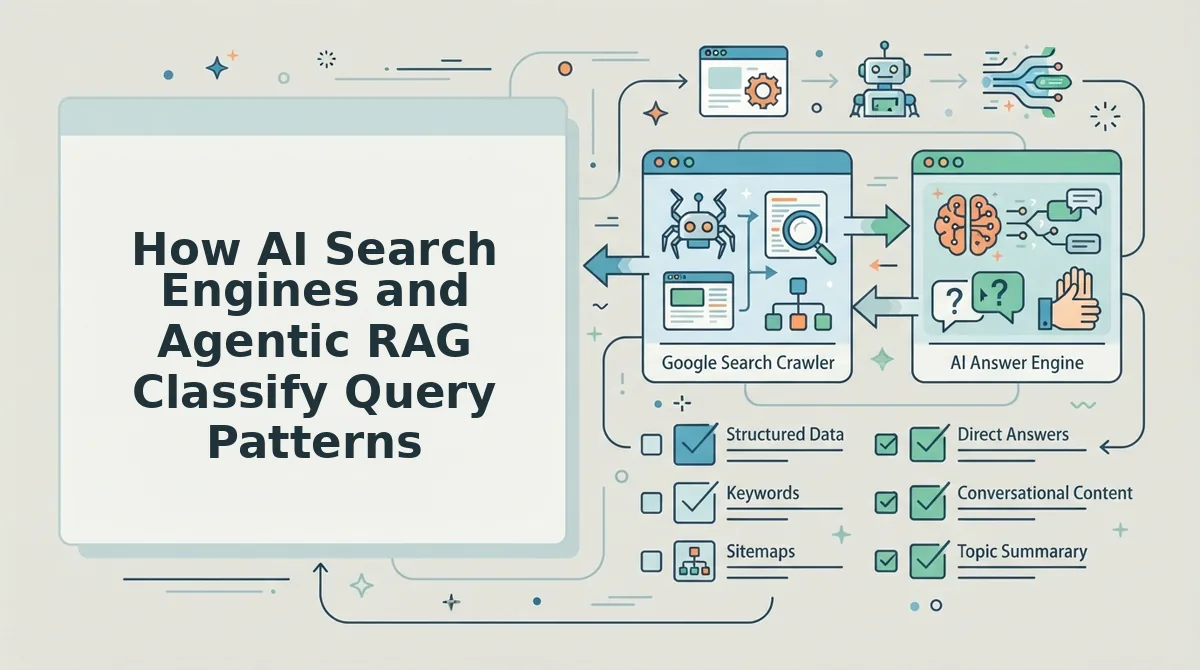
AI search engines classify query patterns by routing incoming user prompts through intent-detection classifiers that match user goals to specific retrieval pipelines. Instead of reading full articles sequentially, prompt routers scan entity-dense passage blocks to extract self-contained answers or call live tools based on the detected intent.
Agentic RAG is an artificial intelligence framework that dynamically routes search queries to specialized retrieval tools, knowledge bases, and synthesis models based on user intent. Think of Agentic RAG like a hospital triage desk. The desk does not treat every patient identically; it evaluates symptoms instantly and routes minor cuts to a clinic, prescriptions to a pharmacy, and complex trauma to a multidisciplinary surgical team.
For search publishers aiming to understand how to get cited in AI answers and chatbots, knowing how these retrieval pipelines parse text is essential for modern discovery. Agentic retrieval systems evaluate user queries through three sequential stages:
- Token Classification: The system identifies key entities, question words, and semantic intent markers within the prompt to determine whether the user seeks an immediate fact, a process, or an evaluation.
- Retrieval Strategy Selection: Technical architectures outlined by industry researchers like Abhik Maiti and enterprise frameworks from Progress Software route simple queries to direct vector stores, while routing commercial evaluations to multi-source retrieval tools.
- Direct Passage Synthesis: The model extracts standalone text chunks from relevant documents and synthesizes them into an attributed answer without processing surrounding fluff.
Why does this architectural distinction matter for content optimization?
When a user submits an informational query like a definition request, the pipeline selects a direct vector lookup. The model inspects indexed passages, isolates a self-contained entity definition, and extracts it verbatim. However, when a user enters a commercial comparison, the classifier triggers tool-calling pipelines that pull data from structured tables and feature matrices across multiple sources to assemble a comparative synthesis.
To capture direct citations across both informational lookups and complex evaluations, structure your pages into modular sections that lead with direct answers before expanding into technical specifics.
How to Map Intent Patterns to Content Architecture Step by Step
Mapping intent patterns to content architecture requires categorizing queries by user search objectives, assigning distinct URL tiers, and applying page layouts and schema markup that match informational, commercial, or transactional needs. Content architecture is the structural design of a website that organizes content hierarchies, URLs, and internal links to satisfy specific search intents.
Consider a bloated 50-keyword CSV where variations of the same tool or workflow appear on every row. Publishing unorganized articles for every synonym causes keyword cannibalization, confusing AI retrieval models and diluting ranking power. Before starting, gather your raw keyword export, current sitemap URL, and CMS template settings; the full mapping process takes roughly 45 minutes per topic cluster.
- Filter and group linguistic search patterns. Open your keyword spreadsheet and segment queries by linguistic modifiers such as "how to", "what is", "best", "vs", and "pricing". Group informational queries into educational topics, comparison queries into evaluation clusters, and purchase terms into conversion targets. You should see your raw spreadsheet organize into three clean columns showing clear intent categories instead of repetitive keywords.
- Assign intent blueprints across URL tiers. Map each keyword group to a distinct URL format to eliminate cannibalization across your domain. In a SaaS search cluster, route conceptual definition terms like "what is automated SEO" to an informational guide containing self-contained definition passages, direct comparative terms like "best SEO automation platforms" to a commercial evaluation matrix, and map high-intent queries like "buy SEO content software" directly to a transactional product signup page. This approach ensures each page targets an unambiguous search objective. You should see a bloated 50-keyword list condense into four cleanly delineated URL blueprints.
- Embed intent-matched schema markup. Select your CMS page template and configure structured data corresponding directly to the search intent. Apply
ArticleandFAQPageschema to informational definition guides to qualify for direct answer citations, use item list properties on commercial evaluation matrices, and assignSoftwareApplicationschema to transactional conversion pages. Test each URL in Google’s Rich Results Test until you see valid status indicators across all entity types. - Connect intent tiers with hierarchical internal links. Insert descriptive anchor text pointing upward from top-of-funnel informational passages to commercial comparison hubs, then link commercial tables directly to transactional signup endpoints. This linking pattern guides search crawlers through a logical topic hierarchy from broad answers to conversions. You should see every informational page reference its related commercial matrix without orphaned URLs.
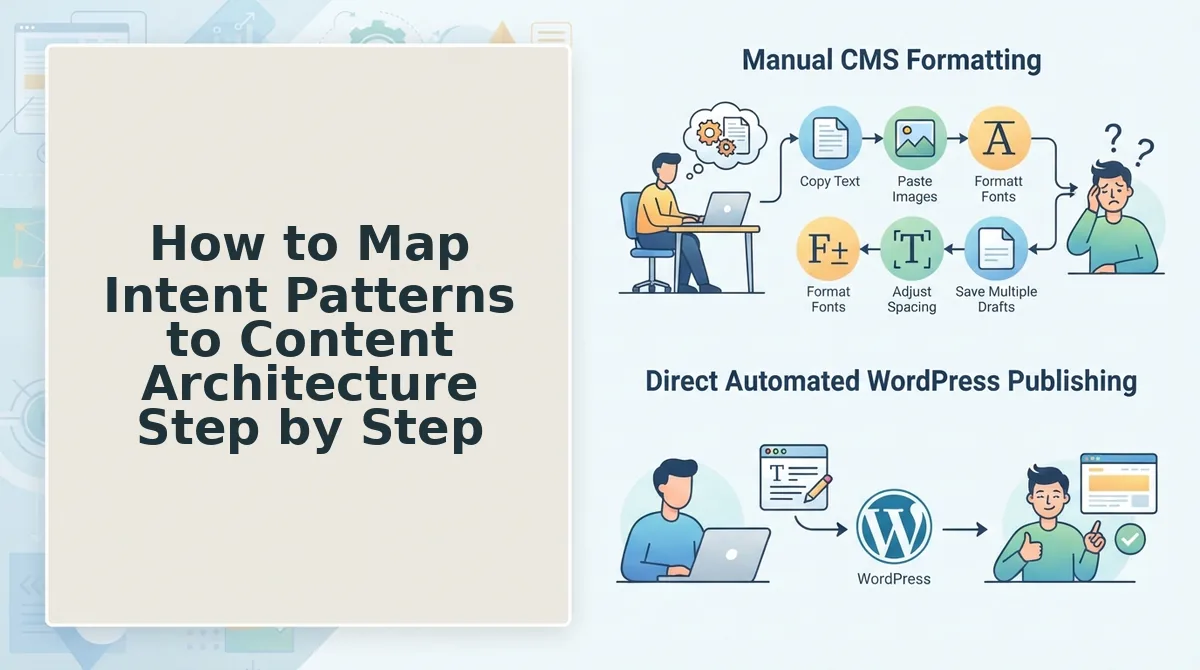
Can content engines automate this architecture without manual keyword sorting? Publishers looking to turn sitemaps into citation-ready clusters can explore automated content engine plans that crawl site structures, apply brand guidelines, and ship structured articles directly to WordPress.
How to Diagnose and Fix Intent Drift on Declining Pages
Diagnosing and fixing intent drift requires auditing the live SERP to detect whether search engines reclassified the query's primary intent, followed by deciding whether to restructure the existing URL or branch into a dedicated sub-page.
Intent drift is the algorithmic reclassification of a query's underlying objective when retrieval models detect that searcher behavior now favors a different content format or conversion stage.
What should you do when your comprehensive 3,000-word guide drops from position 2 to position 8 overnight without any manual penalty? Consider a worked example: an informational guide explaining search indexing mechanics suddenly loses rank because algorithms reclassified the query into comparison listicles evaluating software. When the top five search results display comparison matrices instead of educational tutorials, forcing an informational draft to rank without altering its core format will fail. Resolving this mismatch requires a structured diagnostic protocol.
- Inspect top-ranking SERP page archetypes: Review the specific page templates occupying the top five positions to identify structural intent changes. This analysis reveals whether algorithms now favor comparison listicles, interactive tools, or concise documentation over long-form prose. Query the primary term directly and catalogue the dominant page templates before editing your existing copy.
- Analyze AI answer synthesis sources: Audit the citation sources referenced by generative AI answer engines for your target query. AI retrieval systems prioritize content structured around the newly favored intent, swapping narrative prose for bulleted evaluation criteria when queries turn commercial. Inspect these citations through your content refresh workflow to identify whether the engine extracts tabular product data or procedural steps.
- Audit impressions against sudden click-through collapses: Check search analytics to identify declining pages maintaining high impressions alongside plunging click counts. This divergence proves search engines still associate your page with the target entity, but users bypass your listing because the snippet advertises the wrong intent archetype. Isolate these URLs as confirmed victims of intent drift rather than crawl errors or technical penalties.
- Apply the rewrite versus branch decision matrix: Determine whether to restructure the declining URL or create a targeted commercial sub-page. If the primary query flipped entirely to commercial evaluation, rewrite the existing URL to match the roundup format; if the query splintered into distinct informational and commercial sub-intents, preserve the educational guide and branch the comparison intent into a new page. Implement this branch rule to preserve historical backlinks while targeting the reclassified SERP archetype.
Frequently Asked Questions About User Intent Patterns
Search systems evaluate intent patterns through multi-stage semantic routers to surface direct answers that resolve specific user objectives without secondary navigation.
What algorithms classify search intent in AI search systems?
AI search engines classify search intent by processing query syntax across three distinct algorithmic tiers:
- TF-IDF models: Filter initial lexical relevance and keyword frequency.
- Vector embeddings: Map semantic relationships and conceptual context across dimensions.
- Transformer routers: Assign predictive intent classes to retrieve concise factual answers.
How does intent-driven clustering prevent keyword cannibalization?
Intent-driven clustering prevents keyword cannibalization by consolidating semantically related queries under a single canonical URL instead of publishing competing pages for minor keyword variants. When each page owns one distinct intent, search platforms avoid splitting PageRank, entity topical authority, and crawl budgets across multiple internal assets.
Why does an AI search engine alter its direct answer for identical queries?
AI search engines alter direct answers when algorithmic updates adjust citation confidence or when fresh crawling discovers higher-authority reference data. Variations in user search history, geographical location, and retrieval-augmented generation (RAG) latency also influence which extracted source text is synthesized into the final response block.
How do I format content to trigger direct answers in search engines?
State the core answer within the first 40 to 60 words directly beneath your target subheading. Use objective, declarative syntax, define key entities clearly, and strip away conversational filler. Search algorithms extract standalone paragraphs that completely resolve the target question without requiring external context.
Aligning Content Architecture with Search Bots and AI Routers
Modern retrieval systems reward architectures that resolve query syntax instantly, prioritizing programmatic clarity over generic keyword density. Aligning with search bots requires treating pre-click syntax and post-click task completion as unified engineering requirements rather than separate editorial goals.
Relying on manual prompt writing guarantees intent drift as algorithmic crawlers demand tighter entity validation. To maintain visibility across traditional SERPs and generative engines, implement two technical adjustments:
- Structure every section header around explicit query syntax followed by an immediate factual answer.
- Replace fragmented research tools by linking your publishing pipeline directly to crawler-verified data.
You can execute this immediately by adding your domain to the BloGoose autopilot content engine, which extracts your brand voice context and deploys intent-aligned, citation-optimized articles straight to your CMS. Search visibility is no longer won by drafting manual prompt essays, but by building structured architectures that answer user intent before the crawler requests the next token.