How an AI SEO content engine extracts brand voice from your site
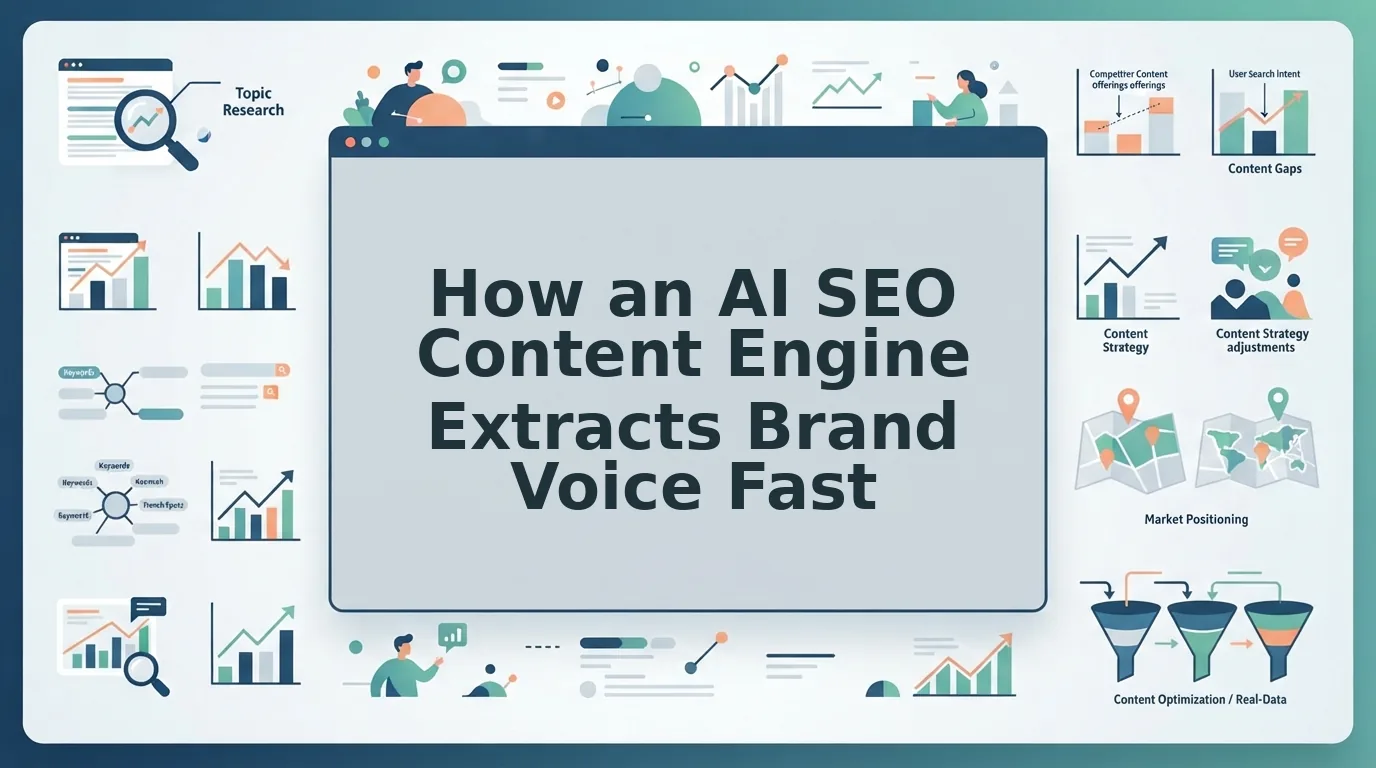
You paste an outline into a chat window, tweak your tone instructions, and watch the output collapse into robotic prose. Founders spending 45 minutes re-prompting chat interfaces per article to preserve editorial tone know that prompt drift breaks organic publishing workflows. An AI SEO content engine extracts your authentic voice directly from your live domain architecture instead of relying on fragile chat prompts.
You will learn how automated crawlers parse published content to formalize tone guidelines, link graphs, and niche terminology into structured files. This breakdown covers the mechanics of sitemap-level analysis along with the limits of automated extraction before human review. Later, we examine a specific context file that prevents keyword cannibalization across newly drafted clusters.
Consider a publisher replacing disconnected writing tools:
- Situation: A site contains established articles, but editorial rules remain undocumented across the team.
- Action: The operator enters the domain into the setup wizard, prompting the platform to locate the XML sitemap, inspect live pages, and detect the CMS stack.
- Outcome: The engine generates eight editable Markdown brand context files, including style-guide.md and internal-links-map.md, grounding future generation in validated site rules.
Inspecting these generated Markdown files allows your team to calibrate brand rules before shipping articles directly to your CMS. Preparing your domain requires specific baseline prerequisites before initiating this crawl.
Expected Outcomes and Prerequisites for Automated Brand Grounding
Automated brand grounding delivers a deterministic editorial footprint and structured style parameters from existing URLs, requiring only a live domain with an accessible XML sitemap as a prerequisite. Rather than relying on manual prompt experiments, this ingestion pipeline converts published pages into reliable operational boundaries.
An AI SEO content engine is an automated software system that analyzes site architecture, extracts editorial rules, and drafts search-optimized articles directly to a content management system. Think of automated brand grounding like an orchestra conductor studying a composer's original sheet music; instead of guessing the intended sound, the conductor reads the exact tempo, dynamics, and instrumentation already written.
Automated brand grounding is the programmatic ingestion of a website's structural and editorial assets to establish voice, entity models, and linking conventions without manual prompting. Rather than relying on ambiguous chat prompts like "write professionally," the system inspects published sitemaps and content archives to extract measurable writing habits. It processes these inputs into deterministic rules that control tone, structural constraints, and topical targets across future drafts. This pipeline ensures that generated articles mirror historical publishing standards and meet strict search engine citation criteria.
Why replace manual prompt engineering with a structural data pipeline?
- Predictable tone: Eliminates erratic AI phrasing by generating eight editable markdown brand context files that define voice traits, writing examples, and target keywords.
- Algorithmic visibility: Top video search trends reveal 80% of AEO adoption hinges on structured conversational answers and direct entity definition rather than raw volume.
- Zero stack sprawl: Replaces isolated research subscriptions and manual document formatting with unified content rules.
Reviewing these auto-generated context files gives publishers complete control to refine internal link maps and target phrases before publishing a single post. Executing this pipeline begins by analyzing the structural layout of your existing URLs.
Step 1 Crawl Site Architecture to Parse Structural Footprints
An AI SEO content engine parses structural footprints by crawling a domain's XML sitemap and DOM elements to map content taxonomy, URL slug depth, and published heading hierarchies. This extraction process establishes topical boundaries and documents your historical coverage before drafting begins.
Before initiating the crawl, ensure that your website has an accessible XML sitemap index and that you have open access to the setup wizard.
Imagine deploying an automated writer that immediately publishes a guide targeting a topic your site already ranks for. Unchecked generation without structural ingestion leads to duplicated coverage, wasted crawl equity, and cannibalized search performance.
XML sitemap parsing is the programmatic ingestion of indexed URL trees to identify established taxonomy, update frequencies, and existing topic clusters.
How does crawling site architecture prevent internal keyword cannibalization? Extracting XML sitemap trees to map existing topic clusters and prevent internal keyword cannibalization gives the engine a complete inventory of every published slug, category path, and heading hierarchy. By cross-referencing proposed topics against live URLs, the engine identifies exact keyword overlap and intent duplication before drafting starts. This crawl preserves your existing search rankings, protects your topical authority, and guarantees that every newly generated piece occupies a distinct position in search engine result pages.
- Type your primary domain address into the setup wizard input field (estimated time: 30 seconds). Enter the root URL without appending subdirectories. You should see a green verification indicator confirming the engine located your sitemap index.
- Select your active content directories from the detected sitemap list (estimated time: 1 minute). Mark the post and category directories representing your live editorial content. You should see the interface confirm the total count of valid URLs queued for structural parsing.
- Run the architecture ingestion scan to evaluate page layouts and parent-child directories (estimated time: 2 minutes). Confirm the extraction prompt to allow the engine to inspect Document Object Model (DOM) tags and URL paths. You should see an internal link map sitemap crawl render directly in your workspace.
With the structural map finalized, the engine uses these technical baselines to generate structured operational guidelines.
Step 2 Compile Domain Rules into Persistent Markdown Context Files
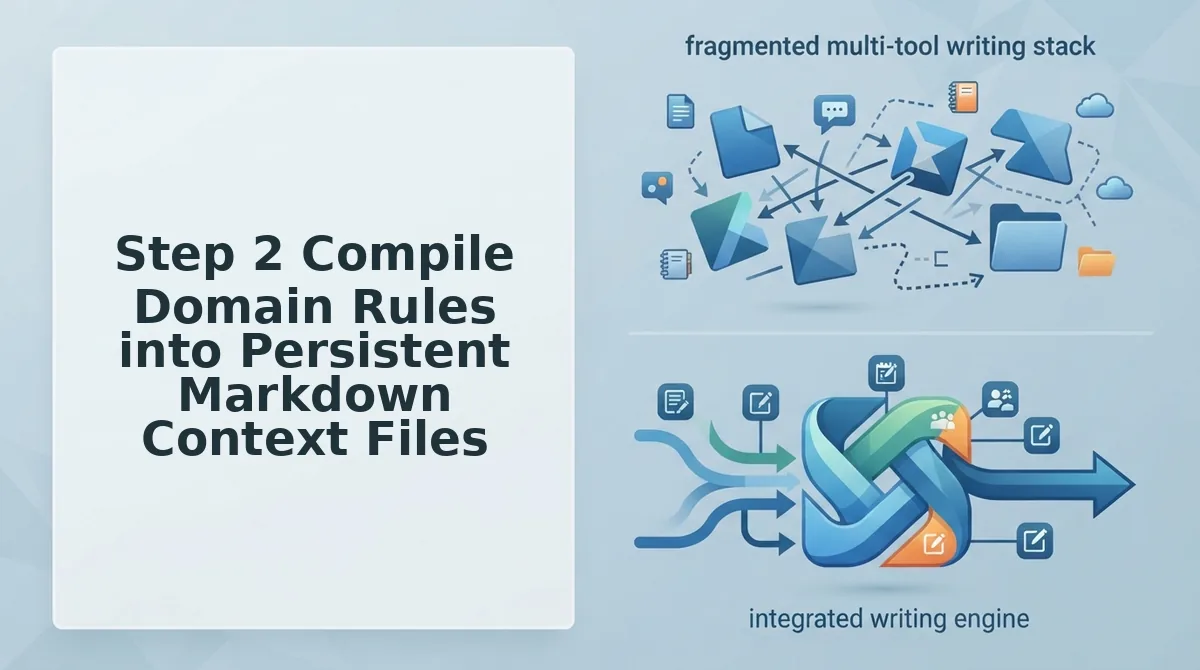
Compiling domain rules into persistent Markdown context files translates raw crawl signals into standardized configuration documents that govern autonomous AI drafting without repetitive prompt engineering. This process establishes deterministic parameters for tone, target keywords, and internal links before article generation begins.
A Markdown brand context file is a structured reference document that stores deterministic tone, formatting, and structural constraints for autonomous content generation. Standardizing extracted tone rules into deterministic style-guide.md and brand-voice.md files anchors autonomous drafting so every post matches your actual site personality. Teams using this method avoid generic AI phrasing by locking in a permanent single source of truth.
Prerequisites: A completed domain sitemap crawl from Step 1 and an active setup session. Estimated time: 2 minutes.
- Click the Generate Context option in the setup wizard to process extracted page data. You should see eight editable Markdown files appear in your workspace, including style-guide.md, target-keywords.md, and internal-links-map.md.
- Select brand-voice.md to review the extracted tone rules, constraints, and vocabulary patterns. You should see explicit DO and DON'T rules populated directly from your published content.
- Open style-guide.md to confirm formatting rules, heading levels, and layout guidelines. You should see a green checkmark indicating your domain parameters have been saved.
Consider a publisher with existing technical articles who needs consistent voice replication across new clusters. In the setup wizard, the engine parsed their published HTML footprints to generate markdown style guide from website assets automatically. The operator inspected brand-voice.md, confirmed the pragmatic voice traits, and verified URL paths in internal-links-map.md. BloGoose saved these ground rules to memory, ensuring every future draft maintained tone consistency without manual intervention.
Ready to turn your site structure into voice-accurate, rank-ready articles without manual writing loops? Connect your site to BloGoose to build your persistent context engine today.
With your brand rules compiled into persistent files, the engine is ready to structure individual passage blocks for search crawlers and AI answer models.
Step 3 Format Passage Blocks for Search SERPs and AI Answers
Formatting passage blocks for search SERPs and AI answer engines requires structuring self-contained semantic units directly beneath descriptive subheadings so retrieval algorithms can isolate verified answers instantly. Dual-optimized passage retrieval is the process of engineering discrete text blocks that satisfy Google passage indexing while feeding large language models unambiguous entity relationships. High-ranking organic pages fail chatbot citation engines when answers are dispersed across narrative paragraphs instead of 80-120 word semantic definitions.
Stop obsessing over page-level keyword density. Does legacy repetition guarantee discovery? Not anymore.
- Front-load 80-to-120-word direct-answer definitions: This technique places a standalone answer block immediately below every major subheading. Search bots and answer engines extract these blocks because they resolve the user query without requiring broader context. Master how to get cited in AI answers and chatbots by drafting a two-sentence factual assertion followed by a specific operational mechanism.
- Isolate entity attributes in parallel unordered lists: This format breaks dense technical features, dependencies, or parameters into individual, easily scanned bullet points. Machine extractors parse HTML lists far more reliably than multi-clause sentences because attribute-to-subject relationships remain explicit. Review each draft in your preview layout and convert narrative descriptions into clean lists whenever you explain three or more operational steps.
- Anchor factual claims to verifiable parameters instead of editorial modifiers: This practice substitutes marketing adjectives with exact architectural inputs, file specifications, and platform settings. Large language models frequently discard subjective adjectives like efficient or robust, but they index concrete technical thresholds as factual reference material. Enforce this standard by cross-referencing your claims against your generated context files before generating final copy.
- Compress token density by stripping conversational throat-clearing: This editing discipline eliminates transitional filler and speculative fluff that dilutes semantic weight. Answer engine scrapers measure information density per token, penalizing verbose introductions that delay factual delivery. Implement a strict review pass to purge rhetorical setups such as needless introductory framing.
- Frame section headers as precise syntactic query targets: This structural choice aligns your H2 and H3 tags with the exact semantic queries submitted by searchers and retrieval bots. Traditional editorial headers obscure search intent, whereas syntactic headers create explicit entry points for passage indexing. Map every heading directly against competitive search signals uncovered during your automated site crawl.
Once your semantic passage blocks are properly structured, you must ship them to production and alert search engines immediately.
Step 4 Publish Directly to WordPress and Ping the Indexing API
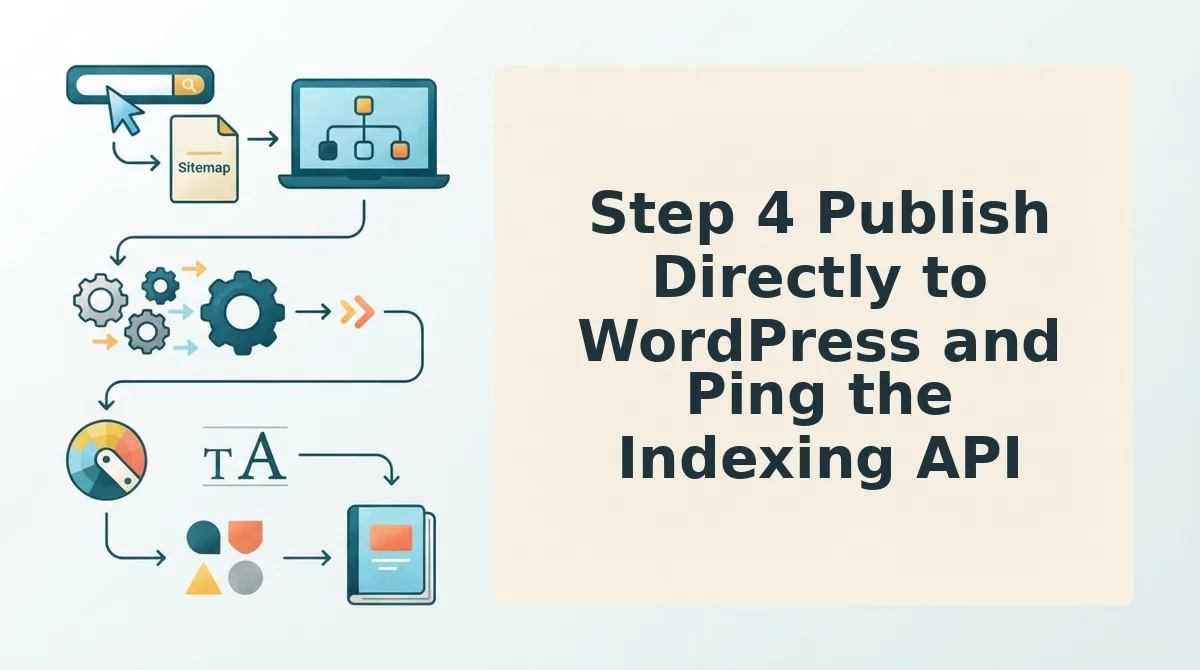
Publishing directly to WordPress and notifying search engines requires sending structured JSON post payloads through the WordPress REST API and dispatching immediate URL crawl requests through a configured Google Cloud service account. This automated sequence bypasses manual editor staging so fresh, brand-aligned content enters search queues the moment generation finishes.
Imagine finishing a cluster draft and watching it appear fully formatted in your CMS editor, while search crawlers receive an automated prompt to fetch the new post within minutes. The WordPress REST API is an application interface that allows external platforms to create, update, and manage WordPress content remotely using structured data objects.
Prerequisites: An active WordPress install with Application Passwords enabled, administrator permissions, and a configured Google Cloud service account credentials file.
- Open your WordPress admin dashboard, navigate to Users, then click Profile. Scroll to the Application Passwords field, type a label like "BloGoose Engine", and click Add New Application Password. You should see a generated 24-character token appear on screen. (Estimated time: 2 minutes)
- Select your integration tab inside the engine dashboard, paste the generated application key alongside your WordPress username, and click Test Connection. Eliminating manual copy-paste CMS staging by pushing structured post objects directly via WordPress REST API endpoints ensures that HTML tags, featured images, and metadata map precisely to your live database. You should see a green "Connection Verified" notification badge. (Estimated time: 1 minute)
- Upload your service account JSON key file under the Indexing credentials field to configure how to ask google to crawl new posts via indexing api automatically upon draft release. The engine establishes an authenticated OAuth handshake directly with Google endpoints. You should see an active status reading "Indexing API Ready". (Estimated time: 2 minutes)
- Click Publish Post on your completed article queue. The engine dispatches the payload to your CMS as a published post or pending draft and pings the indexing endpoint in a single pipeline. You should see an HTTP 200 response code logged alongside the live URL in your history panel. (Estimated time: 5 seconds)
Why let production bottlenecks slow your search velocity? Automated pipeline delivery turns hours of CMS formatting and URL registration into a hands-off background process.
Once live payloads ship and search bots receive crawl notifications, you must inspect your outputs to ensure tone consistency and indexed status across engines.
How to Verify Brand Voice Extraction and Content Indexation
You verify brand voice extraction and content indexation by measuring sentence length variance, auditing forbidden corporate cliché density, and checking URL crawl confirmation inside Google Search Console. A calibrated AI engine matches these stylistic constraints automatically while confirming search engine pickup immediately after publication.
Most operators assume indexing delays stem from technical sitemap errors, yet search crawlers routinely bypass ungrounded drafts that read like generic training data. Reviewing drafts against standard brand context extraction mistakes ensures your site assets bypass robotic syntax before search bots inspect them.
A brand voice diagnostic is a structured comparison between generated article passages and predefined domain rules covering tone, vocabulary, and structural layouts.
To verify voice fidelity and technical indexation, first analyze the syntactic rhythm of your published passages. High-performing brand grounding exhibits dynamic sentence length variance, alternating between concise punchlines and complex explanatory sentences while showing zero forbidden corporate clichés like "in today's fast-paced digital world." Next, review crawl confirmation inside Google Search Console by running a live URL inspection within forty-eight hours of publication. If the status returns as discovered rather than indexed, your brand context likely failed to inject distinct entity depth, requiring updates to your domain rule files.
| Platform | Voice Extraction Workflow | CMS and Indexing Handling | Best For |
|---|---|---|---|
| Jasper | Brand voice training via custom prompt profiles and corporate campaign assets | Manual export or third-party webhooks without automated indexing calls | Enterprise marketing teams managing omni-channel campaigns |
| Surfer SEO | NLP entity density guidelines and keyword frequency benchmarks | Manual copy-pasting or CMS extension editing | Writers seeking real-time entity scoring in a hands-on document editor |
| BloGoose | Automated sitemap crawling into editable Markdown context files | Direct publishing to WordPress or custom API with Indexing API requests | Founders and publishers scaling hands-free content clusters |
Choose Jasper if you require multi-channel marketing copy across email, social media, and ad variants across enterprise departments. Choose Surfer SEO if you want manual control over keyword optimization scores inside an active editing interface. Choose BloGoose if you need an autonomous pipeline that crawls site architecture, preserves tone via Markdown files, and requests crawling automatically.
Our recommendation is an integrated engine like BloGoose for organic publishing workflows. Eliminating the divide between voice extraction and direct indexation ensures your domain identity remains consistent across search results and AI citations without tedious multi-tool assembly.
Evaluating these verification metrics often raises operational questions about how extraction mechanics operate behind the scenes.
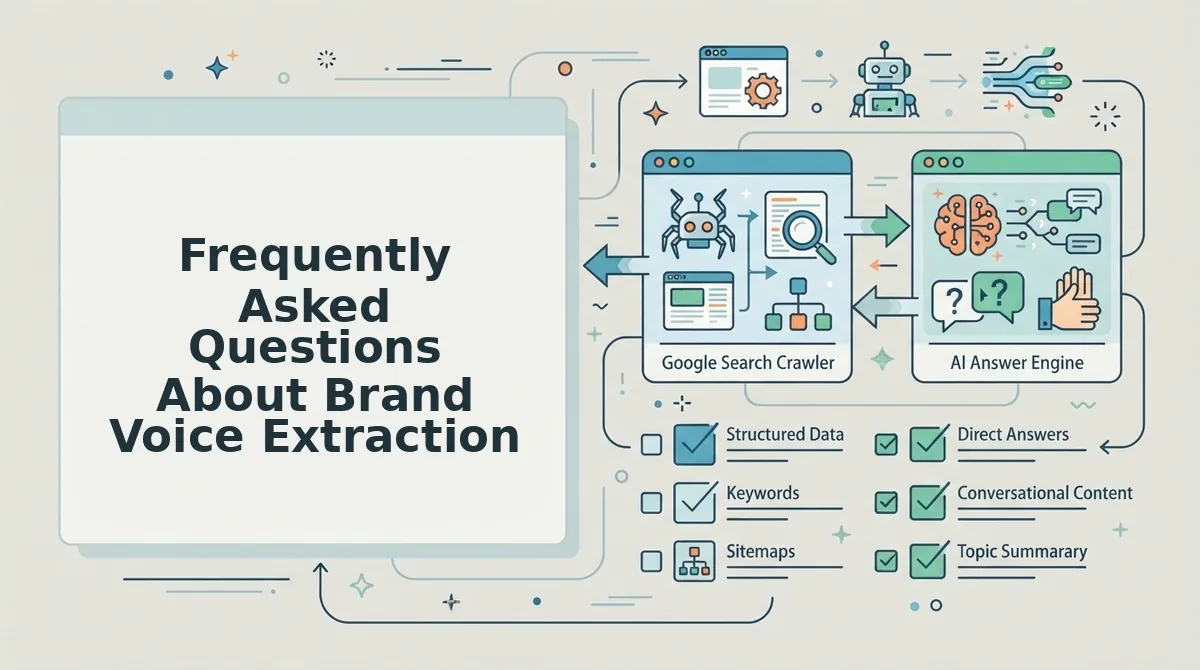
Frequently Asked Questions About Brand Voice Extraction
Automated brand voice extraction converts published website content into codified editorial guidelines to ensure AI-generated posts match your domain tone, formatting, and factual standards.
How does an AI SEO content engine capture a website's tone without manual prompts?
The engine crawls your XML sitemap, inspects published articles, and compiles linguistic patterns into editable Markdown context files. Instead of relying on ad-hoc prompts, it documents vocabulary limits, structural layouts, and formatting rules directly from your live domain to maintain authentic tonal consistency across every draft.
Does automated brand voice extraction comply with Google Search Essentials?
Yes, provided the generated content delivers distinct information gain and verifiable substance. Google Search Essentials evaluates content quality, factual utility, and primary user value rather than programmatic production methods, making grounded voice profiles essential for eliminating superficial or derivative AI filler.
Why does brand voice grounding improve visibility in AI search citations?
Answer engines prioritize well-structured, authoritative statements over generic prose. Grounded context files enforce concise paragraph structures, clear semantic hierarchies, and distinct factual claims, allowing chatbots and search models to extract definitive answers and attribute source citations directly to your domain.
What core elements does the platform extract from a site crawl?
An automated crawl parses your site footprint into specific operational rules:
- Syntactical tone markers and sentence length constraints
- Approved internal link architecture and target keywords
- CMS technical specifications and schema requirements
These parameters form persistent reference documents that guide every downstream article without ongoing manual configuration.
Consistent voice modeling provides the baseline needed to systematically expand organic reach across competitive search verticals.
Scale Your Search Footprint with Autonomous Context Grounding
Grounding your publishing engine in an automated crawl of your site architecture permanently eliminates brand voice drift across search engines and AI answers. Picture opening your publishing dashboard next month to find complete content clusters already drafted in your exact tone, without spending a single minute writing system prompts. This shift resolves the operational bottleneck of organic search: editorial precision does not require manual oversight when your domain footprint serves as your persistent context layer.
Zero prompt engineering is required once the site context layer is compiled into structured Markdown files. How do you transition from brittle prompt chasing to an autonomous publishing model?
- Extract your baseline: Run your domain through an architectural crawl to map your current internal linking, CMS stack, and topical coverage.
- Review generated context files: Validate the extracted style guide and target keyword rules before queuing automated publishing runs.
Drop your website domain into the BloGoose setup wizard to turn your live site architecture into an autonomous, citation-ready content engine. Sustainable organic authority comes from anchoring AI output directly to your site architecture rather than chasing ephemeral prompt hacks.