
How an Automated Content Quality Review Loop Refines Drafts
You've published a draft that passes every grammar check, yet it still doesn't sound like your brand, rank for your target keywords, or get cited in AI answers. That's the exact frustration founders and content publishers face when stitching together fragmented AI tools. An automated content quality review loop exists to close that gap, and most teams don't even know the pattern has a name.
You're right to feel that "quality" is being thrown around vaguely. What you'll learn here is the concrete check to score to fix to re-check cycle that turns a mediocre draft into a rank-ready article, evaluated against your site's rules, not generic ones. We'll walk through what the loop actually is, the 4-pass framework step by step, and how it scores against your own guidelines.
Here's the surprising part: agent loops are a proven pattern in coding, Nate Herk's YouTube breakdown has over 162K views and Owain Lewis's take has 45K+, yet almost no one has mapped that loop to content quality. By the end, you'll see why the final pass most tools skip is the one that matters most.
BloGoose automates this entire cycle, from site crawl to published draft, so you don't have to run the passes manually.
What an Automated Content Quality Review Loop Actually Is
An automated content quality review loop is a repeating four-stage cycle, check, score, fix, re-check, that evaluates a draft against your site's specific brand context files instead of universal grammar rules. It keeps refining the article until it passes every threshold you've defined.
Think of it like a restaurant expediter who checks every plate against that restaurant's recipe book, not a generic cookbook. A grammar checker only asks, "Is this sentence correct English?" A review loop asks, "Does this match the tone in your style-guide.md? Are the target keywords from target-keywords.md placed where your seo-guidelines.md demands? Are the facts cited?"
Here's the progression from simple to advanced:
- Simple: Run a draft through one automated check, say, keyword density or H2 hierarchy, and fix what fails.
- Intermediate: Chain multiple checks in sequence. Each pass scores the draft against a different rule file, and the output feeds the next pass.
- Advanced: The loop re-runs automatically after every fix until all scores clear their thresholds. This mirrors the agent-loop pattern developers use: an AI agent performs an action, evaluates the result, and iterates until the goal state is reached.
Agent loops are a recognized pattern in coding, Nate Herk's video on the topic has drawn over 162K views, and Owain Lewis's breakdown has 45K+, but content-specific review loops remain underserved. Most AI writing tools stop at generation. A true review loop treats the draft as a work-in-progress that gets scored against your brand context on every pass.
Grammar checkers evaluate universal rules. A review loop evaluates your site's style-guide.md, target-keywords.md, and seo-guidelines.md, the files BloGoose extracts during its site crawl and brand context extraction step. That's the difference between a draft that's merely correct and one that's ready to publish.
The 4-Pass Review Loop, Step by Step
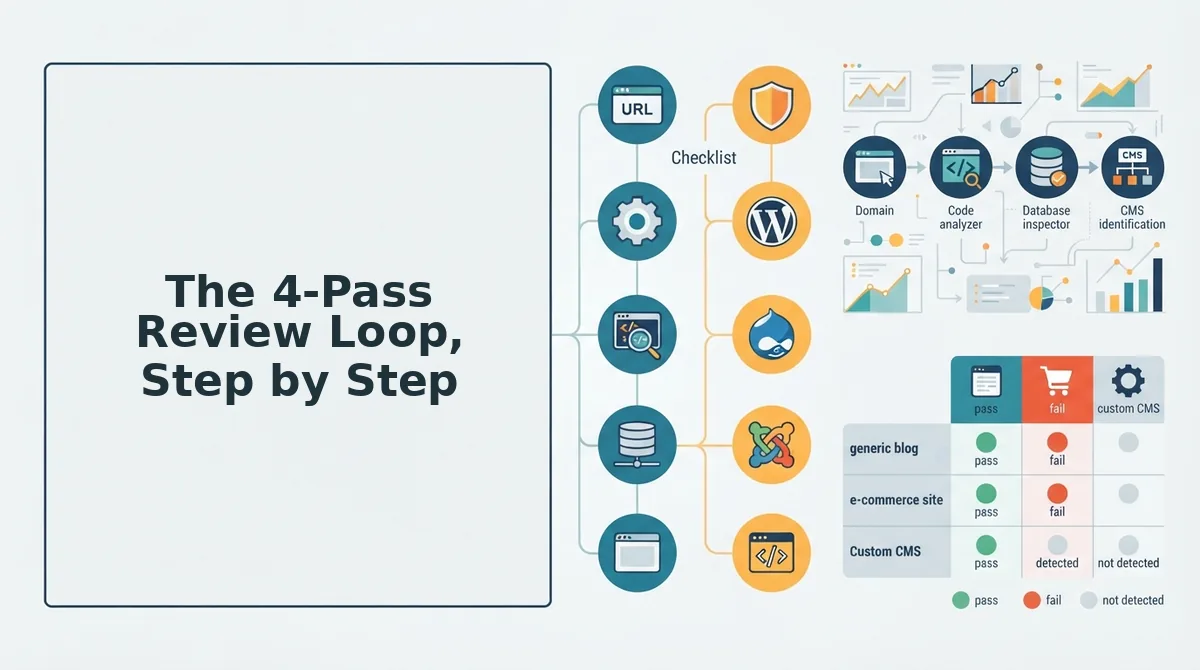
A 4-pass review loop runs every draft through four sequential quality gates. Structure, Brand Voice, SEO/AEO, and Factual, each with its own check, score, and fix action. You'll need your site's target-keywords.md, style-guide.md, and seo-guidelines.md files ready before starting.
- Pass 1, Structure Check (5-10 minutes). Open your draft and verify the H2 hierarchy is logical, the primary keyword appears in the first 100 words, and the word count matches the target range in target-keywords.md. If the H2s don't ladder from broad to specific, restructure them before moving on. You should see every section map cleanly to one keyword intent.
- Pass 2, Brand Voice Check (10-15 minutes). Compare the draft's tone, terminology, and formatting against your style-guide.md, the file extracted from a sitemap crawl of your published pages. If your brand uses "autopilot" instead of "automation," swap every instance. You should see zero terminology drift from your existing content.
- Pass 3. SEO and AEO Check (15-20 minutes). Review meta descriptions, passage optimization, and internal links against seo-guidelines.md. Confirm each section is self-contained enough to be quoted in an AI answer. For SEO and AEO criteria, check that answer-engine passages are 80-120 words and that target keyword placement rules are followed in every H2. You should see a green checkmark on each criterion.
- Pass 4, Factual Verification (10-20 minutes). Verify every factual claim and source citation in the draft. This is the step most AI content tools skip, and the one that separates rank-ready content from confident-sounding errors. Cross-check each statistic against its original source. You should see a citation for every number and named claim.
BloGoose runs all four passes automatically as part of its publishing pipeline, scoring each draft against your extracted brand context and re-running the loop until every pass clears. That's the check to score to fix to re-check cycle in action.
Next, let's look at how these review loops score against your site guidelines, and what a passing score actually looks like.
How Review Loops Score Against Site Guidelines
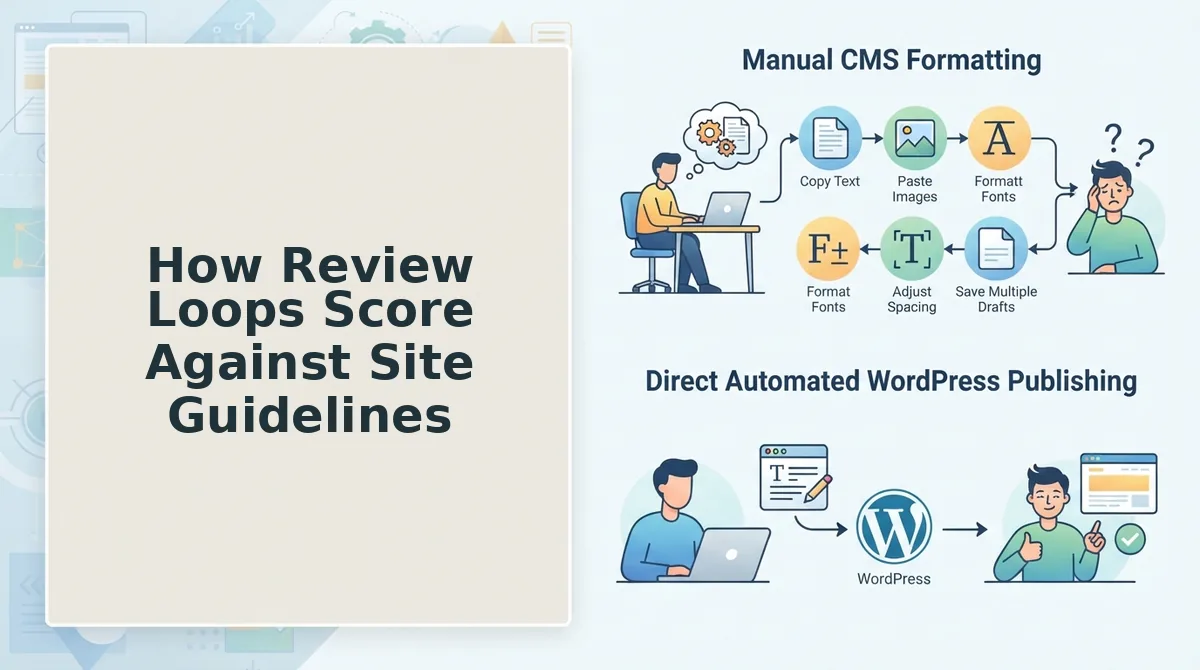
A scoring review loop is a rules engine that converts your documented brand, keyword, and SEO requirements into machine-checkable pass/fail criteria applied to every draft before it reaches your CMS.
Think of it like a restaurant kitchen's expediting station: the chef doesn't taste every plate from memory alone. A printed ticket lists each dish's required components, and the expediter checks plates against that ticket before they leave the pass. BloGoose does the same for content, except the ticket is generated from files you already maintain.
The mechanism works in three escalating layers. At the simple level, BloGoose reads your brand context files, markdown documents like style-guide.md, target-keywords.md, and seo-guidelines.md, and converts each instruction into a discrete rule. At the intermediate level, those rules are grouped into scoring categories: tone, keyword placement, and structure. At the advanced level, the loop runs multiple passes, with each pass checking a narrower slice of the draft and feeding corrections back into the next revision.
Here is how the three core files map to concrete checks:
| Context File | Rule Type | Example Check |
|---|---|---|
style-guide.md |
Tone rules | Flag banned phrases like "game-changer" or "unleash"; verify required terminology such as "autopilot" appears at least once |
target-keywords.md |
Placement rules | Confirm the primary keyword appears in the H2, the intro paragraph, and the meta description |
seo-guidelines.md |
Structural rules | Check minimum word count, internal link count, and passage formatting for featured snippet eligibility |
What makes this approach different from generic grammar checkers is that the rules are derived from your own site, not a universal style manual. A DTC skincare brand and a B2B SaaS blog may both forbid the word "revolutionary," but only the skincare brand requires the phrase "clinically tested" in every product roundup. BloGoose extracts those distinctions from your sitemap and published pages, then encodes them as machine-checkable constraints.
For teams managing target keyword placement rules across dozens of posts, this removes the manual spreadsheet audit. The loop scores each draft against the same rule set every time, which means a post published in March is held to the same standard as one published in October, unless you update the context file, in which case every future draft inherits the new rule automatically.
If your current workflow involves a writer, an editor, and a separate SEO reviewer each checking different things at different times, consolidating those checks into one automated scoring pass is the fastest way to cut revision cycles without lowering the bar.
Pass, Revise, or Reject: Setting Quality Thresholds
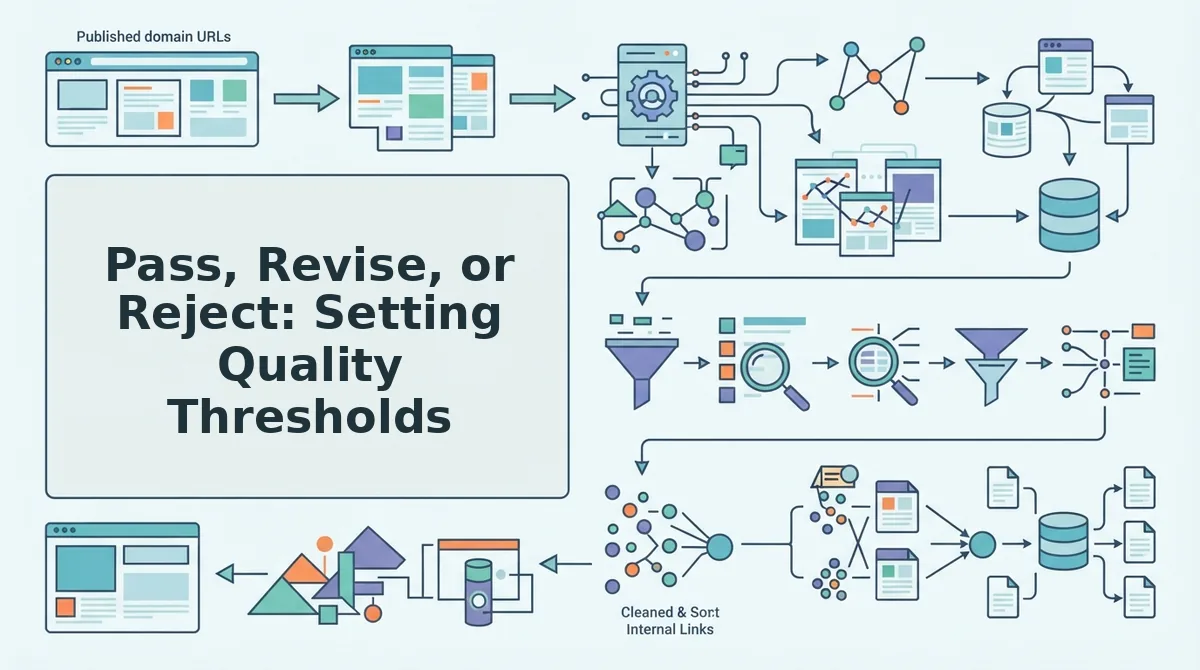
Quality thresholds turn a numeric score into a routing decision: publish now, fix specific issues, or restructure the draft entirely. Most content tools stop at a single pass/fail number, which forces writers to guess what "72" means.
BloGoose uses a three-tier system that mirrors how human editors actually work. A draft scoring 90-100 passes automatically and ships to your CMS. A draft scoring 70-89 enters a revise tier, where the loop returns targeted feedback, "primary keyword missing from H2" or "internal link count below minimum", rather than a vague "improve this." A draft below 70 is rejected for restructuring, because the problems are likely architectural, not cosmetic.
| Score Range | Decision | What Happens | Best For |
|---|---|---|---|
| 90-100 | Pass | Draft ships to WordPress or your API without manual review | High-volume publishers who trust their context files and need zero-touch publishing |
| 70-89 | Revise | Loop returns a list of specific failed checks; writer fixes only those items | Teams with an editor in the loop who want speed without sacrificing control |
| Below 70 | Reject | Draft is flagged for restructuring; outline or angle likely needs rework | New sites still calibrating their brand voice, or content types outside the trained pattern |
Thresholds are not universal. A site publishing daily news briefs may accept a 75 as pass because speed matters more than polish, while a legal blog may require 95 before anything ships. BloGoose lets you tune the bands per content type, and the right settings emerge from iteration, start conservative, review what gets flagged, then adjust. Competitor platforms typically skip threshold logic entirely, leaving writers to interpret raw scores without routing guidance.
Where Automated Review Loops Fail (and How to Fix It)
Automated review loops are powerful, but they break in predictable ways. Knowing the failure modes upfront prevents you from shipping content that scores well on paper and reads poorly to humans.
- Generic rules miss brand nuance. A loop trained only on universal grammar and SEO conventions will flag "starting a sentence with 'And'" but miss that your brand never uses the word "leverage" as a verb. The fix is to feed the loop sitemap-crawled brand context files that encode your actual published voice, not a generic style manual.
- Rigid thresholds block good drafts. A hard pass/fail cutoff at 90 means a draft scoring 89 gets rejected even if the only issue is a missing internal link. The fix is a revise tier with targeted feedback, so writers fix the one failed check instead of rewriting the entire piece.
- Factual verification is shallow. Most loops check grammar, tone, and keyword placement but never verify whether a statistic or claim is actually true. The fix is to require source citations on every factual claim and cross-check those sources against your existing published content before the draft passes.
AskDiana's continuous review cycle demonstrates the same principle: automated checks work best when they run repeatedly against evolving source material rather than once against a static snapshot. The loop is only as good as the context files and verification rules you feed it.
With those failure modes addressed, the remaining questions are mostly about implementation details.
Frequently Asked Questions About Automated Content Quality Review Loops
An automated content quality review loop is a repeatable system that scores every draft against your brand guidelines, SEO requirements, and factual checks, then routes it for revision, rejection, or publishing based on thresholds you set.
What triggers a rewrite versus a reject in an automated review loop?
A rewrite triggers when a draft scores below 70 or fails critical checks like a missing primary keyword or wrong tone. A reject triggers when the draft fails structural requirements, wrong topic, broken formatting, or unsalvageable factual errors, that make revision more expensive than starting over.
Can an automated review loop replace a human editor?
No. Loops handle repetitive compliance checks, keyword placement, tone consistency, readability, internal linking, at scale. Human editors remain essential for strategic judgment, brand nuance, and fact verification that requires domain expertise or current events awareness.
How often should the review loop run?
Run the loop on every draft before publishing, then re-run it after each revision. Skipping the post-revision pass lets new errors slip through, a tone fix in one paragraph can break keyword density or readability scores elsewhere in the draft.
What is the difference between a review loop and a content brief?
A content brief defines what to write, target keywords, audience, angle, structure. A review loop evaluates what was written against that brief. The brief sets the standard; the loop enforces it. Both are required for consistent output at scale.
Why does my content pass the review loop but still not rank?
Passing a review loop means the draft meets your internal quality bar, not that it will rank. Ranking depends on search intent match, topical depth, backlinks, and competition. A loop catches compliance failures; it cannot guarantee SERP position or AI citation inclusion.
Start Refining Drafts with a Review Loop Today
The 4-pass framework and threshold logic only work if the loop checks against accurate brand context files. A loop scoring against vague or outdated guidelines produces consistently wrong approvals, automation amplifies whatever standard you feed it.
Start with a manual 4-pass checklist on your next three drafts. Score each pass, track where drafts fail, and refine your thresholds. Once the pattern is clear, automate the loop: BloGoose runs the automated content quality review loop end to end, sitemap crawl, brand context extraction, 4-pass review, and CMS-ready output, without stitching together separate tools.
Your next draft is the test case. Run it through the loop, watch where it trips, and let the threshold logic do the deciding.