
Automated editorial calendar planning vs Jasper for SEO blogs
You open an AI writing copilot, spend forty minutes tweaking prompts for a single draft, and realize your editorial queue is still completely stalled. Content teams report spending over 15 hours coordinating drafts, exports, and manual uploads despite using AI writing assistants.
Evaluating automated editorial calendar planning vs Jasper highlights a fundamental operational divide: replacing single-document tools like Jasper with an automated SEO content engine shifts your operation from micro-managing individual documents to scheduling rank-ready keyword clusters. You will discover the exact structural differences, production bottlenecks, and CMS publishing trade-offs between both workflows.
This guide specifically evaluates organic search blogging across WordPress and custom API architectures, deliberately excluding short-form social copy and multi-channel ad variants. We also examine why prompt-driven document editors quietly degrade your site-wide internal link structure as publishing volume scales.
Consider how workflow execution shifts in practice:
- Situation: An operator drafts isolated search articles inside Jasper, manually adjusting subheadings, organizing image files, and tracking publishing schedules in disjointed spreadsheets.
- Action: The operator switches to an automated setup that crawls the site XML sitemap, builds brand context files, plans topical clusters, and writes complete articles.
- Outcome: Finished posts deploy directly to WordPress staging with verified internal link targets and layout previews fully configured.
To understand how these philosophies diverge in daily practice, examining the core architectural differences provides immediate clarity.
The Verdict on Automated Editorial Calendar Planning vs Jasper
Automated editorial calendar planning operates as an autonomous publishing pipeline that crawls site structures and pushes scheduled articles to CMS endpoints, whereas Jasper functions as an interactive writing assistant built for cross-channel marketing collateral.
An automated editorial calendar engine is a programmatic system that maps topic clusters from technical site architecture and executes publishing workflows without manual prompt writing. Jasper is architected as an interactive copy assistant for multi-channel marketing campaigns, whereas automated editorial calendar engines are built for programmatic, sitemap-aligned organic search growth.
Jasper excels when human copywriters need real-time suggestions to iterate on social media variants, executive emails, and product launch announcements. However, sustaining organic search performance requires deep alignment between search intent, internal linking, and consistent production cadences. A dedicated planning engine removes disconnected document drafting by transforming domain data into citation-ready posts that publish directly to your CMS.
| Feature Dimension | Jasper | Automated Editorial Calendar Engine |
|---|---|---|
| Core Architecture | Interactive prompt copilot for document drafting | Autonomous sitemap-to-publish automation pipeline |
| Target Content Type | Multi-channel marketing campaigns and ad copy | SEO topic clusters and informational search blogs |
| Publishing Route | Manual exporting and third-party copy pasting | Direct publishing to WordPress or custom API endpoints |
| Brand Grounding | Prompt-level style guides and manual inputs | Automatic site crawl producing 8 Markdown context files |
Stop treating blog production like an ad hoc copywriting exercise.
Choose Jasper if: You manage a brand team producing diverse marketing collateral across email sequences, social posts, and ad variations that require line-by-line editorial steering.
Choose an automated calendar engine if: You operate an established publication or growth team focused on ranking topical clusters on Google and winning AI chatbot citations without managing spreadsheets.
Our recommendation: For search-driven customer acquisition, rely on an autopilot content engine. Instead of coordinating disparate prompts across disconnected tools, you can extract your domain context into structured files like style-guide.md and internal-links-map.md to automate ranking-focused production from research to live publication.
Before committing to either pathway, teams must evaluate the underlying technical benchmarks that define an effective search workflow.
Core Criteria for Evaluating Search Content Systems
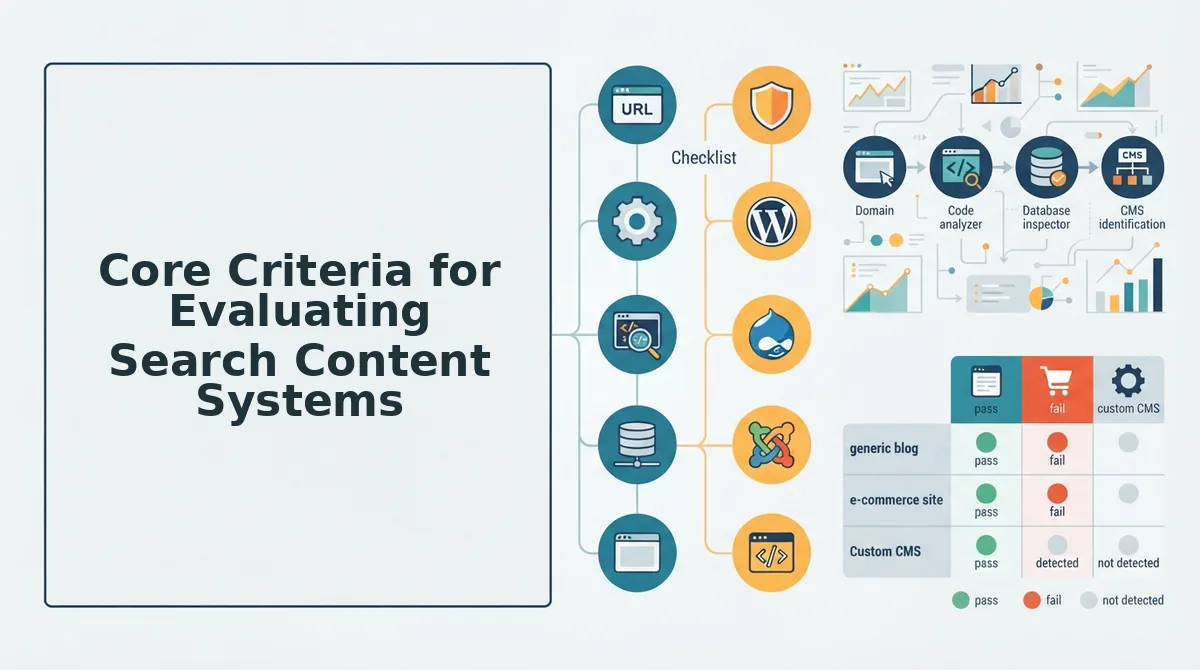
An automated search content system is an end-to-end publishing infrastructure that coordinates keyword research, topical scheduling, drafting, media generation, and CMS distribution without manual prompt intervention. How should teams judge whether a platform can replace fragmented copywriting software for organic search?
Evaluating an organic growth stack requires looking beyond isolated draft generation. Think of standalone text generators like a car engine sitting on a workbench: the motor runs, but without a transmission, chassis, and wheels, it cannot drive you anywhere. An integrated publishing system provides the entire vehicle by connecting data discovery directly to indexed pages.
An automated search content system is an end-to-end publishing infrastructure that coordinates keyword research, topical scheduling, drafting, media generation, and CMS distribution without manual prompt intervention. Rather than treating content production as isolated copywriting tasks, this architecture discovers keyword clusters from live search queries, structures them onto an automated editorial calendar, writes section-by-section drafts grounded in brand context, generates inline image assets, and deploys finished posts straight to WordPress or custom endpoints. This unified execution eliminates the administrative drag of moving drafts between disconnected optimization checkers, scheduling spreadsheets, and external image tools.
How does this operate in everyday production workflows? The system functions across three operational stages:
- Foundational context: The engine crawls your existing XML sitemap to extract baseline brand voice guidelines, technical stack setups, and internal link paths.
- Dynamic clustering: Real-time SERP and social research feeds an automated calendar, targeting search queries and answer engine citations rather than static prompts.
- Autonomous deployment: The platform writes complete sectional articles, inserts relevant visual assets, publishes directly to the CMS, and requests rapid crawl indexing through search engine APIs.
This structural cohesion matters because stack sprawl introduces compounding financial and operational debt. Stitching together Jasper for copywriting, Surfer SEO for entity scoring, CoSchedule for calendar tracking, and standalone image generators inflates your software overhead. Consolidating those fragmented subscriptions into an all-in-one engine like the $199 flat Pro plan eliminates seat licensing fees, token tracking, and manual copy-pasting.
Adopt an integrated system when your team needs regular, voice-accurate content clusters that rank on search engines without managing prompt engineering homework, disconnected LLM bills, or manual CMS formatting.
To see why these evaluation standards matter in day-to-day operations, consider how a standard workflow unfolds when using an interactive assistant like Jasper.
How Jasper Operates for Ad-Hoc Marketing Copy
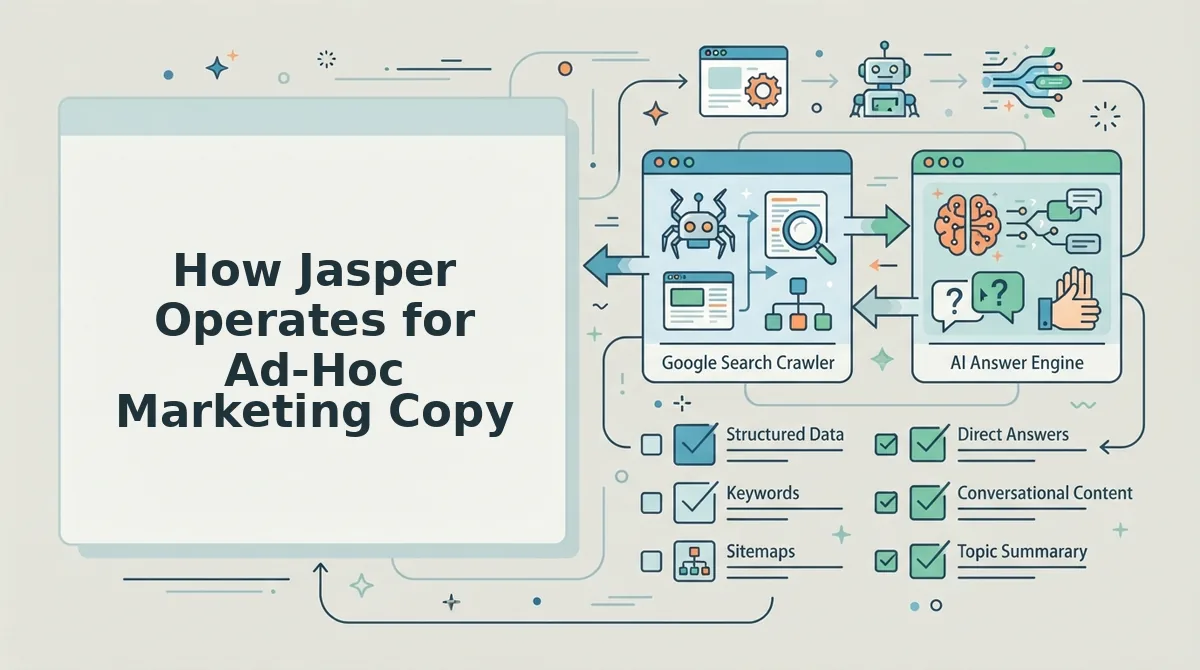
Jasper operates as an enterprise marketing copilot by generating ad-hoc copy through conversational document staging rather than executing automated, crawler-ready blog pipelines. Jasper is an enterprise marketing copilot focused on multi-channel copywriting, ad variants, and corporate campaign workflows.
Imagine drafting a targeted organic cluster: an operator opens a blank document, runs multiple prompts for a single article, edits the text, designs graphics in a separate application, and formats everything inside a content management system by hand. While Jasper excels at generating creative campaign collateral like marketing emails and paid ad variations, using an isolated document editor for search publishing introduces operational friction. Without automatic site crawling, live search result extraction, or direct CMS syncing, organic search operations stall inside repetitive copy-paste loops.
Search publishing inside an ad-hoc assistant follows a five-step production loop:
- Manual keyword sourcing in external subscriptions: Operators conduct search volume research in standalone platforms and paste raw entity lists into the chat interface. This step creates data silos because the writing tool cannot independently inspect search engine result pages or identify live competitive content gaps. Teams execute this by exporting external spreadsheets and referencing them during drafting prompts.
- Prompt document generation inside isolated editors: Writers configure brand voices within chat documents to generate individual long-form drafts. This approach limits scale because each piece requires manual prompt guidance rather than pulling instructions from structured markdown brand context files. Operators execute this by entering section outlines and monitoring token outputs across separate project folders.
- Line-by-line copy editing for tone calibration: Editors review the raw draft to remove repetitive transitions, verify factual claims, and eliminate generic phrasing. This step is critical because conversational language models frequently produce generalized prose that lacks deep technical nuance without strict grounding. Teams execute this by revising sentences manually in the document stage before approval.
- External image asset creation and asset staging: Content managers design visuals or export graphics using separate design tools outside the editor. This fragments the workflow because visual media is not generated or placed automatically alongside draft sections. Practitioners handle this by downloading visual files, compressing them locally, and matching them to document headers.
- Manual CMS pasting and link mapping: Publishers copy the finalized text and images directly into WordPress or a custom API endpoint. This manual handoff increases publishing overhead because internal linking maps and metadata must be configured by hand. Teams complete this step by formatting headers, setting permalinks, and scheduling each post individually.
A solo operator needed to produce search content for an existing site. The operator opened Jasper, drafted an article via repeated prompt iterations, adjusted the phrasing, generated graphics in another window, and pasted the finished text into WordPress. The process yielded a single polished post, but managing the fragmented steps manually consumed hours of production time.
In contrast to this fragmented manual routine, an autonomous calendar pipeline coordinates the entire production cycle programmatically.
How Autonomous Calendar Engines Handle Search Production
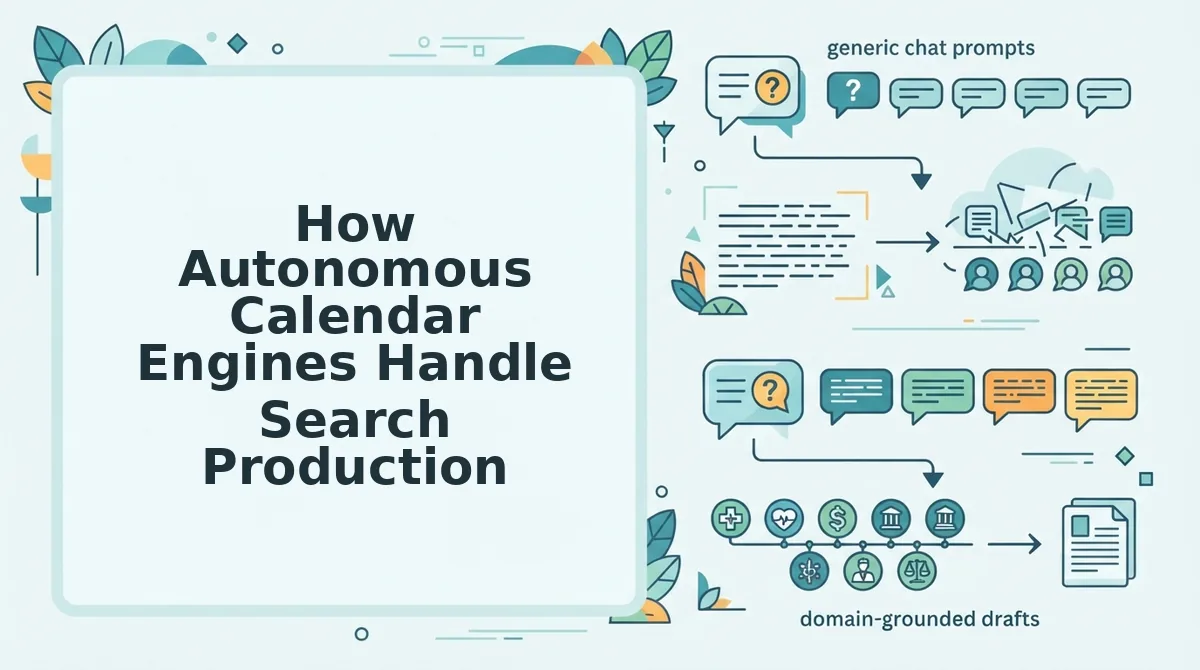
Autonomous calendar engines handle search production by crawling live XML sitemaps to map internal architecture, scheduling topical clusters, and publishing formatted articles directly to content management systems. This end-to-end automation replaces manual prompt engineering, external spreadsheet tracking, and disconnected drafting tools with programmatic publishing pipelines.
An autonomous calendar engine is an integrated content system that extracts domain rules from existing web pages, schedules keyword clusters, and dispatches rank-ready drafts directly through CMS APIs.
Most teams assume quality SEO requires constant prompt tweaking inside isolated chat windows. That manual routine introduces stack sprawl. When systems pull context directly from your sitemap, your site architecture guides every draft instead of ad-hoc prompt commands.
Prerequisites: You need an active website domain with a publicly accessible XML sitemap and administrator credentials for WordPress or a custom API endpoint.
- Type your website domain URL into the setup wizard input field to crawl your public sitemap and CMS stack (Estimated time: 2 minutes). You should see eight generated Markdown brand context files appear, including your site style guide, target keywords, and internal links map.
- Select your extracted niche to trigger real-time SERP and social research queries (Estimated time: 3 minutes). You should see a structured 30-day content calendar generator interface populate with keyword clusters and search intent targets.
- Open Settings, then API Keys, and paste your WordPress application credentials or custom API key into the endpoint field (Estimated time: 1 minute). You should see a verified connection status confirming your publishing target is reachable.
- Click Schedule to activate autonomous drafting, inline asset placement, and indexing signals (Estimated time: 1 minute). The platform will write each sectional draft, publish finished posts to your CMS, and ask Google to crawl new posts using search indexing API calls.
Consider a standard workflow: a publisher enters their site domain into the platform setup interface. The system reads published pages, identifies existing topical pillars, and builds an internal links map without manual input. When writing scheduled drafts, the engine pulls anchor opportunities directly from that map and posts the finished article to WordPress with citations included.
Automated crawl extraction turns your existing website structure into consistent, rank-ready search output without prompt-writing overhead.
While programmatic pipelines excel at organic search velocity, every automation framework has operational boundaries that require human steering.
Where Pure Autopilot Content Engines Hit Their Limits
Pure autopilot content engines hit their limits when marketing campaigns require ad-hoc creative angles, multi-channel testing, or subjective corporate messaging that cannot be reverse-engineered from search queries. An autonomous content engine is a software system that extracts brand context from sitemaps, structures topic clusters from live SERP data, and publishes finished search articles directly to a CMS without manual drafting. While autonomous engines excel at informational and commercial search clusters, they are structurally unsuited for bespoke PR announcements, interactive brand copy, or multi-variant paid social ads. When campaigns demand fast creative redirection rather than organic search rankings, hands-on copilots remain the superior choice.
Can an automated pipeline replace your entire marketing copy stack? The architecture says no.
- Multi-variant paid ad testing: Paid acquisition relies on generating dozens of rapid headline angles, emotional hooks, and value proposition variants tailored for split-testing across social channels. Autopilot engines build exhaustive long-form topical guides from keyword search intent rather than concise conversion frameworks. Route high-velocity advertising copy through Jasper campaign workflows to test short-form hooks before running paid media budgets.
- Bespoke corporate PR announcements: Public relations content involves sensitive corporate milestones, executive quotes, and legal disclosures that exist entirely outside of existing search demand. An engine indexing site maps and SERPs cannot deduce unreleased company strategy or nuance confidential partnerships without explicit human inputs. Draft corporate press materials manually in a generative editor where communications teams can control every factual claim.
- Interactive brand copy and microcopy: Conversion-rate optimization assets like product landing pages, pricing tooltips, and onboarding microcopy require tight UX design alignment rather than search entity density. Autonomous publishing pipelines ship complete editorial posts directly to CMS endpoints, which bypasses the interface testing necessary for digital product copy. Use dedicated design sprints and interactive prompt editors to refine messaging embedded inside user interfaces.
- Real-time crisis communications: Managing sudden brand reputation incidents demands defensive messaging, empathetic phrasing, and minute-by-minute tone adjustments that algorithmically scheduled content queues cannot evaluate safely. Automated publishing schedules run the risk of pushing scheduled educational guides during an active brand crisis. Pause automated publishing webhooks immediately during PR events and manage public statements through coordinated, human-guided copy review.
Navigating these distinct boundaries often raises tactical questions about everyday publishing workflows and feature support.
Frequently Asked Questions About Content Calendars and Jasper
Automated editorial calendar planning executes autonomous organic search production from keyword research to CMS publishing, whereas Jasper operates as an ad-hoc writing assistant that requires manual oversight for scheduling, formatting, and optimization.
Can Jasper automatically publish scheduled blog posts directly to WordPress?
Jasper does not autonomously schedule, format, and publish articles directly to WordPress. Users must manually export generated copy, upload media assets, and configure taxonomy tags inside the CMS. Automated calendar engines eliminate this friction by compiling finalized drafts and shipping them straight to CMS endpoints on a recurring schedule.
Does Jasper automatically submit new URLs to the Google Indexing API?
Jasper does not provide native integration with the Google Indexing API to request automated crawl passes. Writers using standalone AI tools must manually submit published URLs through Google Search Console. In contrast, autonomous search platforms ping indexing endpoints immediately after publishing to accelerate search bot discovery.
Why do standalone AI writers require external spreadsheet management?
Standalone AI writers generate isolated documents rather than connected topic clusters. Lacking direct sitemap crawling, operators must coordinate multiple production stages manually:
- Mapping keyword targets across separate spreadsheets
- Formatting media, metadata, and schema in CMS editors
- Tracking cross-article internal link coverage
How does automated calendar planning establish topical authority?
Automated calendar engines establish topical authority by crawling your existing sitemap, identifying coverage gaps against live search results, and scheduling comprehensive pillar clusters. The engine automatically links related subtopics together and maintains consistent publishing velocity, signaling deep subject relevance to search engines without requiring manual prompt engineering.
With these technical differences clarified, the final step is determining which system matches your team's primary growth model.
Choosing the Right System for Your Organic Search Traffic
Selecting between an ad-hoc AI assistant and an autonomous editorial calendar engine comes down to whether your organic growth depends on multi-channel promotional copy or scalable, citation-optimized search rankings.
Picture your content operations next quarter: you either spend twenty hours every month prompt-engineering individual articles, fixing generic outputs, and hand-formatting CMS layouts, or your infrastructure continuously claims search territory. The operational reality is clear: standalone chat tools cannot build entity-dense clusters without compounding editorial overhead. Keep Jasper if your primary focus is multi-channel marketing campaigns; move to an automated editorial engine if organic search clusters and hands-off publishing drive your pipeline.
How should you eliminate this operational friction?
- Audit your publishing bottleneck to determine whether prompt engineering or manual CMS uploading restricts your organic output.
- Enter your domain into the BloGoose setup wizard to crawl your XML sitemap, inspect existing pages, and automatically generate your eight markdown brand context files.
- Connect your WordPress installation or custom API to deliver rank-ready articles directly to your site without manual drafting loops.
Ultimately, sustainable organic growth requires continuous, structured cluster momentum rather than disconnected copywriting prompts.