
How to Balance Search Intent Across a Content Calendar
Most content calendars fail because they're built around topics, not intent, and the result is a publishing schedule that looks busy but converts nothing. If you've ever stared at a calendar full of "great ideas" that never moved the needle, you already know the problem: you planned what to write, not why someone would read it. Channel-first planning is outdated; intent-first planning is the advanced approach, and it's the difference between traffic that bounces and traffic that buys.
Here's the good news: you don't need to scrap your calendar. You need to rebalance it. This guide will show you how to balance search intent across content calendar planning so every slot earns its place, starting with the exact ratio to use, the three-question filter that classifies any keyword in under a minute, and the maturity triggers that tell you when to shift the mix. Along the way, you'll see why the starting ratio most teams guess is wrong, and what to change it to instead.
If you want a head start, an autopilot 30-day content calendar generator can map intent across your first month of publishing automatically, but the framework below works whether you automate it or build it by hand.
What Search Intent Actually Means for a Calendar
Search intent is what the reader plans to do after they land on your page, not what the query literally says. When you map intent to a calendar, you're scheduling outcomes, not just articles.
Think of intent like a restaurant menu. A diner asking "what's good here?" wants recommendations (informational). A diner comparing two entrees wants a nudge (commercial). A diner waving a credit card wants to order (transactional). A diner asking for the restroom wants directions (navigational). Your calendar should serve all four tables, not just the ones that look easy to write for.
Here's how each intent type translates into calendar slots:
- Informational: the reader wants to learn, expects a blog post or guide. These build topical authority and feed the top of your funnel.
- Commercial investigation: the reader compares options, expects a comparison or review. These warm up buyers who are close to choosing.
- Transactional: the reader is ready to buy, expects a product or pricing page. These convert authority into revenue.
- Navigational: the reader wants a specific site, expects a branded page. These protect your brand searches and rarely need frequent updates.
Your keyword map should already label intent for every term you're targeting. If it doesn't, you're scheduling blind, and the calendar will drift toward whatever feels easiest to write, which is almost always informational content that never converts.
The 70/30 Starting Ratio (and When to Change It)
Think of it like building a store before running ads. You wouldn't pay for foot traffic to an empty shelf. Informational posts are the shelves, they build topical authority that commercial pages then convert. Without enough informational depth, your commercial pages have no authority to rank on, and no internal links pointing to them.
Here's the maturity-based adjustment table:
| Site Stage | Informational | Commercial | Logic |
|---|---|---|---|
| New site (0-6 months) | 70% | 30% | Build authority first; commercial pages have nothing to stand on yet |
| 6-month site | 60% | 40% | Authority is forming; start converting it with more comparisons and reviews |
| Established site (12+ months) | 50% | 50% | Authority is earned; commercial content now has internal links and trust to rank |
The logic is simple: informational posts build topical authority that commercial pages then convert.
Before you assign any keyword to a calendar slot, make sure your keyword map labels intent clearly; otherwise the ratio is just a guess. An automated content engine can also classify intent and slot it into the right ratio for your site's stage, removing the manual spreadsheet work entirely.
Once you know your ratio, the next step is classifying each keyword correctly, and that starts with three questions.
The 3-Question Intent Classification Checklist
Batch-classify an entire keyword list in under 10 minutes by running every term through three yes/no questions. You'll need your keyword spreadsheet open and a browser tab ready for live SERP analysis.
- Open the SERP for the keyword and ask: does it show product pages or blog posts? Type the keyword into Google and scan the top 10 results. If 7+ results are product, category, or pricing pages, mark the keyword commercial. If 7+ are guides, tutorials, or listicles, mark it informational. You should see a clear pattern within 30 seconds per keyword.
- Scan the query itself for buying words, buy, best, review, vs, price, discount, or alternative. Highlight any keyword containing these modifiers in your spreadsheet. Keywords with buying words are commercial even if the SERP shows mixed results. This step takes about 10 seconds per keyword.
- Check the People Also Ask box for the query's dominant question type. If PAA questions start with "how," "what is," or "why," the intent leans informational. If they start with "which," "where to buy," or "how much," it leans commercial. Record the PAA pattern in a third column. You should have a completed classification for all 10 keywords in roughly 8 minutes.
Worked example on a 10-keyword list: best running shoes (commercial, buying word + product SERP), how to lace running shoes (informational, how-to SERP + PAA), running shoes vs trail shoes (commercial, "vs" modifier), running shoe size guide (informational, guide SERP), cheap running shoes (commercial, price modifier), what are stability running shoes (informational, "what are" PAA), running shoes for flat feet (commercial, product SERP), how long do running shoes last (informational, "how long" PAA), best running shoes 2026 (commercial, "best" + year), running shoe rotation explained (informational, explainer SERP). Output: 5 commercial, 5 informational, a balanced starting mix.
How to Rotate Intent Across 30 Days
A 30-day intent rotation prevents your calendar from skewing too commercial or too informational. The core rule: every commercial page needs two informational posts published before it, so search engines see topical depth before you ask for the click.
Prerequisite: a classified keyword list from the 3-question checklist above, grouped into content clusters. You can also generate the rotation automatically with the autopilot 30-day content calendar generator.
- Open your calendar tool and map Week 1 as 3 informational posts from cluster A plus 1 commercial post. Schedule the informational posts on Monday, Wednesday, and Friday; place the commercial post on Thursday. You should see cluster A gaining topical coverage before any sales page goes live.
- Click into Week 2 and schedule 2 informational posts continuing cluster A, plus 2 commercial posts. The commercial posts now have four informational predecessors, satisfying the two-to-one support rule. You should see a 2:1 informational-to-commercial ratio holding across the first 14 days.
- Select Week 3 and switch to cluster B: 3 informational posts plus 1 commercial post. This mirrors Week 1's structure but for a new topic cluster. You should see cluster B building the same foundation cluster A received.
- Open Week 4 and finish with 2 informational posts from cluster B plus 2 commercial posts. The month ends with 10 informational and 6 commercial posts, a 62/38 split that keeps the calendar ranking-ready without starving revenue pages.
If you're managing this rotation manually across multiple clusters, the pattern repeats cleanly: every commercial page is supported by two informational posts published before it. BloGoose applies this rule automatically when it builds your calendar from a site crawl, so you don't have to track the ratio in a spreadsheet.
Mixed-Intent Keywords: The Decision Rule
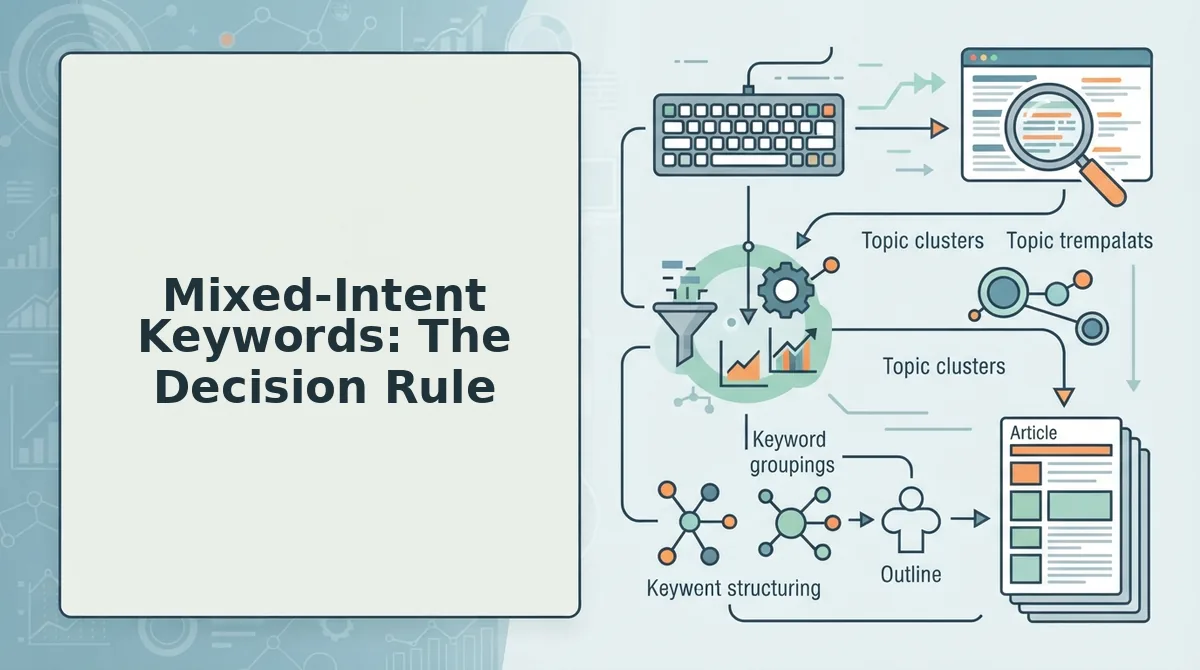
Mixed-intent keywords show both product pages and informational content in the SERP. The decision rule: serve the dominant intent in the H1 and primary CTA, then give the minority intent a dedicated section and an internal link to a separate page.
Prerequisite: your SERP analysis from the classification checklist, plus a page you can link to for the minority intent.
- Open your SERP analysis and identify which intent holds the majority of top-10 results. If 6+ results are commercial, the dominant intent is commercial. You should see a clear majority before you write a single heading.
- Write the H1 and primary CTA to match the dominant intent. For a commercial-dominant keyword, the H1 targets buyers and the CTA pushes a product or demo. You should see the page's main conversion path aligned with what most searchers want.
- Add an H2 section that serves the minority intent, then link from that section to a dedicated page for it. This captures the secondary searcher without diluting the page's main purpose. You should see the minority-intent section ranking for its own long-tail queries over time.
Example: AI SEO content engine has mixed intent, some searchers want to buy a platform, others want to understand how these engines work. Serve the commercial intent in the H1 and primary CTA, add an H2 like "How an AI SEO Content Engine Works" for the informational minority, and link that section to a dedicated how-to page. That structure captures both audiences without splitting your page's focus, and it's exactly the kind of informational depth that earns AI citations next.
AEO and Intent: Why Informational Content Wins AI Citations
Answer engine optimization (AEO) is the practice of structuring content so AI answer engines like ChatGPT, Perplexity, and Google's AI Overviews can extract and cite it as a direct answer. Informational content wins AI citations disproportionately because answer engines are trained to retrieve definitive explanations, not sales pages.
Think of an AI answer engine like a reference librarian who only quotes from the encyclopedia, never from the store catalog. When a user asks "what is a content calendar," the engine pulls from pages that define the term, explain the workflow, and answer follow-up questions in plain language. Commercial pages rarely make the cut because they answer "what should I buy," not "what is this."
Every question-based post you schedule is a potential citation source. The workflow is simple: when you classify a keyword as informational using the 3-question checklist, you are simultaneously flagging it as an AEO target. Schedule those posts alongside commercial pages so each product or service page is supported by two informational posts that answer the questions your buyers ask before they convert.
At the intermediate level, you can structure informational posts for passage indexing, which is the process of formatting a self-contained paragraph so search engines can extract it as a standalone answer. A passage-optimized paragraph states the definition in the first sentence, adds one supporting detail, and closes with a practical example, all within 80 to 120 words. For example: "Search intent is the underlying goal a user has when typing a query into a search engine. Intent falls into four categories: informational, navigational, commercial, and transactional. A query like 'how to plan a content calendar' signals informational intent, while 'best content calendar tool' signals commercial intent."
Advanced practitioners go further by mapping AEO targets to specific answer engine behaviors. AI answer engines favor content that uses entity-rich language, meaning the page names specific concepts, tools, and relationships rather than vague pronouns. When you write an informational post, name the entities your audience already searches for: the AEO content optimization tool you use, the CMS you publish to, the metric you track. This gives answer engines concrete nodes to cite.
The competitive gap is clear: most content teams optimize for Google rankings alone and never connect intent planning to AEO.
FAQ: Balancing Search Intent Across a Content Calendar
What ratio of informational to commercial content should a 30-day calendar have?
Informational posts build topical authority and earn AI citations, while commercial pages capture ready-to-buy traffic. Adjust the ratio after reviewing 60 to 90 days of ranking and conversion data for your specific niche.
How do I know if a keyword is informational or commercial before I write?
Run the 3-question checklist: Does the query ask "what," "how," or "why"? Does the top-ranking page explain rather than sell? Would a reader need to buy something to get value from the answer? Three yes answers mean informational intent. Two or more no answers signal commercial or transactional intent.
What do I do when one keyword has mixed intent?
Apply the dominant-intent rule: identify which intent appears in the majority of top-10 results and target that intent on the page. If the split is close to 50/50, create two separate pages, one informational and one commercial, and link them together so each captures its own audience.
Can I rank informational and commercial content on the same page?
Rarely, and only when the commercial section is a small supporting element. Google typically ranks one intent per page. A page that tries to both explain a topic and sell a product usually fails at both. Split mixed-intent keywords into separate pages and interlink them.
Why does informational content get cited by AI answer engines more often?
AI answer engines are trained to retrieve definitive explanations, not sales copy. Informational pages that define terms, answer questions directly, and use entity-rich language match the retrieval patterns of answer engines. Commercial pages answer "what should I buy," which AI systems rarely cite as a standalone answer.
How often should I rotate intent in a content calendar?
Rotate intent week by week. Schedule two informational posts for every one commercial page, and place the commercial page after its two supporting informational posts. This pattern builds topical context before the commercial page goes live, which strengthens internal linking and ranking signals.
Build an Intent-Balanced Calendar That Ranks and Gets Cited
The open loop from the start of this article was simple: most content calendars fail because they treat every keyword as the same kind of opportunity. The resolution is now clear. Intent is the organizing principle, and the 70/30 ratio is the starting structure that makes it actionable.
Classify every keyword with the 3-question checklist before it enters the calendar. Rotate intent week by week so each commercial page is supported by two informational posts that build topical context and earn AI citations.
The synthesis is this: intent balance is not a one-time setup, it is a feedback loop. Your calendar teaches you which intent mix converts for your audience, and that data reshapes the next 30 days. The teams that win are the ones who automate the classification and rotation instead of doing it by hand in a spreadsheet.
Your next step is to generate an intent-balanced calendar with BloGoose's autopilot content engine, which crawls your site, extracts your brand voice, and builds a 30-day plan with the 70/30 ratio already applied. The loop closes when you publish, measure, and let the next calendar learn from what ranked.