How to Balance Search Intent Across a Monthly Blog Plan
Most content calendars fail for a predictable reason: they're built on topic ideas, not search intent. A team fills a spreadsheet with 30 article titles, publishes on schedule, and watches half the posts attract zero clicks, because nobody searched for them the way the content was written. If you've ever stared at a flat traffic report after a month of consistent publishing, you know the frustration. This guide will show you exactly how to balance search intent across a monthly blog plan so every post earns its place in the calendar. You'll learn the four intent types, a practical 60/30/10 mixing framework, and a three-step SERP-reading method for assigning intent before you write a single word. Along the way, you'll see why creators like Jade Beason, whose video "1 month of content in 1 hour" has drawn 212,452 views, are desperate for faster, intent-driven planning. And why beginners like Sophia Lee, whose "How to Plan Your Blogging Content" video resonates with new bloggers, struggle with topic ideation and calendar structure. The surprising finding? Most blogs don't need more content, they need the right intent mix, and the fix is simpler than you think. A platform like BloGoose can automate this by crawling your site, extracting your brand voice, and building an intent-balanced calendar that publishes directly to WordPress.
What Search Intent Actually Means for a Blog Plan
Search intent is the underlying goal a user has when they type a query into a search engine, and it determines whether your blog post answers that goal or gets ignored. Think of search intent like a restaurant menu: a diner asking "what's good here?" wants recommendations (informational), a diner comparing two entrees wants details to decide (commercial), and a diner saying "I'll have the salmon" is ready to order (transactional). Your blog plan needs dishes for every stage of that appetite.
There are four intent types, each tied to a specific blog publishing goal:
- Informational intent, the searcher wants to learn something. Example: "how to get cited in AI answers and chatbots." These posts build topical authority and attract top-of-funnel traffic.
- Commercial intent, the searcher is investigating options before a purchase. Example: "AI SEO content engine." These posts compare features, pricing, and alternatives, and they convert readers into leads.
- Transactional intent, the searcher is ready to act. Example: "publish AI blog posts directly to WordPress." These posts target bottom-of-funnel keywords and drive signups or sales.
- Navigational intent, the searcher wants a specific brand or page. Example: "BloGoose pricing." These posts capture branded demand and protect your owned search real estate.
Here's how the four intent types map to blog goals in a monthly plan:
| Intent Type | Blog Goal | Example Query |
|---|---|---|
| Informational | Build authority, earn AI citations | How to get cited in AI answers |
| Commercial | Capture comparison shoppers | AI SEO content engine |
| Transactional | Drive signups and purchases | Publish AI posts to WordPress |
| Navigational | Own branded search results | BloGoose pricing |
Intent matters more than search volume because a high-volume keyword with mismatched intent produces clicks but no outcomes. A post targeting "AI SEO content engine" that reads like a tutorial will frustrate a buyer comparing tools, and Google will notice the bounce. For a deeper look at structuring posts that get quoted in AI-generated answers, see our guide on AEO content optimization.
To assign intent correctly, examine the top-ranking results for your target keyword. If the first page is dominated by listicles and how-to guides, the intent is informational. If it's full of product comparisons and "best of" roundups, the intent is commercial. If it shows pricing pages and signup flows, the intent is transactional. Match your post format to the dominant format on page one, and your monthly plan will stop fighting the algorithm and start feeding it.
The 60/30/10 Framework for Monthly Content Mix
Think of it like a balanced investment portfolio: informational posts are your index funds, steady, compounding authority; commercial posts are growth stocks, higher risk, higher conversion potential; transactional posts are your cash positions, small but immediately actionable.
This ratio works because it mirrors how real audiences move through a buying journey. Most of your readers are not ready to buy today. They're researching, comparing, and learning. Informational content captures that majority and builds the trust that makes your commercial and transactional posts convert later. If you invert the ratio, publishing mostly transactional content, you'll rank for fewer queries and exhaust your audience's patience.
However, the 60/30/10 baseline should shift based on your site's maturity, niche, and revenue model. Here's the adjustment table:
| Site Profile | Informational | Commercial | Transactional |
|---|---|---|---|
| New site (under 6 months) | 70% | 20% | 10% |
| Established B2B site | 50% | 35% | 15% |
| E-commerce blog | 40% | 30% | 30% |
Before finalizing your mix, audit your existing content to see which intent types are already covered, and which gaps are costing you rankings. Our guide on how to find content gaps before writing walks through the process step by step. A platform like BloGoose can automate this analysis by crawling your site, detecting intent coverage across your existing posts, and generating a calendar that fills the gaps in the right proportions. Next, you'll learn how to read a SERP and assign intent in three steps.
How to Read a SERP and Assign Intent in 3 Steps
Reading a SERP and assigning intent takes under 10 minutes per keyword once you learn the pattern. You need a browser in private or incognito mode, a spreadsheet or calendar tool, and the keyword you plan to target.
- Search the keyword and list the top 5 organic results. Open a private browsing window, type the keyword into Google, and skip past ads and AI Overviews. Record the URL, title, and content type of the first five organic results in your spreadsheet. You should see a clear pattern emerge, if four of five results are listicles, the SERP rewards listicles. This takes about 3 minutes per keyword.
- Classify each result as informational, commercial, or transactional. Label each of the five results: informational covers how-to guides, definitions, and explainers; commercial covers comparisons, reviews, and best-of roundups; transactional covers product pages, pricing pages, and signup flows. Count the labels. The dominant label across the five results is the intent Google has assigned to that keyword. Expect 2-3 minutes per keyword for this step.
- Assign the dominant intent and slot it into the matching calendar week. Open your monthly content calendar and place the keyword in the week that matches its dominant intent, informational keywords go in Week 1, commercial in Week 2, transactional in Week 3. If the SERP shows a near-even split between two intents, flag the keyword for a mixed-intent post. You should see each calendar week fill with intent-aligned topics rather than a random assortment.
Worked Example: "Best AI SEO Tools"
Search "best AI SEO tools" and you will typically see five listicle-style comparison posts from software review sites and marketing blogs. Classify all five as commercial intent, they are best-of roundups designed to help readers evaluate options before buying. The dominant intent is commercial, so this keyword belongs in Week 2 of your calendar alongside other comparison and review content. If one or two results are how-to guides explaining how to choose a tool, the SERP is trending mixed-intent and you should structure your post to answer the selection question before listing options.
For a deeper walkthrough of this method applied to niche keywords, see our guide on finding content gaps with live SERP analysis.
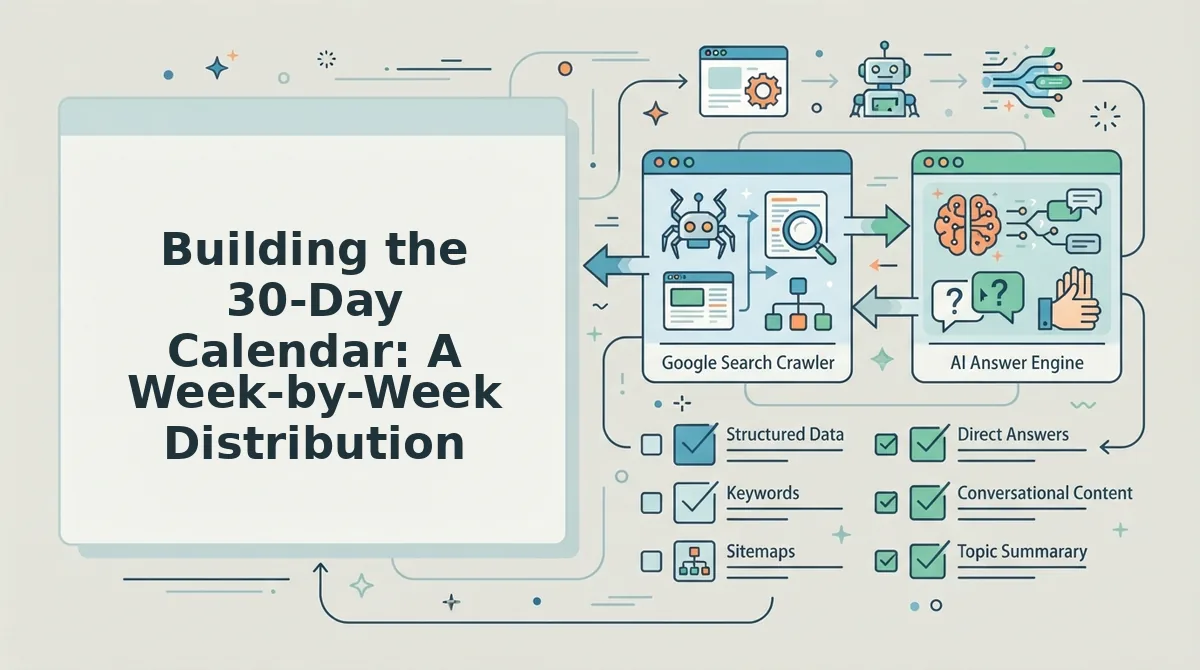
Building the 30-Day Calendar: A Week-by-Week Distribution
A 30-day calendar built on the 60/30/10 framework distributes intent across four weeks so search engines see topical depth and readers find the right content at the right stage. You need your classified keyword list from SERP analysis, a spreadsheet or calendar tool, and roughly 30 minutes to lay out the month.
- Week 1: Schedule 2 informational posts. Open your calendar and place two how-to guides or definition posts in the first week. These build topical authority and give search engines foundational content to index. You should see Week 1 filled with content that answers questions, not content that sells.
- Week 2: Schedule 1 commercial post plus 1 informational post. Add one comparison or best-of roundup alongside one informational piece. This pairing keeps the blog educational while introducing evaluation-stage content. Expect Week 2 to feel balanced between teaching and comparing.
- Week 3: Schedule 1 transactional post plus 1 informational post. Place one product-focused, pricing, or signup-oriented post next to one informational article. The transactional post captures high-conversion searches while the informational post maintains publishing cadence. You should see Week 3 driving toward conversion without abandoning top-of-funnel traffic.
- Week 4: Schedule 1 mixed-intent post plus 1 gap-filling post. Add one post that serves two intents and one post that fills a hole found in your content audit. Use SERP title patterns to identify gaps, see our guide on finding content gaps from SERP title patterns. You should see Week 4 close the month with coverage no competitor in your niche has.
A week-by-week distribution works because it mirrors how search engines evaluate topical authority: a site that publishes informational, commercial, and transactional content in a consistent rhythm signals full-funnel coverage. When you map your sitemap to this structure, each URL earns a clear role in the cluster. BloGoose automates this mapping by crawling your sitemap and generating a 30-day calendar with intent labels already assigned, see how the sitemap-to-calendar workflow turns raw URLs into a publish-ready plan.
When One Post Serves Two Intents (Mixed-Intent Strategy)
A mixed-intent post is a single article structured to satisfy both informational and commercial search queries in the same SERP. Think of it like a restaurant menu that lists ingredients and cooking methods next to each dish, the curious reader learns how the dish is made, and the hungry reader still gets to order.
Many keywords produce mixed-intent SERPs where Google ranks both how-to guides and product comparisons on page one. Writing two separate posts splits your authority; writing one post that answers the question first and presents options second captures both audiences. Start with the informational layer, define the problem, explain the evaluation criteria, and answer the "how do I choose" query in the first 300 words. Then transition into the commercial layer with a structured comparison of specific options.
Before: a post titled "Best AI SEO Tools" that lists seven tools with feature tables and no selection guidance. After: a post titled "How to Choose an AI SEO Tool (With 7 Options Compared)" that opens with a 300-word framework for evaluating tools, pricing model, content quality, publishing integrations, then presents the seven options ranked against that framework. The after version ranks for both "how to choose an AI SEO tool" and "best AI SEO tools" queries because it serves both intents in one URL.
A mixed-intent post works when the informational and commercial queries share the same core topic and the same audience. The reader asking "how do I choose an AI SEO tool" and the reader searching "best AI SEO tools" are the same person at slightly different stages, one post can move them from question to decision without a second click. Before writing a mixed-intent post, run a gap analysis to confirm the SERP actually rewards combined coverage, our guide on finding content gaps before writing shows how to verify this in under 15 minutes.
Next, the most common questions about balancing search intent across a monthly blog plan.
FAQ: Balancing Search Intent in Your Blog Plan
Balancing search intent means matching every post to the dominant query type behind the keyword, informational, commercial, or transactional, so your calendar covers the full funnel without cannibalizing rankings. These answers address the most common questions publishers ask when intent assignment gets murky.
How do I balance search intent across a monthly blog plan?
Distribute the mix weekly so each intent type appears consistently rather than clustering all commercial posts at month's end.
What percentage of blog posts should be informational?
Informational content earns the most long-tail impressions, builds the topical clusters search engines reward, and feeds internal links to commercial pages.
How do I know if a keyword is commercial or transactional?
Read the SERP. Commercial keywords show comparison pages, listicles, and review roundups ranking, queries like "best AI writing tools" or "BloGoose vs. manual publishing." Transactional keywords show product pages, pricing pages, and signup flows ranking, queries like "buy AI content software" or "BloGoose pricing." The dominant page type in the top five results tells you the intent.
Can one blog post target multiple search intents?
Yes, but only when the intents are adjacent. A post comparing AI content platforms can serve commercial intent in the comparison section while a how-to subsection captures informational queries. The key is structuring the post so each section answers one intent cleanly, with headings that match the specific query phrasing searchers use.
Why does my informational post rank but never convert?
Because informational searchers are not ready to buy, they are researching. The fix is not forcing a transactional CTA into the post. Instead, link informational posts to commercial comparison pages and transactional product pages, creating a path that moves readers down the funnel when their intent shifts. AEO content optimization also helps informational posts earn AI citations, which builds brand exposure before purchase intent forms.
What happens if I publish too many transactional posts in one month?
Search engines see a thin, sales-heavy site with little topical depth, and readers bounce because every post pushes a purchase. Transactional keywords also have lower search volume and higher competition, so over-indexing on them shrinks your total addressable traffic. The 60/30/10 framework exists specifically to prevent this imbalance from tanking a calendar's organic reach.
Intent Balance Is a System, Not a Guess
The 60/30/10 framework and the three-step SERP-reading method work because they remove opinion from intent assignment. When you read the top five results before writing, the search engine has already told you what the query wants, your job is to match it, not argue with it.
The real unlock is treating intent distribution as a calendar-level decision, not a per-post afterthought. A month where every post is informational builds authority but earns nothing. A month of transactional posts burns trust. The mix is the strategy.
Next step: run your current site through BloGoose's AI SEO content engine, which reads your existing pages, learns your brand voice, and plans a 30-day calendar with the 60/30/10 intent split already built in. You stop guessing at SERPs and start publishing to a plan that matches what searchers actually want.