How to Find Content Gaps in Niche SERPs Fast
Most gap analysis guides assume you have a $200/month tool budget and a 12-tab stack open, but what if you need to find content gaps in niche SERPs fast with nothing but a browser and a spreadsheet? You're not wrong to feel underserved: nearly every tutorial on this topic presumes paid access to enterprise SEO suites, leaving solo publishers and niche site owners stuck reverse-engineering workflows that don't fit their reality.
Here's the agreement: your situation is real, and the standard advice fails you. Here's the promise: by the end of this article, you'll have a repeatable, manual 3-lens framework that surfaces ranking opportunities in under 30 minutes per SERP, no paid tools required. Here's the preview: we'll define what a content gap actually is (and why it's not a keyword gap), then walk through the 3-Lens Gap Scan step by step, and finally show you how to execute a full manual SERP scan on a tight clock.
Along the way, you'll discover why most competitors conflate two very different problems, and how that single confusion is quietly costing them rankings. If you're already using an AI SEO content engine to draft and publish, this framework plugs directly into your existing workflow and makes every article you ship more targeted.
What Is a Content Gap? (And Why It's Not a Keyword Gap)
A content gap is any search query where the top-ranking results fail to fully satisfy user intent, whether through missing answers, thin coverage, or absent formats. A keyword gap is simply a term your competitors rank for that you don't. The distinction matters more than most publishers realize.
Think of it like a restaurant menu. A keyword gap means a dish is missing from your menu entirely. A content gap means the dish exists on every competitor's menu, but every version is undercooked, overpriced, or served without the sides customers actually asked for. You can win the second battle without adding a single new recipe, you just cook the existing one better.
Here's where the confusion costs rankings. Most SEO tools report keyword gaps by default, so publishers chase missing terms and ignore the far larger opportunity: queries where competitors rank but leave searchers unsatisfied. A 500-word post ranking for a query that demands 2,000 words of depth is a content gap. A query for "best X for beginners" returning only advanced guides is a content gap. No keyword tool flags these, but searchers feel them instantly, and Google's ranking systems increasingly reward pages that close them.
This is also where AEO content optimization becomes decisive. When a top-ranking page lacks a direct-answer paragraph, a quotable definition, or a numbered framework, AI answer engines skip it. Closing content gaps means writing passages that both Google and AI assistants can extract and cite, a dual win most competitors haven't engineered for.
The 3-Lens Gap Scan: A Framework for Fast SERP Analysis
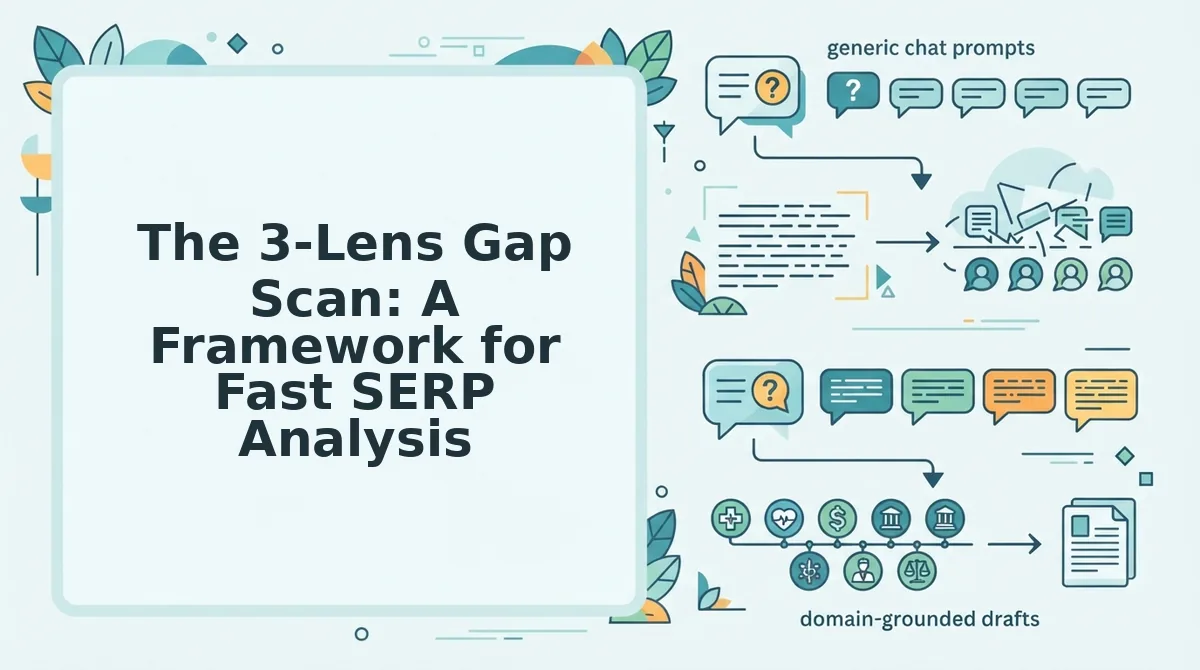
The 3-Lens Gap Scan is a manual framework for identifying content gaps in any niche SERP by examining three dimensions: what searchers want but don't get (Intent Gaps), what topics are covered too thinly (Depth Gaps), and what content types are missing entirely (Format Gaps). Run all three lenses on one SERP before moving to the next query.
Prerequisites: a browser, a spreadsheet with three columns (Query, Lens, Gap Found), and 30 minutes per SERP. No paid tools required.
- Open the SERP and list the top 10 results. Type your target query into Google, note the top 10 organic results, and record each title, URL, and word count estimate in your spreadsheet. You should see a clear picture of what currently ranks, and what formats dominate.
- Run Lens 1: Intent Gaps. Read each title and meta description, then ask: what is the searcher actually trying to accomplish, and does this result deliver it? For example, a query like "best X for beginners" returning only advanced, jargon-heavy guides is an Intent Gap. Log every mismatch in your spreadsheet. Success looks like 2-5 logged intent mismatches per SERP.
- Run Lens 2: Depth Gaps. Open the top 3-5 ranking pages and skim their structure. Count H2s, check word count, and note whether sub-questions are answered or merely mentioned. A 500-word post on a topic that needs 2,000 words of coverage is a Depth Gap. Log each thin page with a one-line note on what's missing.
- Run Lens 3: Format Gaps. Scan the SERP for content types: video, templates, calculators, case studies, comparison tables, step-by-step guides. If a query clearly benefits from a format that no ranking page provides, say, a calculator for a pricing query or a template for a how-to query, that's a Format Gap. Log it with the missing format named explicitly.
Pro tip: complete all three lenses on one SERP before moving to the next query. Switching lenses mid-SERP fragments your pattern recognition and doubles your scan time. For a deeper walkthrough of reading SERPs efficiently, see this guide to live SERP analysis.
Once you've logged gaps across all three lenses, you're ready to turn those findings into a prioritized content plan, starting with a manual SERP scan you can complete in 30 minutes flat.
How to Run a Manual SERP Scan in 30 Minutes
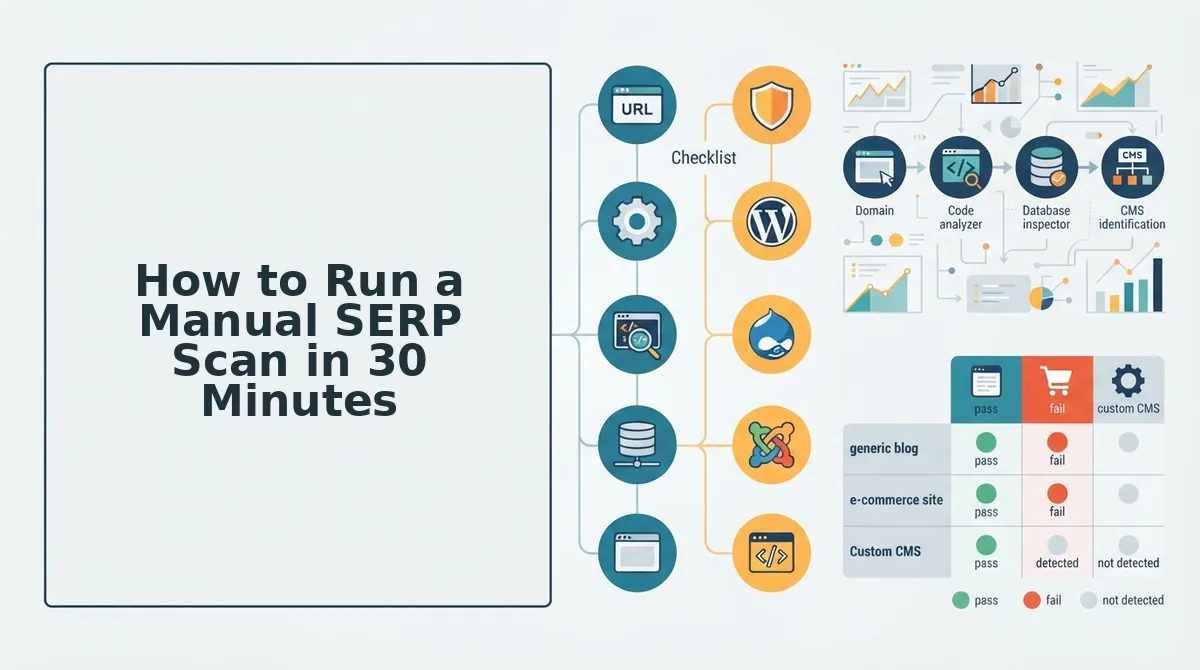
A manual SERP scan maps what the top 10 results actually cover, what questions they leave unanswered, and which formats they ignore, no paid tools required. You need only a browser, a spreadsheet, and the target keyword list you built in Section 3.
- Pull the top 10 results and map their H2s. Open an incognito window, search your target keyword, and click through each of the top 10 organic results. Copy every H2 and H3 into a spreadsheet column labeled by domain. You should see a clear pattern of which subtopics every competitor covers, and which ones only one or two address.
- Mine People Also Ask and related searches for unanswered questions. Scroll the SERP and expand every People Also Ask box, then copy the questions into your sheet. Check the "Related searches" strip at the bottom of the page and add those too. You should end up with 15-30 questions that map to specific user intents not covered by the top 10 pages.
- Check for missing formats. Scan the top 10 results for content types: video embeds, templates, calculators, case studies, comparison tables, or downloadable checklists. Mark any format that appears in fewer than 3 of the top 10 results. You should identify at least one format gap per keyword cluster, often a template or calculator where everyone else published only text.
- Score each gap with the 1-5 rubric from Section 5. For every gap you logged, assign scores for Intent Match, Traffic Potential, Competition (inverted), and Authority Fit, then total them. You should have a ranked list of gaps ready for prioritization, typically 5-10 scored opportunities from a single 30-minute scan. For a deeper workflow that pulls a content gap list from live search results, pair this manual scan with an automated crawl.
How to Prioritize Gaps Worth Filling
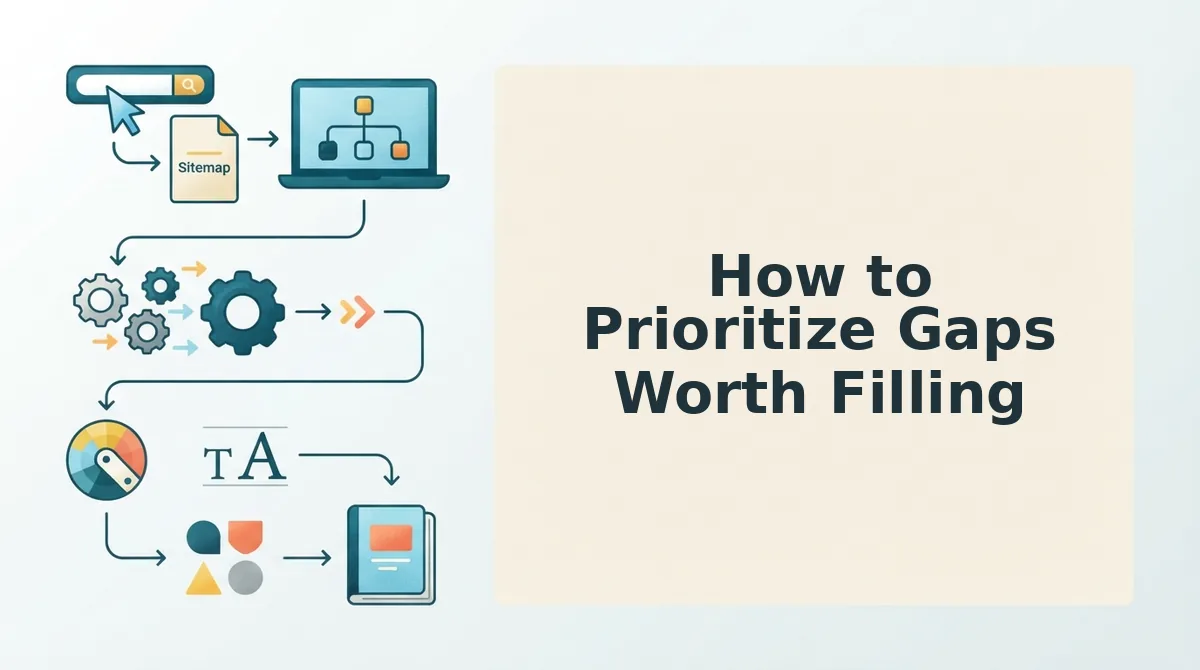
Prioritization turns a raw gap list into a publishing decision by scoring each opportunity against four criteria: intent match, traffic potential, competition, and authority fit. Competitors often rank for gaps they don't fully serve, your job is to find where their coverage is shallow, not just where it's absent.
Score each gap 1-5 on the following rubric, then total the columns:
- Intent Match (1-5): How precisely the gap aligns with what your target reader is trying to accomplish.
- Traffic Potential (1-5): Estimated search volume and PAA visibility for the topic.
- Competition (1-5, inverted): Score 5 when the top 10 results are weak or thin, 1 when they're authoritative and comprehensive.
- Authority Fit (1-5): How naturally the topic extends from content you already rank for.
| Gap | Intent Match | Traffic Potential | Competition | Authority Fit | Total Score |
|---|---|---|---|---|---|
| Niche calculator tool | 5 | 4 | 4 | 3 | 16 |
| Beginner walkthrough | 4 | 5 | 2 | 5 | 16 |
| Comparison table | 5 | 3 | 3 | 4 | 15 |
| Advanced case study | 3 | 2 | 5 | 4 | 14 |
Best for solo operators: the beginner walkthrough, high traffic, low competition, and it builds topical authority fast. Best for established niche sites: the calculator tool, harder to build but defensible once it ranks. Best for affiliate or comparison-driven publishers: the comparison table, which captures bottom-funnel intent. If you're evaluating tools to speed up the scoring workflow, this Surfer SEO alternatives roundup compares options that handle on-page scoring without manual spreadsheets.
BloGoose applies this same rubric automatically when it builds your content calendar, each gap is scored before it ever reaches your draft queue, so you publish the highest-value opportunities first.
Common Content Gap Mistakes That Waste Your Time
Most gap analysis fails not from lack of data but from chasing the wrong gaps. These four mistakes consistently derail niche publishers, and competitors rarely warn you about them.
- Chasing low-intent gaps that will never convert. A keyword with zero competition usually has zero commercial intent. If the SERP shows only informational results and no one is bidding on ads, the traffic won't drive revenue, skip it unless it feeds a top-of-funnel cluster.
- Copying competitor structure instead of finding what's missing. Rebuilding a competitor's exact H2 outline just creates a duplicate page with no differentiation. Map their coverage, then target the subtopics and angles they skipped, that's where the ranking opportunity actually lives.
- Ignoring format gaps. Sometimes a video, template, or calculator ranks better than text because the intent demands it. If the top 10 results are all 2,000-word articles and the query implies a tool or visual answer, the format itself is the gap.
- Skipping PAA mining. People Also Ask boxes surface high-value unanswered questions that often have zero dedicated pages targeting them. Ignoring PAA means missing the exact long-tail queries Google is already telling you people search for.
Fix these four habits and your gap list shrinks from noise to a short, rankable queue, which is exactly what the FAQ below addresses.
FAQ: Content Gap Analysis in Niche SERPs
Content gap analysis answers one question: what is your audience searching for that no existing page fully satisfies? These are the most common questions publishers ask when starting a gap scan.
What's the fastest way to find content gaps?
Run a manual SERP scan on one keyword and apply the 3-Lens Gap Scan: check for missing search intents, thin or outdated coverage, and absent content formats. A single SERP typically reveals 3-5 gaps in under 30 minutes without any paid tools.
Can I do content gap analysis without paid tools?
Yes. Open an incognito window, search your target keyword, and audit the top 10 results for intent coverage, depth, freshness, and format variety. Cross-reference People Also Ask boxes and Reddit threads for questions no ranking page answers directly.
How do I know if a content gap is worth filling?
Score each gap on three factors: search volume or question frequency, ranking difficulty based on current SERP authority, and business relevance to your product or audience. Gaps scoring high on at least two factors are worth prioritizing.
What's the difference between keyword gaps and content gaps?
Keyword gaps are queries your competitors rank for that you don't target. Content gaps are unmet user needs within a SERP you already compete in, missing intents, unanswered questions, or formats like comparisons and templates that no current result provides.
How often should I run a content gap analysis?
Run a full gap scan quarterly for your core topic clusters, and do a quick single-SERP check whenever you plan new content. Niche SERPs shift slowly, but algorithm updates and new competitors can create gaps within weeks.
From Gap Detection to Published Coverage
Finding content gaps is only half the work, the real advantage comes from closing them before competitors notice the same openings. The 3-Lens framework gives you a repeatable system, but the bottleneck is always execution: turning a gap into a researched, optimized, published article.
Start with one SERP today. Run the manual scan, score your top three gaps, and write the brief for the highest-priority one. If you want that workflow automated end to end, BloGoose crawls your niche, identifies gaps across your topic clusters, and publishes rank-ready articles directly to WordPress, no spreadsheet stitching required.
The niches that win aren't the ones with the most content. They're the ones that answer the questions everyone else skipped.