What goes in a competitor analysis file for a content engine
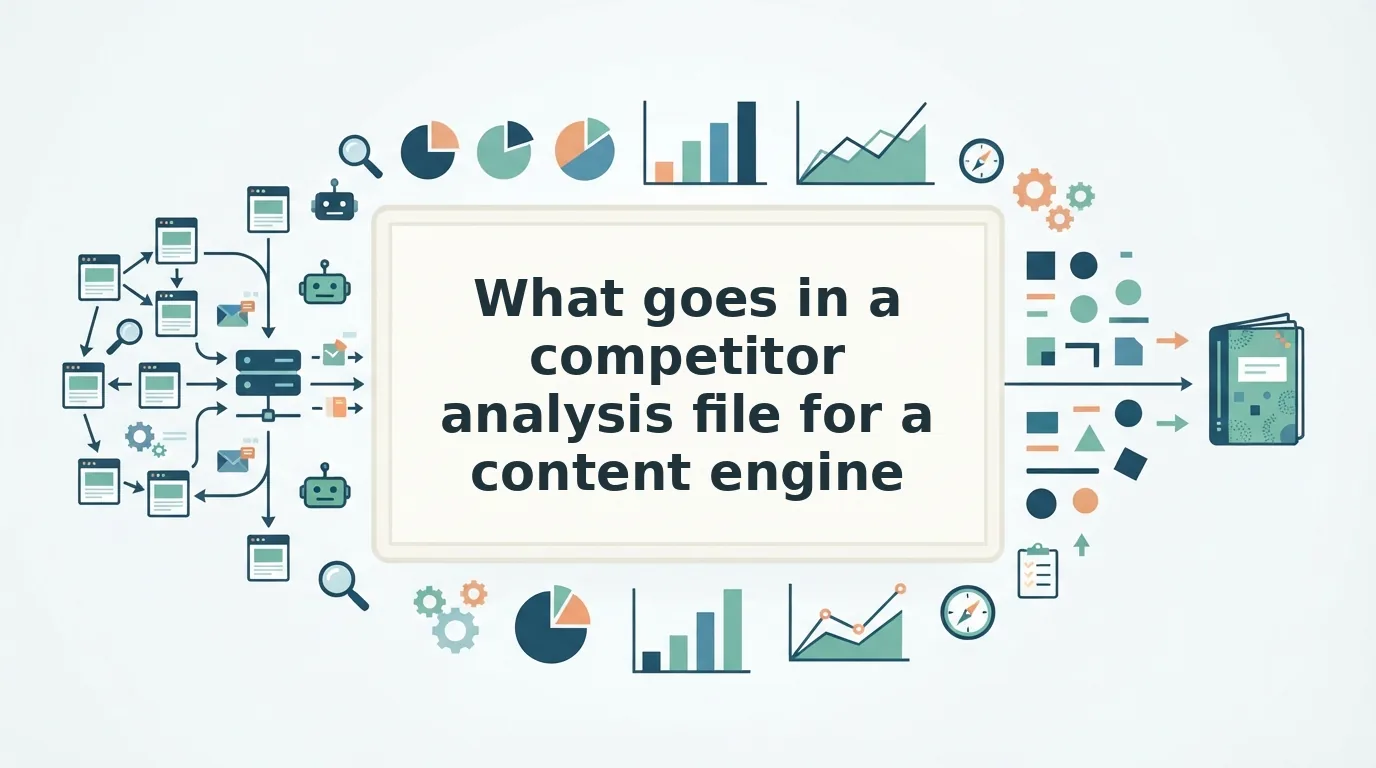
You downloaded the template, filled in the SWOT grid, pasted three market-share charts into the competitor analysis file, and haven't opened it since. That isn't a discipline problem. A document built for a human reader has no second use â nothing downstream consumes it, so it dies the week it's finished.
The whole landscape sells exactly that artifact. HubSpot's template walkthrough has 172,616 views and LYFE's seven-step version 164,336, while the argument for a one-page report sits at 169. Every resource hands over a document for people: SWOT grids, market-share charts, spreadsheet cells, one-page summaries.
None of them describes the file a content engine reads before it writes an outline. That's the version worth building, and it's seven fields wide.
Here's what you get: the fields that belong in it, the granularity each field needs, and the six gap signals a site crawl can log automatically to keep it current. One note in that file â a single line about where a rival's claim stops â is what moved an H2 in a live outline, and it's worth seeing why before the fields make sense.
What goes in a competitor analysis file?
A competitor analysis file is a claim-by-claim record of what each rival publishes, where they publish it, and where your outline beats them. It holds seven fields per row and one row per claim â the format a planning system consumes before it writes a brief or an outline.
A competitor analysis file holds seven fields per competitor claim: the observed position, the claim itself, the evidence URL, the weakness it exposes, your angle, the target section it belongs to, and the date last verified. Each row records one argument a rival makes in one place, so the file stays auditable â open the evidence URL and check the claim still stands. It is not a summary of a company; it is a list of arguments with destinations. A row missing the target section is research. A row with one is a draft instruction.
| Field | What it records | Example entry |
|---|---|---|
| Observed position | Where the rival actually ranks and with which page type | Feature page ranking for the publishing query, not a guide |
| The claim | The single argument that page makes, in one sentence | "Setup is finished once the plugin is installed" |
| Evidence URL | The exact page, so the claim can be re-checked | The install guide's final step |
| The weakness | What the page leaves unanswered or assumes away | Nothing describes what happens after activation |
| Our angle | The counter-position your draft will take | Activation is the start of the workflow, not the end |
| Target section | The H2 in your outline that carries the angle | "What happens after activation" |
| Date last verified | When a human last confirmed the page still says this | A re-check date, not a creation date |
Think of a shipping manifest rather than a warehouse inventory. An inventory tells you what's in the building; a manifest tells each item where it's going, so nothing sits on the dock. The target section is the destination line.
Worked end to end, one row reads like this: the rival's install guide claims setup ends at plugin activation, the evidence URL is the guide's last step, the weakness is the unaddressed crawl-and-configure work after activation, your angle is that activation is the beginning, and the target section is the H2 covering post-activation configuration. That row can go straight into a Which gap signals does a site crawl actually capture?
A site crawl captures six gap signals without anyone deciding what to look for: share of voice, heading coverage, freshness, schema and entity gaps, unanswered questions, and angle saturation. A gap signal is a measurable difference between a rival's ranking page and yours that a crawler can log without interpretation.
- Share of voice across a fixed query set. It counts how many of your tracked queries a rival owns, not their traffic. Lock the set before the crawl and re-score on a schedule; per-URL capture starts with sitemap context extraction.
- Heading coverage against your intended outline. Compare a rival's H2s with the outline you plan to publish. Their headings you lack become obligations; headings you both share are where differentiation drops to paragraph level.
- Freshness of the ranking page. Log last-modified dates across the set. A page that is years old and still ranking is a winnable position, not a defended one.
Every entry above is a field, not a finding. A gap note that cannot name the URL it came from is a hunch.
- Schema and entity gaps. Record the structured data and named entities a ranking page lacks. Missing Article or FAQ markup weakens the page below what its position implies.
- Questions answered in FAQs but never in headings. Harvest question text rivals bury below the fold. Each one is a heading you can claim outright, with demand already proven.
- Angle saturation. Count pages in the set making the same argument. A high count means that position is crowded; your opening is the argument nobody in the set makes.
A logged signal only earns its place when it changes a slot in the outline.
How does a gap note become an outline decision?
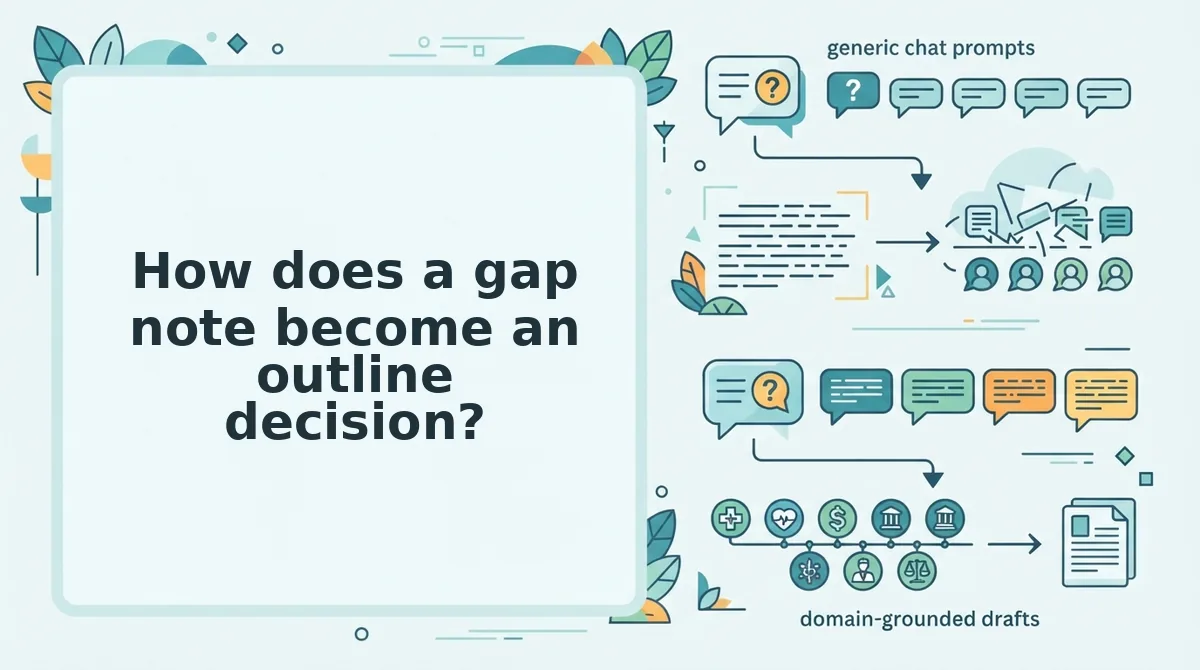
A gap note becomes an outline decision when it names three things: what a rival did, which H2 will answer it, and the sentence the draft gains. Notes missing any of those get dropped, not filed. The chain below takes about 20 minutes once the crawl and the SERP pass have run.
You need two inputs before you start: a completed site crawl with the sitemap located and the CMS stack detected, and one SERP pass on the target keyword.
- Open the gap table and sort by the target-section column (2 minutes). Rows with a blank section are unassigned, so park them at the bottom rather than deleting them. You should see two clean lists: notes with a home and notes without one.
- Read the crawl header first (3 minutes). The sitemap path and detected CMS stack sit at the top of the file. You should see your own stack logged beside the sitemap URL; if that line is wrong, fix it before the notes inherit the error.
- Type the observed position as a claim (4 minutes). The SERP pass logs that rivals stop at "install the plugin." Write that down with the evidence URL beside it. You should see a row a stranger could verify without asking you anything.
- Select the H2 the note belongs to (2 minutes). Choose only from headings already on the calendar. No fitting heading means the note waits â a note that cannot name its H2 does not enter the file.
- Write the sentence the draft gains (5 minutes). The plugin note becomes a paragraph on what happens after activation. You should see prose, not a topic label.
- Log the traceability row (3 minutes). Note, H2, sentence. You should see all three columns filled end to end.
| Gap note | Target H2 | Sentence it changed |
|---|---|---|
| Rivals stop at "install the plugin" | What happens after activation? | "Activation is the halfway point; next you confirm the tag fires." |
That row is the artefact nobody in the template landscape publishes â guides hand you a report, the traceability row shows a consequence. BloGoose runs the crawl and stack detection for you in its setup wizard, so the first column is never guesswork.
File or template, and why most of them rot
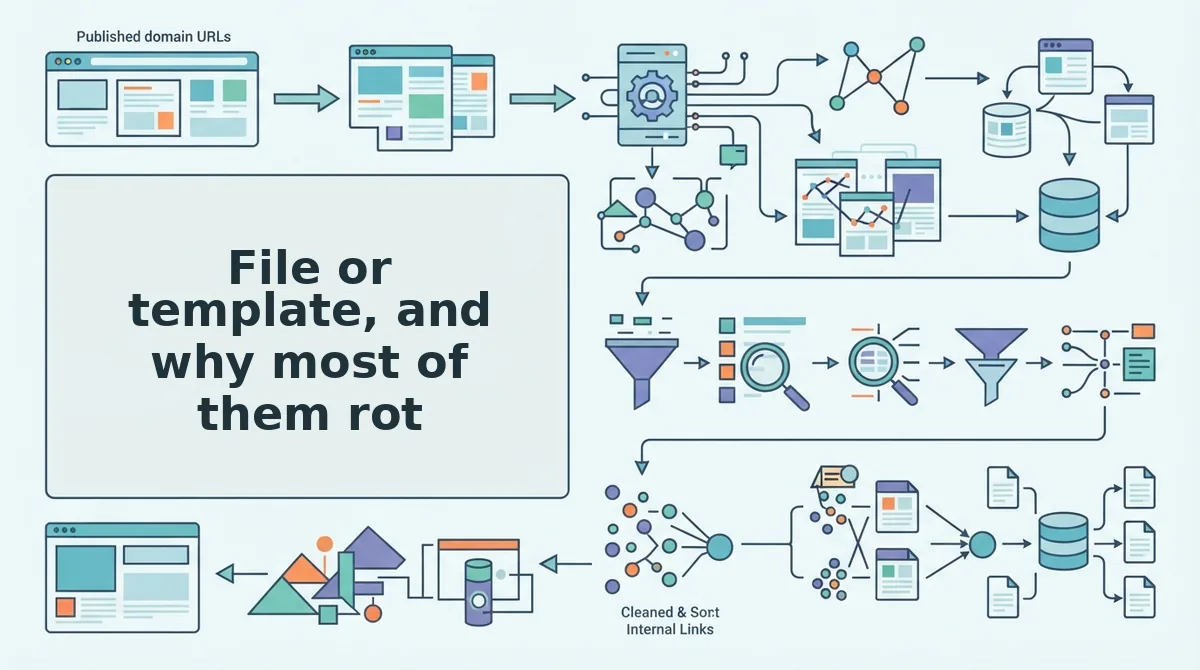
A template is a container for human conclusions. A file is an input a planner queries â and that difference is why most competitor documents are stale the week they get finished.
| Template | File | |
|---|---|---|
| Built for | A human reading once | A planner querying every cycle |
| Unit | A section or slide | A field with an evidence URL |
| Passes when | It fits on a page | It names its target H2 |
| Decay | Silent and undated | Rebuilt when the SERP pass runs |
Should a competitor analysis file be Markdown or a spreadsheet? The format question resolves on who reads it, not on which looks more professional. Markdown suits an engine that ingests the file as context and a team that reviews edits as diffs; a spreadsheet suits filtering and sorting hundreds of rows at once. Pick whichever your outlining workflow can open directly, without a human translating it first, and keep it there.
The one-page-report advice â that research not fitting a page will never get read â is correct for a human reader and inverted for a planner. Brevity is the right optimisation for attention and the wrong one for specificity. A file not re-derived from live SERP data each cycle is worse than no file at all, because it anchors writers to positions rivals abandoned two quarters ago.
Every resource in the landscape is a one-time artefact: a downloaded template, a deck, a PDF. That is exactly the rot pattern being warned against.
The loop this article opened closes here â the unpublished deliverable is the traceability row, not the report. The same file also feeds AEO optimization, which depends on knowing which claims rivals already own.
Point BloGoose at your domain and let the setup wizard locate your sitemap, detect your