Surfer SEO vs BloGoose for Planning a Month of Blog Content
Open a comparison video for Surfer SEO and time how long it takes before the presenter pulls up a second optimizer. That is the tell: the results for Surfer SEO vs BloGoose content planning are video-dominated, and the creators ranking there â Tobi Teaches among them, benchmarking Surfer against Neuronwriter â pit optimizer against optimizer. Almost none compare planners, which is the job you are actually hiring for.
Both tools get filed under "content platform," so the labels blur. Below is a decision rule readable in one screen, built on a handoff-count test: the number of manual transfers between a topic idea and a live URL.
Surfer Academy's own "Build 6 Months of SEO Content in 60 Minutes" treats calendar building as a separate front-end stage from editing, which supports the split. One caveat up front â neither vendor's planner and calendar have been compared in a controlled test. Every capability claim here is vendor-stated and flagged as such.
What the count turns up is a stage most teams pay for twice without noticing, and it is not the one you would guess.
Which Tool Should You Use to Plan a Month of Blog Content
Use BloGoose when choosing topics and getting posts live is your bottleneck; use Surfer SEO when you have already decided what to write and need the draft scored against the SERP. Surfer is content optimization. BloGoose is content operations. That split decides more than any feature matrix.
| Tool | What it does | Best for |
|---|---|---|
| Surfer SEO | Scores and shapes a draft you have already decided to write | SEO specialists and freelance writers working from an approved topic queue |
| BloGoose | Decides what to write and in what order, then publishes to WordPress or a custom API | Founders, content leads and solo operators publishing without a production team |
Surfer earns its reputation: SERP-driven scoring hands a writer something concrete to react to, and that beats a blank page.
BloGoose sequences the earlier stage â its site context describes a domain crawl, brand-voice extraction, a 30-day calendar, and publishing to WordPress or a custom API. It also writes eight editable Markdown files, style-guide.md and target-keywords.md among them, that sit in your repo and diff like code.
So: if picking topics and shipping posts is the bottleneck, Surfer does not address it. If scoring an existing draft against the SERP is the whole job, BloGoose is more machine than you need.
Both capability descriptions are vendor-stated. Verify the publishing path and the file set against your own stack before committing.
If the calendar is the gap, start with the 30-day build and judge the output before the editor.
How Many Handoffs Sit Between Your Calendar and the Published URL
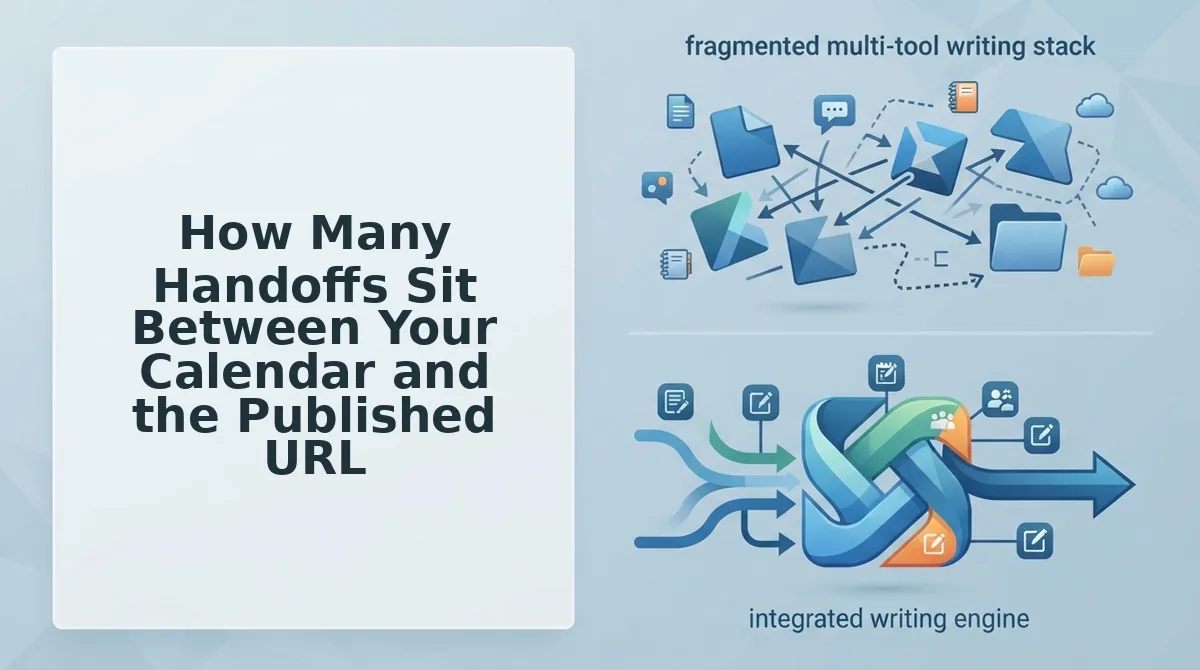
A handoff is any point where a person moves an artifact from one surface to another â a topic off a spreadsheet into a brief, a draft out of a doc and into a CMS. Count every one between a calendar row and a live URL, and that tally becomes your real content cost.
Draw the path first. Most teams name five stages â topic selection, brief, draft, image asset, publish â and can say which tool owns each.
Then mark each one manual or automatic, in an optimizer-centred stack versus an integrated engine.
| Stage | Optimizer-centred stack | Integrated engine |
|---|---|---|
| Topic selection | Manual: spreadsheet or chat | Automatic: crawl builds the calendar |
| Brief | Manual: written per post | Automatic: generated from keyword context |
| Draft | Manual: writer, then scored in an editor | Automatic: drafted against brand-voice rules |
| Image asset | Manual: separate tool, separate export | Automatic: created alongside the draft |
| Publish | Manual: copy, paste, reformat | Automatic: pushed to WordPress or a custom API |
Think of a relay race where the baton is a document. The runners are fine; every exchange is a place to drop it, and nobody times the exchanges.
The advanced reading: count only the handoffs that lose information. The stage most teams duplicate without noticing is the second research pass â re-running keyword or SERP research at draft time because the brief kept the conclusions but not the reasoning behind them. One stage, paid twice.
The count is self-derived, not a benchmark. No vendor publishes a handoff tally, so yours is the only one you can quote.
Score your own workflow this week:
- List every artifact between topic idea and live URL.
- Mark who or what moves each one.
- Count transfers that make someone open a different tab.
- Flag stages where information is rebuilt rather than passed along.
- Compare the tally against draft scheduling intervals, since a calendar usually collapses because every post sits on the same cadence.
Two levers cut the number fastest: a calendar built from crawl data instead of a blank template, which deletes the topic-selection exchange, and balancing search intent across a content calendar, which keeps the brief from being rewritten mid-draft. BloGoose automates the first and writes the second into an editable file in your repo.
Surfer sits at one stage of this map, and it sits there well.
Where Surfer SEO Fits in a Monthly Content Plan
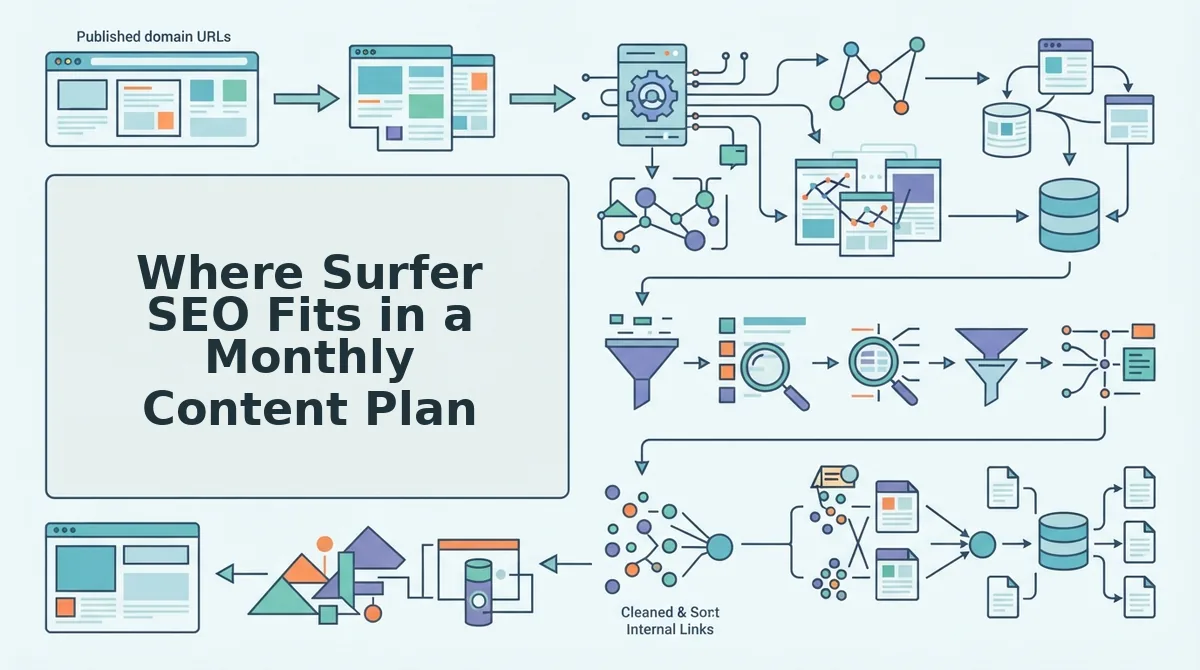
Surfer SEO is strongest after the calendar decision is already made: it is an optimization editor that scores a draft against the entities and keywords present in the current top-ranking pages for one target query. It is not a system for deciding which twelve topics deserve the month.
Surfer's own academy material treats calendar building and editing as separate stages, which is the admission this comparison turns on. Planning a month and optimizing a single article are two different jobs, and only one of them lives inside Surfer's editor.
| Stage | What Surfer SEO Does | What It Leaves to You |
|---|---|---|
| Sitemap and site structure input | Manual â you supply the URL or paste content | Locating and reading the XML sitemap |
| Topic selection for the month | Keyword research surfaces terms and questions | Assigning topics to slots and defending the slot |
| Brief creation | SERP-derived outline suggestions, entity and term targets | Deciding whether the topic merited inclusion at all |
| Draft optimization | Real-time content score against ranking pages | Writing the draft and resolving conflicting term advice |
| Brand voice consistency | Settings inside the editor | Carrying rules forward across a month of posts |
| Publishing | Not the core function | Every handoff from score to live URL |
On the content score itself, the honest framing is narrow: it is a similarity measure against a SERP snapshot taken at one moment, not a ranking forecast. Review coverage from Niche AI Tool asks outright whether the real-time content score actually ranks, which captures a doubt many buyers already carry. The score tells you how closely your draft resembles pages that currently rank. It cannot tell you whether the topic deserved a slot in the month.
Best for the writer who already has a topic and needs a draft to match the SERP. If your bottleneck is a blank page rather than an empty calendar, Surfer is a reasonable fit. Readers who want to see the field before committing should review these Surfer SEO alternatives.
Where BloGoose Fits, From Sitemap Crawl to Scheduled Draft
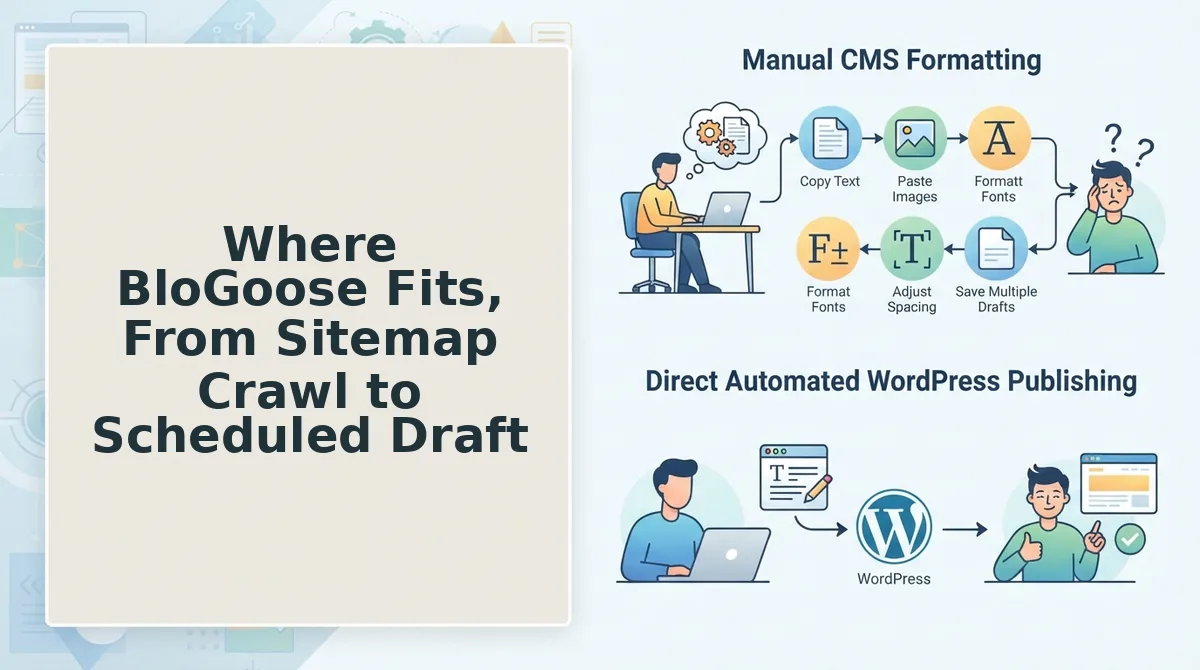
BloGoose is positioned as an autopilot SEO content engine that starts from your sitemap and ends at a published URL, with a 30-day calendar in between. The sequence below is vendor-stated pending human verification, and it is specific enough for you to test each stage yourself.
- XML sitemap crawl sets the topic boundary. You enter a domain and the engine locates the sitemap and reads published pages. This matters because site structure drives topic selection instead of a blank prompt box, and it keeps new posts anchored to pages you already own.
- Eight editable Markdown context files capture brand voice. Files including style-guide.md, target-keywords.md and internal-links-map.md hold the rules as text in your repository, not as settings inside someone's dashboard. You can read, edit and version them.
- Live SERP and social research feeds the brief. Each topic is researched against current results rather than a cached keyword list. See how this works in this live SERP analysis walkthrough.
- A 30-day calendar assigns every topic a slot. Pillar and cluster structure determines what publishes when, so the month exists as a plan before any drafting begins. This is the stage Surfer leaves to your spreadsheet.
- Drafting bakes in SEO and AEO together. Articles are written for classic ranking signals and for extractable answer passages, using the brief as the constraint. The SEO content brief is the artifact you inspect when a draft misses.
- Image generation runs inside the same pass. Supporting visuals are produced per article rather than sourced separately, which removes one more manual transfer from the chain.
- Publishing targets WordPress REST or a custom API. This removes the copy-paste stage entirely rather than shortening it, and versioned context files are the mechanism that prevents plan drift across months.
How does sitemap-driven planning differ from keyword-list planning? A sitemap-first engine reads what your site already covers and proposes topics that strengthen existing pages, while a keyword-list approach starts from external search volume and asks you to reconcile the results with your architecture afterward. That difference is the core of sitemap context extraction, and it is why the crawl stage precedes everything else in the pipeline.
Count the handoffs you removed above and compare that number to the one you counted earlier.
Where BloGoose Stops Short and When Neither Tool Is the Answer
An integrated engine trades granular control for continuity. BloGoose gives you less manual command over a single draft than a dedicated optimization editor does, and there is no controlled comparison of Surfer's planner against BloGoose's calendar in public data â so no claim that an integrated pipeline outranks an assembled one can be substantiated today.
Plan drift is the real failure mode, and it is a process problem rather than a feature gap. Month two stops resembling month one when the person holding the voice rules changes roles, and the calendar quietly dies with their institutional memory.
Some teams should not switch. If you ship two posts a month, your editor works, and publishing is not your bottleneck, consolidation buys you little and charges a migration cost in setup and retraining.
If your month collapses at the calendar-to-URL stage instead, start by writing your voice rules down as files you own. Then run your own sitemap through BloGoose and inspect the eight context files before drafting anything â if they read wrong, fix them first, because those files are what keeps month four matching month one. The AEO content optimization guide covers the passage-level side of that setup.
A plan you can diff, hand over, and defend is a plan that survives a staff change.