Surfer SEO tone settings vs sitemap-crawled writing rules
Your 2,000-word draft opens in your register â right rhythm, right vocabulary, right amount of hedge â and then, somewhere around the fourth section, it starts reading like every competitor on page one.
That collapse sits at the centre of the surfer seo tone settings vs crawled writing rules question, so here is the verdict first. Surfer's tone setting governs one generation. Sitemap-crawled rules travel with every draft as an openable file.
The difference is custody, not output quality: which rule set survives the handoff from brief to publish, and who can open it up and check.
No public benchmark, price, or usage figure for this comparison appears in the evidence available here, so what follows argues from each method's documented behaviour rather than from a test result.
Two failure modes decide it for most teams:
- rules inherited from your own unpublished bad habits
- register borrowed from whichever pages the tool happened to read
Section 5 works out which one does more damage.
The four tests below sort most teams faster than a trial run.
Four tests that decide which rule set fits your team
Neither rule set writes better prose in isolation â the test that decides is custody: who holds the writing rule and who can change it. Score Surfer's tone setting against a crawled rule file on provenance, persistence, inspectability, and repair, and the choice usually makes itself.
Stop asking which one produces better sentences. Ask whose rule is still in force at paragraph 40.
| Test | Surfer tone setting | Crawled rule file | What it decides |
|---|---|---|---|
| Provenance | A human selection from a dropdown, with an Auto option that mimics top-ranking pages | Rules derived from pages you already published | Whether the voice is a decision or an inheritance |
| Persistence | Applied at generation time | Present in the prompt context of every section | Whether the last section still sounds like the first |
| Inspectability | A value in a UI | A readable, diffable Markdown file | Whether you can review the rule before you review the draft |
| Repair | Regenerate or restyle | Edit one line the next draft inherits | The cost of fixing drift once it happens |
Choose Surfer's tone setting if you draft one brand at a time and want a rule in place in a minute; Auto is a fast, honest starting point, and pairing it with live SERP analysis tells you what it is copying. Choose a crawled rule file if you publish continuously, run multiple brands, or must explain to a client why a sentence sounds the way it does.
Best for the solo operator shipping a weekly post: Surfer. Best for the agency editor holding five client voices: crawled rules, because a diffable file replaces memory.
What we'd choose is the crawled file â not because it is cleverer, but because it is repairable. Its honest weakness: a crawl imports your existing bad habits and any inconsistency already live on the site, so the file needs pruning before it earns trust.
Open your last five drafts and score each against the four rows before you pick a tool â most teams discover persistence, not provenance, was their problem.
What that dropdown actually writes into the prompt is narrower than its label suggests.
What Surfer's tone setting actually controls
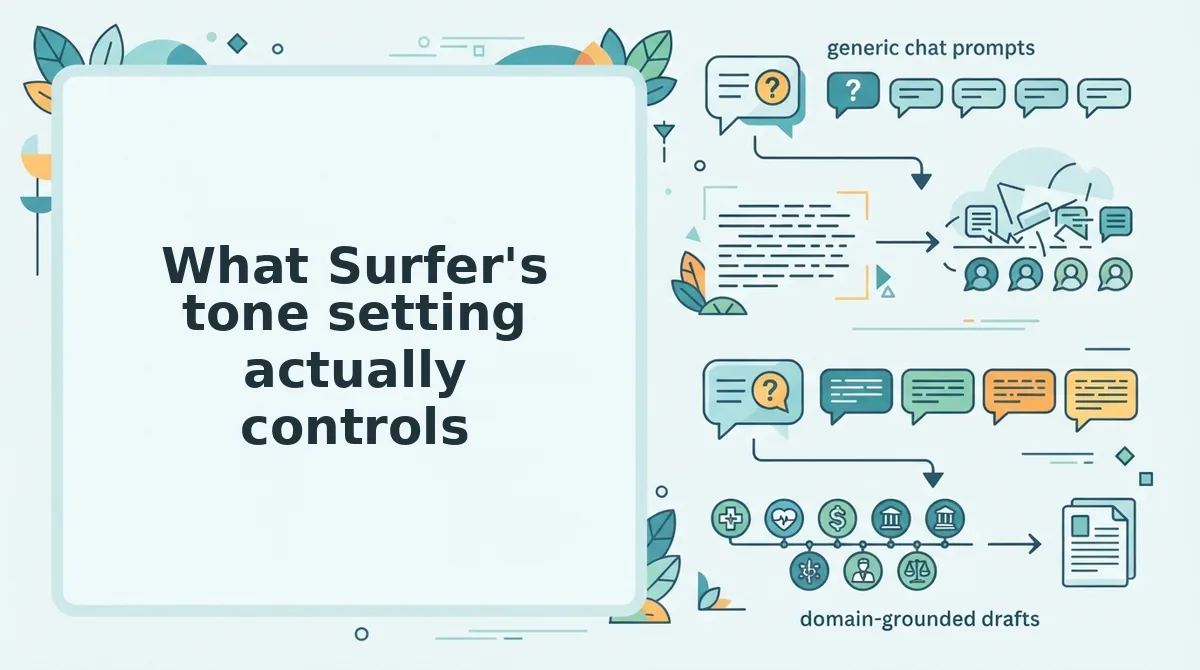
Surfer's tone-of-voice setting controls the register a single draft is written in at the moment it is generated. It is not a one-and-done brand setting buried in account preferences, which is where most explainers of Surfer tone settings versus crawled writing rules go wrong.
Surfer's tone-of-voice setting is a per-draft selector that tells the generator what register to write in before the article exists. The choice happens at generation time, inside the Surfer AI setup flow, not as a restyling pass applied afterward. Workspaces separately carry brand knowledge, voices, and templates per Surfer's own product documentation, so there are two distinct layers: one that lives per draft, one that lives per workspace.
The Auto option is the part worth pinning down. Auto mimics the voice of the top SERP pages, which means the competitor set you chose during setup shapes the register you receive. Think of a GPS narrator: you can pick the voice before the trip starts, but you cannot swap narrators at the fourth turn. And that limitation is structural, not cosmetic.
The competitor set you select is not only a ranking benchmark; it is a voice input.
- Behaves well: a single draft where you choose the voice up front and the article stays short.
- Starts to slip: long drafts, where one selection has to hold a register across many sections.
- Slips hardest: Auto pointed at a competitor set full of head-to-head comparison posts.
What is Surfer's tone-of-voice setting?
Surfer's tone-of-voice setting is a per-draft control inside Surfer AI that sets the register of the generated article. You choose it during setup, before generation, so it applies to the whole draft at once rather than to individual paragraphs. It includes an Auto option that copies the voice of the top-ranking pages in the competitor set you selected, which means the register you get back reflects who you chose to compete against. Workspace-level brand knowledge, voices, and templates sit alongside it as separate, longer-lived settings. Surfer's own SEO guidance notes that AI cannot reliably match brand voice without a human edit pass.
Worked example. Take a long-form draft aimed at a query where the top results are all head-to-head tool comparisons. With Auto selected, the draft opens competently, then settles into the rivals' clipped, combative register â short verdict sentences, plenty of second-person challenges. Nobody asked for that voice; the competitor set supplied it. The correction is not a different tone preset. It is a sentence-level restyling pass against your own rules, which is exactly the labour the dropdown was meant to remove.
Crawled writing rules start from the opposite direction entirely: not a register you pick, but one already sitting in your published pages.
What sitemap-crawled writing rules actually are
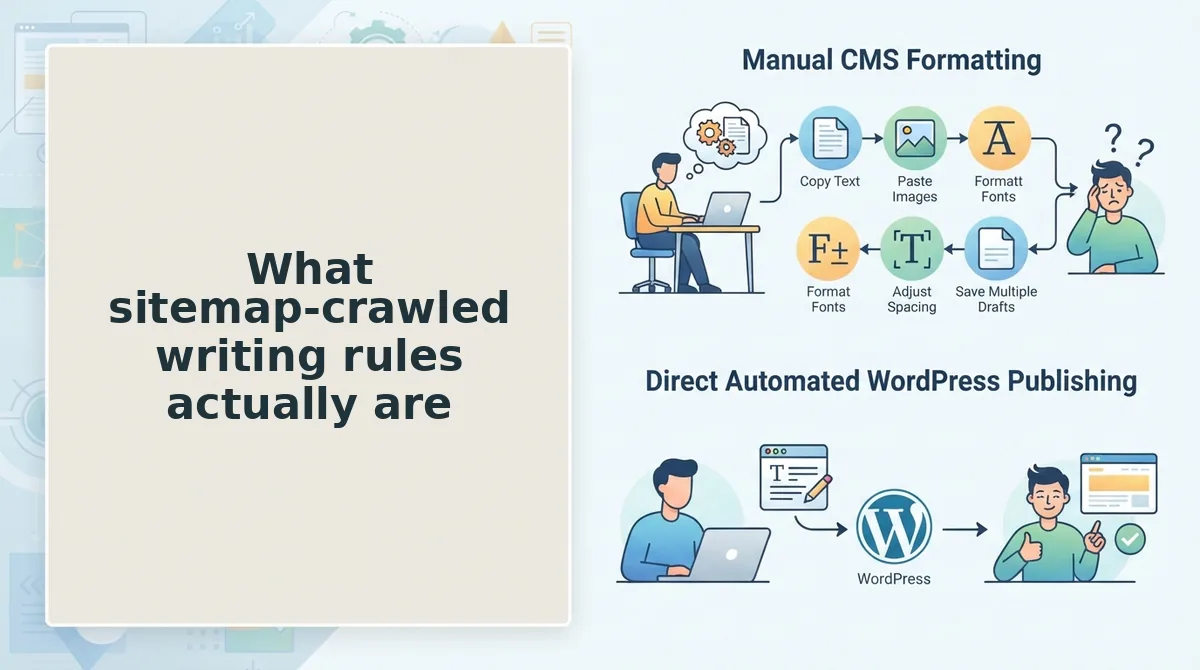
Sitemap-crawled writing rules are editable Markdown files generated by reading your published pages, not a switch inside a writing tool. The crawl converts your live site into a portable document that a drafting engine can load and a human can inspect.
Prerequisites: a live domain with a reachable XML sitemap, and CMS access if robots.txt does not declare one. Time to a usable rule set: roughly 20â40 minutes.
- Open Settings, then Site Crawl, and type your canonical domain (about 2 minutes). BloGoose reads robots.txt, locates the XML sitemap and detects the underlying CMS. You should see the sitemap resolve with a green checkmark.
- Select the post and page sitemaps, and clear the image and tag ones (about 1 minute). Compare the discovered URL count against what you expect to be published. You should see each URL labelled by content type.
- Run the crawl and let it read the published pages (5â15 minutes, scaling with page count). It records sentence length, heading rhythm, vocabulary and internal linking habits. You should see a completed page count, not a partial run.
- Open the generated context files and read the style guide (10â20 minutes). The output includes a style guide file and an internal links map, both editable by hand. You should see rules written as statements about your live copy, not as preferences.
- Pair that style guide with a keyword file for the cluster (about 5 minutes), using the target keywords file for a site crawl as the template. You should see one rule set and one term list sitting side by side, both versionable.
The contrarian part: a crawl is descriptive, not prescriptive. It records what the site does, so an existing inconsistency becomes a rule by default, and a content type you have never published gets no rule at all because the crawler has nothing to derive from. Treat the output as a draft of your standard, then edit it. Compare the mechanism with sitemap context extraction done by hand.
Where does each one break?
Each rule set fails at a different layer: Auto fails at the source, a crawl fails at the inventory, and an undocumented house style fails at the audit. The model is rarely the problem.
- Auto inherits the register of whichever pages you set as competitors. Swap the competitor set and the voice moves with it, by design.
- A crawl inherits your published inconsistencies and makes them binding. If half your posts open with a question and half with a statistic, both patterns become rules.
- A rule set that lives in someone's head cannot be diffed. When output shifts, there is no artifact to compare against, so the correction restarts from opinion.
Why does AI-written content drift toward generic by the final section? Because style instructions are applied section by section, while the outline distributes emphasis. Generated against one competitor set, later sections inherit the averaged