
How to Research Blog Topics That Rank and Get Cited by AI
You've spent hours mining keyword tools, mapping search intent, and building topic clusters, yet your best-ranking articles never show up in ChatGPT, Perplexity, or Google's AI Overviews. That's the quiet crisis facing publishers in 2026: ranking on Google no longer guarantees being quoted by AI. The gap between traditional keyword research and blog topic research for AI citations is where most content strategies quietly die.
You're right to be frustrated. You followed the playbook, keyword difficulty scores, SERP analysis, pillar-and-cluster architecture, and Google rewarded you. But the AI answer engines that now sit between searchers and your content don't care about your domain authority. They care whether your passage is quotable. That's a different game entirely.
This guide gives you a repeatable framework for researching topics that satisfy both signals: Google's ranking algorithm and AI engines' citation logic. You'll learn why traditional topic research misses AI citations, how to score any topic with a 5-factor dual-signal scorecard, and how to run live SERP and social research that surfaces underserved queries. One surprising finding: the competitor SERP for this exact topic is 85% video content, leaving text-based frameworks almost entirely unclaimed, which is precisely why a written scorecard can win. If you want the full picture on how to get cited in AI answers, that companion guide covers the citation mechanics in depth.
Platforms like BloGoose automate the research-to-publish loop, crawling your site, extracting brand voice, and shipping rank-ready articles, but the topic selection logic below works whether you're fully automated or still doing it manually.
Why Traditional Topic Research Misses AI Citations
Traditional topic research optimizes for one audience. Google's crawler, while AI answer engines read content for a different purpose: extracting quotable, self-contained passages. The two systems reward different things, and most keyword research never accounts for the split.
Start with the simple version. Google rewards comprehensive, keyword-optimized pages that cover a topic exhaustively. An AI answer engine, the system behind ChatGPT, Perplexity, and Google AI Overviews that generates direct answers from indexed content, rewards concise, self-contained passages with clear entities, concrete numbers, and unambiguous definitions. A page can rank #1 on Google and still be invisible to AI if its key sentences depend on surrounding context to make sense.
Here's the intermediate layer: think of Google like a librarian who catalogs entire books, while an AI answer engine is a journalist who pulls one quote for a news story. The librarian cares that your book exists and covers the subject. The journalist cares whether one paragraph, lifted alone, still makes sense. Most SEO content is written for the librarian, sprawling, interconnected, context-dependent. AI citation requires writing for the journalist too.
Now the advanced divergence. Google's ranking signals include backlinks, page speed, internal linking, and keyword coverage. AI engines evaluate passage-level extractability: entity clarity, quotable-stat density, question-answer alignment, and self-containment. These are not the same signals. A topic can score high on traditional SEO metrics, search volume, keyword difficulty, SERP competition, and still fail AI citation because it lacks what we'll call a quotable passage: an 80-120 word block that answers a specific question without requiring the reader to see the rest of the page.
This is why AEO content optimization, answer engine optimization, has emerged as a distinct discipline from classic SEO. Exposure Ninja's video on AI platform topic research confirms the discipline exists, but it stays tool-dependent and stops short of offering a scoring framework. That framework is what the next section delivers.
To make this concrete, here's a decision matrix no video competitor provides. Google-only topics have high search volume but low quotability, think "best practices" listicles where every sentence depends on the one before it. AI-only topics have low search volume but high question density, think niche definitional queries that chatbots answer constantly but few people type into Google. The overlap zone is where dual-signal topics live: queries with real search demand that also generate frequent AI answers. Your topic research should target the overlap zone exclusively, because that's where one article earns both rankings and citations.
In short: traditional topic research asks "Will this rank?" Dual-signal topic research asks "Will this rank and will a sentence from it survive being quoted out of context?" Those are different questions, and they require different scoring criteria.
The 5-Factor Topic Scorecard for Dual-Signal Topics
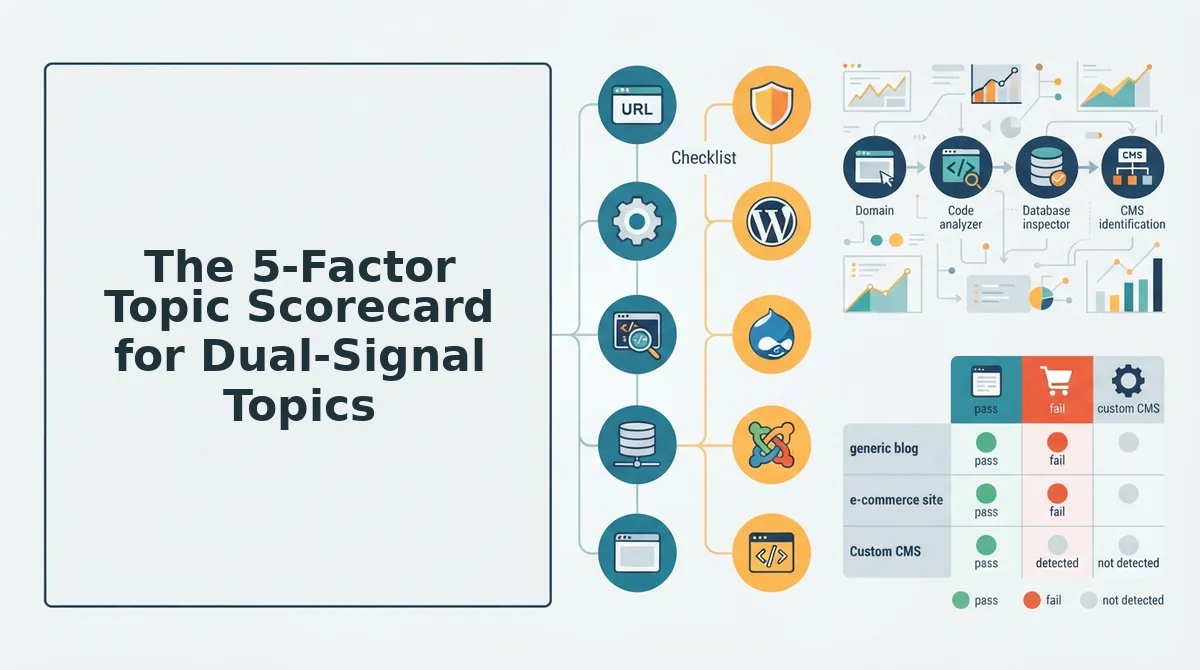
A dual-signal topic is one that satisfies both Google's ranking requirements and AI engines' citation logic. Score each candidate topic 1-5 on the five factors below; any topic scoring 20 or higher is worth pursuing, while anything under 15 should be deprioritized.
- Search demand with SERP gap. This measures whether real people search for the topic and whether existing results genuinely answer them. Use live SERP analysis to find queries where the top 10 results are thin, outdated, or video-only, like the 85% video-dominant SERP for this topic. A high score means you can rank without fighting entrenched text competitors.
- Entity clarity. This asks whether you can define the topic in one sentence without ambiguity. AI engines quote passages that contain clear, named entities, specific tools, metrics, frameworks, or definitions. If you can't state what the topic is in a single declarative sentence, AI engines can't either, and they won't quote you.
- Quotable-stat potential. This evaluates whether the topic naturally accommodates original data, percentages, or concrete numbers. AI answer engines disproportionately cite passages containing statistics because numbers are self-contained and verifiable. Topics like "average email open rate by industry" score high; topics like "how to think about email marketing" score low.
- Question density. This counts how many People Also Ask boxes, chatbot prompts, and forum threads exist around the topic. High question density means AI engines are already being asked about this subject, and they need source material to answer. Use PAA mining and Reddit/Quora scanning to estimate this before committing.
- Passage extractability. This asks whether you can draft an 80-120 word self-contained answer to the core query. Write the passage before you write the article. If the passage requires "as mentioned above" or "see section three" to make sense, it fails extractability, and AI engines will skip it.
Here's the self-contained passage that answers the core question of this section: To research blog topics that rank on Google and get cited by AI, score each candidate on five factors: search demand with a SERP gap, entity clarity, quotable-stat potential, question density, and passage extractability. Rate each factor 1-5 and pursue topics scoring 20 or higher. This dual-signal approach ensures your content satisfies both Google's crawler, which rewards comprehensive coverage, and AI answer engines, which quote concise, self-contained passages with clear entities and concrete numbers.
Once you've scored your topic list, you can organize the winners into pillar-focused content calendars that build topical authority across the overlap zone. Platforms like BloGoose can automate the scoring, clustering, and publishing pipeline, but the framework works whether you run it manually or let the engine handle it.
Next, we'll cover how to run live SERP and social research for dual-signal topics.
How to Run Live SERP and Social Research for Dual-Signal Topics
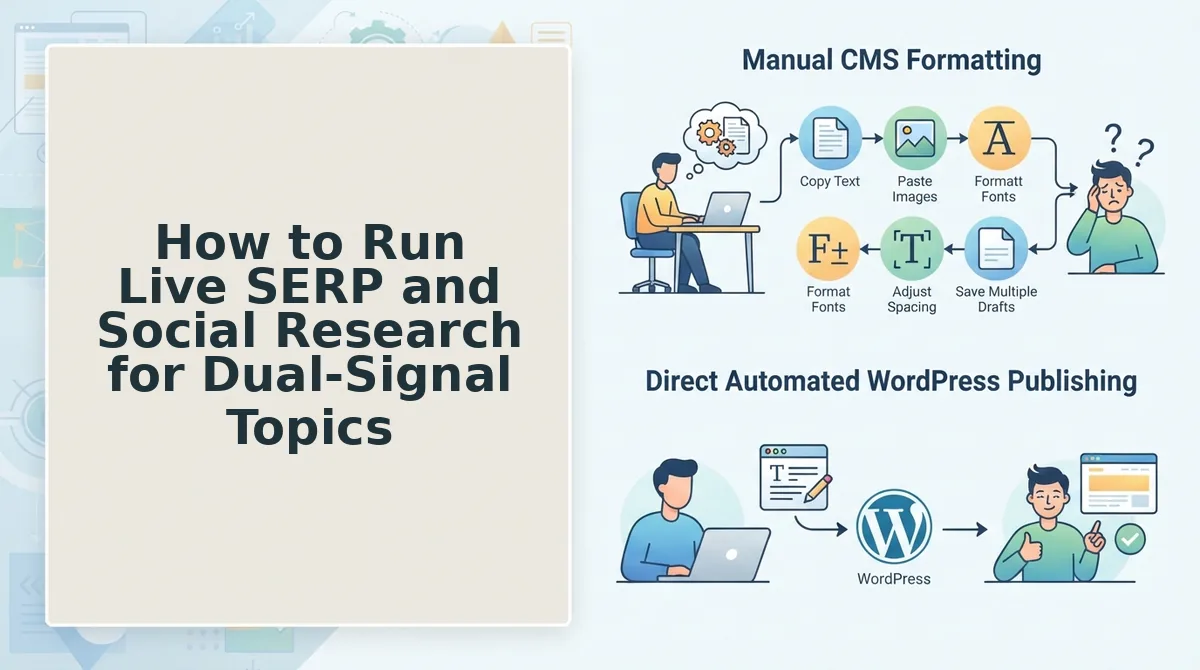
You can research topics for both Google ranking and AI citation in a single workflow by combining live SERP gap analysis with social question mining, then scoring candidates against your 5-factor scorecard. This unified pass saves hours versus running separate keyword and community research sprints.
Prerequisites: A keyword seed list, access to a SERP analysis tool (or BloGoose's live SERP and social topic research), and your 5-factor scorecard from Section 3.
- Pull the top 20 SERP results for your seed keyword. Open your SERP tool and enter the primary keyword. Click Analyze and export the top 20 organic results. You should see a table with URL, word count, headings, and estimated traffic for each result. Scan for thin content under 800 words, missing statistics, and unanswered "People Also Ask" questions, these are your content gaps.
- Mine social threads and video comments for exact user language. Open Reddit, Quora, YouTube comments, and niche Facebook groups. Type your topic into each platform's search bar and filter by Most Recent or Top Comments. Copy 10-15 verbatim questions users ask. You should see recurring phrasing like "how do I actually…" or "does anyone know if…", this is the language AI models train on and quote.
- Score each candidate topic against your 5 factors. Open your scorecard and rate each gap or question on entity clarity, question density, original data potential, answer self-containment, and search volume. Discard anything scoring below 3 on entity clarity. You should see 3-5 candidates emerge as dual-signal winners.
- Validate citation potential with a quick AI probe. Open any AI chat interface and paste the user question. Type: "Answer this in 100 words." If the AI gives a confident, sourced answer, the topic has existing citation demand. If it hedges or says "it depends," you found a gap worth filling. You should see a clear yes/no signal within 30 seconds.
Total time per seed keyword: 45-60 minutes. Educational Hub's video shows AI can accelerate topic discovery, but it doesn't validate citation potential, that final probe step is what separates rankable topics from quotable ones.
The Quotable Passage Test: Validate Your Topic Before You Write
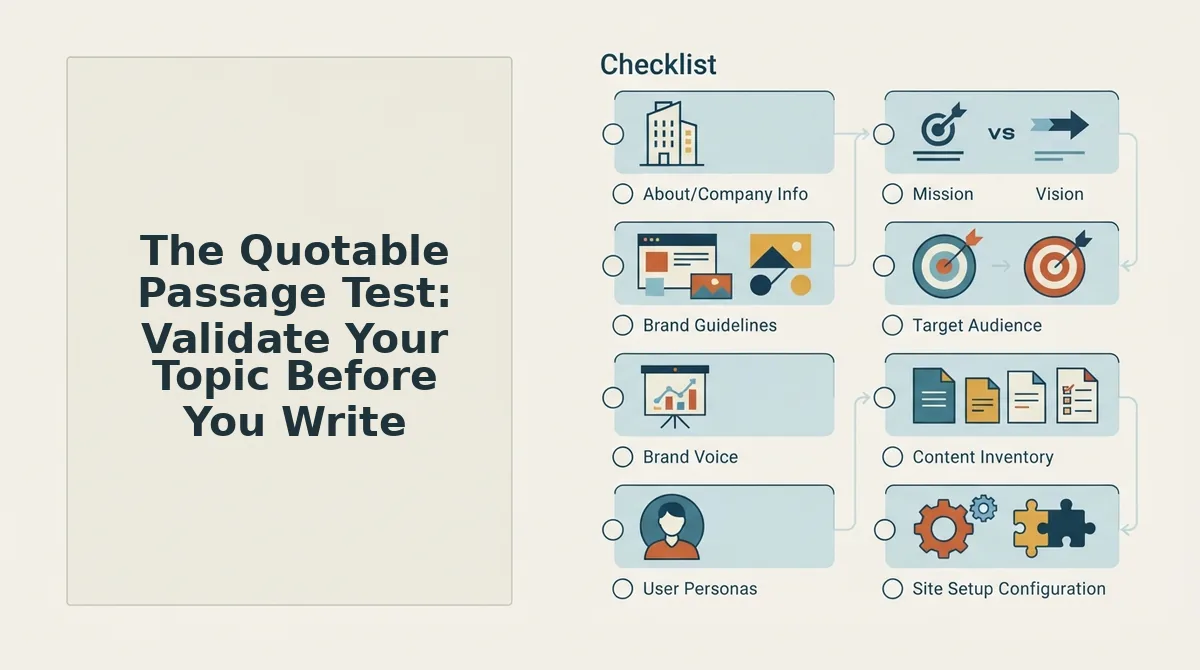
The Quotable Passage Test is a pre-publish heuristic: draft an 80-120 word self-contained answer to your target question, then check whether an AI could lift it verbatim as a complete citation. If the passage needs surrounding context to make sense, the topic has low citation potential.
Prerequisites: Your shortlisted topic from Section 4, your 5-factor scorecard, and 15 minutes per candidate.
- Draft a standalone 80-120 word answer. Open a blank document and write one paragraph that directly answers the user's question. Include a specific entity, a number or stat if available, and a clear conclusion. You should see a passage that reads like a complete answer with no "as mentioned above" or "see below" references.
- Run the red-flag checklist. Read your passage and check for these warning signs: the topic requires lengthy background context, no clear entity is named, no original statistic or data point appears, or the answer is spread across multiple sections of your outline. If two or more red flags appear, the topic likely won't get cited regardless of ranking position.
- Test the passage in an AI interface. Open any AI chat tool and paste your passage. Type: "Would you cite this as a source for [question]?" If the AI confirms it's quotable, proceed. If it asks for more context or rewrites it heavily, revise the passage before committing to the topic. You should see a clear confirmation or rejection within one minute.
Yash Mittra's video warns that using AI wrong gets content ignored, validation matters more than volume. For a deeper look at how to structure articles that pass this test consistently, review our guide on citation-optimized article structure. If you're validating topics manually across dozens of keywords, BloGoose's research workflow automates the SERP gap and social mining steps so you only spend time on the Quotable Passage Test itself.
Google Ranking vs AI Citation: Which Topics Do Both?
Google ranking and AI citation reward different topic characteristics: Google favors broad search demand and domain authority, while AI answer engines favor self-contained answers with clear entities and original data. The overlap zone, topics with question density, named entities, and citable statistics, is where dual-signal content wins.
| Topic Type | Ranks on Google | Cited by AI | Characteristics | Best For |
|---|---|---|---|---|
| Thin definitions | Often | Rarely | Broad overviews, no stats, generic phrasing | Sites with high domain authority covering basics |
| Niche direct answers | Rarely | Often | Highly specific questions, exact user language, no search volume | Authority builders targeting AI visibility over traffic |
| Dual-signal topics | Often | Often | Clear entities, original data, question density, self-contained answers | Publishers who need both organic traffic and AI citations |
Google-only topics are tempting because they show search volume, but thin definitions rarely survive in AI answer engines that prefer sourced, specific claims. AI-only topics can earn citations without meaningful traffic, which suits brand-awareness plays but won't fill a pipeline. The overlap zone is where BloGoose's research workflow focuses: topics that pass the Quotable Passage Test and still carry enough search demand to justify the write.
Understanding which topics live in the overlap zone is the foundation, next, we answer the most common questions about applying this research method to your own content pipeline.
FAQ: Blog Topic Research for AI Citations
Topic research for AI citations means finding subjects with enough search demand to rank on Google and enough quotable, fact-dense material for ChatGPT, Google AI Overviews, and Perplexity to extract and cite. The 5-factor scorecard and Quotable Passage Test cover both signals in one pass.
How do I research blog topics that rank and get cited by AI?
Run a 5-factor scorecard on every candidate: search demand, entity clarity, quotable-stat potential, question density, and passage extractability. Validate the winner with the Quotable Passage Test before drafting. This dual-signal approach filters out topics that rank but never get cited, or get cited but never rank.
What makes a topic quotable by ChatGPT or Google AI Overviews?
A topic is quotable when it contains extractable, self-contained passages: definitions, numbered steps, statistics, or direct answers under 60 words. AI systems pull from content that states a fact in one or two sentences without requiring surrounding context to make sense.
Can one workflow cover both Google ranking and AI citations?
Yes. Start with live SERP and social research to map what Google already rewards, then apply the Quotable Passage Test to confirm the same topic produces extractable answers. Topics that pass both checks are dual-signal: they satisfy search intent and give AI models clean passages to cite.
What tools help with topic research for AI citations?
Use a site crawler to extract your existing content structure and brand voice, a SERP analysis tool to map ranking pages and People Also Ask questions, and a passage-extraction checker to test whether your draft contains self-contained quotable sentences. BloGoose automates this research workflow end to end.
Why does question density matter for AI-cited topics?
Question density measures how many real user questions cluster around a topic in PAA boxes, Reddit threads, and chatbot logs. High question density signals that AI systems actively pull answers for that subject, which increases the odds your content gets cited when you answer those questions directly.
Start Researching Topics That Rank and Get Cited
The gap between ranking and getting cited is not a mystery. It is a research problem with a repeatable solution. The 5-factor scorecard filters candidate topics through search demand, entity clarity, quotable-stat potential, question density, and passage extractability. The Quotable Passage Test then confirms whether a topic can produce the self-contained, 40-60 word answers AI systems actually extract.
Most topic research stops at search volume and competition. That is why most content ranks without ever appearing in an AI answer. The dual-signal workflow closes that gap before you write a single sentence.
Your next step is to run one candidate topic through the scorecard and passage test this week. If you want that research automated, the BloGoose AI content engine crawls your site, extracts your brand voice, and builds topic calendars scored for both ranking and citation potential. For a deeper dive on the citation side, read our guide on how to get cited in AI answers.
The publishers who win the next search cycle will not write more content. They will research topics that earn both rankings and citations before the first draft exists. That advantage is available to you today.