How to Set Brand Voice for Sites With Few Published Posts
Your crawl finds three blog posts, and the AI writer returns robotic mush that could belong to any competitor. That frustration is fair: brand voice for sites with few published posts feels impossible when the model has almost nothing to imitate.
Few posts means little voice signal, so the AI falls back to a generic tone. Brand voice is your stable personality across all content, and tone is that voice adjusted to context, such as a launch post versus a support reply.
You don't need 20 posts to set a usable voice. Extract rules from your homepage, about page, and product pages, then hand-edit them into brand-voice.md, style-guide.md, and writing-examples.md so the AI has a specific personality to copy.
Before you start, collect your homepage, about page, and product page copy, and set aside about 30 minutes for hand editing. First, you'll see which pages carry the most voice, which reveals that your best voice evidence isn't on your blog. Then you'll follow five steps to build each file.
Which Pages Carry Brand Voice When Your Blog Is Nearly Empty?
Your homepage, about page, and product pages carry your brand voice when the blog is nearly empty. Conversion copy already states how you talk, so you can extract rules from it instead of waiting for 20 posts.
A voice source is any published page that reveals how a brand thinks, what it opposes, and how it names things. The Voice Source Ladder ranks three page types from simple to advanced. Each page feeds a different rule type in your brand context files, so together they replace a missing blog archive.
| Page | Signal it carries | Rule type to extract |
|---|---|---|
| About page | Beliefs and stance | Stance rules: what you believe and what you reject |
| Homepage | Positioning and contrast phrases | Contrast rules: what you are versus the alternative |
| Product pages | Terminology and precision | Vocabulary rules: preferred terms and level of detail |
Think of it like learning a new coworker's personality from three meetings. Lunch shows their beliefs, a debate shows what they push back on, and a project review shows their vocabulary.
How do you turn homepage copy into a voice rule? BloGoose's homepage positions the product against "another chat window with hopes" and the "12-tab content stack," which shows a habit of naming a concrete pain in plain contrast instead of making abstract claims. In brand-voice.md, that habit becomes a rule: DO name the concrete pain in plain contrast, such as tabs, tools, or manual loops, and DON'T use inflated startup jargon like "revolutionary" or "next-gen synergy." One homepage line now steers every draft the AI writes, with no blog archive required.
Before you write rules, review these brand context file mistakes so you don't copy sales pressure into your editorial voice. BloGoose's site crawl inspects these published pages automatically and drafts voice rules as a starting point.
How to Set Brand Voice for AI Writing With Only a Few Posts
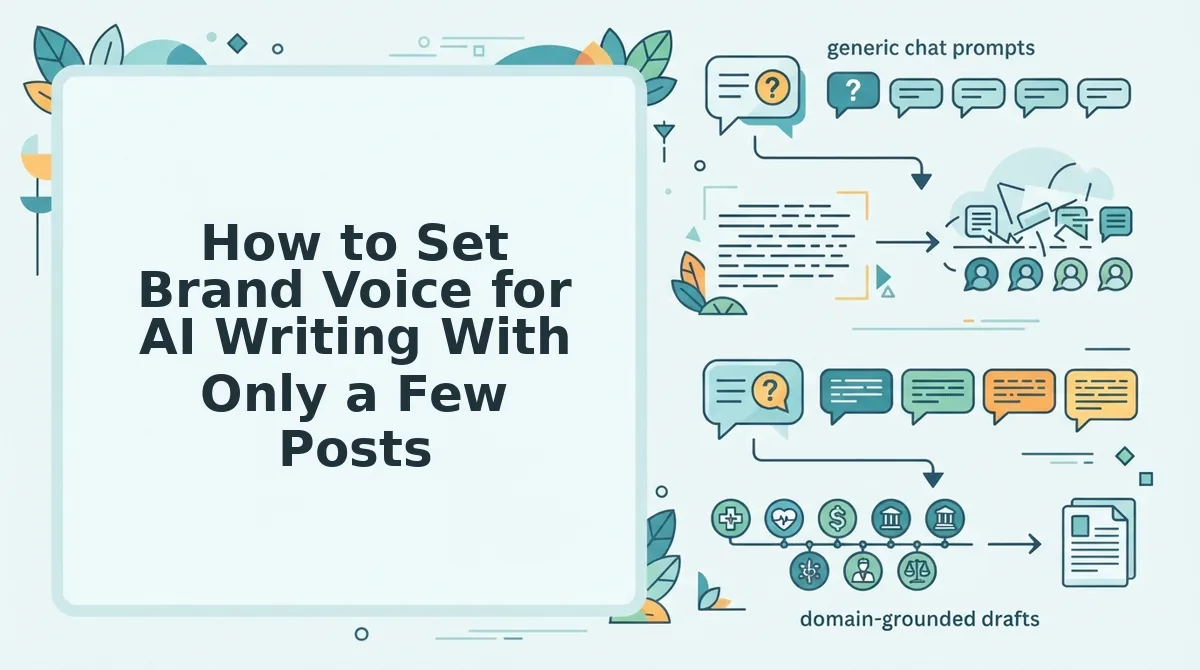
Set brand voice on a thin site in three moves. Crawl your core pages, strip out the sales pressure, and hand-edit three files: brand-voice.md for traits, style-guide.md for rhythm, and writing-examples.md for reference paragraphs. The whole pass takes about 30 minutes once your homepage, about, and product copy are collected.
Why do 2-3 hand-edited examples beat a large archive of posts? Writing examples are reference paragraphs that a model imitates sentence by sentence. If you feed it many off-voice posts from different freelancers or older AI drafts, it averages their conflicting habits and drifts back to a generic tone. A few paragraphs you edited yourself give the model one consistent pattern for sentence length, stance, and word choice, so a small, clean sample beats a big, noisy one.
Prerequisites: homepage, about page, and product page copy, any Markdown editor, and about 30 minutes.
- Crawl your site and collect core copy (5 minutes). Enter your domain in the BloGoose setup wizard, or open each page manually. Paste the homepage, about, and product page text into one document. Success looks like three labeled blocks of copy, ready to mine.
- Strip the sales pressure (5 minutes). Rewrite each homepage line so it keeps the stance and drops the CTA push. Joanna Wiebe's challenger-voice idea is a useful lens: don't sound like your competitors, and don't sound like nobody.
- Before: "Ditch the 12-tab content stack. Start your free trial today!"
- After: "Most teams run a 12-tab content stack. One engine can replace it."
- Hand-edit the DO/DON'T traits in brand-voice.md (10 minutes). Write at least one DO and one DON'T rule for each trait. For example, Direct and Pragmatic becomes "DO lead with the outcome." Confident and Plainspoken becomes "DON'T hedge or say 'leverage.'" Success looks like every trait having a rule you can check against a draft.
- Set rhythm and formatting rules in style-guide.md (5 minutes). Define sentence length, paragraph length, heading style, and when to use lists. Success looks like rules you can answer with yes or no, such as "Paragraphs stay at 1-3 sentences."
- Write 2-3 example paragraphs in writing-examples.md (5 minutes).
How to Check Your Brand Voice Setup Worked
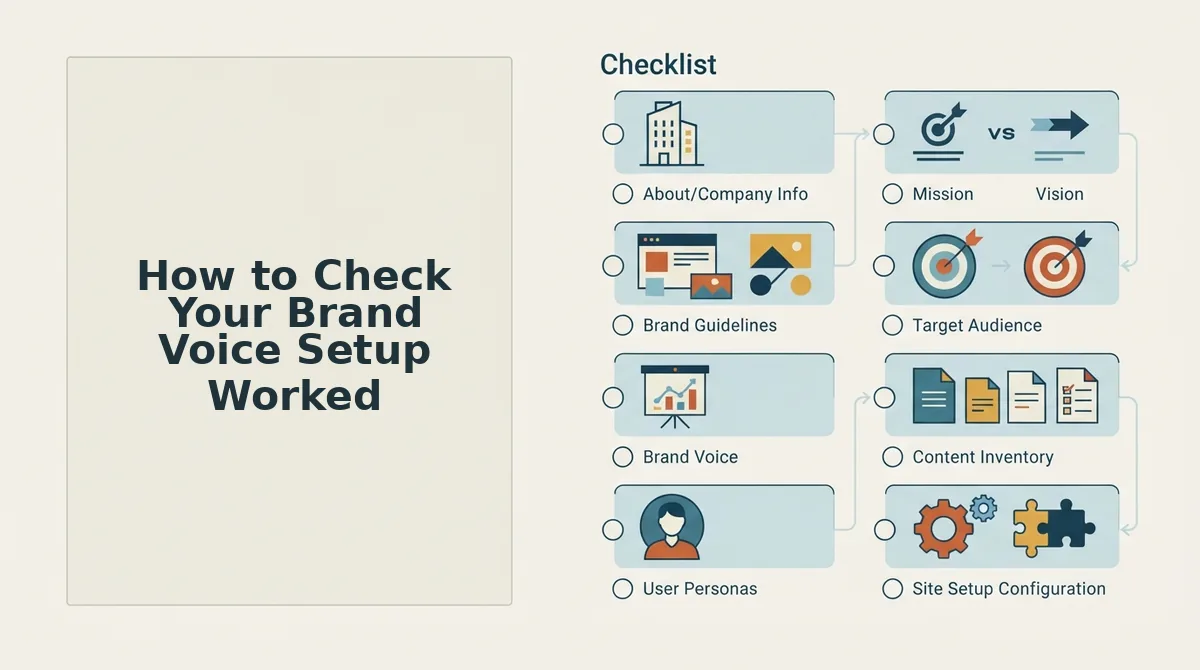
Generate one test draft and read it line by line against the DO/DON'T list in brand-voice.md. Each rule the draft breaks points to a specific file to fix, so you edit one source instead of rewriting prompts.
A manual read is slower than running a readability score. It does catch tone problems that a score cannot see, such as hype words or claims you never make. Use this table to trace each problem to its file.
Symptom in test draft File to open Fix Best for Generic, could-be-anyone tone style-guide.md Add sentence-length, person, and formality rules Solo operators with no editor Wrong jargon or banned terms brand-voice.md (DON'T list) List the exact words and phrases to avoid Founders in technical niches Flat, monotone rhythm writing-examples.md Swap in a sample that has the cadence you want Content publishers who care about style Off-topic or inflated claims features.md Correct or remove capabilities that are vague Growth leads and DTC brands Worked example: tone drift traced to an empty DON'T list
A test draft opens with "In today's fast-paced digital landscape" and calls a feature "game-changing." The DO list in brand-voice.md is complete, but the DON'T list is blank. The model had no boundaries, so it fell back on stock filler.
The fix is to add 3 to 5 explicit bans, such as "No scene-setting openers" and "No hype adjectives." Then regenerate the draft from the same brief and compare the two versions. When your site changes later, update brand context files before you run another test.
FAQ
How many writing examples are enough?
Two or three strong examples are usually enough. The model copies patterns, so one off-voice sample can pull every draft toward it. A few tight, representative pieces teach rhythm better than many uneven ones, and they leave fewer mixed signals.
Should I update voice files as I publish more posts?
Yes. When a new post needs only light edits and readers respond well to it, swap it in as an example. Replace your weakest hand-written sample first. Over time, your examples will reflect how your published work actually sounds.
Is homepage copy too salesy to use as a voice source?
No, as long as you calibrate it first. Keep the vocabulary, point of view, and sentence style. Remove the urgency, the superlatives, and the calls to action. Blog content informs the reader, and homepage copy converts, so remove the sales pressure before you write rules from it.
What's the difference between brand voice and tone?
Voice is your constant personality, meaning the words, values, and perspective you always use. Tone is how that voice adapts to the context. For example, a troubleshooting guide sounds calmer than a launch post. Your voice files define the voice, and each brief sets the tone.
Start With the Copy You Already Have
A thin blog is not a voice problem. The voice is already present in your homepage, about page, and product pages. It just hasn't been written down as rules.
Follow the Voice Source Ladder in one line: pull rules from those three pages, remove the sales pressure, and hand-write 2 to 3 examples to fill the gaps. Then run one test draft and use the symptom table to fix anything that drifts.
Your next step is to crawl your site with the AI SEO content engine at BloGoose. Review and edit the brand context files it generates before you schedule your first article. Every post you publish after that adds to the voice you defined at the start.