
How to Build a Style Guide from Your Website Crawl
Your last five articles sound like they were written by five different people, and your AI drafts sound like nobody at all. That inconsistency isn't a talent problem; it's a documentation problem. Most teams never write down how they actually sound, so every new writer and every AI prompt starts from scratch.
You're right to be frustrated. The fix isn't another generic "brand voice" workshop or a 40-page PDF nobody reads. The fix is to build a style guide from your website crawl, extracting the tone, rhythm, and formatting rules already living in your published pages, then compiling them into an editable file your whole team can use.
Here's the roadmap: first, you'll see exactly what a crawl extracts and why it beats manual documentation. Then, you'll follow a five-step workflow that turns your domain into a working style guide. Along the way, you'll learn why BloGoose, an AI-powered SEO content engine, runs this crawl on every customer domain and generates 8 editable Markdown context files, including a style-guide.md you can edit immediately.
One surprising finding ahead: the pages that reveal your true voice aren't your blog posts. They're your pricing and feature pages, and most teams never think to look there.
What a Website Crawl Actually Extracts for a Style Guide
A website crawl for style-guide purposes is an automated scan of your published pages that identifies and catalogs the linguistic and formatting patterns that make your content recognizably yours. It turns your existing writing into a repeatable set of rules.
Think of it like a sommelier tasting every bottle in your cellar to write down what defines your house blend. The crawl "tastes" your homepage, pricing page, feature pages, and blog posts, then records the consistent notes: sentence length, word choice, punctuation habits, and structural tics.
Here's what a crawl extracts, in order of complexity:
- Tone markers, the adjectives and emotional register you default to. Are you "straightforward" or "playful"? The crawl counts these signals across pages.
- Sentence rhythm, average sentence length, use of fragments, and paragraph density. Short, punchy sentences signal a different voice than long, clause-heavy ones.
- Jargon density, how many industry-specific terms appear per 100 words, and whether you define them inline or assume reader knowledge.
- Formatting conventions, heading capitalization, list usage, bold and italic patterns, and how you structure calls to action.
- Pronoun rules, first person plural ("we") versus second person ("you") versus third person, and where each appears.
A website crawl extracts tone markers, sentence rhythm, jargon density, formatting conventions, and pronoun rules from your published pages, then compiles them into an editable style-guide.md. The crawl doesn't invent rules, it observes what you already do consistently and writes those observations down.
One critical nuance: tone extraction works best with 10 or more published pages. Below that threshold, the sample is too thin to separate genuine patterns from one-off choices. Multi-author sites need an extra step, human review of the generated style guide, because the crawl will surface contradictions between authors that require an editorial decision, not an automated one.
The most reliable extraction sources are your homepage, pricing page, and feature pages, not blog posts. These conversion-focused pages carry the most deliberate voice decisions, because someone sweated over every word before publishing.
The 5-Step Crawl-to-Style-Guide Workflow
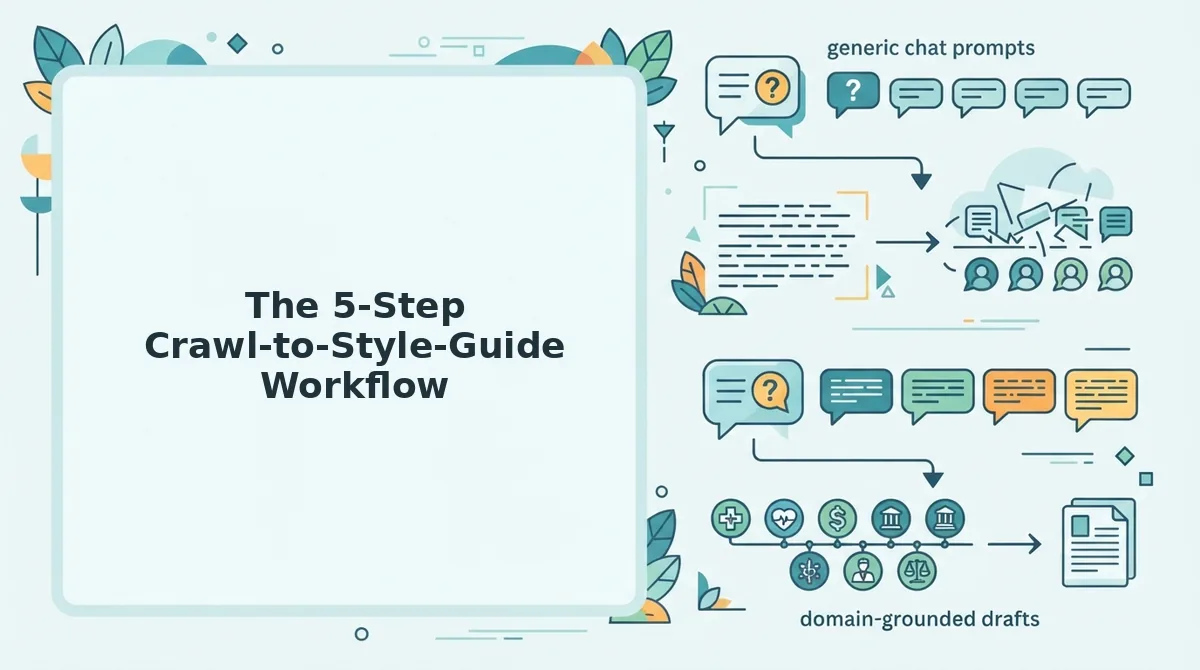
You can turn any domain into a working style guide in under an hour using a crawl-based pipeline. The process requires a crawl tool or an AI-powered SEO content engine that automates the extraction, plus a domain with at least 10 published pages for reliable tone detection.
- Drop your domain into the setup wizard. Enter your website URL and let the crawler begin. You should see a confirmation that the domain was accepted and the crawl has started scanning your site structure.
- Locate and verify your XML sitemap. The crawler checks for a sitemap at standard paths like
/sitemap.xml. If found, it uses the sitemap to prioritize which pages to inspect. If no sitemap exists, the crawler falls back to following internal links, a slower path that may miss orphaned pages. You should see a status message confirming which method was used. - Inspect published pages for voice patterns. The crawler reads your homepage, pricing page, feature pages, and blog posts, extracting tone markers, sentence rhythm, jargon density, formatting conventions, and pronoun rules. This step takes 2-5 minutes depending on site size. You should see a progress indicator as pages are processed.
- Generate the editable Markdown context files. The pipeline produces 8 files: style-guide.md, target-keywords.md, competitor-analysis.md, writing-examples.md, internal-links-map.md, and seo-guidelines.md, plus two additional context files for brand and audience data. Each file is plain Markdown you can open, edit, and commit to your repo. You should see a download or export confirmation listing all 8 files.
- Review and refine the style guide. Open style-guide.md and check the extracted rules against your intuition. Multi-author sites should have an editor reconcile contradictions, for example, if one author uses "we" and another uses "I," the guide needs a single ruling. The pipeline detects your CMS and technical stack during this step, tailoring the generated style guide for direct publishing to WordPress or your custom API. You should see a CMS detection note in the output.
The pipeline detects the CMS and technical stack to tailor the generated style guide for direct publishing. This means the style-guide.md you receive is already formatted to work with your publishing workflow, not a generic template you have to adapt manually.
Once your style-guide.md exists, the real question is what belongs inside it.
What Goes Inside a style-guide.md (Real File Structure)
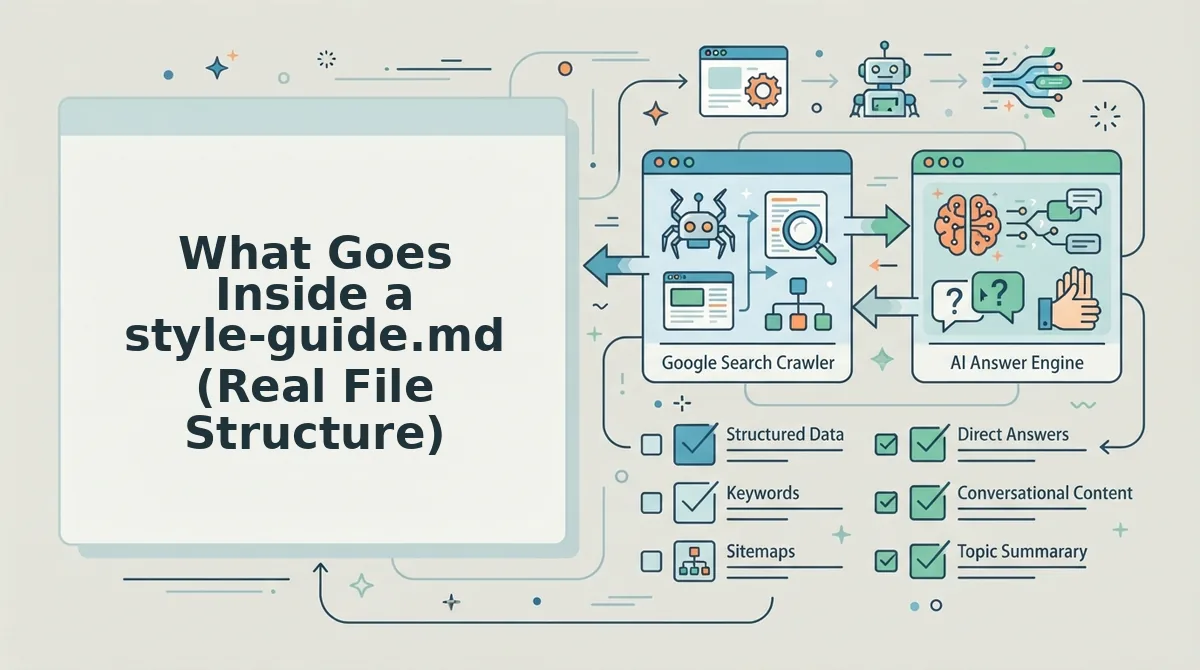
A production-ready style-guide.md is one of eight editable markdown brand context files that together define how your site sounds, ranks, and converts. Each file is plain Markdown, so teams can refine rules before the next draft without touching the pipeline.
- style-guide.md, the master voice and tone rulebook. This file holds sentence-length ranges, pronoun policy, banned words, and formatting conventions. It matters because every draft checks against it, and it is the single source of truth when a writer or AI agent questions a phrasing choice.
- target-keywords.md, the search-intent map. This file lists primary, secondary, and long-tail keywords tied to specific URLs and funnel stages. It matters because it prevents keyword cannibalization and keeps every article pointed at a page that already matters to your conversion goal.
- competitor-analysis.md, the gap and differentiation ledger. This file records what ranking competitors cover, where they are thin, and what angle your site owns. It matters because it turns a crawl into a positioning decision instead of a mimicry exercise.
- writing-examples.md, the annotated sample bank. This file stores 5-10 crawled passages that best represent your voice, each with a one-line note on why it works. It matters because concrete examples outperform abstract rules when training writers or AI drafts.
- internal-links-map.md, the cluster architecture. This file maps pillar pages to supporting posts and records anchor-text conventions. It matters because internal linking is the highest-leverage on-page signal most style guides ignore.
- seo-guidelines.md, the technical and on-page rules. This file covers title tag patterns, meta description length, heading hierarchy, and schema expectations. It matters because voice consistency without technical consistency still loses rankings to sites that enforce both.
- cms-context.md, the publishing environment spec. This file documents your CMS fields, category taxonomy, author profiles, and any required plugins or blocks. It matters because a style guide that ignores the CMS produces drafts that break at publish time.
- brand-voice.md, the positioning and audience contract. This file captures who you serve, what job they hire you for, and the emotional register you commit to. It matters because it anchors every other file to a business outcome, not just a tone preference.
How to Spot Voice Drift Across Your Crawled Pages
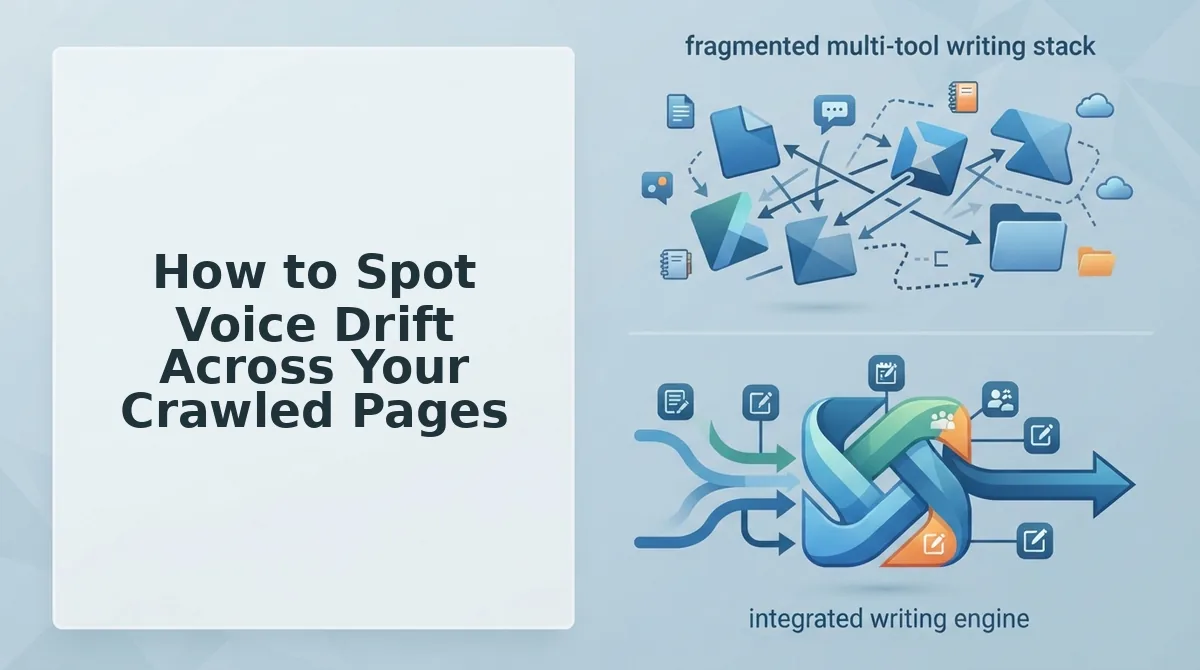
Most guides assume your site has one consistent voice, but real multi-author sites drift. A crawl captures published voice, not aspirational voice, so you need a diagnostic before trusting the output.
Prerequisites: A completed site crawl with page-level text extracted, plus a spreadsheet or the BloGoose crawl report open. Budget 20-30 minutes for a 50-page site.
- Export the crawled text and sort pages by author or publish date. Open your crawl report and group pages by the author field or date range. You should see clusters that correspond to different writers or content eras, these are your drift candidates.
- Compare average sentence length across the top 10 pages per cluster. Copy three paragraphs from each cluster into a word counter and note the mean sentence length. You should see a spread of more than 5 words between clusters if drift exists; flag any cluster that deviates from your style-guide.md target range.
- Check pronoun usage per cluster. Search each cluster for first-person singular ("I"), first-person plural ("we"), and second-person ("you") frequency. You should see one dominant pattern; mixed patterns across clusters signal that different authors wrote to different imagined readers, a common brand context extraction mistake.
- Measure jargon density with a simple ratio. Count industry-specific terms per 500 words in each cluster. You should see a consistent ratio; a cluster with 3x the jargon of others is either targeting a different audience or was written without the style guide.
- Flag outliers and route them for human review. Mark any cluster that fails two of the three checks. You should end with a short list of pages to rewrite or exclude from your writing-examples.md file before the next draft cycle runs.
If this manual pass feels slow, BloGoose runs the same drift checks automatically during the crawl-to-style-guide pipeline and surfaces outliers before any article is drafted.
FAQ
How do I build a style guide from a website crawl?
Crawl your site to extract published pages, then analyze sentence length, pronoun usage, jargon density, and formatting patterns across at least 10 pages. Group findings into editable Markdown files covering voice, keywords, competitors, examples, links, SEO rules, CMS specs, and brand positioning. Review outliers manually before finalizing.
What should a style-guide.md file contain?
A style-guide.md should contain sentence-length ranges, pronoun policy, banned words, formatting conventions, and tone rules with annotated examples. It works best as one of eight linked Markdown context files, including target-keywords.md, writing-examples.md, and internal-links-map.md, that together define voice and ranking behavior.
Can brand voice extraction be automated?
Yes. BloGoose automates the crawl-to-style-guide pipeline by extracting brand voice rules from your published pages and outputting editable Markdown files. The crawl needs at least 10 published pages to detect tone reliably, and multi-author sites still benefit from a human review pass before drafts are generated.
Why does my site's voice sound different on older pages?
Voice drift happens when different authors, eras, or content strategies produce inconsistent sentence length, pronoun usage, or jargon density. A crawl exposes this drift because it captures published voice, not aspirational voice. Flag outlier clusters and exclude them from your writing examples before training the next draft.
The Crawl-to-Style-Guide Workflow Pays Off in Every Future Draft
You started with a question: can a website crawl produce a style guide that actually sounds like you? The answer is yes, and the 8-file framework is what makes it repeatable. Each Markdown file captures a different layer of your brand: voice rules, terminology, formatting quirks, citation preferences, and the sentence rhythms your best pages already use.
The real payoff isn't the crawl itself. It's what happens after. Every future article inherits those rules automatically, so your content stops drifting toward generic AI mush and starts compounding into a recognizable, quotable body of work.
Here's the workflow in one breath:
- Crawl your live domain. BloGoose extracts brand context from your sitemap and published pages.
- Review the 8 generated Markdown files, edit anything that feels off, then lock it in.
- Publish with the style guide active, every draft stays voice-accurate without manual prompting.
Drop your domain into BloGoose and get a style guide generated from your live site in minutes, not weeks of manual documentation. From there, the same engine produces citation-optimized articles that sound like you on page one and in AI answers.
A style guide built from your actual crawl doesn't just describe your voice, it becomes the operating system for every sentence you publish next.