Byword Indexing Workflow Comparison for Automated Search Pings
You export dozens of newly generated articles to your CMS, check your server logs days later, and discover zero search engine bot visits. Bulk generation solves production speed, but a practical byword indexing workflow comparison shows that content pipelines stall the moment discovery is left entirely to passive XML sitemaps.
Waiting for standard search engine crawlers to discover unlinked URLs naturally can leave complete article clusters stranded for weeks. Integrating proactive pings directly into your publishing loop ensures search engines are notified the minute an export completes. This guide outlines how automated ping protocols match up against passive indexing setups so you can eliminate deployment bottlenecks across your sites.
Consider this standard deployment scenario:
- Situation: An operator publishes a full pillar cluster directly to WordPress using an AI SEO content engine, but leaves discovery to the default sitemap.
- Action: The publisher configures automated search engine ping requests triggered immediately upon API export rather than waiting for scheduled crawler sweeps.
- Outcome: Search engines receive direct endpoint notifications for fresh URLs instantly, bypassing the discovery delay inherent in passive XML feeds.
While direct notification accelerates crawler awareness, indexing itself remains subject to search engine quality systems and crawl quotas. Later in this comparison, you will see why pinging every URL at once can trigger unexpected crawl-rate throttling on newer domains.
Recognizing where these integration boundaries exist determines which teams benefit most from automated discovery.
Who Needs an Automated Search Indexing Workflow?
An automated search indexing workflow is necessary for programmatic publishers, digital agencies, and solo founders who publish content velocity that exceeds manual submission capacities. Without automated pings, high-volume publication schedules encounter extensive indexing lag that leaves pages invisible to organic search.
An automated search indexing workflow is an integrated system that alerts search engine crawlers immediately after new content is published or updated. Think of it like a courier hand-delivering a newly printed manuscript directly to the central catalog, rather than leaving it on a doorstep hoping an inspector wanders by. High-output publishing without systematic bot notification turns every newly pushed URL into unmonitored technical debt.
Do not confuse this mechanism with internal AI embeddings. While a vector database indexes semantic text for internal language model retrieval, automated search engine pinging operates externally, actively signaling public web bots to inspect, crawl, and catalog HTML resources.
High-volume output fails if discovery stalls:
- Content acceleration outpaces crawling: Producing dozens of articles across topical clusters creates silent backlog if engines do not discover newly deployed URLs.
- Resource depletion: Without targeted pings, search bots expend discovery time on older paths instead of fresh output, resulting in severe crawl-budget waste.
- Multi-tool management fatigue: Handling keyword software, standalone generators, and individual submission consoles drains operational focus away from content architecture.
To avoid fragmented publishing stacks, operators can connect an end-to-end platform like BloGoose to automatically inspect sitemaps, generate brand-aligned articles, and ship them directly to a CMS destination. Modern search infrastructure demands direct technical integration at the point of delivery.
How Byword Pushes Content to Search Engines
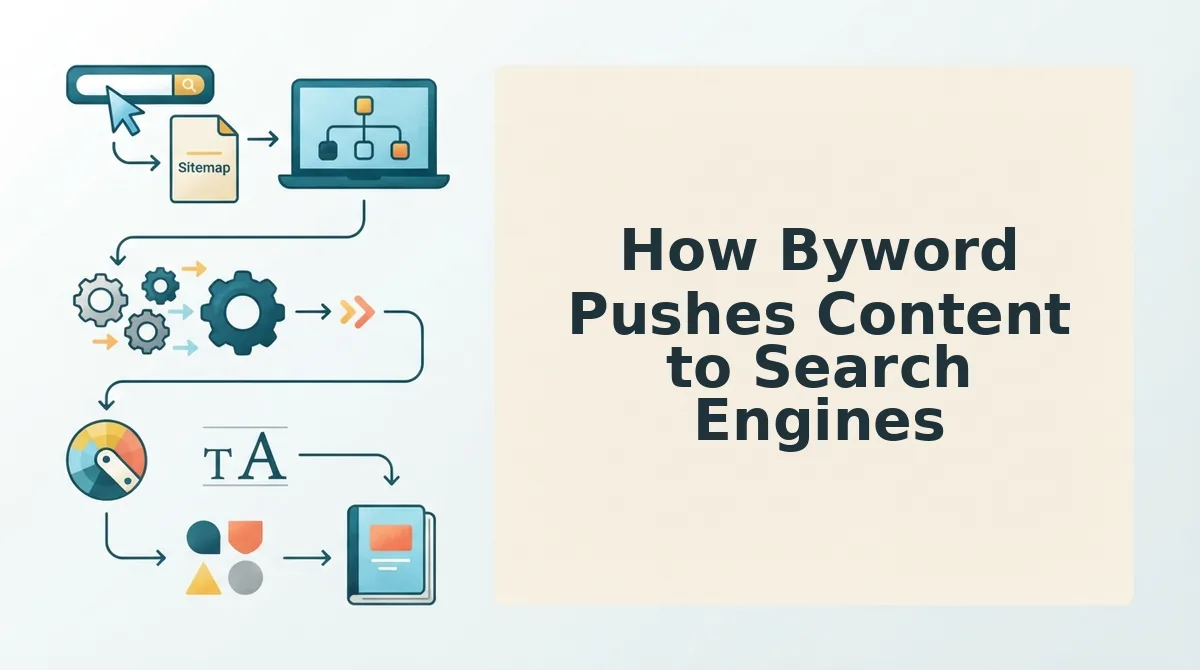
Byword pushes content to search engines by exporting generated drafts directly to your CMS and relying entirely on external plugins, Zapier webhooks, or passive XML sitemaps to notify search bots. Because its core platform handles article generation rather than automated index pings, you must manually bridge the gap between CMS delivery and search engine discovery.
Consider the typical handoff. You generate twenty articles, send them downstream to WordPress, and immediately realize that zero search crawlers know those URLs exist until external pipelines fire.
A post-publish search ping is an automated webhook notification sent to search engine APIs alerting crawlers to index a newly published URL. Before attempting this setup, make sure you have active admin access to Byword, an active Zapier account, administrator credentials on your WordPress CMS, and an external indexing API key.
- Navigate to the Byword dashboard and click Integrations to select your connected CMS endpoint. Your selected site should display a status of connected with an active green sync indicator. (Estimated time: 1 minute)
- Open Zapier and click Create Zap using WordPress: New Post Published as your trigger event. Select your WordPress URL from the dropdown to confirm the webhook connection test passes. (Estimated time: 3 minutes)
- Select your designated external indexing service as the action app inside Zapier and paste your indexing API key into the authorization field. A successful authorization shows an active account confirmation checkmark. (Estimated time: 2 minutes)
- Map the live article URL field from your WordPress trigger step into the target URL payload of the indexing action. Run a test step to confirm the endpoint returns a successful status 200 response. (Estimated time: 2 minutes)
- Turn on the Zapier automation and monitor the first batch of generated articles delivered by Byword. Each new live post in WordPress will now trigger the external ping sequence within five minutes. (Estimated time: 1 minute)
Byword focuses on generation and CMS delivery, leaving search engine crawl notifications to third-party integrations or passive sitemaps. When managing large-scale publishing pipelines through Byword bulk content publishing workflows, relying on a disconnected export-first setup creates friction points that require continuous maintenance across multiple software layers.
These extra webhook handoffs highlight the fundamental technical split between decoupled publishing engines and integrated crawling architectures.
Architectural Comparison Between Byword and Native Search Engine Pinging
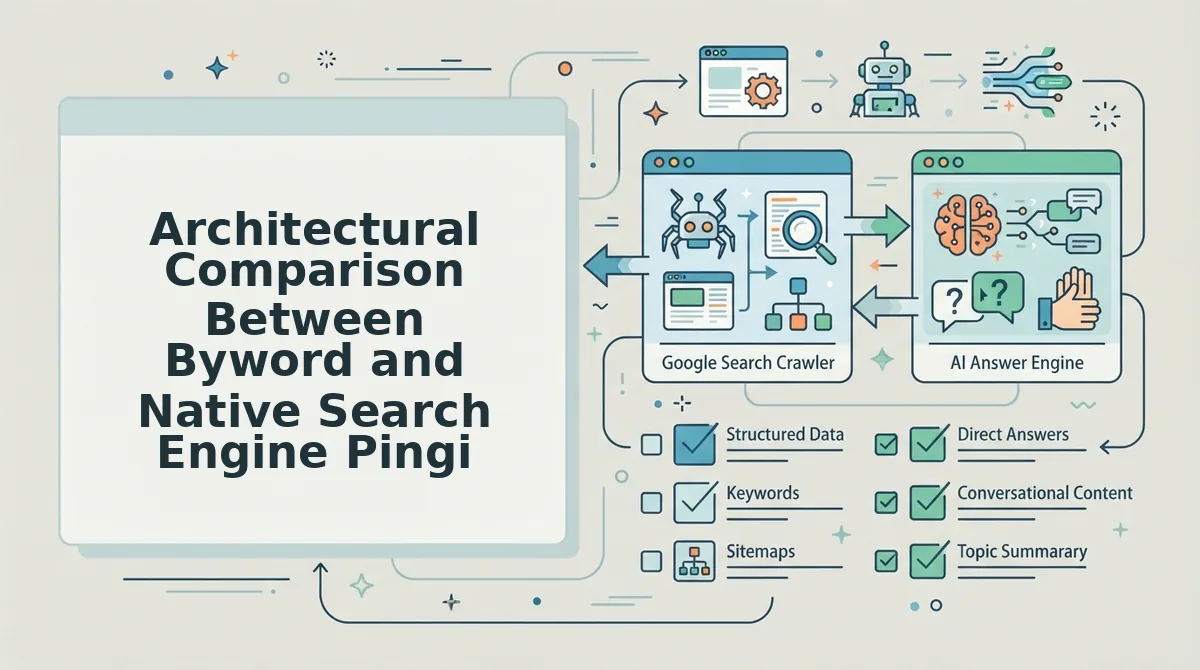
The core architectural difference between Byword and native search engine pinging lies in whether indexing dispatches run through external middleware integrations or directly via automated API calls at the moment of publication. Native search engine pinging is an automated publishing architecture that dispatches instant crawl requests to search bots via direct API endpoints the moment content deploys to a CMS.
Byword excels at large-scale, prompt-driven drafting with direct export integrations to WordPress and Webflow. However, handling indexing from that workflow requires chaining third-party webhooks, Zapier connections, or WordPress indexing plugins that rely on standard XML sitemap update pings. While Byword provides an efficient drafting engine for raw volume, operators must maintain multi-tier subscriptions across writing tools, integration middleware, and separate indexing services to complete the delivery loop.
In contrast, an integrated AI SEO content engine handles generation, publishing, and direct search dispatch within a single infrastructure. Rather than waiting for bot crawlers to passively re-read modified sitemap feeds, it executes direct API service account requests immediately upon deployment.
| Architectural Dimension | Byword + Middleware Stack | Native Direct Pinging Engine |
|---|---|---|
| API Dependencies | Requires multi-tool stacks (Drafting tool + Webhooks/Plugins + Indexing service) | Unified pipeline with direct search engine endpoints built in |
| Dispatch Mechanism | Standard CMS XML sitemap ping loops or external webhook triggers | Direct API service account requests and real-time IndexNow dispatches |
| Maintenance Overhead | High; multiple failure points across API keys, CMS plugins, and middleware tiers | Zero external middleware maintenance; single execution workflow |
| Cost Structure | Multi-tier subscriptions across content, connection, and indexing tools | Consolidated platform cost covering production through indexing |
| Best Suited For | Teams with established webhook pipelines wanting purely decoupled generation | Growth teams and solo operators needing automated end-to-end delivery |
Why tolerate fragile webhook glue when your publishing pipeline can communicate directly with search crawlers?
Direct API service account requests eliminate the typical discovery delay inherent in passive XML sitemap polling. Setting up how to ask google to crawl new posts via indexing api natively ensures your content pushes directly to search engines without stack sprawl or manual spreadsheet tracking.
Our Recommendation
Choose Byword if you manage complex custom workflows requiring raw text output routed into specialized staging environments. Choose an all-in-one engine like BloGoose if you want an autopilot platform that turns site structure into rank-ready content published directly to WordPress with automated indexing built in.
Examining the exact network calls demonstrates how direct crawl dispatching functions under the hood.
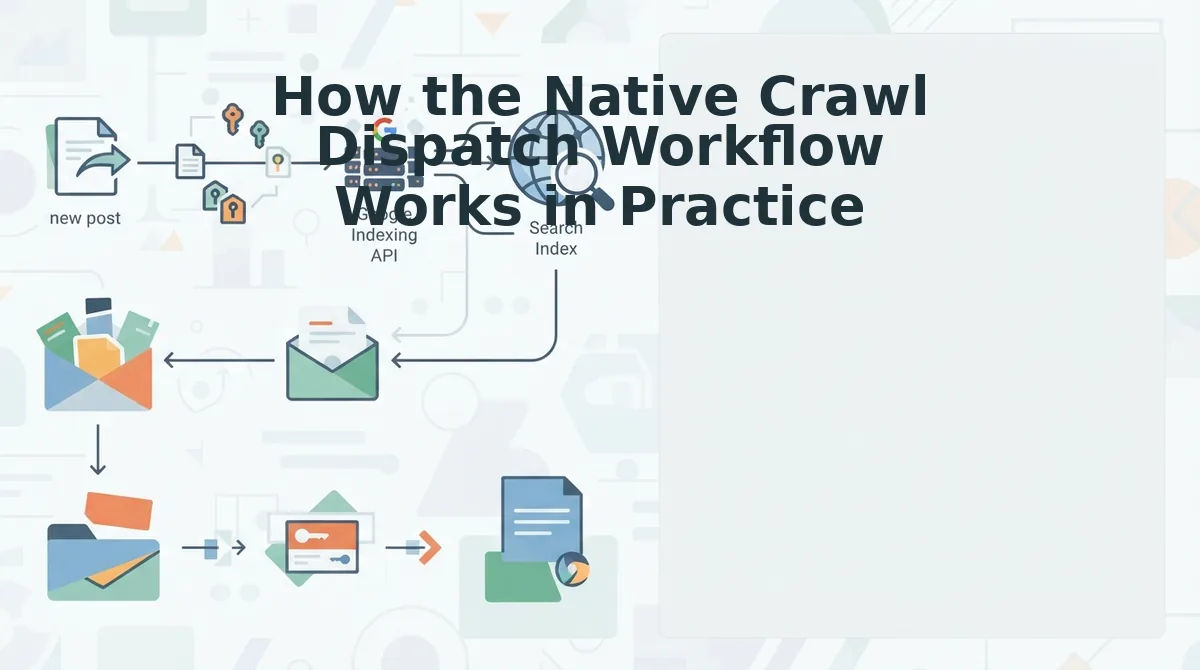
How the Native Crawl Dispatch Workflow Works in Practice
The native crawl dispatch workflow operates by linking automated draft generation directly to publishing hooks, transmitting crawl requests to search engines the instant content deploys. This closed-loop architecture eliminates the need for manual console submissions or middleman middleware.
Native crawl dispatch is an automated indexing pipeline that triggers search engine notification protocols directly from the publishing engine. Instead of configuring third-party automations across disparate tools, publishing an article pushes updates to your CMS and fires indexing requests simultaneously.
Before beginning, ensure you have an active BloGoose account, connected WordPress or custom API credentials, and your validated Google Indexing API configuration.
- Enter your target domain into the site setup wizard. The engine locates your XML sitemap and maps existing page topics within two minutes, showing a green confirmation checkmark once structural analysis finishes.
- Select your generated content cluster inside the calendar dashboard. Choose the target keyword set and click Generate Articles to produce draft content matched to your extracted voice guidelines.
- Click the Publish button on the completed draft screen. This action transmits formatted HTML directly to your CMS while BloGoose executes native service account calls to search engines, bypassing webhook setup while respecting endpoint rate limits.
- Open the execution log under Publishing History. You will see a timestamped success status showing verified CMS delivery and completed search engine dispatch notifications.
Consider this standard publishing scenario: A publisher schedules five cluster articles targeting search queries. When clicking publish, BloGoose simultaneously sends the finished markup to WordPress and dispatches immediate crawl requests through the background API integration. The content appears on the live site while search bot dispatch completes automatically without requiring manual URL inspection tools or Zapier triggers.
Running high-volume programmatic output requires strict attention to the operational thresholds enforced by search endpoints.
Limits, Quotas, and Safety in Automated Programmatic Indexing
Automated programmatic indexing safety requires balancing submission limits, protocol rules, and strict content evaluation standards rather than treating search engine pings as a guaranteed path to visibility. Programmatic indexing accelerates crawl discovery, but crawl discovery does not ensure ranking eligibility or index retention on quality-conscious search engines.
Pinging search engines at scale without technical restraint triggers algorithmic filters and wastes crawl budget. What happens when automation outpaces relevance?
- Google Indexing API daily quota caps govern the maximum volume of automated publish and update requests a site can dispatch every 24 hours. Exceeding these standard account thresholds triggers request rejections and drops pending notifications entirely. Manage your schedule by distributing publishing calls evenly through an automated queue rather than sending batch bursts that exhaust the API limits immediately.
- Crawl acceleration versus ranking eligibility represents the architectural boundary between page discovery and inclusion in the searchable index. A successful API handshake only guarantees that a bot schedules your URL for retrieval, not that the content meets the threshold for search visibility. Track organic impressions in Search Console rather than raw ping confirmations to measure true indexing health.
- IndexNow protocol submission limits restrict the frequency and aggregate volume of URLs shared across participating search engines like Bing and Yandex. Blasting repetitive batches of unchanged URLs depletes crawl priority and risks temporary IP throttling across verification endpoints. Configure your CMS to dispatch notifications only when genuine content creation or major page modifications occur.
- Search quality and topical relevance safeguards evaluate programmatic URLs against algorithmic anti-spam systems after crawl execution takes place. Submitting thin, disconnected pages in rapid succession trips automated spam filters regardless of delivery protocol integrity. Align automated publishing schedules with strict search quality compliance guidelines to protect overall domain authority.
- Internal link graph validation dictates whether search bots discover supporting authority signals after landing on a pinged destination. Dispatched endpoints that lack incoming contextual links appear as low-value orphan assets to search crawlers. Build contextual site structure and topic cluster links before triggering outbound indexing signals to external engines.
- HTTP response status health checks confirm that target destination URLs load with valid headers before external endpoints receive submission alerts. Pinging search bots to canonical URLs that serve temporary redirects or unresolved 404 errors rapidly degrades domain crawl trust. Run automated status checks within your publishing platform to verify that only clean 200 HTTP codes trigger indexing pings.
Understanding these mechanical constraints helps operators troubleshoot edge cases across different content generation models.
Frequently Asked Questions About Search Indexing Workflows
Automating crawl signals requires understanding the strict technical boundaries between distinct search engine submission protocols and programmatic publishing software.
What is the difference between IndexNow and the Google Indexing API?
IndexNow notifies participating engines like Bing and Yandex immediately when URLs change, whereas the Google Indexing API strictly handles JobPosting and BroadcastEvent structured data. Submitting standard blog pages through Google's API violates technical guidelines, while IndexNow accepts standard editorial URLs through open API keys without manual bot validation steps.
Does Byword natively submit search pings without third-party plugins?
Byword generates and exports articles but does not natively dispatch automated crawl requests to search engines upon publication. Teams relying on Byword must integrate third-party CMS plugins, custom webhooks, or external ping tools to notify search crawlers when newly generated content goes live on their domain.
Why does Google ignore programmatic indexing API pings for standard blog posts?
Google restricts its Indexing API to short-lived content types to prevent spam and resource exhaustion across its web crawler pool. The automated dispatch system evaluates page entity schemas:
- Invalid content types get dropped silently without search evaluation.
- Approved JobPosting schemas trigger rapid bot visits within hours.
How do I automate search engine indexing for high-volume content pipelines?
Deploy an integrated publishing setup that pushes live URLs directly to IndexNow endpoints while dynamically updating your XML sitemap. Comprehensive engines bundle post-generation webhooks, eliminating external automation scripts and ensuring search engines discover newly published programmatic clusters within minutes of CMS delivery.
Evaluating these protocol differences determines which infrastructure best supports your long-term organic publishing goals.
Choosing the Right Engine for Your Programmatic Publishing Pipeline
Choosing an indexing architecture comes down to whether your engineering team should maintain custom webhooks or offload discovery directly to an integrated organic dispatch pipeline. The architectural split revealed earlier confirms that piecing together disparate tools creates maintenance debt that stalls organic velocity.
Audit your publishing pipeline against these operational requirements:
- Audit developer overhead: Calculate the monthly developer hours required to monitor external ping scripts, manage API rate quotas, and fix disconnected delivery webhooks.
- Map ingestion latency: Measure the actual elapsed time between a draft finishing generation and a search crawler receiving the structured notification.
- Assess stack fragmentation: Determine if your generation layer and delivery channels operate within an isolated workflow or depend on fragile multi-tool automation loops.
Does your team spend more time debugging webhook handoffs than publishing voice-accurate clusters? Teams needing organic scale without stack sprawl should configure a unified automated blog publishing engine to handle end-to-end drafting, optimization, and CMS synchronization.
Programmatic organic growth is won by infrastructure velocity: the most efficient publishing engine is not the one with the most connected tools, but the one that eliminates the technical seams between generation, delivery, and automated search discovery.