
Byword vs unified SEO content engines for publishing
You've just spent 45 minutes copying a Byword draft into WordPress, reformatting every heading, hunting for a royalty-free image, and manually submitting the URL to Google Search Console, only to realize you have 14 more articles in this month's cluster. That manual publishing loop is the silent killer of content velocity. The Byword vs unified SEO content engines debate isn't really about who writes better first drafts; it's about what happens after the draft leaves the generator. You're right to feel the friction: bulk generation tools solve the writing bottleneck but leave the publishing pipeline untouched.
By the end of this article, you'll understand exactly where Byword stops, what a AI SEO content engine adds to the workflow, and how to calculate the real cost per published article, not per generated draft. We'll walk through Byword's genuine strengths, define the unified engine category, and break down a six-criteria head-to-head comparison. One finding may surprise you: the tool that feels slower in a demo often ships content to Google faster in production.
What Byword Does Well: Bulk Generation at Speed
Byword is an AI article generator optimized for producing large volumes of long-form drafts quickly, with a clean interface that minimizes setup friction. It excels at the top of the content funnel, turning a keyword or topic into a structured, readable draft, but stops short of the publishing workflow that turns drafts into indexed pages.
Think of Byword like a high-output kitchen prep station: it chops, dices, and plates ingredients at impressive speed, but you still have to carry every finished dish to the table, arrange the garnishes, and ring the service bell yourself. The prep is excellent; the service is manual.
Byword's core strengths are real and worth acknowledging before any contrast. Its interface is notably clean, and the bulk generation focus means you can queue dozens of articles without touching a prompt each time. Scale is the primary Byword use case, teams that need 50 or 100 drafts in a week will find the throughput genuinely useful.
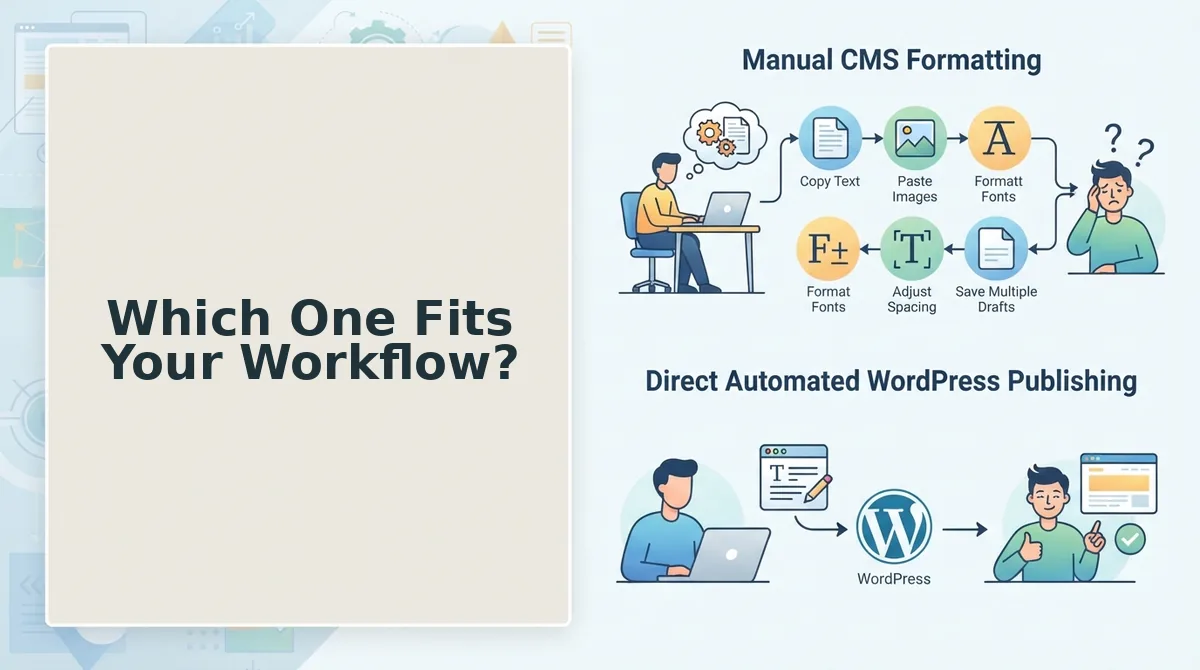
However, the draft-to-publish gap is where the workflow math gets expensive. After Byword produces a draft, users typically face a manual chain: copy-pasting content into a CMS, reformatting headings and body text, sourcing and inserting images, uploading the final page, and then submitting an indexing request to Google. That's five to six manual steps per article, repeated across every piece in a cluster. For a solo operator or small growth team, this is the exact stack sprawl that erodes publishing consistency. A deeper look at how sitemap context extraction vs Byword compares reveals why raw generation speed doesn't translate to published-page velocity.
Byword's positioning makes sense for writers who want a fast drafting assistant. It makes less sense for publishers whose bottleneck is the publishing loop itself, a distinction that matters more as Google and AI answer engines increasingly reward sites that ship contextually consistent, technically clean pages at regular cadence.
What a Unified SEO Content Engine Adds
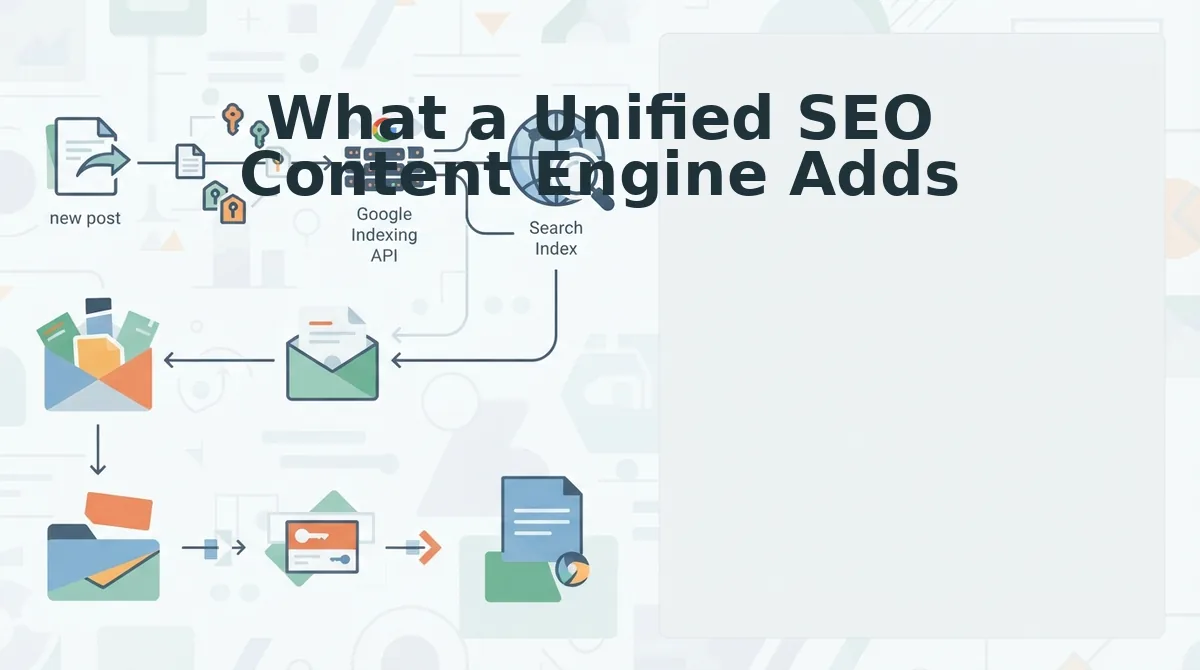
A unified SEO content engine is a platform that combines research, brand-context extraction, writing, optimization, and direct CMS publishing into a single automated workflow, eliminating the manual handoffs between tools that fragment most content operations.
Think of a unified engine like a fully staffed restaurant kitchen with a dumbwaiter: the prep, cooking, plating, and delivery to the table happen in one continuous system, and the chef never has to leave the line to serve a dish. The output arrives where it needs to go without a manual relay.
The workflow difference starts before a single word is written. A unified SEO content engine begins by crawling your existing site, reading the XML sitemap, inspecting published pages, and extracting brand voice rules, keyword patterns, and internal link structures. That context feeds directly into every draft, so articles sound like your site rather than a generic AI voice. Live SERP and social research are built into the same pipeline, meaning the engine checks what's currently ranking and what's being shared before it writes, not as a separate research step you perform in another tab.
The most consequential difference is what happens after the draft. Direct CMS publishing via API means the finished article lands in WordPress or your custom CMS without copy-paste, reformatting, or manual upload. Indexing requests go out automatically, and the content is structured for AI answer engines, using citation-friendly formatting, clear entity definitions, and passage-level answers that make your content quotable by chatbots. For a concrete walkthrough of this pipeline, see how direct CMS publishing removes the upload bottleneck entirely.
Here's the workflow math that matters most:
| Workflow Step | Byword | Unified Engine |
|---|---|---|
| Draft generation | Automated | Automated |
| Brand voice matching | Manual prompt tuning | Automated via site crawl |
| Copy to CMS | Manual copy-paste | Automated via API |
| Formatting & images | Manual | Automated |
| Indexing request | Manual submission | Automated |
| Total manual steps per article | 6+ | 1 (review) |
For a publisher running 20 articles per month, that's the difference between 120+ manual steps and 20 review checkpoints. The unified engine doesn't just write faster, it removes the steps where publishing pipelines actually stall.
That workflow math sets up the real question: how do these two approaches compare across the criteria that determine ranking and citation performance?
Head-to-Head: Byword vs Unified Engines Across 6 Criteria
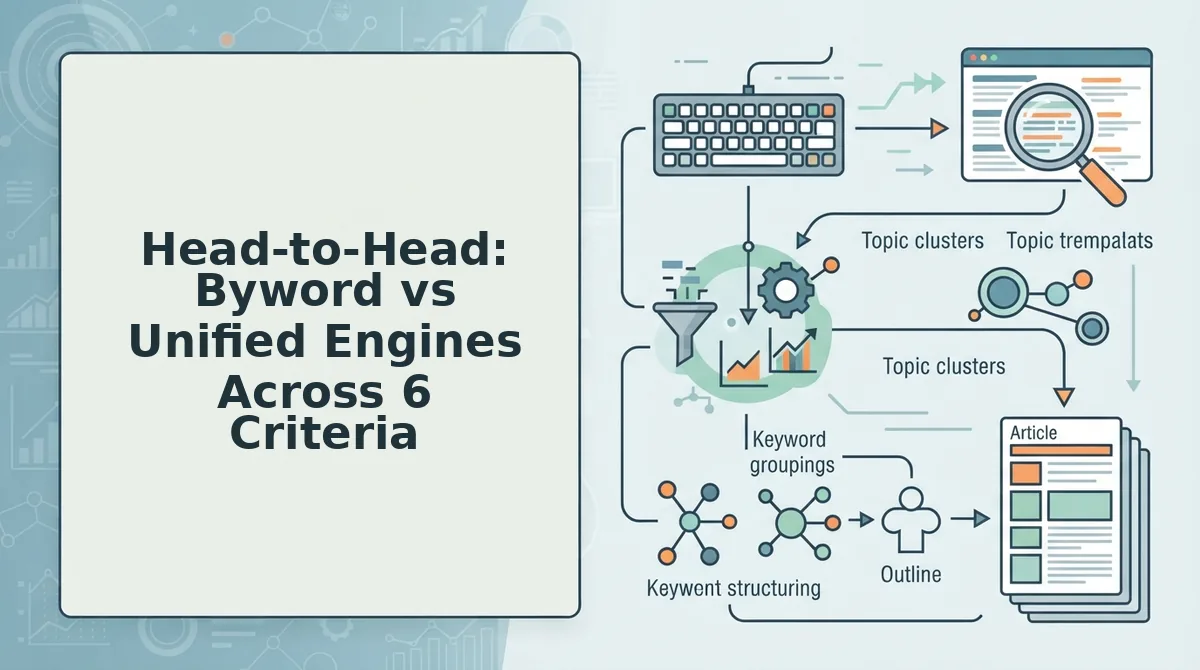
Byword wins on raw draft speed and simplicity; unified SEO content engines win on total workflow time, publishing automation, and AI-answer readiness. The right choice depends on whether you need a fast writer or a complete publishing pipeline.
To make the comparison concrete, we scored both approaches across six criteria on a 1-5 scale, where 5 represents best-in-class performance. The scoring reflects capabilities documented in each platform's public feature set, not subjective preference.
| Criterion | Byword | Unified SEO Content Engine | Why It Matters |
|---|---|---|---|
| Raw draft speed | 5/5, bulk generation in minutes | 4/5, slightly slower due to crawl and brand-context steps | Speed matters most when you have an existing publishing pipeline |
| Brand voice customization | 3/5, tone presets and custom instructions | 5/5, crawls your site and extracts voice rules automatically | Voice accuracy determines whether content sounds like you or like generic AI |
| Publishing automation | 1/5, export and copy-paste required | 5/5, direct CMS publishing via API | Manual publishing is the hidden time sink in content operations |
| Search indexing | 1/5, manual submission via Search Console | 5/5, can trigger indexing API requests automatically | Unindexed content earns zero traffic regardless of quality |
| AEO readiness | 2/5, standard article structure | 5/5, content structured for AI answer engine citations | AI chatbots increasingly determine which brands get quoted |
| Total workflow time | 2/5, fast drafts, slow everything after | 5/5, one system from crawl to indexed post | Total time, not draft time, determines publishing cadence |
Best for solo bloggers and lean teams: Byword, if you already have a WordPress workflow, enjoy manual formatting, and only need raw drafts fast. Best for publishers, agencies, and DTC brands: a unified engine like BloGoose, if you want to remove copy-paste, formatting, and indexing steps from your weekly routine. See unified engine pricing to compare against your current tool stack cost.
Which One Fits Your Workflow?
The honest answer depends on how many manual steps you tolerate between draft and published, indexed article. Use the scenarios below to match your situation to the right tool.
- You already have a publishing pipeline and only need raw drafts, choose Byword. If your team enjoys formatting, uploading, and submitting content manually, Byword's bulk generation speed is a genuine advantage. You save money by keeping your existing stack and adding only the writing layer.
- You want to remove manual copy-paste, formatting, and indexing steps, choose a unified engine. A unified platform handles crawl, draft, optimization, publishing, and indexing in one system. This eliminates the six-step manual loop that eats hours per article.
- You run programmatic SEO at scale, choose a unified engine. Manual overhead compounds fast: 50 articles × 6 manual steps equals 300 repetitive actions per batch. A unified engine collapses those 300 steps into one automated workflow, making scale sustainable without hiring.
- You need content that gets quoted in AI answers, choose a unified engine. Unified engines structure content for AI answer engine extraction from the start. Byword produces standard articles that may rank but are less likely to be cited by chatbots.
- You publish to WordPress on a fixed schedule, choose a unified engine. Direct CMS publishing means articles land formatted and live without a human touching the upload button. Pair it with an autopilot 30-day content calendar generator and your publishing cadence runs itself.
- You are testing AI content on a small budget, start with Byword. If you are unsure whether AI content fits your brand, Byword's lower commitment lets you experiment. Upgrade to a unified engine once volume justifies removing the manual middle.
- You manage multiple client sites or brand properties, choose a unified engine. Per-site brand context extraction and centralized publishing reduce the coordination cost of running content across many domains. Manual pipelines break down at multi-site scale.
Byword vs Unified SEO Content Engines: FAQ
Byword is a bulk AI writing tool that stops at the draft; a unified SEO content engine is a complete system that crawls your site, extracts brand voice, writes, optimizes, publishes, and indexes content automatically. The difference is the gap between a finished draft and a live, ranking article.
Does Byword publish to WordPress?
No. Byword generates drafts that you must export and manually upload to WordPress. Unified engines like BloGoose publish directly to WordPress via CMS API, removing the copy-paste and formatting steps entirely.
What does a unified engine do that a bulk writer can't?
A unified engine crawls your existing site to extract brand voice rules, builds topic calendars from your structure, optimizes for AI answer engines, publishes directly to your CMS, and triggers indexing API requests. A bulk writer only produces text.
Is Byword enough for programmatic SEO at scale?
Only if you accept significant manual overhead. At 50 articles per batch, six manual steps per article means 300 repetitive actions. Unified engines remove the manual middle, making scale sustainable without additional headcount.
Why does AEO readiness matter when choosing between these tools?
AI answer engines increasingly determine which brands get cited in chatbot responses. Unified engines structure content for AEO content optimization from the first draft, while Byword produces standard articles less likely to be extracted and quoted.
How do I decide between Byword and a unified engine?
Count your manual steps per article. If you only need drafts and enjoy the publishing process, Byword works. If you want drafts, publishing, and indexing handled automatically, a unified engine is the better fit.
The honest answer depends on one question.
The Honest Answer Depends on One Question
The entire Byword-versus-unified-engine debate collapses into a single question: what happens after the draft is written? If your team already has editors, a CMS workflow, and an indexing strategy in place, Byword's bulk generation speed is genuinely useful. You need raw material, fast, and it delivers.
But if you're still copying drafts into WordPress, manually building internal links, and hoping Google notices, you're not solving a writing problem. You're solving a pipeline problem. Unified engines remove the manual middle entirely: crawl your site, extract brand voice, write the article, publish it, and trigger indexing, without you touching a spreadsheet or a prompt box.
That's the synthesis most comparisons miss. Byword is a strong bulk writer, not a publishing pipeline. The draft-to-publish gap is where rankings stall and AI citations never materialize.
- Evaluate Byword if you need high-volume first drafts and already own the publishing stack.
- Start with a unified engine if you want the entire loop, crawl, write, publish, index, automated from one dashboard.
- See unified engine pricing to compare the cost of automation against your current manual hours.
Autopilot publishing isn't about writing more. It's about removing every step between a finished draft and a ranked, citable page.