
How to Create SEO Guidelines From Your Own Website Content
Every AI draft that starts from a blank prompt breaks your site's patterns, the same way a new hire with no onboarding would. The fix isn't another chat window with hopes. It's learning how to create SEO guidelines from website content you've already published, because your site already knows its rules. You just haven't written them down.
Manual guidelines are tedious and drift. Every new writer or AI draft reinvents your keyword placement, heading structure, and linking logic from scratch. That's the exact pain that makes SEO tool stitching mistakes feel unavoidable, you're compensating for missing rules with extra tools.
This guide walks you through extracting those rules from your own site: crawling what ranks, pattern-matching your optimization choices, and codifying them into guidelines your team or AI engine can follow. Along the way, you'll see why your ranking pages encode winning patterns, and why extraction beats invention every time. A platform like BloGoose automates this extraction by crawling your domain and detecting the underlying technical and content patterns, so you don't have to do it by hand.
What Are SEO Guidelines? (And How They Differ from a Style Guide)
SEO guidelines are a codified rule set for meta patterns, keyword targeting, internal linking, and credibility standards that every page on your site should follow. A style guide covers voice, tone, and formatting; SEO guidelines cover optimization mechanics.
Think of the difference like a restaurant: the style guide is the plating and service manual, while the SEO guidelines are the recipe ratios, how much salt, how long in the oven, which ingredients must appear. You can plate a dish beautifully and still serve it raw if the recipe rules are missing.
At a basic level, SEO guidelines specify title tag formats, meta description length, and which keywords map to which page types. At an intermediate level, they define internal linking rules, how many contextual links per 1,000 words, which anchor text patterns to use, and which pillar pages receive priority. At an advanced level, they codify credibility signals: citation sources, schema markup requirements, and E-E-A-T elements like author bios and update timestamps.
Most teams confuse the two documents. A SEO content audit often reveals that tone is consistent across posts while title tag structure, keyword density, and internal link placement vary wildly. That variance is the gap SEO guidelines close. Without them, every new page is a guess; with them, every page compounds the authority of the ones before it.
Step 1: Crawl Your Site and Inventory What Already Ranks
Your ranking pages encode your winning patterns. Start with your own site's existing patterns; extraction beats invention. Before you write a single guideline, you need a complete inventory of what's already live and performing.
Prerequisites: Access to Google Search Console or your analytics platform, your domain's XML sitemap, and a crawler or content engine that can inspect page structure at scale.
- Locate your XML sitemap. Open your domain and append
/sitemap.xmlor check your robots.txt file for the sitemap reference. You should see a list of every indexable URL on your site. If your CMS generates it automatically, confirm it's current, stale sitemaps hide recent pages from your inventory. - Detect your CMS and page templates. Inspect the source code of three to five pages and note the generator meta tag or template structure. You should be able to identify whether pages use a consistent title tag pattern, heading hierarchy, and meta description format. This tells you which optimization elements are already systematized.
- Build a page inventory. Export your sitemap URLs into a spreadsheet and pull the top 20 pages by organic traffic from Search Console. You should see a clear list of which pages drive impressions and clicks, these are the pages whose patterns deserve codifying first.
- Identify top-performing pages. Sort the inventory by clicks and note the common elements: title tag length, keyword placement in the H1, number of internal links, and content depth. You should see recurring patterns across your winners that underperforming pages lack.
This inventory is the raw material for every guideline you'll write. A platform like BloGoose automates this step by crawling your domain, locating the XML sitemap, and detecting the underlying technical patterns, so you start with data, not guesswork. Next, you'll turn those patterns into rules.
Step 2: Pattern-Match Your Existing Optimization Choices
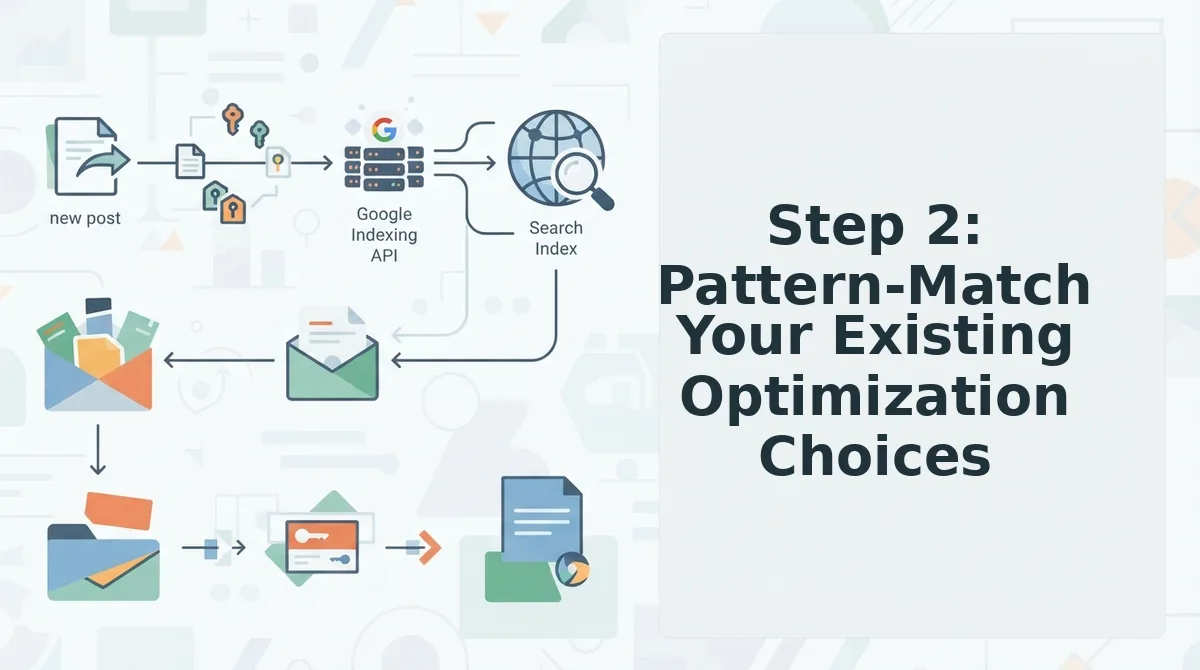
Pattern-matching converts scattered on-page observations into codified, repeatable rules. Content that satisfies search engines and drives engagement is the baseline for pattern extraction, so start with pages that already perform.
Prerequisites: Your crawl inventory from Step 1, a spreadsheet, and 30-45 minutes. No paid tools required.
- Open your crawl inventory and filter to the top 10 ranking URLs. Select only pages holding positions 1-10 for their primary keyword. You should see a focused list of your proven winners.
- Extract each page's title tag, meta description, H2 list, internal link count, and image alt text. Paste these into a five-column spreadsheet. You should see raw optimization data side by side for comparison.
- Look for repeating numeric ranges across the top pages. Count title tag characters, meta description length, and H2s per page. You should see clusters, for example, all titles between 48-58 characters or all descriptions between 140-155 characters.
- Build a Pattern-Matching Table with two columns: Observed Pattern to Rule to Write. For example, "all H1s under 60 chars" becomes "Title Tag Pattern rule: keep H1s under 60 characters." You should see vague observations turning into prescriptive statements.
- Review title tag patterns and image alt conventions for reference benchmarks. Compare your extracted ranges against documented best practices. You should see where your site aligns and where it drifts.
- Record each rule with a source example URL. Link every rule back to at least one ranking page that demonstrates it. You should see a defensible, evidence-backed rule set ready for codification.
Step 3: Codify Rules into a Markdown Guidelines File
Codify your extracted patterns into a Markdown guidelines file, because Markdown is portable across tools, readable by AI systems, and version-controllable in Git. A structured file turns your one-time analysis into a reusable asset that every future article can reference automatically.
A Markdown guidelines file is a plain-text document that stores your SEO rules in a format both humans and machines can parse without conversion. Here is the 8-file structure that covers the full scope of what you extracted in Steps 1 and 2:
- style-guide.md. This file captures voice, tone, formatting, and brand-specific language rules. It matters because consistency across hundreds of articles is impossible to maintain manually, and AI drafting tools read this file directly to match your voice. Use it to record sentence-length preferences, banned phrases, and punctuation conventions you observed in your top-performing pages.
- target-keywords.md. This file maps each pillar page and cluster article to its primary and secondary keywords. It matters because keyword drift is the most common cause of cannibalization and diluted rankings. Use it to define one primary keyword per URL and list the semantic variants each article should naturally include.
- competitor-analysis.md. This file documents what competitors rank for that you do not, along with their content gaps. It matters because your guidelines should encode where you can realistically win, not just what you already do. Use it to list competitor URLs, their ranking keywords, and the angle your content will take to differentiate.
- writing-examples.md. This file stores 3-5 annotated excerpts from your best-performing articles. It matters because abstract rules fail; concrete examples teach. Use it to show exactly how a strong intro, a transition, and a conclusion look in your brand voice.
- internal-links-map.md. This file defines the pillar-cluster relationship and required internal link anchors. It matters because internal linking is the most underused ranking lever in most content operations. Use it to specify which pages must link to which, and with what anchor text.
- seo-guidelines.md. This file is the master rulebook that references all other files. It matters because it gives writers and AI tools a single entry point. Use it to define title tag patterns, meta description formulas, heading hierarchy rules, and image alt-text conventions.
- publishing-checklist.md. This file lists every pre-publish verification step. It matters because a missed canonical tag or broken internal link can silently suppress rankings. Use it as the final gate before any article ships.
- changelog.md. This file records every update to the guidelines with a date and reason. It matters because SEO guidelines must evolve as search behavior and your site change. Use it to keep a version history that prevents regressions.
Here is a minimal skeleton for your master seo-guidelines.md:
- Title Tag Pattern: [Primary Keyword] + [Differentiator], max 60 characters
- Meta Description Formula: [Problem] + [Outcome] + [CTA], max 155 characters
- Heading Structure: One H1, H2s for major sections, H3s for sub-points only
- Internal Link Rule: Every article links to its pillar page and 2-3 cluster siblings
- Image Alt Text: Descriptive, includes primary keyword when natural, never keyword-stuffed
If you want to skip the manual file creation, a docs builder can generate these Markdown files from your crawled site data automatically. Once your rules are codified, the next step is testing them against what searchers actually want.
Step 4: Validate Against Search Intent and Competitor Gaps
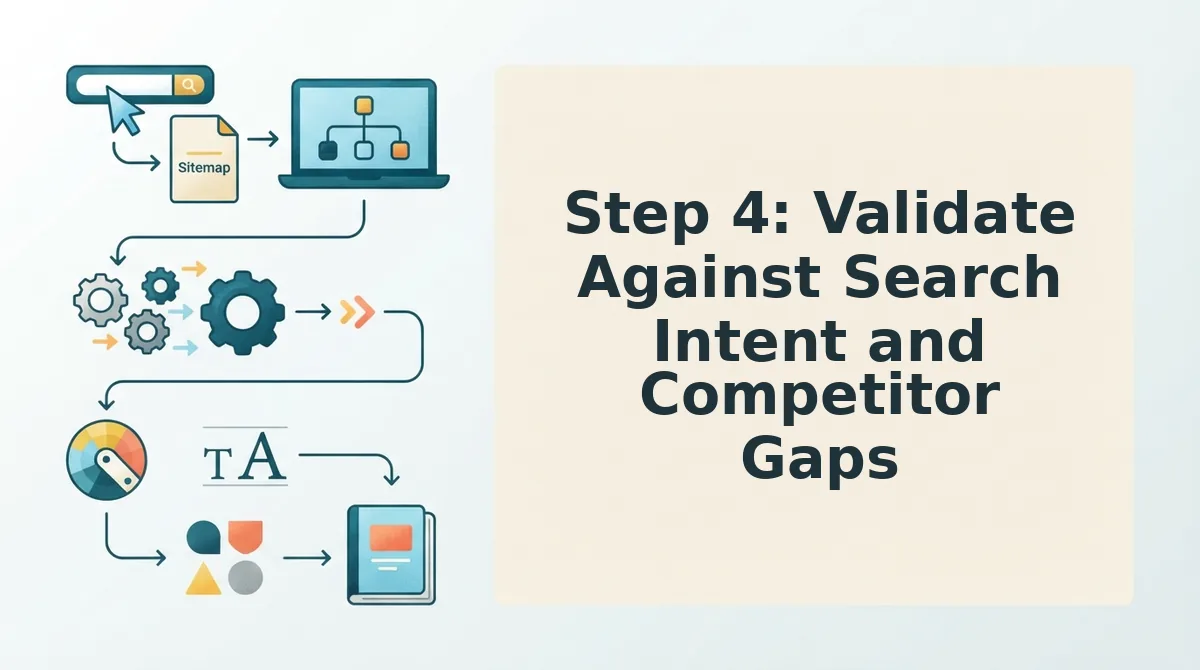
Your extracted rules are a hypothesis, not a conclusion. Cross-check every codified pattern against live SERP intent and competitor behavior before locking it into your guidelines file, your site may encode outdated practices, and validation is the correction step.
Prerequisites: Your Markdown guidelines file from Step 3, access to a SERP analysis tool (Ahrefs, Semrush, or manual Google searches), and your target keyword list.
- Pull the top 10 SERP results for each target keyword. Open an incognito window and search your primary terms. Record the dominant content format (listicle, how-to, comparison, definition) for each result. You should see a clear format consensus across at least 7 of 10 results.
- Compare your extracted rules against the SERP format. If your site consistently publishes 800-word posts but the SERP rewards 2,000-word guides, flag that rule as outdated. Expected outcome: a list of rules that conflict with current intent.
- Analyze competitor outlines for structural gaps. Select three ranking competitors and map their H2/H3 patterns. Note sections they include that your extracted rules omit. Competitor-driven outlines are required for validation, not optional.
- Run a keyword gap analysis. Upload your domain and the three competitors into your SEO tool. Identify queries competitors rank for that you do not. Add any recurring gap topics to your guidelines as required coverage areas.
- Update your guidelines file. Strike rules that conflict with SERP evidence. Add missing structural patterns. You should end with a document that reflects current intent, not just historical habit.
Pro tip: Search intent analysis before writing is non-negotiable. If your extracted rules say "always use short paragraphs" but the SERP rewards dense technical breakdowns, the SERP wins. Your guidelines serve the ranking, not your comfort zone.
Once your rules survive validation, the question becomes whether to repeat this process manually or let a tool handle it.
Step 5: Automate the Extraction (or Do It Manually)
You can extract SEO guidelines from your own site either by hand or with an automated SEO content engine. Both paths produce a usable rulebook, but they differ sharply in time cost, drift risk, and consistency.
| Approach | How It Works | Time Investment | Main Risk | Best For |
|---|---|---|---|---|
| Manual audit | Open top-ranking pages, note title patterns, heading structures, internal link habits, and keyword placements by hand | 4-8+ hours per site section | Drift risk, guidelines go stale as soon as publishing habits change; subjective judgment varies by auditor | Small sites (under 30 pages) with one owner who writes everything |
| Spreadsheet + checklist | Export URLs from a crawler, score each page against a fixed checklist, consolidate findings into a doc | 2-4 hours per section, plus ongoing maintenance | Checklist fatigue; teams skip fields under deadline pressure | Content managers who need a repeatable quarterly audit |
| Automated extraction | Crawl the XML sitemap, detect recurring optimization patterns, and generate a Markdown guidelines file from the detected rules | Minutes, not hours | Requires a tool that actually reads your site rather than generic templates | Publishing teams and agencies managing multiple client sites |
Manual auditing is thorough when done well, and it forces you to see details an automated pass might miss, like a clever internal link placement that no crawler would flag as a pattern. The honest tradeoff is that manual work is subjective: two auditors can read the same page and extract different rules, and nobody re-audits weekly, so guidelines quietly fall out of sync with what the site actually does.
Automated extraction wins on consistency and speed. A sitemap crawl plus pattern detection produces a Markdown file that reflects the live site, not someone's memory of it. If you run a multi-site agency or publish daily, that repeatability is the difference between guidelines people use and guidelines people ignore.
Step 6: Maintain and Refresh Your Guidelines
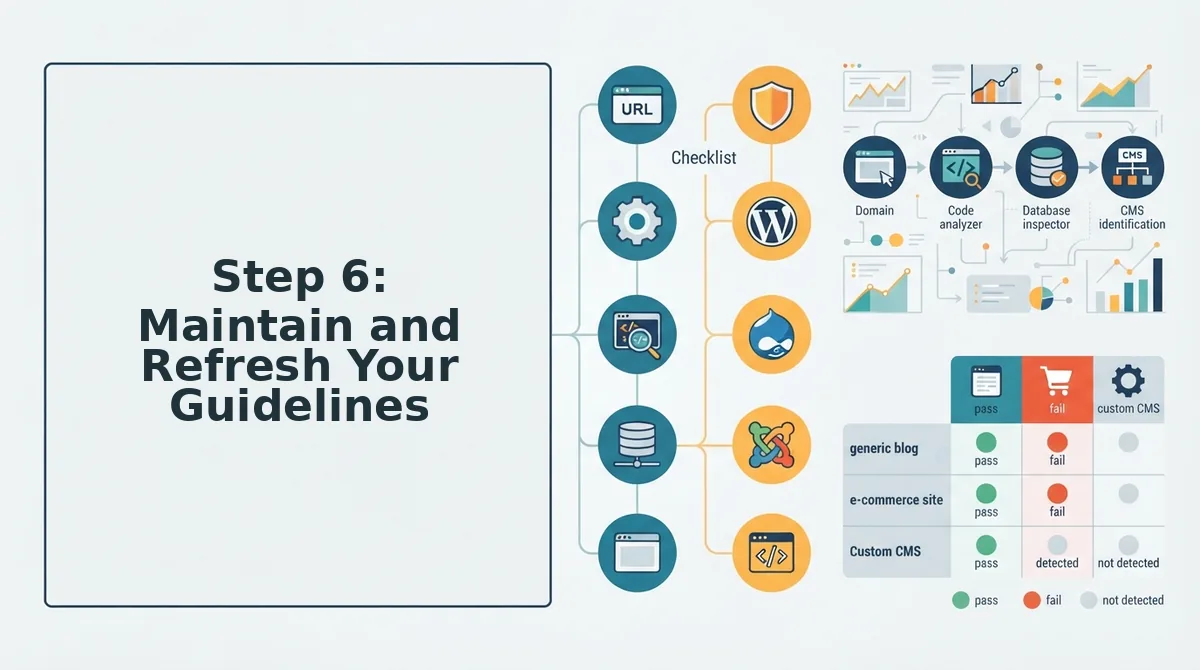
SEO guidelines decay the moment your site changes. Here's where most teams drop the ball: they write the document once, file it, and never reopen it until a new hire asks why the rules exist.
Prerequisites: Your guidelines file from Step 3, access to your site's analytics or Search Console, and a calendar reminder for quarterly review.
- Set a quarterly review date. Open your guidelines file and compare each rule against your last 90 days of published content. You should see at least one rule that no longer matches reality, update or delete it.
- Trigger a refresh on site redesigns. When you change your CMS, URL structure, or template, re-crawl the site within one week. You should see new heading patterns and internal link opportunities that need codifying.
- Add rules for new content types. When you publish a new format, case studies, comparison pages, glossaries, write down the title pattern, word count range, and internal link targets. You should see the new format reflected in the guidelines within the same sprint.
- Check competitor and algorithm shifts. When a major algorithm update rolls out or a competitor changes their SERP position, review the affected sections. You should see at least one guideline flagged for revision.
- Run a content refresh pass. Identify pages that dropped in rankings and compare them against your current guidelines. You should see a list of pages that violate your own rules, fix those first.
Each refresh should take under an hour if your guidelines are specific. If a review takes longer, your rules are too vague to test against real pages.
FAQ: SEO Guidelines from Website Content
Can I automate this instead of writing it manually?
Yes. An automated SEO content engine can crawl your XML sitemap, detect recurring title patterns, heading structures, and internal link habits, then generate a Markdown guidelines file. Manual auditing works for small sites, but automation keeps guidelines in sync with live publishing without hours of re-auditing.
What's the difference between SEO guidelines and a style guide?
SEO guidelines govern how content is structured for search: title tag patterns, heading hierarchy, keyword placement, internal linking rules, and meta description formulas. A style guide governs voice, tone, grammar, and brand terminology. Both are needed; they answer different questions about the same page.
How do I keep guidelines from going stale?
Set a quarterly review date and trigger refreshes on site redesigns, new content types, algorithm shifts, and new competitor activity. Compare each rule against your last 90 days of published content. If a rule no longer matches reality, update or delete it. Stale guidelines are worse than no guidelines because they codify outdated habits.
What should an SEO guidelines document actually contain?
A usable SEO guidelines document contains: title tag and meta description formulas, H1 - H3 heading patterns, target word count ranges by content type, internal linking rules (how many links, where they point), keyword placement rules, image alt text conventions, and URL structure rules. Each rule needs a real example from your own site.
Why does my site rank for some keywords but not others?
Your existing top-ranking pages already encode the optimization patterns that work for your domain. Pages that don't rank often violate those patterns, wrong title structure, missing internal links, or keyword placement that diverges from what your winning pages do. Extracting rules from your winners closes that gap.
Turn your site's patterns into a living SEO rulebook.
Turn Your Site's Patterns into a Living SEO Rulebook
Your website already contains the answers. The patterns that earned rankings, the formatting choices that earned featured snippets, the internal linking logic that guides crawlers, all of it is sitting in your sitemap, waiting to be codified. The payoff from the opening question is simple: you don't need to invent SEO guidelines. You need to extract them.
Three moves get you there this week:
- Revisit your sitemap. Export your top 20 ranking URLs and note what they share, heading structure, content depth, keyword placement.
- Use the 8-file Markdown structure. Codify those patterns into a guidelines file your team can actually follow, not a 40-page PDF nobody reads.
- Automate the extraction. If spreadsheet archaeology isn't your job, BloGoose crawls your site, learns the patterns, and turns them into a living rulebook without manual coordination.
Guidelines that sit in a drawer are just documentation. Guidelines that feed your publishing pipeline are a compounding asset, every new article reinforces the patterns that already work, and every refresh sharpens them further.
Your best SEO consultant has been your own site all along; you just needed to take notes.