How to Detect Ranking Signals for AI Answer Topics
Your content ranks on page one, yet an AI assistant confidently cites your competitor, and even misattributes the quote to your brand. That's the quiet crisis of AI search: as the Signal Before Noise video warns, an AI answer can include a citation while still misrepresenting its source. If you can't detect ranking signals for AI answer topics, you're optimizing for a search landscape that no longer exists.
You're right to feel like the rules changed overnight. They did. But here's the promise: by the end of this article, you'll have a repeatable framework for identifying which passages AI engines actually pull, why they choose them, and how to engineer your content accordingly.
Here's the roadmap: first, we define what AI answer ranking signals actually are. Then, we break down why traditional SEO metrics fall short. Finally, we walk through a five-step detection framework you can apply today. Along the way, you'll learn how to get cited in AI answers, and one surprising finding about why there's no position 1 in AI search, and no page 2 to climb off of. Platforms like BloGoose automate much of this detection, but understanding the signals yourself is what separates guesswork from strategy.
What Are AI Answer Ranking Signals?
AI answer ranking signals are the content characteristics that determine which passages an AI answer engine selects, synthesizes, and cites when responding to a query. They are not the same as traditional SEO ranking factors.
Think of a traditional search engine like a librarian who ranks entire books by how many other libraries reference them. An AI answer engine is more like a researcher who photocopies the single best paragraph from any book on the shelf, regardless of that book's overall reputation. The unit of competition has shifted from the page to the passage.
At a simple level, AI engines favor passages that directly answer a question in 40-80 words, define key entities inline, and stand alone without requiring surrounding context. At an intermediate level, this means structuring content so that each paragraph functions as a self-contained answer: a clear subject, a definition, and a concrete example or data point. At an advanced level, you're optimizing for source diversity. AI engines often prefer corroborating passages from multiple domains over a single authoritative page, which means your content must be quotable in isolation and consistent with how other credible sources frame the same topic.
Here's the contrarian reframe most competitors miss: AI answer engines select self-contained passages with clear entity definitions, not pages with high domain authority. A page with 90 referring domains can lose the citation to a page with 12 referring domains if the latter's paragraph answers the query more cleanly. The passage is the product; the page is just packaging.
Why Traditional SEO Signals Fall Short for AI Answers
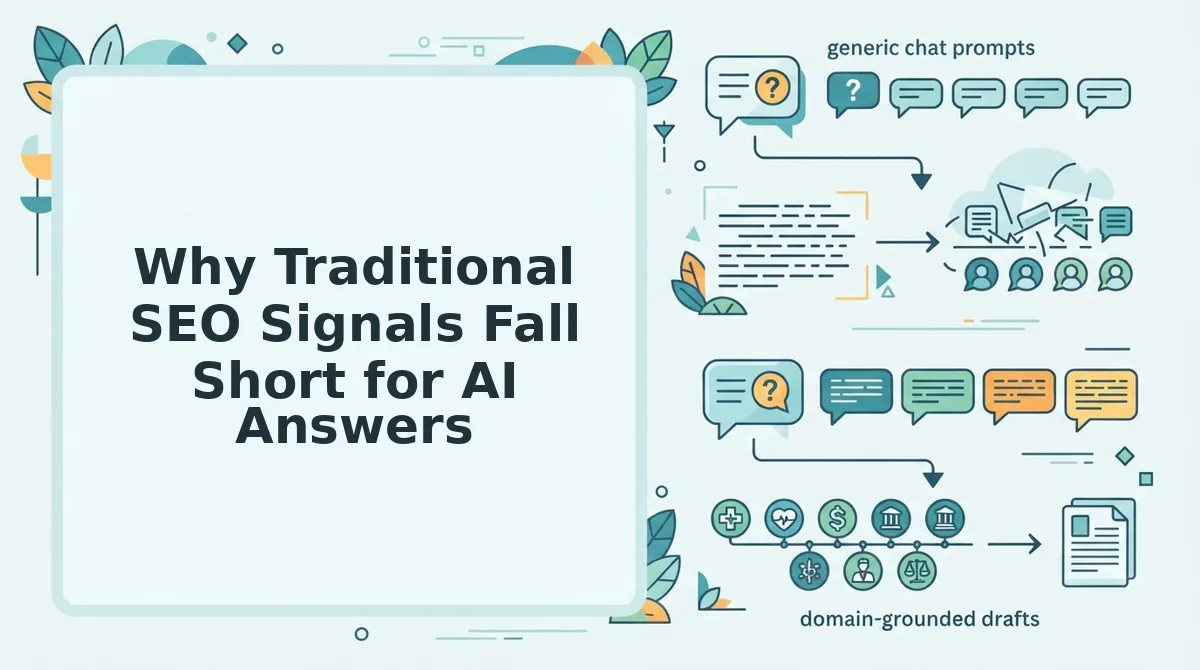
Traditional SEO signals remain necessary for discoverability, but they are insufficient for AI citation. Backlinks, keyword density, and domain authority help a page get indexed and crawled, they do not guarantee a passage gets selected, quoted, or attributed correctly.
To be fair, classic SEO still matters. A page with zero backlinks and thin authority is unlikely to be crawled by AI answer engines in the first place. Domain authority acts as a baseline filter, and keyword relevance helps engines map your content to query intent. These signals are the entry ticket, not the win condition.
The gap appears when you compare what each system rewards:
| Signal Type | Traditional SEO Metric | AI Answer Equivalent |
|---|---|---|
| Authority | Domain authority, backlink count | Entity clarity, source diversity across domains |
| Relevance | Keyword density, title tag optimization | Passage self-containment, direct answer format |
| Placement | Position 1-10 on a SERP | Citation inclusion, quote accuracy, attribution |
Best for established publishers: Traditional SEO remains your foundation, keep building authority and topical coverage. Best for challenger brands and niche sites: AI answer optimization levels the field, because a well-structured passage can out-cite a high-authority page. As the trendos video puts it: there's no position 1 in AI search, and no page 2 to climb off of. You either get cited or you don't.
This is where AEO optimization diverges from classic SEO: it's about engineering passages for selection, not pages for ranking. Platforms like BloGoose automate this by extracting brand voice rules and structuring content around self-contained answer blocks. But before you can optimize, you need to detect which signals actually move the needle, and that's exactly what the five-step framework covers next.
The 5-Step Signal Detection Framework
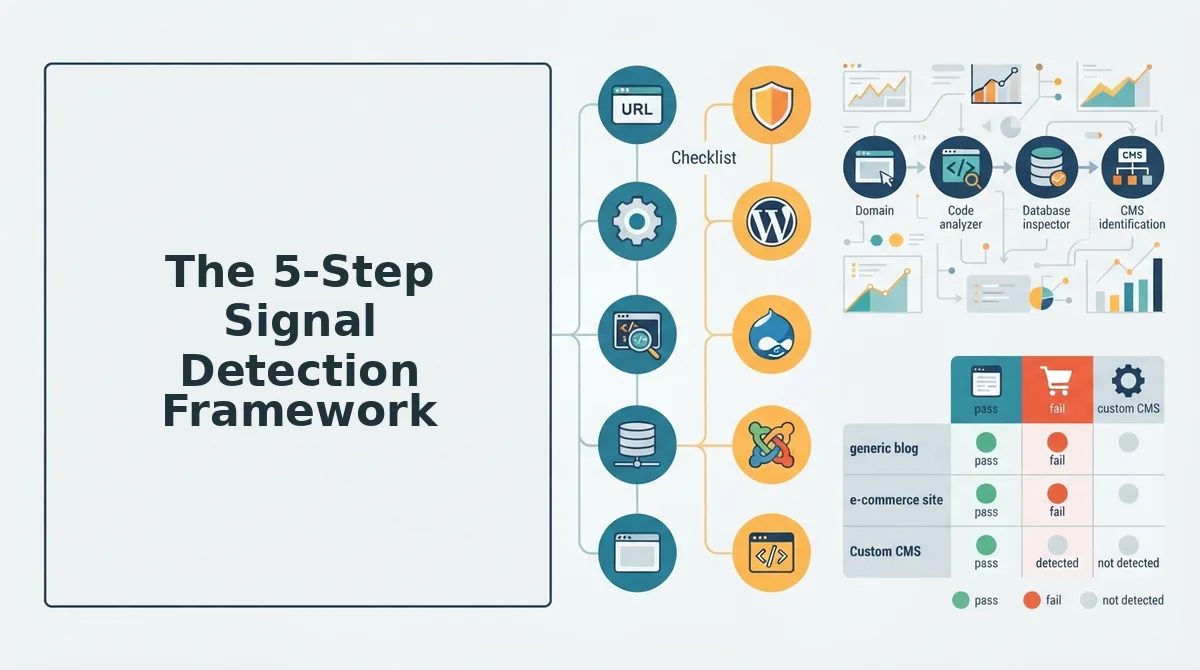
Detecting AI answer ranking signals requires a repeatable methodology, not guesswork. The Observe to Query to Compare to Isolate to Verify framework below gives you a systematic way to identify which signals drive citations across ChatGPT, Perplexity, Gemini, and Google AI Overviews.
Prerequisites: Access to ChatGPT (free tier works), Perplexity, Google Search with AI Overviews enabled, a spreadsheet for logging results, and 30-45 minutes per topic cluster. No paid SEO tools are required for baseline detection.
- Observe. Map the current citation landscape. Open Google and run your target query, then record the top 10 organic results and any pages cited in the AI Overview. Next, open ChatGPT and Perplexity, paste the same query, and log every domain each engine references. You should see a list of 8-15 unique domains that appear across at least two engines. These are your citation competitors.
- Query. Run structured prompts across engines. Type the same question into ChatGPT, Perplexity, Gemini, and Google Search using a consistent template: "What is [topic] and which sources do you recommend?" Log the exact answer format, cited URLs, and whether the engine names sources inline or in a footnote. You should see clear patterns in which pages get cited repeatedly versus those ignored entirely.
- Compare. Diff cited pages against non-cited pages. Open two browser tabs side by side: one cited page and one top-ranking page that was not cited. Compare heading structure, first-paragraph entity definitions, source links, and content length. You should see structural differences, cited pages typically define entities in the first 100 words and use question-matching H2s, while non-cited pages bury definitions or use vague headings.
- Isolate. Test one signal at a time. Select a single page you control and modify exactly one variable: rewrite the H2 to match the query phrasing, add a 80-120 word self-contained definition block, or insert a primary source citation. Wait 7-14 days, then re-run the same queries from Step 2. You should see a measurable change in citation frequency for that page, if not, revert and test a different signal.
- Verify. Confirm causation with controlled changes. Run a before-and-after comparison using your query log. Track citation counts per engine over a 30-day window after each content change. You should see citation rates move only when you modify signals that matter for that specific query type. For a worked example, query "AI SEO content engine" and log which competitor pages get cited across ChatGPT, Perplexity, and Google AI Overviews, then apply the observed patterns to your own page and re-test.
To detect signals faster without manual tab-switching, use live SERP analysis to monitor which pages enter and exit AI citation sets in real time. BloGoose automates this Observe to Query to Compare loop, so you can focus on the Isolate and Verify steps that actually move citation rates.
Passage indexing note: AI answer engines favor pages that contain self-contained, quotable passages between 80 and 120 words. A passage qualifies as self-contained when it defines its key entity, states a complete claim, and requires no surrounding context to be understood. To create one, write a short paragraph that opens with the entity name, includes one supporting fact or statistic, and closes with a clear takeaway sentence. When an AI engine extracts this passage verbatim, it can cite your page without needing to paraphrase or stitch together fragments from multiple sections.
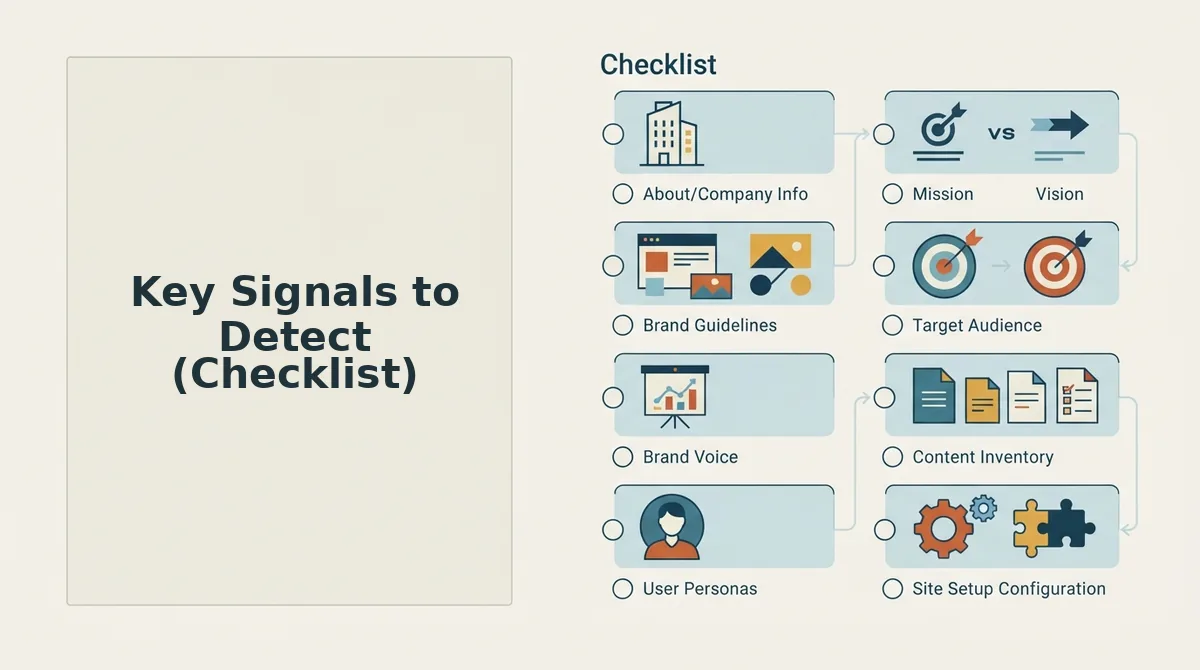
Key Signals to Detect (Checklist)
Seven signals consistently determine whether AI answer engines cite a page. Work through this checklist in order, the first three carry the most weight across ChatGPT, Perplexity, and Google AI Overviews.
- Passage self-containment. AI engines extract quotable blocks, not entire pages. A self-contained passage of 80-120 words that defines its entity and makes a complete claim is far more likely to be cited verbatim. Audit your top pages: can any single paragraph stand alone and still make sense? If not, rewrite your key claims as standalone blocks.
- Entity definitions in the first paragraph. Engines prioritize pages that immediately tell them what the topic is. Pages that define the primary entity within the first 100 words get cited more often than pages that delay definitions. Open your target page and check whether the first paragraph answers "What is [entity]?" directly.
- Question-matching headings. H2s and H3s phrased as the exact questions users ask, and that AI engines receive, signal direct answer coverage. A page with H2s like "What is an AI SEO content engine?" and "How does AI content indexing work?" matches query patterns better than creative or branded headings. Compare your heading structure against the top 20 questions in People Also Ask for your topic.
- Source diversity and primary citations. AI engines reward pages that link to multiple distinct, authoritative sources, especially primary sources like original research, official documentation, or first-party data. Pages citing only secondary blog posts or no sources at all get skipped. Add at least 2-3 primary source links per article.
- Freshness signals. Recently updated pages with visible dates, current statistics, and references to recent developments get prioritized for time-sensitive queries. AI engines weigh recency heavily when the query implies currency. Add a visible "last updated" date and refresh statistics at least quarterly.
- Answer format alignment. Pages that mirror the engine's preferred output format, numbered lists for procedural queries, tables for comparisons, short definitions for conceptual queries, get extracted more readily. Match your content format to the dominant format in current AI answers for your query.
- Brand mention frequency across the web. Pages from domains that appear frequently in discussions, citations, and references across the broader web build entity authority. AI engines favor domains they encounter repeatedly in training and retrieval data. Track how often your domain appears in other sites' content and AI outputs using a tool like an AEO content optimization tool.
How to Verify AI Citations (Practical Protocol)
Verifying whether AI engines actually cite your content requires direct, repeatable testing, not assumptions. This protocol takes about 20 minutes per page and works across all major AI answer engines.
Prerequisites: A logged-in ChatGPT account, Perplexity access, Google Search with AI Overviews enabled, and a simple spreadsheet for logging outputs.
- Open ChatGPT and run a citation query. Type: "What is [your target topic]? Cite your sources." Record whether your domain appears in the response. You should see either a direct mention of your brand, a linked citation, or no reference at all.
- Open Perplexity and repeat the query. Type the same question and check the source list below the answer. You should see numbered source citations, log whether your page appears and in what position.
- Open Google Search and trigger an AI Overview. Search your target query and check the AI Overview box at the top. You should see cited sources in the dropdown, record whether your page is among them.
- Open Gemini and run the same query. Type the question and note whether Gemini names your brand or links your page. You should see consistent patterns across engines, if one engine cites you and others don't, the gap points to a specific signal you're missing.
- Log all outputs in a tracking sheet. Create columns for date, engine, query, cited (yes/no), citation position, and notes. You should see trends emerge over 2-4 weeks of testing.
If you're not getting cited, apply the signal fixes from Section 5 and re-test. For a deeper walkthrough on earning citations, see our guide on how to get cited in AI answers. BloGoose automates this verification loop by tracking your domain's citation status across engines after every publish, so you see exactly which content changes move the needle. Now let's address the most common questions about AI answer ranking signals.
FAQ About AI Answer Ranking Signals
AI answer ranking signals are the content, authority, and formatting factors that determine whether a large language model cites your page when responding to a user query. Most signals overlap with Google's quality guidelines, but AI engines weight citation frequency, source diversity, and direct-answer structure more heavily.
How do I know if my content is being cited by AI?
Query ChatGPT, Perplexity, or Google AI Overviews with your target questions and check whether your domain appears in the cited sources. Track results weekly in a spreadsheet, noting which pages get cited and which competitors replace you. Third-party citation monitoring tools can automate this, but manual spot-checks remain the most reliable baseline.
What's the difference between AI ranking and Google ranking?
Google ranks pages for click-through, while AI engines rank passages for extraction. Google rewards domain authority, backlinks, and page-level optimization. AI engines prioritize direct answers, source consensus across multiple domains, and content that mirrors how users phrase questions conversationally. A page can rank on Google yet never appear in AI citations.
Which AI engines should I optimize for first?
Start with Google AI Overviews, since they inherit Google's crawl infrastructure and influence the largest search volume. Next, prioritize Perplexity for its citation-heavy interface and ChatGPT for its market share in conversational queries. Track all three simultaneously because citation patterns differ meaningfully across engines.
Do backlinks matter for AI answers?
Yes, but indirectly. AI models use backlink profiles as a proxy for source credibility during training and retrieval. A page cited by multiple authoritative domains is more likely to be treated as a consensus source. However, backlinks alone cannot compensate for content that fails to answer the question directly.
How often should I audit AI citations?
Audit monthly for stable topics and biweekly for fast-moving niches. Run the same 10-15 core queries across each target engine, record which sources appear, and flag pages where your content dropped out. Citation patterns shift as models update, so treat audits as an ongoing signal-detection loop rather than a one-time project.
Start Detecting AI Answer Signals This Week
Signal detection stops being theoretical the moment you run the five-step framework against your actual content. Pick three target queries, observe which sources each AI engine cites, isolate the patterns, test one optimization, and verify the result. That single loop produces more actionable insight than a month of reading about AI search.
The open loop from the start of this article resolves simply: AI answer rankings are not random, and they are not gated behind proprietary algorithms. They follow detectable, repeatable patterns in answer structure, source consensus, and citation frequency. The publishers who win are the ones who systematize detection instead of guessing.
Run the framework this week to build your signal playbook. When manual observation becomes tedious, the BloGoose AI SEO content engine automates live SERP research and citation comparison, so your signal detection scales alongside your publishing cadence.
Your first citation win is one structured observation away.