
How to Fix AI Blog Sections That Feel Disconnected

You read the draft back and it feels like three different people wrote it, because, in a sense, three different passes did. AI drafts often generate one section at a time without transition planning, creating a patchwork feel that readers sense immediately but struggle to name. If you've ever stared at a post wondering why it doesn't flow, you're not imagining it.
Agree: that disjointed feeling is real, and it's the most common reason AI content underperforms even when every individual section is factually solid. Promise: this article gives you a repeatable system to fix AI blog sections that feel disconnected, not by rewriting everything, but by diagnosing exactly where the breaks happen and repairing them surgically. Preview: you'll learn the four root causes of disconnection, run a three-step diagnostic on any draft, and apply targeted fixes for each break type.
One finding will surprise you: most disconnected sections aren't caused by bad writing at all, they're caused by a missing handoff you can fix in under five minutes per section. An AI content engine that drafts sections with transition planning built in, like BloGoose, eliminates the problem at the source, but the diagnostic below works on any draft you already have.
Why AI Drafts Produce Disconnected Sections (The 4 Root Causes)
Disconnected AI sections are breaks in logical flow caused by four specific generation failures: topic drift, voice shift, missing handoff, and ghost sections. Each has a distinct mechanism and a distinct fix.
Think of an AI draft like a relay race where each runner starts from a slightly different position on the track. The baton gets passed, but the team never runs one continuous line. That's what happens when a model generates section by section without a shared transition plan.
Topic Drift happens when the model loses the core query mid-draft. Section one answers "how to fix disconnected sections," but section three starts answering "why AI content fails", a related but different question. The model followed a plausible tangent instead of the original promise.
Voice Shift occurs when the model switches training data patterns between sections. One section reads like a technical manual, the next like a casual blog post. The information is right; the register is wrong. This is especially common when drafts exceed 1,500 words, where the model re-anchors to different source styles.
Missing Handoff is the most frequent and least discussed cause. A section ends cleanly but never sets up the next idea, so the reader hits a wall instead of a bridge. The content is correct in isolation but fails as a sequence.
Ghost Section is content that exists but doesn't earn its place in the argument. It's on-topic, well-written, and completely unnecessary, a detour that breaks momentum because it serves no step in the reader's journey from question to answer.
An AI content engine that drafts sections with transition planning addresses all four causes at generation time, but understanding the mechanisms lets you diagnose and repair any draft, from any tool.
The Section Bridge Diagnostic (Run This First)
The Section Bridge Diagnostic is a three-step checklist that identifies exactly where and why an AI draft feels disconnected before you rewrite anything. Run it on any draft in under ten minutes, no tools required beyond the document itself.
- Check the Promise. Open your introduction and write down the core question it promises to answer. Then read only the first sentence of every section. Each one should advance that promise. Expected outcome: you'll spot Topic Drift immediately, any section whose opening sentence answers a different question is flagged. This takes about three minutes.
- Check the Handoff. Read the final sentence of each section, then the first sentence of the next. Ask: does the ending set up the beginning? Expected outcome: you'll identify every Missing Handoff, sections that end on a period instead of a bridge. Budget two minutes for a 1,500-word draft.
- Check the Callback. Scan later sections for references to ideas introduced earlier. A connected draft calls back to its own terms and examples. Expected outcome: you'll catch Ghost Sections, content that never gets referenced again and Voice Shifts, tonal changes that break the callback chain. Allow five minutes.
Before running the diagnostic, extract your brand voice rules from your existing site so you have a baseline for what "connected" sounds like in your publication, extracting brand voice rules from your existing site prevents you from fixing flow while accidentally flattening your tone.
Once you've flagged every break, you're ready to repair each one by type.
How to Repair Disconnected Sections (Fix Each Break Type)
Repair each break type with a targeted fix: topic drift, voice shift, missing handoff, or ghost sections. You'll need your draft, your brand style guide, and 10-15 minutes per section.
- Repair Topic Drift, rewrite the section's first sentence to restate the core question. Open the drifting section, locate the first sentence, and replace it with a direct restatement of the article's main question plus the section's specific angle. You should see the section snap back to the article's spine within one read-through.
- Repair Voice Shift, paste your style guide next to the draft. Open your style guide in a second window, then read the shifted section aloud against it. Rewrite any sentence that violates tone, vocabulary, or sentence-length rules. You should hear the section match your brand voice by the second pass.
- Repair Missing Handoff, write the last sentence of each section after the next section exists. Open the next section, identify its opening idea, then return to the previous section and add a closing sentence that previews that idea. You should see a logical bridge where the reader naturally continues.
- Repair Ghost Sections, delete or merge filler content. Select any section that restates the intro or adds no new information, then either delete it or merge its one useful sentence into a neighboring section. You should see the draft shorten and tighten without losing substance.
If you're repairing multiple sections in one sitting, run the draft through a review loop for AI drafts after each fix to confirm the repair holds. BloGoose's content engine applies these repair patterns automatically during drafting, so you spend minutes reviewing instead of hours rewriting.
The Review Loop That Prevents Disconnection (Before You Publish)
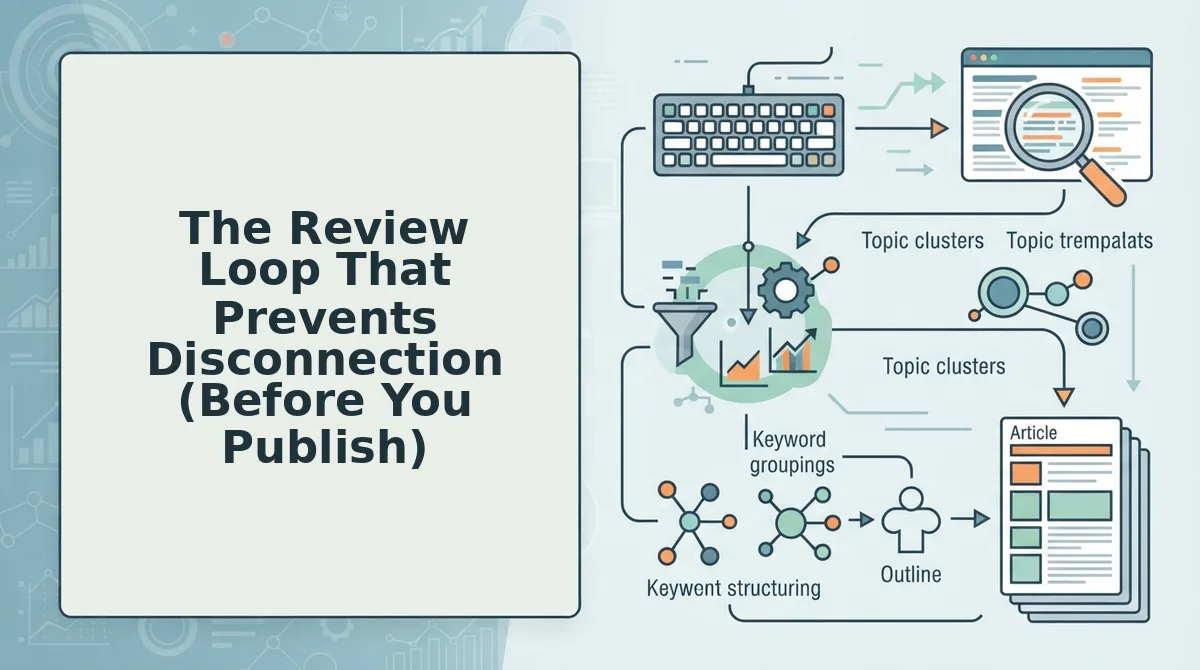
A three-step review loop catches disconnection at the outline stage, before you invest in full drafting. Run each step in order, and you'll publish cohesive sections the first time.
- Read only the first and last sentence of every section. This isolates handoff gaps instantly. If the last sentence of one section doesn't logically set up the first sentence of the next, you've found a break before readers do.
- Run a single-question test on the whole draft. Ask: "What is the one question this article answers?" If any section's first sentence can't be traced back to that question, mark it for repair or removal.
- Use a coherence checklist before hitting publish. Verify that each section states a claim, supports it, and hands off to the next. BloGoose's review loop for AI drafts automates this checklist, flagging sections that fail the handoff test before they reach your CMS.
Make this loop a habit on every draft, and disconnection stops being a repair job and becomes a non-issue.
FAQ
Why does my AI blog post read like separate articles?
AI drafts often read like separate articles because each section is generated independently without a shared narrative thread. The model treats every heading as a fresh prompt, so transitions, voice consistency, and logical handoffs get lost between sections.
How do I make AI-generated content flow better?
Make AI content flow by writing section transitions after the full draft exists, not during initial generation. Read the last sentence of each section against the first sentence of the next, then rewrite any gap so one idea previews the other.
Can I fix disconnected AI sections without rewriting everything?
Yes, you can fix disconnected sections with targeted edits: rewrite each section's first sentence to restate the core question, add a bridging last sentence, and delete filler sections. Most drafts need 10-15 minutes of repair, not a full rewrite.
What causes AI blog sections to feel disconnected?
Disconnected sections come from four root causes: topic drift, voice shift, missing handoffs, and ghost sections. Each has a specific repair tactic, from restating the core question to deleting filler content that adds no new information.
Disconnection Is a Fixable Pattern, Not a Rewrite Problem
You don't need to scrap the draft. You need a repeatable bridge-building habit. The Section Bridge Diagnostic takes under 10 minutes, and the repair methods map directly to the four root causes you identified earlier in this article.
Here's the sequence that closes the loop:
- Run the diagnostic on your next AI draft before editing anything else.
- Repair the highest-impact break first, usually the missing transition between your second and third sections.
- Apply the review loop as a final pass, checking for pronoun drift, topic jumps, and orphaned claims.
One question worth asking yourself: Would a reader who skips every subheading still follow the argument? If yes, the bridges are working.
Disconnection is fixable with a systematic approach, not a full rewrite. Start fixing your AI drafts with BloGoose, the platform's site crawl and brand context extraction give your articles the structural continuity that keeps readers moving and search engines citing.
Connected sections aren't a writing talent, they're a diagnostic habit you can run in minutes.