How to fix one weak blog section without rewriting the post
Your post used to pull traffic and now sits flat. One section in the middle reads like a different writer dropped it in â the intro promises a comparison, the paragraph delivers a definition, and the register is off by a full notch. The instinct is to nuke the draft. That is the expensive move. You can fix one weak blog section in place, regenerate the block against the outline it already occupies, and keep the URL, the internal links, and whatever history the page has earned.
Imran Siddiq's video on old posts quietly losing rankings captures the panic that triggers a full redraft. Professor Wolters' formatting walkthrough explains the other half: readers bail on presentation long before they judge a sentence.
What follows is the repair path â a triage table for diagnosing the block, a four-field contract that stops regeneration from drifting, and the republish mechanics that leave page history intact. One block gets replaced; the URL never changes. Hold onto this, though: a large share of "weak writing" flags turn out to be heading problems. Refresh the post instead of rewriting it and the rest of the diagnosis falls into place.
Is the section weak, or is the heading the problem?
Check the H2 before you touch a sentence. A heading that promises something its body does not deliver produces the same symptom as bad prose â the reader leaves at the same point â so ruling out the promise costs nothing and eliminates half the failure modes.
Section-level editing is the surgical edit of one block, heading and body together, against an outline that stays fixed. The surrounding sections, the internal links and the URL do not move; only the weak passage does.
| Failure mode | Symptom | Likely culprit | Fix |
|---|---|---|---|
| Intent drift | Body defines a term under a heading that asked for steps | Heading written before the draft and never reconciled | Regenerate to the promise, or sharpen the H2 |
| Voice drift | Sentences shorten, contractions flip, hedges disappear mid-post | Voice rules passed as adjectives rather than a file | Regenerate with the voice file attached |
| No evidence | Confident claims with nothing behind them | Block generated without a source or example | Hand-edit â only you know what backs it |
| Orphaned transition | Block reads fine alone, the next H2 starts cold | Block moved or regenerated outside its outline slot | Hand-edit the seam |
Regenerate when the problem is genericness; hand-edit when it is specificity. If the paragraph is fluent and empty â definitions where you wanted an example, hedged claims where you wanted a number â the block holds nothing you would lose by replacing it, so regenerate with a fuller contract. If it fails because a fact is wrong, a link points at the wrong page, or the handoff into the next H2 no longer lands, only a human edit fixes it. Replacing a block that carries your one original observation is how a post loses the thing that made it rank.
Best for: regeneration suits operators shipping AI drafts at volume, where blocks contain no information worth preserving. Hand-editing suits single-author blogs, where the fact base lives in your head and the seam matters more than the prose.
Full rewrites earn their reputation honestly â a post whose angle is wrong at the root cannot be rescued section by section, and the videos ranking on this problem are right that formatting drives abandonment before sentences do. Run a live SERP analysis first if you suspect the page is not competing at all. Otherwise the block is the unit, and a crawl-based engine like BloGoose extracts your voice rules as a file â the input manual regeneration keeps skipping. That is also where AEO content optimization starts: one passage answering one question cleanly.
What does a section need before you regenerate it?
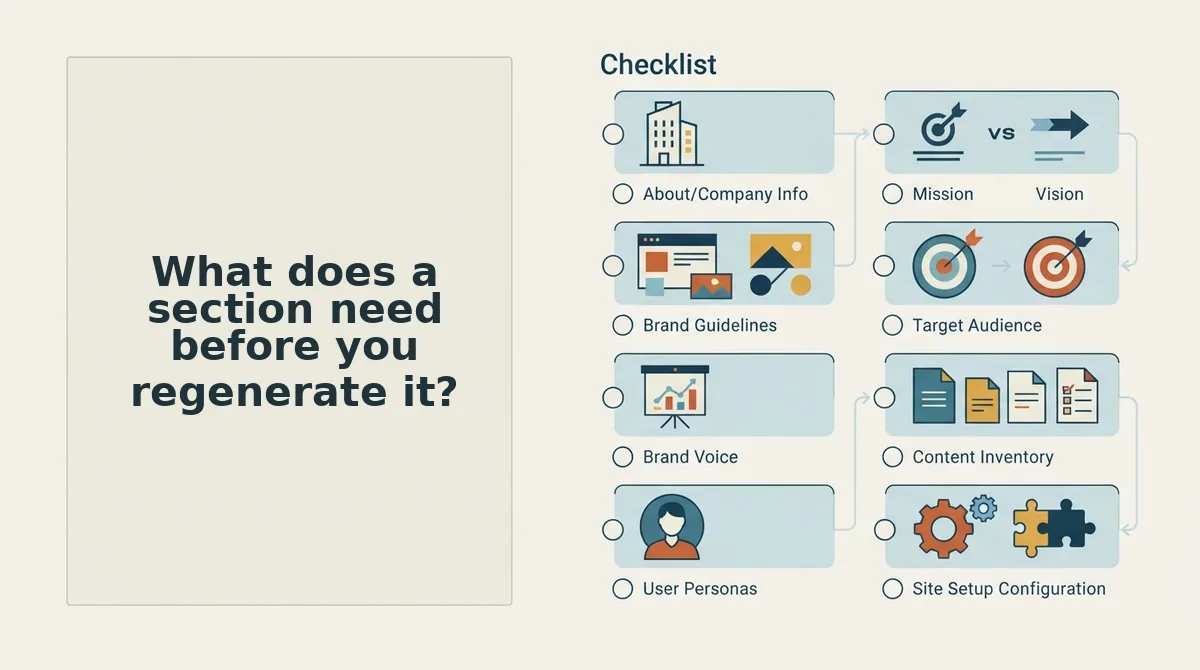
A block regenerates cleanly only when it inherits four inputs. Skip one and the model fills the gap with averages, which readers hear as a different writer.
The Section Contract is the four-field brief a block must carry into regeneration: the heading's promise, its outline slot, the brand voice file, and the internal link it owes.
The heading's promise is the simple field â an H2 asking how to replace one block has to return steps, not a definition. The outline slot is the intermediate one: what the section before just said, and what the section after already assumes.
Voice is the field teams pass as vibes. Voice rules work as a file â sentence-length ceiling, banned phrases, contraction policy, how the brand hedges. Pass "friendly" and the block returns friendly by default, which is exactly why one prompt for a whole post drifts.
The internal link is the advanced field: each block sits in a cluster and usually owes the adjacent page a link, which keeps it pointing somewhere instead of ending in a shrug. Two failures worth naming â voice drift is the block matching the topic but not the register; intent drift is the blockâ¦e heading never asked.
Regenerate with three of four fields and you get "content that resonates with your audience." Add the fourth â the link it owes your pricing page â and the same block names the actual handoff step. Think of repainting one wall: paint code, finish, trim line, not just the colour name.
Which leaves the mechanical half: swapping the block back in.
How do you replace one block and republish the post?
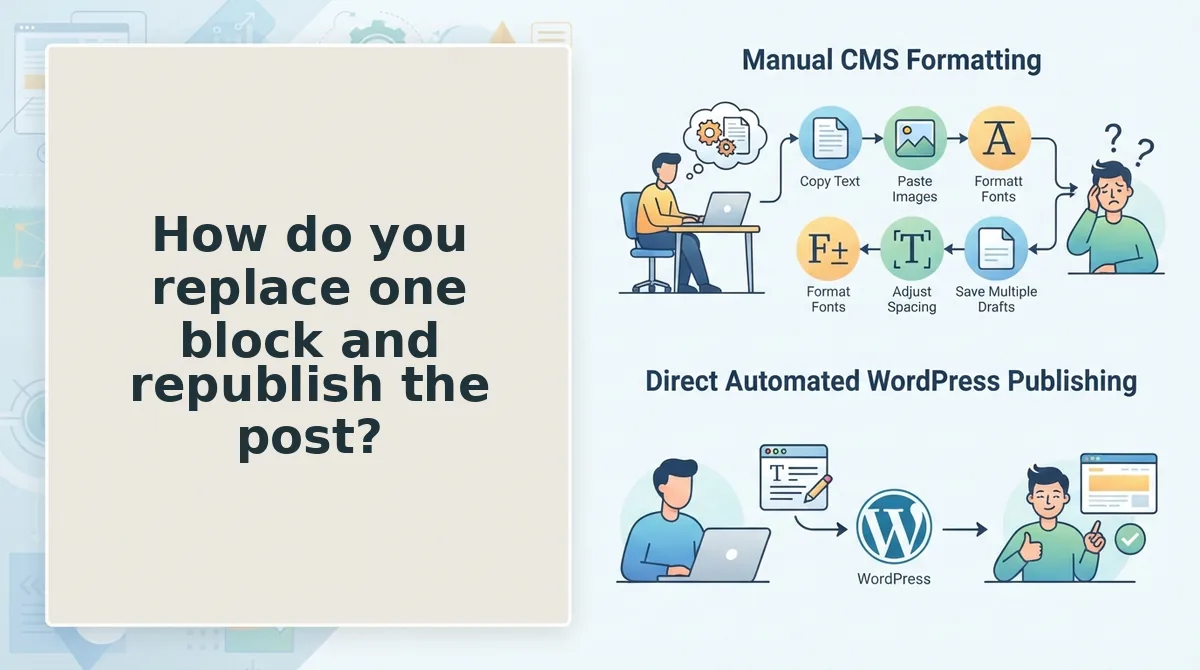
Regenerate only the weak section against its four contract fields. Check it against the heading's promise, then update the existing post at the same URL. Expect roughly 20 to 30 minutes of work, with nothing outside the target block changing.
Before you start: have the section contract, edit access to WordPress or your custom API, and Google Search Console access.
- Paste the four contract fields into your regeneration input: the heading's promise, the outline slot, the brand voice file, and the internal link the section owes. This takes about 5 minutes. All four fields should appear in a single input.
- Lock every section outside the target block by leaving neighboring sections out of the edit scope. Only one block should be marked for change.
- Regenerate the block, then read the new text against the heading's promise before it reaches the CMS. This takes 5 to 10 minutes. The new opening sentence should answer the heading, and the owed link should be present.
- Open Posts, then All Posts in WordPress. Click Edit, replace only that block, and click Update. You should see "Post updated." at the same URL.
- Request recrawling through the Indexing API. Then confirm that your sitemap lastmod shows today's date.
Will editing a post hurt its rankings? Mechanically, republishing does not reset the page. The URL and canonical stay identical, so the existing page simply gets recrawled. Only two signals change: the article's dateModified and the sitemap's lastmod value. Search engines see an updated version of a known page, not a new page competing with the old one. Problems usually come from accidental collateral changes during the edit, such as a broken canonical tag, a removed internal link, or a stripped schema block. The parity check below exists to catch those changes.
Five-item parity check: canonical, internal links, images with alt text, article schema, and meta description should all match the pre-edit version.
BloGoose builds this workflow in by drafting against your site's voice rules and publishing straight to WordPress or your custom API.
When should you fix it, cut it, or rewrite the post?
Fix the section when its heading still earns a click, cut it when it serves no reader, and rewrite the post only when the keyword is wrong. Regeneration repairs prose. It cannot rescue a broken keyword choice or a dead outline slot.
| Action | When it applies |
|---|---|
| Fix | The heading's promise is still valid, but the prose lost the thread. |
| Cut | The section serves no query and owes no internal link. |
| Rewrite | The target keyword itself is wrong. |
The economics favor surgery. Regenerating one block against an existing outline keeps everything that already works. A blank-prompt redraft gambles all of it to repair a single paragraph.
Republish to the identical URL every time. Your canonical URL stays put, one block changes, and the page's history remains intact. Next week, open Search Console and confirm the page was recrawled with the updated content.
Next step: drop your domain into the BloGoose setup wizard so it can crawl your sitemap and extract your voice rules. That gives every future section repair a contract to start from. Treat each weak block as a quick fix, not a reason to start the post over.