
How to ground AI writing rules from site crawl data
You prompt a commercial model to write for your blog, and it returns robotic corporate mush that clashes with your catalog. To ground ai writing rules from site crawl data means extracting formatting structures, vocabulary bounds, and link architectures directly from production URLs to govern draft generation deterministically. You already built the catalog; you will learn how to convert published inventory into enforceable machine parameters that eliminate generic drafting errors.
Executing this workflow requires three structural prerequisites:
- An accessible XML sitemap displaying clean canonical URLs.
- Clean DOM rendering uninhibited by dynamic script blockers.
- Persistent rule file destinations for structured constraints.
In practice, submitting a root domain into the BloGoose setup wizard automatically crawls the XML sitemap, inspects published posts, and compiles eight editable Markdown context files, including style-guide.md and internal-links-map.md. This eliminates manual prompt homework by establishing clear editorial boundaries before drafting begins. You can deploy this crawl-driven extraction workflow across your own site stack to enforce brand voice without writing custom prompts.
Yet storing snippets in vector databases often fails to preserve consistent editorial tone across long-form content.
Examining retrieval failures reveals why semantic similarity struggles to capture structural voice constraints.
Why Vector RAG Fails at Editorial Tone vs Crawl-Based Rule Grounding
Vector retrieval-augmented generation (RAG) fails at editorial tone because cosine similarity retrieves semantic facts rather than structural syntax, cadence, or negative style constraints. While semantic search identifies what a company talks about, deterministic rules derived from a complete site crawl dictate how the brand actually writes.
Vector RAG is an information retrieval architecture that queries chunked text embeddings to inject topically relevant context into an LLM prompt window. It works exceptionally well for knowledge bases, product documentation, and answering ad-hoc factual customer support tickets.
Editorial production demands more than topical fact retrieval. When a generation pipeline relies purely on dynamic chunk retrieval without explicit negative constraints, prompt drift failure rates rise because models mimic localized snippet phrasing rather than global brand guidelines. A chunk containing a customer case study does not inform the model whether your publication bans passive voice, mandates specific header structures, or prohibits startup buzzwords.
The difference comes down to mechanical architecture:
| Architecture | Context Type Retrieved | Tone Control Mechanism | Best For |
|---|---|---|---|
| Vector Embeddings (Cosine Similarity) | Topical facts and semantic fragments | Probabilistic similarity matching | Enterprise support desks needing real-time knowledge base lookups |
| Static Chat Prompting | Manual instructions | Single-prompt system instructions | Solo writers producing one-off editorial pieces manually |
| Deterministic Site Crawl Rules | Syntax, cadence, linking maps, formatting rules | Hardcoded negative constraints and style guides | Content publishers scaling automated, rank-ready search assets |
Choose vector RAG if your primary challenge is factual accuracy across a dynamic catalog of technical documentation. Choose deterministic site crawl rules if you need reproducible editorial voice across full content clusters.
Our recommendation for scalable organic publishing is grounding generations in deterministic crawl data exported into markdown brand context files. Parsing full XML sitemaps and existing body copy extracts concrete syntax patterns, heading hierarchies, and internal linking parameters that semantic similarity searches routinely miss.
Capturing these parameters begins by surveying your existing domain architecture.
Step 1: Extract Core Site Structure and Discover URL Scope
Core site structure extraction catalogs indexable editorial URLs from XML sitemaps while filtering out non-editorial utility paths to establish reliable brand context. This initial discovery isolates the live article database required to ground tone guidelines, competitive keyword maps, and internal link architecture without manual spreadsheet audits.
Can an automated system extract your editorial voice accurately if half its training data consists of checkout flows, privacy policies, and paginated archives? Ingesting unstructured domain sweeps introduces administrative noise that corrupts style rules and muddies search intent signals.
XML sitemap traversal is the automated process of parsing hierarchical sitemap files to identify, catalog, and validate indexable site URLs. During site onboarding, targeted extraction scripts inspect root indexes to differentiate long-form articles from functional assets. Evaluating site directives protects against scraping errors by honoring user-agent instructions, including disallow blocks applied to modern crawl configurations. Isolating clean post nodes ensures your downstream context files reference only high-performing editorial copy rather than interface boilerplate.
Ensure you have your primary website address accessible before starting; completing structural discovery typically takes under 3 minutes.
- Type your root domain into the crawler setup field to trigger automated CMS stack detection. You will see a green confirmation badge confirming whether your site operates on WordPress, a headless setup, or a custom API.
- Inspect the active robots.txt filtering rules referencing AI crawler behaviors like Google-Extended to avoid permission conflicts. The crawler console renders a real-time list of accessible endpoints alongside blocked administrative folders.
- Execute the targeted extraction script logic focusing exclusively on post-type XML nodes within the detected sitemap index. The platform populates a verified inventory for your internal link map sitemap crawl while automatically filtering out account portals, paginated category loops, and utility redirects.
With the editorial URL scope confirmed, the next stage strips away layout wrappers to isolate raw prose.
Step 2: Strip DOM Noise and Isolate Pure Editorial Content
Stripping DOM noise isolates the primary article body by pruning non-editorial markup, preventing navigation links, legal banners, and sidebar widgets from corrupting brand voice extraction.
DOM noise stripping is the programmatic filtering of non-content elements from a webpage's Document Object Model to extract pure editorial copy. Without sanitizing raw crawl output, language models evaluate boilerplate navigation menus, affiliate disclosures, cookie notices, and author cards alongside body paragraphs. These extraneous elements introduce false-positive tone markers, skewing sentence-length averages and polluting vocabulary profiles with repetitive legal or promotional phrases. Isolating the primary article container through targeted extraction selectors guarantees that downstream AI analysis evaluates authentic editorial syntax, paragraph rhythms, and domain-specific terminology instead of interface scaffolding.
Imagine crawling a vibrant consumer blog only to find your downstream AI drafts mimicking a rigid terms-of-service agreement. Think of DOM sanitation like straining pulp and seeds from citrus juice: you need the pure editorial liquid, not the surrounding structural rind.
At an operational level, automated frameworks like Crawl4AI apply CSS selector isolation rules targeting main article containers such as the primary article tag or custom post wrappers. The crawler strips unneeded nodes before text conversion, ensuring that UI components never dilute your editorial style baseline.
Uncleaned extraction pipelines regularly trip over specific DOM element classes that distort tone:
- . cookie-consent and legal wrappers, which inject rigid, compliance-heavy language into conversational brands.
- . author-bio cards, which distort first-person voice by introducing repetitive third-person biographical summaries.
- . sidebar-widget links, which inflate noun frequency with disjointed category labels and navigational tags.
Filtering out these peripheral containers guarantees that your linguistic baseline reflects authentic writing patterns rather than website software defaults.
With clean text isolated from site markup, the next task organizes these linguistic signals into actionable operational rules.
Step 3: Map Raw Crawl Patterns into Structured Markdown Rulebooks
Mapping raw crawl patterns into structured Markdown rulebooks transforms messy HTML extracts into modular, version-controlled steering documents that govern every AI generation pass. Converting crawl observations into an 8-file Markdown context architecture eliminates hallucinated tones, stops prompt bloat, and enforces exact technical formatting across automated pipelines.
When an automated crawl discovers that top-performing audited URLs maintain a tight heading cadence distribution ratio, such as placing an H3 every 180 words beneath an H2, feeding raw text dumps into single chat prompts produces inconsistent mush. Replacing mega-prompts with segmented rulebooks ensures deterministic output.
A Markdown context architecture is a modular collection of plain-text system files that explicitly defines editorial tone, internal linking targets, and search parameters for generative models.
- Synthesize structural rhythm into style-guide.md: This file translates observed DOM structure into strict drafting constraints, defining paragraph lengths, bullet patterns, and the heading cadence distribution ratios derived from top-performing audited URLs. It matters because generative models default to run-on prose without hard structural limits. Configure your generator to read these layout rules before generating any sectional draft.
- Compile ranking criteria into seo-guidelines.md: This rulebook captures metadata character caps, search intent targets, and primary keyword placements identified across your indexed pages. It matters because search engines penalize thin content that ignores search intent patterns and keyword density baselines. Use this file as a validation filter before any generated text reaches your CMS.
- Codify narrative tone into brand-voice.md: This asset records specific voice traits, active vocabulary preferences, and required reading levels extracted from editorial copy. It matters because generic LLM completions sound robotic and alienate repeat readers. Apply it as a global system instruction to strip marketing fluff and corporate jargon automatically.
- Preserve link topology in internal-links-map.md: This counterintuitive rulebook prioritizes internal architecture over outward external research by logging crawl paths and cluster URLs. It matters because automated articles frequently create orphan pages when they lack immediate awareness of surrounding site taxonomy. Map these historical endpoints so the engine injects contextual in-content anchors naturally.
Consider a publisher managing a technical blog. The site setup wizard crawls the existing domain, identifies XML sitemaps, and extracts recurring editorial patterns across dozens of published URLs. The platform automatically converts these raw crawl observations into editable brand context files, establishing exact structural constraints. The resulting draft adheres strictly to the site's authentic heading cadence and terminology without manual prompt editing.
Instead of manually compiling these parameters across disconnected spreadsheets, deploy the AI SEO content engine from BloGoose to inspect your XML sitemap, generate your modular context files automatically, and ship rank-ready articles directly to WordPress.
Once your positive editorial rules are secured in structured files, you must isolate the unwanted behaviors to block.
Step 4: Convert Extracted Site Patterns into Negative Prompts and Hard Constraints
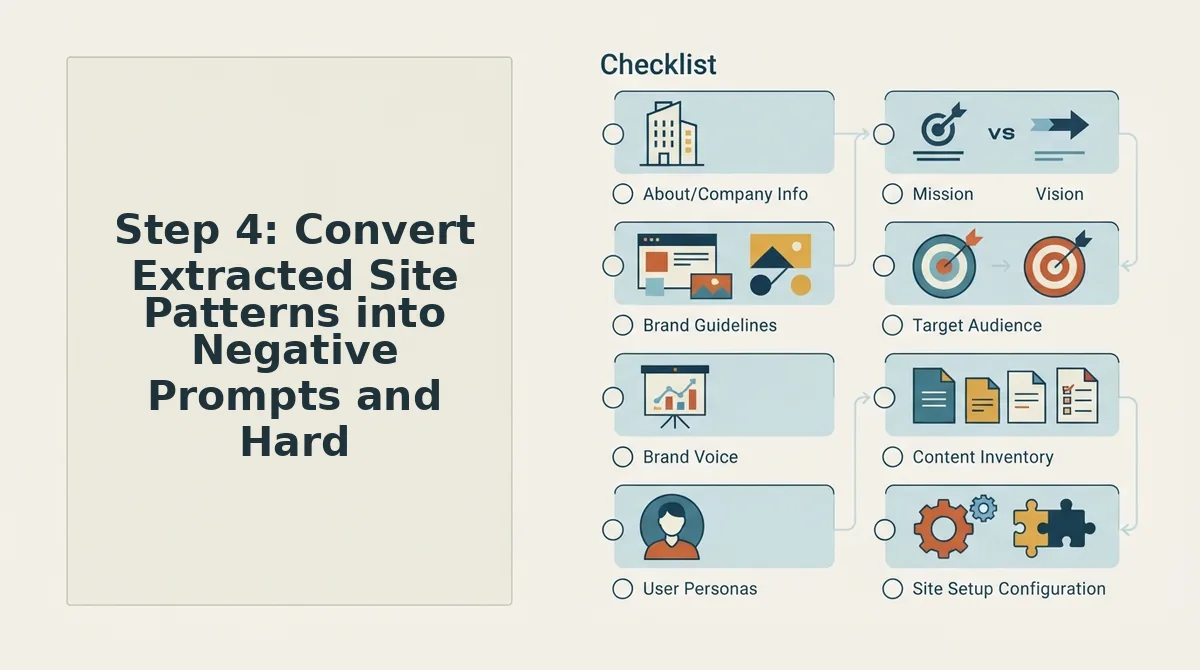
Converting extracted site patterns into negative prompts requires translating crawl data into explicit exclusion rules that ban generic AI vocabulary and lock in your site's target readability metrics. Negative prompting is a configuration method that explicitly restricts specific words, phrases, and sentence structures from an AI model's generation space.
Most content teams waste hours crafting descriptive positive voice guidelines. Telling an AI what to sound like invites hallucinated fluff; enforcing what it cannot write guarantees consistency.
Prerequisites: An isolated plain-text export of your crawled editorial copy and write access to your brand context Markdown files.
- Calculate empirical readability baselines (Est. time: 5 minutes): Run your crawled body copy through empirical readability scoring formulas, such as Flesch-Kincaid Grade Level, to establish your domain's natural sentence length and syllable density. You should see an average reading level benchmark that establishes a hard ceiling for future drafts.
- Construct a negative vocabulary block (Est. time: 10 minutes): Compile a negative prompt template that disallows words absent from your crawl, explicitly targeting banned AI transition crutches like "delve", "testament", and "in conclusion". You should see an absolute exclusion rule specifying: "Never use the following tokens or their grammatical variants: delve, testament, in conclusion, furthermore."
- Inject constraints into configuration files (Est. time: 5 minutes): Open your editorial configuration file and paste these structural bounds directly alongside your seo guidelines markdown checklist. You should see your platform validate the syntax and apply the hard negative boundaries to every downstream drafting prompt.
Why do hard constraints outperform positive style descriptions? Positive instructions like "write plainly" allow models to select common statistical averages, which reintroduces corporate filler. Hard constraints eliminate probabilistic shortcuts, forcing the model to select concrete verbs and industry-specific phrasing found in your crawl data.
Next, you must evaluate whether these boundary parameters successfully withstand repetitive drafting loops without degradation.
How to Verify Your Grounded Writing Rules Prevent Prompt Drift
You verify grounded writing rules by testing newly generated drafts against a deterministic audit scorecard before pushing content into live CMS staging environments. Picture deploying twenty automated articles, only to discover the underlying model quietly discarded your style documentation and lapsed into bland corporate filler. Think of verification like an aircraft pre-flight inspection: every flight control surface and indicator must read within strict operational tolerances before takeoff, regardless of pilot confidence.
Prompt drift verification is an automated quality assurance process that evaluates generated copy against baseline style and link constraints to prevent unauthorized model deviations. In an automated publishing workflow, language models gradually wander toward generic web prose unless strictly audited against extraction rules derived from your sitemap crawl. By testing every draft with a deterministic audit scorecard prior to CMS export, site owners systematically isolate unauthorized phrasing deviations, calculate exact vocabulary compliance percentages, and confirm that required entity targets are present. This programmatic check guarantees that autonomous content production preserves established brand voice without requiring continuous manual copyediting.
A reliable post-generation validation checklist isolating unauthorized phrasing deviations operates across three progressive technical checkpoints:
- Structural Cadence: Perform heading frequency checks to confirm that subheadings maintain crawl-derived depth ratios without sprawling into unbroken blocks of text.
- Lexical Precision: Measure your vocabulary compliance percentage to prove that negative prompt constraints successfully filtered out blacklisted terminology.
- Entity Consistency: Inspect explicit anchor link targets against your sitemap repository to ensure automated references resolve to valid canonical URLs.
Catching lexical slippage at this automated validation gate ensures only rank-ready, voice-compliant articles reach your database before you learn how to ask google to crawl new posts via indexing api to expedite indexing.
Resolving these mechanical quality controls establishes a dependable baseline for autonomous publishing, leading directly into common edge cases that teams encounter during implementation.
Frequently Asked Questions About Grounding AI on Site Crawl Data
Site crawl data grounds generative models directly within runtime prompts, eliminating prompt drift and recurring fine-tuning costs.
Why use in-context crawl grounding instead of model fine-tuning?
In-context grounding costs substantially less and updates instantly compared to model fine-tuning. Fine-tuning bakes static phrasing into model weights at high computational expense, whereas injecting crawl-derived Markdown files directly into system prompts ensures factual precision without retraining cycles or outdated tone drift.
How do you crawl dynamic JavaScript single-page applications for writing rules?
Headless browser rendering extracts complete DOM snapshots from JavaScript SPAs before editorial parsing begins. Standard HTTP scrapers miss client-side rendered text, so the crawler must evaluate the JavaScript layer to capture published headers, body copy, and UI microcopy before distilling brand guidelines into Markdown context.
How often should you update Markdown rule files when brand guidelines evolve?
Update your Markdown rulebooks immediately whenever editorial tone, positioning, or core product scopes shift. Systematically review these operational triggers:
- Monthly audits capturing new product terminology
- Quarterly updates reflecting fresh competitor angles
- Immediate adjustments enforcing newly banned phrases
Clean rule files protect ongoing pipeline accuracy.
What is the most reliable way to prevent AI hallucination using crawl files?
Hard constraints derived from crawl data prevent hallucinations by explicitly bounding what the AI can reference. Formatting crawl patterns into negative prompts and verified entity maps stops the model from inventing non-existent features, unverified pricing tiers, or unindexed URLs during long-form article generation.
Operating from verified crawl context establishes the exact blueprint needed to automate production across your entire domain.
Scale Deterministic Brand Publishing with Crawl-Grounded Context
Deterministic brand publishing turns raw site architecture into strict editorial constraints, eliminating the prompt drift that makes generic AI writing unusable. Picture an editorial pipeline where your sitemap automatically dictates topic boundaries, vocabulary lists, and internal link targets without endless prompt rewriting. By replacing conversational retrieval with structured Markdown rulebooks extracted directly from existing HTML, you resolve the inconsistency that previously stalled scaled content production.
Deploy this crawl-grounded architecture across your publishing workflow using three operational checkpoints:
- Extract baseline rulebooks: Crawl your XML sitemap to capture active voice parameters, negative constraints, and existing internal link maps into editable Markdown files.
- Validate constraint fences: Test drafts against extracted negative prompts to confirm the engine rejects banned phrasing and robotic structure before content generation completes.
- Bridge extraction to CMS: Connect your validated editorial rulebooks directly into an automated publishing loop that ships production drafts straight to your platform.
Drop your website domain into the BloGoose setup wizard to generate your domain-specific context files and begin shipping rank-ready content directly to WordPress or your custom API.
Editorial consistency at scale is never achieved by engineering better prompts, but by anchoring automated content generation directly to the verified structure of your live site.