Jasper alternative for SEO blog content that publishes to WordPress
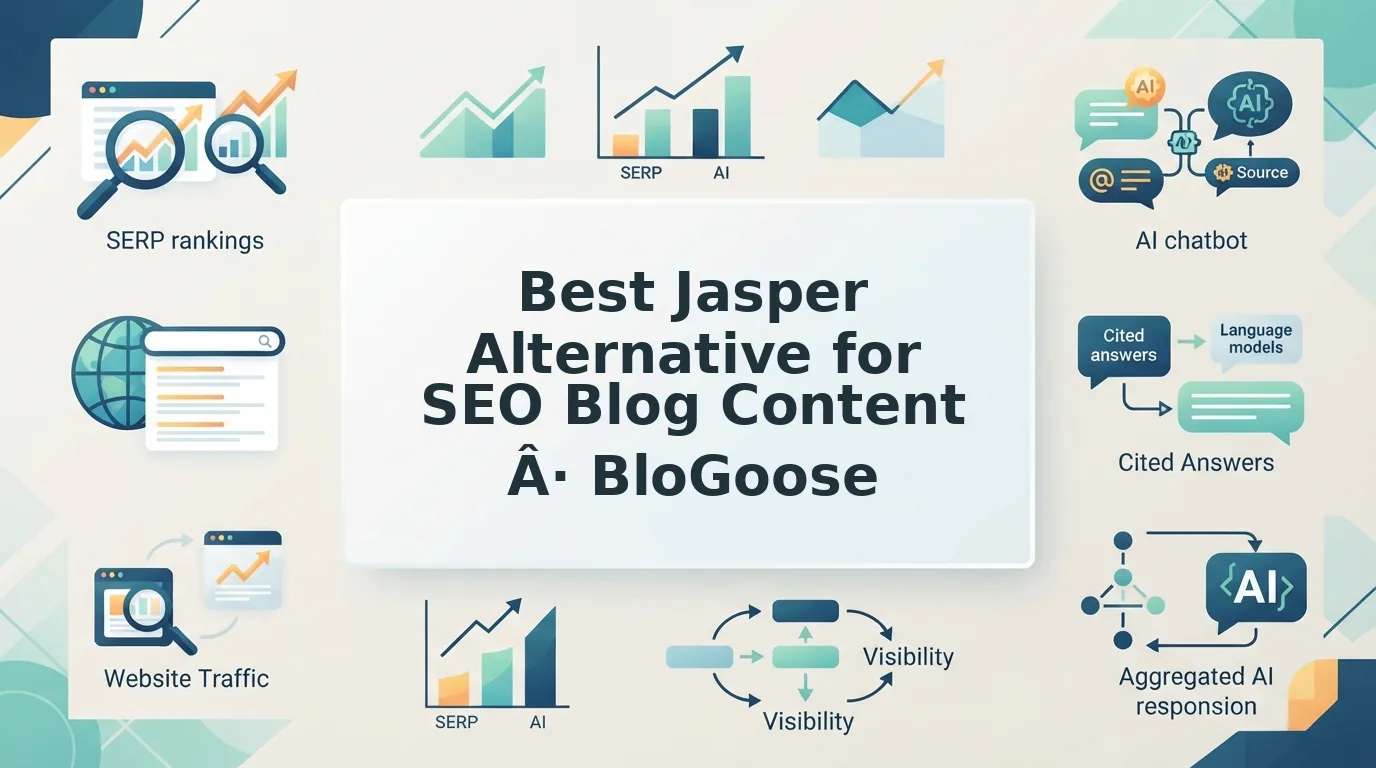
Your team finishes a Jasper draft, and then the real work begins. Someone opens SERP tabs, rewrites for voice, uploads images, and pastes everything into WordPress. That is the "12-tab content stack" at work. A strong jasper alternative for SEO blog content removes those handoffs instead of only speeding up the writing.
You are not doing it wrong. In BloGoose's view, Jasper is built as a marketing copilot. It is strong at campaign copy, but it is not designed to run a search content pipeline from research to a published post.
The verdict: If the job is ranking blog content that ships to WordPress, choose the SEO content engine category. BloGoose fits teams that publish to WordPress or a custom API. Keep Jasper only for campaign copy.
Below, you will find a 5-point fit test laid out as a criteria table. You will also see how many manual handoffs each tool category leaves and a breakdown of the three categories: copilots, autobloggers, and content engines. Along the way, we cover one step most teams forget entirely once the post is live.
Before you compare tools, list every manual step between "draft done" and "post indexed" in your current workflow. Then score each option below against that list. An AI SEO content engine should shrink the list to a final review.
What Makes a Good Jasper Alternative for SEO Blog Content?
A good Jasper alternative for SEO blog content does five things. It takes live SERP input and writes in a voice grounded in your own site. It also maps internal links, publishes natively to WordPress or a custom API, and structures answers for AI citation.
The 5-Point Fit Test is a checklist for judging whether an AI writing tool can run a ranking blog pipeline instead of just producing text. It asks five questions:
- Does the tool pull live SERP data before writing?
- Is its voice learned from your published pages instead of a generic prompt?
- Does it map internal links across your existing content?
- Can it publish natively to WordPress or a custom API?
- Does it structure answers so AI chatbots can quote them?
Each point the tool fails becomes work your team does by hand.
| Fit test criterion | Copilot | Autoblogger | Content Engine |
|---|---|---|---|
| Live SERP input | Partial | Partial | Yes |
| Site-grounded voice | Partial | Partial | Yes |
| Internal-link map | No | Partial | Yes |
| Native WordPress/custom API publishing | No | Partial | Yes |
| AEO structure | Partial | Partial | Yes |
| Handoffs left (of 8) | Most | Some, varies by tool | Review only |
These ratings describe each category in general, and individual tools vary. The eight handoffs in the last row are SERP research, the brief, voice check, images, formatting, internal links, CMS upload, and the indexing request.
Each category has a real strength. Copilots are fast and flexible across formats. Autobloggers produce volume with little setup. Content engines trade some of that flexibility for a repeatable pipeline from research to a published post.
- Copilot: Best for brand marketers producing ad, email, and social copy.
- Autoblogger: Best for niche-site operators who put volume ahead of voice.
- Content Engine: Best for founders, growth leads, and publishers who need voice-accurate clusters live on WordPress.
BloGoose crawls your sitemap, extracts your brand voice rules, plans a 30-day calendar, and builds AEO structure into every draft as an AEO content optimization tool.
Jasper as a Marketing Copilot (and When to Keep It)
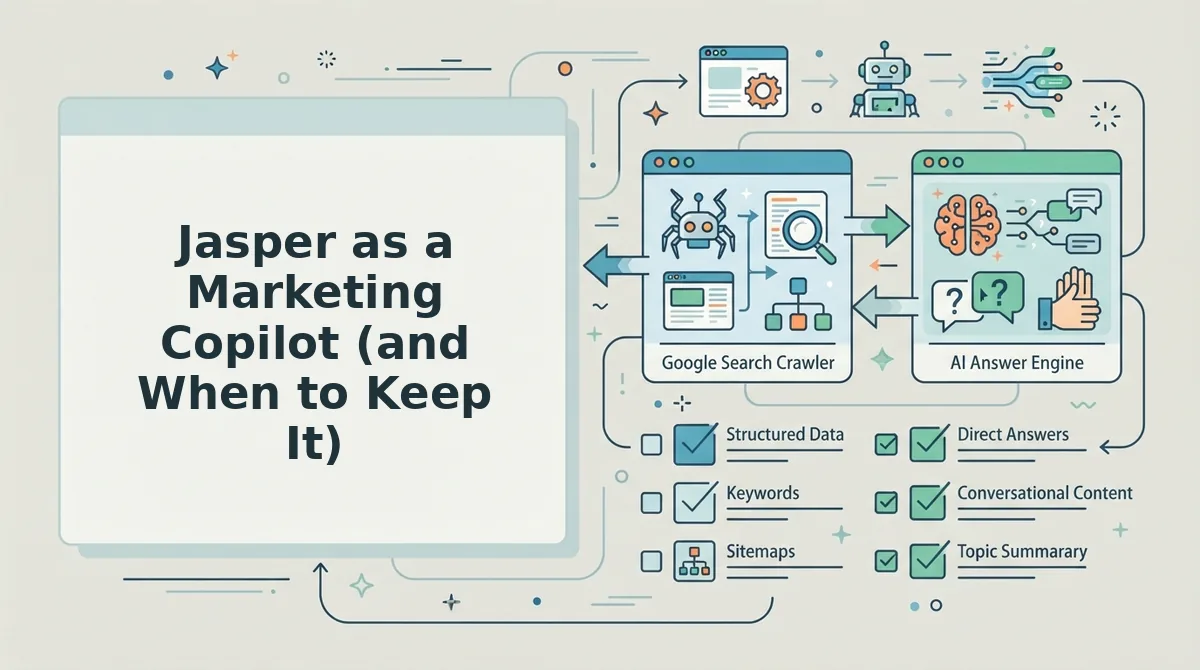
Keep Jasper if most of your output is campaign copy. For the SEO blog pipeline, pair it with an SEO content engine or switch to one, because in BloGoose's view Jasper is a marketing copilot, not a publishing system.
A marketing copilot is an AI writing assistant that helps a marketer draft, vary, and repurpose copy while a human steers every step. Think of it as a sous-chef. It handles prep quickly, but someone else still plates the dish and carries it to the table.
This difference matters because the two jobs work differently. Campaigns need many short variants across channels. Content clusters, which are groups of linked articles built around one core topic, need research, internal linking, and publishing done the same way every time.
A GuideAtlas tutorial on configuring Jasper for scaling blog content walks users through adding SEO briefs by hand, step by step. Treat it as category context rather than proof. It still shows where the SEO layer sits: outside the tool.
Against the fit test, we rate Jasper's category as partial on site-grounded voice and AEO structure. Live SERP input, internal-link mapping, and native publishing mostly depend on manual work. After a Jasper draft, your team still owns SERP research, the voice check, images, internal links, CMS upload, and indexing. The indexing request is the step most teams forget once a post is live.
Keep Jasper if your team mostly produces ad variants, email sequences, social posts, and landing-page copy across several channels at once. In that work, a human reviews every line anyway, the output is short, and nothing needs to rank or be indexed. Jasper's copilot model fits that rhythm. Pair it with an SEO content engine, or switch, once your blog becomes a pipeline of recurring articles. Those articles need live SERP research, a voice learned from your site, internal links, and native WordPress publishing.
Autobloggers take the opposite approach, so they are next.
Autobloggers (Autoblogging.ai, Agility Writer, SEOWriting.ai, Wisewand)
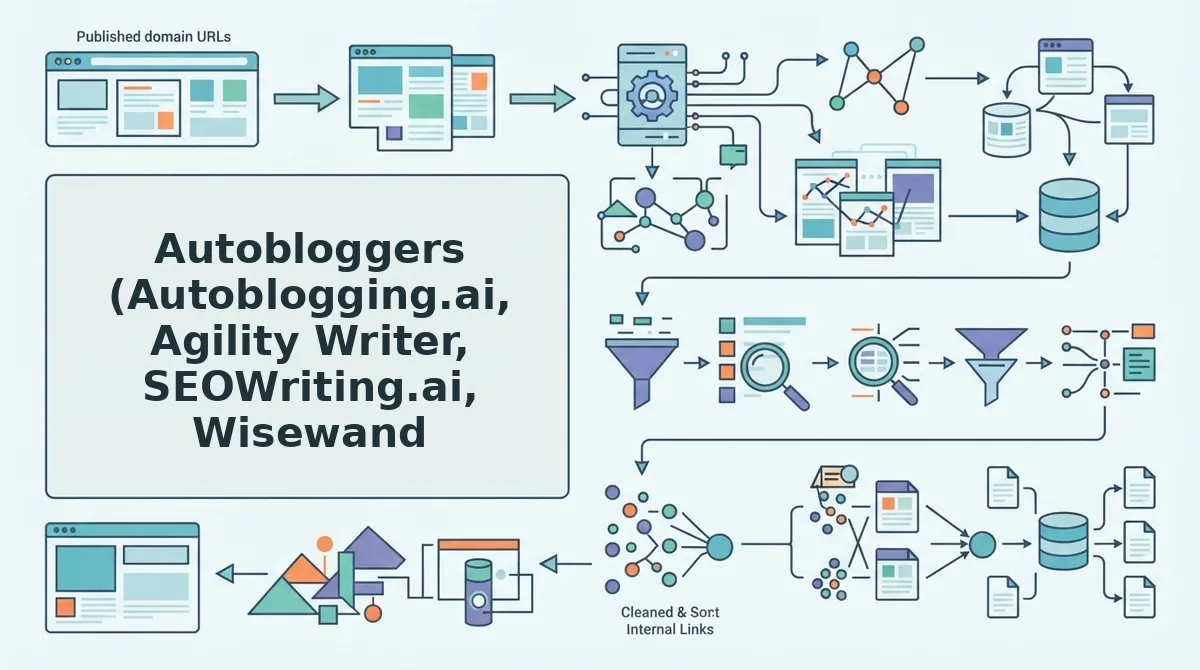
Autobloggers are built for volume: they turn a keyword or topic into a finished long-form article with very little input. That speed is a real strength, but you need to check whether the output reflects your site's voice and internal-link structure.
Most public comparisons skip that check. One YouTube video compares Autoblogging.ai, Agility Writer, and SEOWriting.ai across six tools but never defines selection criteria. A Wisewand tutorial shows a clear single-tool flow from writing persona to search intent, but it does not compare Wisewand with anything else.
So instead of trusting a ranking, run the same fit test on each vendor's own site and documentation.
| Tool | What public demos show | Question to verify with the vendor |
|---|---|---|
| Autoblogging.ai | Featured in a six-tool video comparison | Does it read your existing pages before drafting? |
| Agility Writer | Featured in the same comparison | Can it suggest internal links to your published URLs? |
| SEOWriting.ai | Featured in the same comparison | Does it publish to WordPress, and what does the draft look like when it arrives? |
| Wisewand | Tutorial walks from writing persona to search intent | Is the persona saved and reused across a full content cluster? |
Ask every vendor the same four questions:
- Is brand voice extracted from your site or typed into a prompt?
- Are internal links based on your real sitemap?
- Does the tool plan a cluster or only single articles?
- What happens after publishing, such as an indexing request?
Best for: publishers who need high-volume output and can accept less voice precision, such as niche-site operators testing many keywords.
How an SEO Content Engine Like BloGoose Goes From Research to Publish
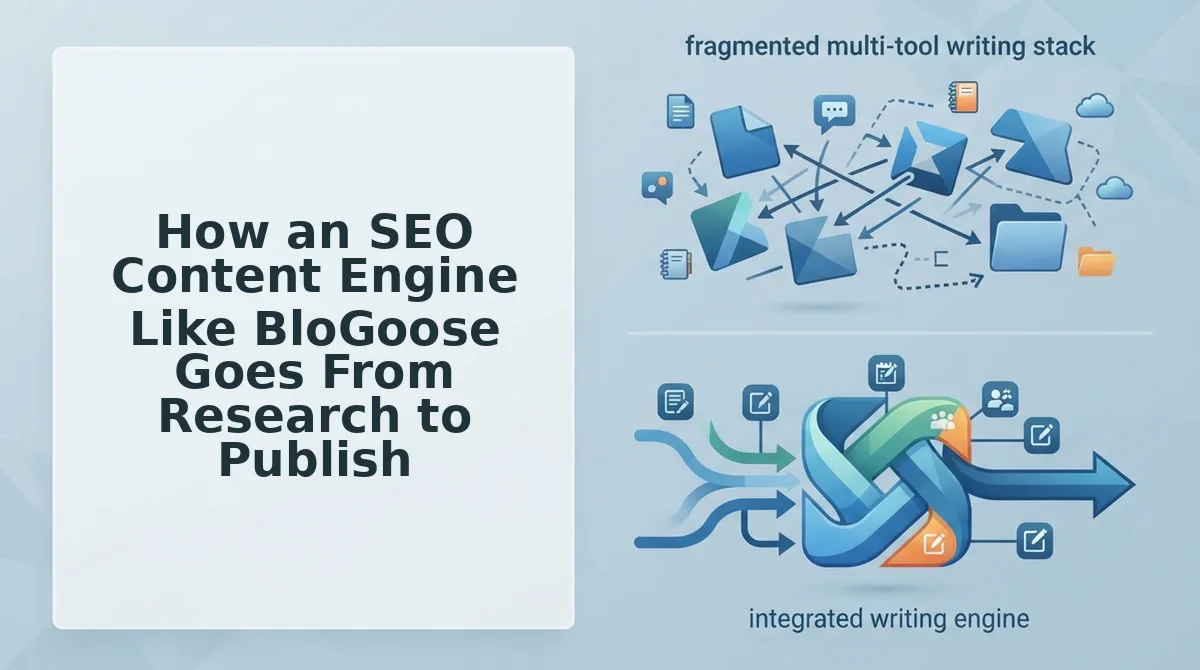
An SEO content engine is software that crawls your website, learns its brand voice, plans a content calendar, drafts search-optimized articles, and publishes them to your CMS in one workflow. It replaces the separate research, writing, image, and publishing tools that teams usually connect by hand.
Prerequisites: your live domain, WordPress admin access or a custom API endpoint, and a Google Cloud project if you want indexing requests.
- Enter your domain in the setup wizard. BloGoose finds your XML sitemap, inspects your published pages, and detects your CMS. You should then see eight editable Markdown brand context files covering your voice, features, SEO brief, and keywords. Plan on a focused review session to adjust them before you continue.
- Open the content calendar. Review the 30-day plan built around your pillar topics. Reorder or remove topics until each week supports a cluster you actually want to rank for.
- Run research on a scheduled topic. BloGoose pulls live SERP and social signals for the keyword. You should see the angles competitors cover and the gaps worth filling.
- Generate the draft. The article is written section by section with SEO and AEO structure: direct-answer openings, scannable lists, and tables. Check that each H2 answers its question in the first sentence.
- Review the inline images. Images are generated inside the same workflow, so you will not need a separate design tool for each post.
- Publish to WordPress or your custom API. The finished post lands in your CMS. See how the automated blog publishing engine handles this handoff.
- Request indexing. Connect a Google Indexing API service account so new URLs are submitted for crawling after publishing. Follow the Google Indexing API setup guide. Once it works, you should see the request confirmed instead of waiting on Google to discover the page.
Scored against the fit test, an engine extracts voice from your site rather than a prompt, uses your real sitemap for structure, plans clusters instead of one-off posts, and closes the post-publish loop with indexing.
If your current process involves copying drafts into WordPress and submitting URLs by hand, start with step 1. Your domain is the only input the wizard needs.
Where BloGoose Is Not the Right Fit
BloGoose is not the right fit if you need ad variants or multi-channel campaign copy. That is Jasper's lane.
Brand context is the set of editable files that tell the engine how your site sounds and what it sells. BloGoose is built for SEO blog articles, not social captions or email sequences.
Publishing goes to WordPress or a custom API. If you run another CMS, you will need an API endpoint, which is simply a URL that accepts new posts.
Think of context files like a style guide handed to a new writer. If you redesign your site and never update the guide, the writer keeps describing the old site. BloGoose's own guidance says to refresh these files after a redesign. Teams that expect zero setup should also review common brand context file mistakes first.
Finally, indexing requests only work after you configure a Google Indexing API service account. A service account is a Google credential that your software uses instead of a person.
With those limits in view, choosing a tool becomes much simpler.
Which Jasper Alternative Should You Choose?
Choose by counting handoffs, not by comparing prose quality. The tool that leaves the fewest manual steps between your site and a published, indexed article is the one that will keep your calendar full.
Here is how the three categories stack up:
- Keep Jasper for campaigns. It drafts marketing copy well, but research, SEO optimization, and WordPress publishing remain separate handoffs you manage.
- Pick an autoblogger for raw volume. It ships fast, yet voice editing and cluster planning still land back on your desk.
- Choose an SEO content engine for voice-accurate clusters. Crawl, voice extraction, calendar, drafting, images, and publishing run as one pipeline, leaving you a review step.
Before you commit, run the 5-point fit test on every tool on your shortlist. Any tool that fails on voice or publishing will rebuild the stack you are trying to escape.
If BloGoose passes your test, run your domain through the setup wizard and watch it map your sitemap into a pillar-focused calendar. Want numbers first? See BloGoose pricing.
The best Jasper alternative is not the one that writes better sentences; it is the one that removes the handoffs between your site and the search results.