Jasper brand voice settings vs a crawled writing style file
Two tabs are open. On one, a teammate is assembling a Jasper brand voice profile â uploading samples, ticking tone attributes, attaching brand knowledge. On the other, someone is approving a Markdown style file generated from your own published pages. Both of them believe setup is the finish line.
It isn't. The Jasper brand voice settings vs crawled style file question is really a question about ownership: where the rules live, who can edit them, and who repairs them after your next rebrand.
You are right to be weighing this rather than clicking through another setup demo. Here is the honest footing first: these two approaches were not tested head to head for this article, and no published output benchmark comparing them exists. The argument below rests on mechanism â what each method captures, what it needs as input, and what it costs to maintain â not on scored samples. That is more than the affiliate tutorials offer; the visible landscape on this query is almost entirely video walkthroughs and demos, and none of them hands you a decision framework.
What you get: the verdict and the criteria behind it, then a plain description of what each side actually configures. You also get the part the demos skip entirely â who maintains the thing in month six, when voice drift sets in and nobody notices. That maintenance question is where the two approaches separate most sharply, and it is where we will end up.
Is Jasper brand voice better than a crawled style file?
Neither wins outright. Jasper's brand voice settings are better for teams producing inside one tool who want to configure once and start drafting fast. A crawled style file is better for teams that need the rules to be portable, inspectable, and owned as house documentation rather than vendor configuration.
The distinction that decides most evaluations is portability. A configured Jasper voice profile is assembled within Jasper â you upload samples, choose tone and persona attributes, attach brand knowledge â and it stays there. A crawled style file is plain text generated from your existing published corpus, which means it can be versioned, reviewed in a pull request, handed to a freelancer, or pasted into a different model tomorrow. If your team has ever rebuilt tone rules from memory after switching tools, you already know which cost is larger. Jasper's genuine strength is speed to first draft: configuration is guided, visible, and requires no one to write a spec. The crawled file's strength is durability and governance â it describes your site as it actually reads, and it survives tool changes.
| Evaluation criterion | Jasper brand voice settings | Crawled writing style file |
|---|---|---|
| What gets captured | Tone, persona attributes, and brand knowledge you select by hand | Observed patterns from pages you have already published |
| Source material | Uploaded writing samples and manual attribute choices | An existing published corpus, read from the site |
| Portability | Lives inside one tool | Plain text the team owns and can move |
| Upkeep owner | Whoever administers the Jasper account | Whoever owns the content system and re-crawls it |
| Portfolio governance | Separate profile per brand, maintained individually | Separate file per brand, reviewable and diffable |
Best for the solo operator or small team already standardizing on Jasper: brand voice settings. Configuration is the shortest path from blank page to on-tone draft. Best for agencies, multi-brand publishers, and regulated sites: a crawled style file. A written file can be approved by legal, tracked across versions, and applied to several tools at once. Teams that want the crawl side automated â sitemap discovered, pages inspected, voice rules extracted into reusable context files â can see how that works in BloGoose's context files built from a site crawl.
What Jasper's brand voice settings actually configure
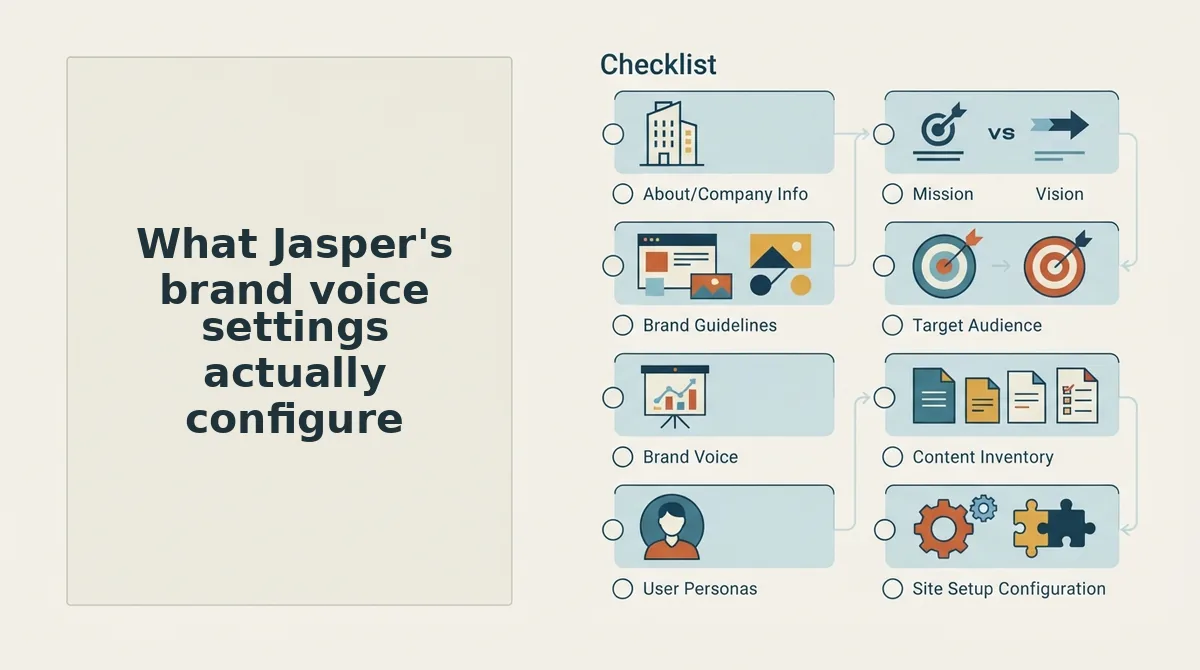
Jasper brand voice is a saved profile inside the Jasper workspace that tells the generator how a specific brand should sound, built from writing samples plus attributes and knowledge you select manually. It is configuration, not documentation â the output is a setting the tool applies, not a file your team can read, diff, or carry elsewhere.
Think of it like a car's memory seat position: comfortable, instantly recalled, and useless in a rental. The setting belongs to the vehicle, not to you.
Three inputs go into it. First, uploaded writing samples â real prose the model imitates, which means someone has to decide which pieces represent the brand well. Second, tone and persona attributes, the sliders and descriptors that narrow the register: formal or casual, first person or third, energetic or measured. Third, brand knowledge assets, the background facts and positioning the generator should treat as true. In practice the workflow looks like this: collect two or three strong pieces, strip out anything off-brand, pick attributes that match them, add the facts, save the profile, then draft.
Notice what that sequence hides. The profile is assembled by hand from material a human chose, and every choice is a judgment call made once and rarely revisited. Setup walkthroughs stop at the save button and never address export or upkeep. A profile also cannot describe what your site actually publishes â it can only approximate what you told it.
The crawled approach starts from the opposite end: not what you say about your voice, but what your pages already do.
What a crawled writing style file actually captures
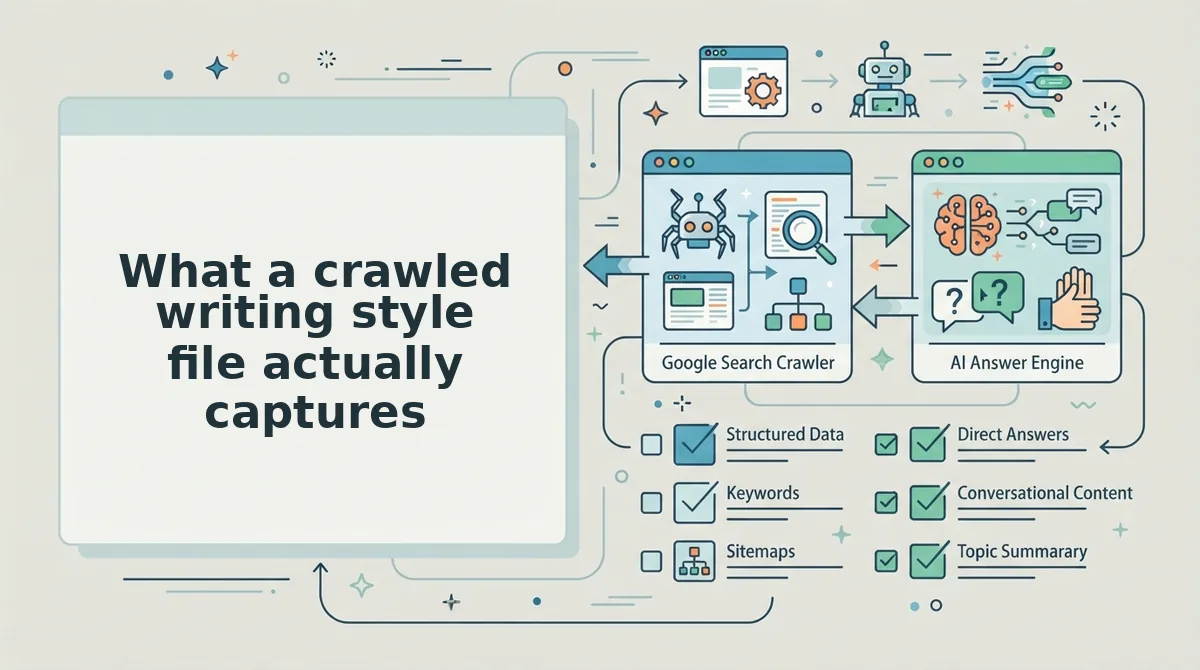
A crawled writing style file is a set of plain-text rules extracted from a site's own published pages â tone, terminology, formatting habits and linking conventions â saved in a format any model or editor can read. It is built from the corpus you already shipped rather than from samples you select in advance.
The distinction matters because voice is not the whole of style. A configured profile holds voice; a crawl captures voice plus house mechanics. That second half explains why copy can sound right and still look wrong on the page.
| Dimension | Captured by a crawled file | Captured by a configured profile |
|---|---|---|
| Tone | Observed patterns with real examples attached | Set by selecting tone attributes |
| Mechanics | Heading habits, sentence length, paragraph rhythm | Largely absent |
| Terminology | Product names, preferred and banned terms | Partly, via uploaded samples |
| Link habits | Internal link patterns and anchor conventions | Largely absent |
Best for the crawl: teams publishing across more than one model or CMS, and anyone whose brand rules must survive a tool change. Best for Jasper: a single writer who wants tone locked down in one workspace without sourcing a corpus first.
Portability is the practical difference. A configured voice profile lives inside the tool that holds it â the rules are settings, and settings do not travel. A Markdown style file is text you own, so it can be pasted into a prompt, committed to a repository, or handed to a new writer on day one. BloGoose's sitemap crawl generates eight Markdown context files from the site itself, each editable and each portable across tools. That same recurring terminology is the mechanism behind durable AEO content optimization, since answer engines reward consistent language. The breakdown of extracting brand context from a sitemap covers how the extraction itself works.
Where the hours go, input curation or output correction
This sounds academic until you price the hours. Both approaches push work in front of the draft, and this ledger names every human task that survives.
- Assembling sample documents (Jasper side). Someone has to find, clean and upload the writing the profile learns from. Pick documents that represent the brand you want, not the brand you had two rebrands ago.
- Choosing tone attributes (Jasper side). Every attribute you toggle is a decision about how the brand sounds, and it needs someone with authority to make it. Name that person before setup, not after the first off-voice draft.
- Keeping the profile current (Jasper side). Positioning shifts; the profile does not. Budget a review whenever messaging changes, or the tool keeps writing in the old voice with full confidence.
- Pruning outlier pages (crawl side). A crawl reads what is published, including the campaign page and the guest post that never matched. Strip those before approving the extracted rules.
- Filtering legacy and stale content (crawl side). Retired product names and old pricing pages teach the file the wrong vocabulary. Exclude them by URL pattern or date.
- Approving the extracted rules (crawl side). The file is a draft until a human signs off. Read the eight context files before they drive a single article.
Then route the decision with four separate questions â the ledger accounts for labor, this accounts for fit:
- Is there a published corpus? Without one, a crawl has nothing to learn from.
- Which channels does the copy ship to? One tool, one profile; several, and you need text that travels.
- Who owns updates? A named owner makes either approach survivable; nobody means drift.
- One brand or several? Portfolios multiply profile upkeep, while a shared file set scales.
BloGoose runs the crawl, builds the calendar and ships the drafts, which leaves you the pruning and the sign-off instead of the assembly. The live SERP analysis guide shows where research sits in that loop.
Where each approach breaks down
Brand voice drift is the slow divergence between how a brand actually sounds and how its stored rules say it should sound, and it outranks a clumsy first draft as a problem. Think of a houseplant: it rarely dies in a day, it dies because nobody watered it for three weeks.
At the simple end, a Jasper voice profile goes stale when positioning changes even if the pages have not moved. The settings still describe the company you were, and the tool applies them faithfully.
At the intermediate end, a crawled file drifts the other way. Legacy and outlier pages pollute the corpus until someone prunes them, so the extraction is only as good as the sitemap you feed it.
The harder question is which constraint actually binds. It is maintenance decay, not output quality â both approaches produce competent drafts, and both degrade on a clock you set but rarely check. Jasper's clock is your messaging calendar; the crawl's is your publishing calendar. Worth saying plainly: Jasper's profile is faster to stand up for one brand on one toolchain.
BloGoose rebuilds the style file from the sitemap on demand, which turns the crawl clock into something you reset rather than maintain by hand. If you are still assembling a stack, the roundup of content optimization tools is a reasonable next read.
Pick the one that goes stale on a clock you can manage.
Pick the one that goes stale on a clock you can manage
Two tabs, one answer: Jasper's brand voice is configured, a crawled style file is owned, and neither stays accurate without someone watching it. Both degrade. The difference is whose calendar the drift lands on.
So route on staffing, not preference:
- Publishing across multiple tools or models? Crawl the domain, prune the outliers, keep the file portable and versioned.
- Single brand, single tool, one editor? Configure the profile and schedule a quarterly re-read.
Either way, approval stays. Someone reads the draft and signs off before it ships â the one cost no setup removes.
If your voice has to survive a tool change, start with the crawl: point BloGoose at your domain and let it build the style file from pages you've already published.
The tool that stays accurate is the one somebody is still maintaining.