Jasper vs Surfer SEO vs BloGoose for long-form blog articles
Most tutorials on jasper vs surfer seo for blog articles never pick a winner. They use both tools together.
Jim Lopez's YouTube walkthrough, "Jasper A.I Tutorials on How to create an SEO Optimized Blog Post using Surfer Seo," presents the two as one workflow rather than as rivals. A team drafts a long-form post in Jasper, then pastes it into the Surfer content editor to optimize it against the target terms. The draft happens in one tab and the scoring happens in another.
It still makes sense to want to choose one. Both tools cost money, and paying for two subscriptions to produce a single article is hard to justify to a founder or a finance lead.
This guide gives you a clear verdict for each team type: solo operators, content teams, agencies, and DTC brands. You'll get a three-way comparison that adds the autopilot SEO content engine, a category most head-to-heads skip. You'll also get a criteria table and a hand-off audit of the paired workflow.
Watch for one detail as you read. Neither Jasper nor Surfer covers the step that comes after optimization, and that gap changes the decision.
Which Is Best for Long-Form Blog Articles: Jasper, Surfer SEO, or BloGoose?
Jasper is an AI writing copilot built for drafting. Surfer SEO is a scoring editor built for on-page optimization. An autopilot SEO content engine like BloGoose handles drafting, optimization, and publishing in one pipeline. Pick the option that covers the jobs your team can't staff.
The Three Jobs of a Blog Article
- Draft: turn a brief into long-form copy. This is Jasper's core job.
- Optimize: align the draft with the terms that ranking pages use. This is Surfer's core job.
- Ship: format the post, add images, and publish it to the CMS. BloGoose covers this job alongside the other two.
| Team type | Verdict | Why |
|---|---|---|
| Solo operator | Autopilot engine (BloGoose) | One person can't absorb every hand-off, and the pipeline runs all three jobs. |
| Content team | Jasper + Surfer pair | The tools mirror an existing split between writers and SEO editors. |
| Agency | Surfer | A content score gives every writer's draft one shared optimization standard. |
| DTC brand | Jasper | Brand voice drafting fits teams that already handle SEO and publishing in-house. |
Key takeaway: Jasper drafts, Surfer scores, and neither publishes.
Can Jasper or Surfer SEO publish a blog article on its own? Publishing isn't the core job of either tool. Jasper generates the draft and Surfer scores it against competing pages, so formatting, images, and the CMS upload still fall to someone on your team. Autopilot engines exist to close that gap. BloGoose crawls your site, drafts with SEO and AEO built in, creates images, and publishes directly to WordPress or a custom API. That is what automated SEO content means in practice.
If shipping is your bottleneck, BloGoose can plan a 30-day content calendar from your site structure and publish each article on schedule.
How Do Jasper, Surfer SEO, and BloGoose Compare on the Criteria That Matter?
They differ on six criteria: core job, voice grounding, SEO research source, image handling, publishing, and number of tools. Jasper is strongest at drafting and Surfer at scoring. BloGoose runs the whole chain from sitemap crawl to publish, which removes the hand-offs that the paired workflow creates.
| Criteria | Jasper | Surfer SEO | BloGoose |
|---|---|---|---|
| Core job | Drafting long-form copy | Scoring on-page optimization | Draft, optimize, and publish |
| Brand voice grounding | Brand voice guidance you supply | Not a voice tool; guides term usage | Eight editable Markdown context files built from a sitemap crawl |
| SEO research source | Your brief or a paired SEO tool | Top-ranking pages for the keyword | Live SERP and social research |
| Image handling | Added manually in the paired workflow | Added manually in the paired workflow | Inline images generated with the draft |
| Publishing step | Manual CMS upload | Manual CMS upload | WordPress or custom API publish |
| Tools needed | Jasper, an optimizer, and a CMS | Surfer, a writer, and a CMS | One |
The Stack Hand-Off Audit
The steps below come only from the paired tutorial workflow described above:
- Draft in Jasper.
- Copy the draft.
- Paste it into the Surfer editor.
- Work through the term suggestions.
- Reformat the post.
- Upload it to the CMS.
- Add images manually.
That is seven manual steps across three tools. Steps 5 through 7 are the ship job, and neither Jasper nor Surfer owns it.
How does BloGoose keep brand voice consistent across long-form articles? It grounds every draft in eight editable Markdown context files generated from a crawl of your sitemap and published pages. Jasper depends on voice guidance you supply, and Surfer measures term density and content score rather than tone. BloGoose's pipeline then runs in sequence: sitemap crawl â context files â live SERP and social research â draft â inline images â WordPress or custom API publish. Because you can edit the context files directly, your voice rules stay visible and adjustable for future drafts.
- Jasper is best for writers who want a drafting copilot and already own optimization and publishing.
- Surfer is best for SEO editors refreshing existing pages or standardizing drafts from multiple writers.
- BloGoose is best for founders and solo operators who need the ship job handled too, with AEO content optimization built into every draft.
With the criteria mapped, start with the drafting specialist and what Jasper is actually built for.
What Is Jasper Built For in Long-Form Blog Writing?
Jasper is built for drafting. It works as an AI writing copilot that helps a human writer produce long-form text faster, while the writer keeps control of direction, structure, and tone.
An AI writing copilot is a tool where a human steers the prompts and the outline section by section. The AI suggests text, and the person decides what stays, what changes, and what comes next.
How the Drafting Loop Works
At the simplest level, you give Jasper a topic and some context, and it returns paragraphs. For a long-form post, the loop becomes more structured. You draft or approve an outline, then expand one heading at a time, then rewrite or regenerate any section that misses the mark.
Think of it like power steering. The car moves more easily, but you still choose every turn. That makes Jasper a good fit for teams that want hands-on control of each draft, such as editors who rework intros, adjust arguments, and add their own examples mid-stream.
Where Jasper Sits in the Three Jobs Framework
A published long-form article needs three jobs done: draft, optimize, and ship. Jasper covers the draft job only.
The optimize job means scoring the draft against what already ranks on the search engine results page (SERP), the list of results Google shows for a query. The ship job means sending the finished post to your content management system (CMS), such as WordPress. In the tutorials covered earlier, neither step happens inside the Jasper drafting flow, so a second and third tool usually enter the stack.
- Pro: Section-by-section control keeps the writer in charge of argument and voice.
- Pro: Drafting long sections is faster than writing from a blank page.
- Con: No built-in SERP scoring, so optimization needs a separate tool.
- Con: No CMS hand-off shown in the tutorials, so publishing stays manual.
What Does the Surfer SEO Content Editor Actually Do?
The Surfer SEO Content Editor scores a draft against top-ranking pages and suggests terms to add. It is primarily an optimization layer, not a drafting tool, so it covers the optimize job in the Three Jobs framework and leaves drafting and shipping to other tools.
Two terms explain most of the editor. A content score is a grade showing how closely your draft matches patterns found in pages that already rank. NLP terms are words and phrases that natural language processing, or software that reads text the way a search engine might, finds repeatedly across those pages.
The workflow below follows the one shown in Jim Lopez's "How Surfer Seo Content Editor Can Help Optimize Your Blog Posts," where a writer works through term suggestions on a pasted long-form draft.
- Paste the draft into the editor. The writer brings in a long-form post written elsewhere. This matters because Surfer evaluates text rather than generating the core draft.
- Read the term suggestions panel. The editor lists NLP terms and suggested usage ranges. This shows which topics competing pages mention that the draft may have skipped.
- Work terms into existing sections. The writer adds missing terms where they fit the argument. Doing this inside real sentences keeps the copy readable instead of stuffed.
- Check structure guidance. The editor flags elements like headings and length compared with ranking pages. Use it to spot thin sections, not as a fixed template.
- Recheck the content score. The writer watches the score respond as edits land. Treat it as a direction signal rather than a finish line.
The risk on long-form posts is voice. Chasing term counts across a long article can flatten a distinctive tone into the same phrasing every competitor uses, and the editor does not know your brand-voice rules.
How Does BloGoose Work as an Autopilot SEO Content Engine?
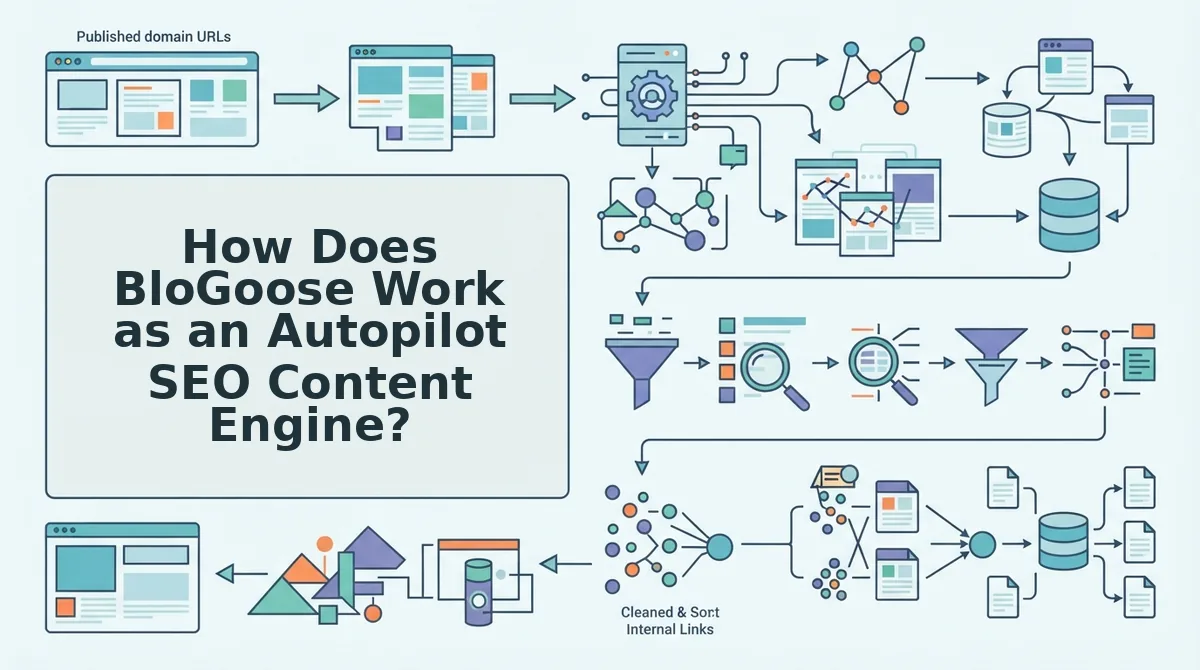
BloGoose runs drafting, optimization, and publishing as one pipeline. An autopilot SEO content engine is a system that reads your site, learns its voice, plans topics, drafts optimized articles, and publishes them without a human stitching tools together at each step.
That replaces the "12-tab content stack" and "another chat window with hopes" with a single flow covering all three jobs: draft, optimize, ship. AI is included, so there is no separate LLM bill.
Prerequisites: your website domain with an XML sitemap, plus either a WordPress site or a custom API endpoint to receive posts. Setup details live in the BloGoose setup documentation.
- Enter your domain in the setup wizard. Type your site URL and start the setup. This takes about a minute, and the wizard begins locating your sitemap.
- Let BloGoose crawl the sitemap. It inspects your published pages and detects your technical setup. You should see your site's pages recognized before moving on.
- Review the eight Markdown context files. BloGoose generates editable files such as brand-voice.md, features.md, seo-context.md, and target-keywords.md. In practice, an operator opens brand-voice.md, edits a voice trait, and saves it before the first draft runs. Avoid the common brand context file mistakes here, because every article inherits these rules.
- Approve the 30-day calendar. Check the pillar-focused topic plan. Success looks like a full month of articles mapped to your keywords.
- Run research and drafting. Each article draws on live SERP and social research, then drafts with SEO and AEO (answer engine optimization, the structure AI chatbots quote) built in.
- Check inline images. BloGoose creates images inside each article, so no separate design step is needed.
- Publish to WordPress or your custom API. Finished posts ship directly to your CMS, closing the loop without copy-pasting.
If your bottleneck is coordinating a drafting tool, an optimizer, and manual uploads, this pipeline collapses all three into one setup you configure once.
Autopilot is not right for every team, though.
Where Is BloGoose the Wrong Choice?
BloGoose is the wrong choice if you want to steer every paragraph yourself, if your site context is out of date, or if you only need to score drafts you already wrote. Each limit comes from how an autopilot engine works.
An autopilot SEO content engine is software that plans, drafts, optimizes, and publishes articles from stored site context instead of from prompts you type line by line.
Control. A copilot works like a driving instructor with dual brakes: you hold the wheel and it assists. An autopilot works more like a taxi: you set the destination and review the result. Writers who want to direct every sentence will find Jasper's copilot model a closer fit.
Context upkeep. Output quality depends on accurate brand context files. These are the voice rules and site structure BloGoose extracts during its crawl. A redesign or repositioning makes them stale, so you should update brand context files after a redesign before the next calendar runs.
Scope. BloGoose publishes to WordPress or a custom API, which is an endpoint your developers build to receive finished articles. If your team only wants to grade existing drafts on term coverage, that is Surfer's job. Confirm current capabilities in the BloGoose docs before you commit.
Jasper vs Surfer SEO FAQ
These answers cover the questions people ask most often when they compare Jasper, Surfer SEO, and an autopilot engine.
Can Jasper and Surfer be used together?
Yes. A common paired workflow drafts the article in Jasper and then moves it into Surfer's Content Editor for term and structure scoring. The trade-off is hand-offs. You pay for two subscriptions, copy text between tools, and still publish to your CMS manually.
Which tool is easiest for beginners?
Beginner ease depends on which task you would rather learn. Jasper requires steering through prompts. Surfer requires chasing term-score targets while you edit. BloGoose shifts the effort to reviewing and maintaining context files after its site crawl, so the effort moves from each draft to occasional setup.
Do I need a separate AI subscription with BloGoose?
No. AI is included in BloGoose, so you do not connect your own model account or pay a separate AI provider. Research, drafting, optimization, and image creation all run inside the same pipeline, which then publishes to WordPress or your custom API.
Does a high Surfer content score guarantee rankings?
No. A content score measures how closely your draft matches the terms and structure of pages that already rank. Rankings also depend on links, site authority, search intent, and freshness, which a score cannot see. Treat the score as a coverage check, not a forecast.
Which Tool Should You Pick Next?
Pick the tool that removes your biggest manual step. Jasper drafts, Surfer scores, and BloGoose ships. That was the finding promised at the start: the real difference is which job stays on your plate.
- Solo writers who want to steer every draft: keep Jasper.
- Teams with existing drafts that need optimization: add Surfer for scoring.
- Founders and publishers who need all three jobs: run your domain through the AI SEO content engine so drafting, optimization, and publishing happen in one pipeline.
Your next step is to drop your domain into the BloGoose setup wizard and review the brand context it extracts. Then compare plans on BloGoose pricing. A consistent content cluster starts once your workflow stops depending on hand-offs.