
Live SERP Research vs Manual Keyword Tools for Blog Topics

Every week you spend building content from stale keyword data, a competitor using live SERP research ships an article that outranks yours before you hit publish. The debate between live SERP research vs manual keyword tools isn't academic, it's the difference between reacting to last quarter's search landscape and responding to what Google is ranking right now.
You already know the frustration: you pull a keyword report, build a brief, write the post, and six weeks later the page sits on page three while a thinner article ranks above you. HaxholmWeb puts it bluntly, analyzing keyword competition is "timely and difficult." The data you're using was captured before the current SERP settled, and the difference comes down to one thing: when the data was captured.
This guide breaks down how each approach works, where manual tools quietly fail, and what live research reveals that cached metrics can't. You'll learn a concrete workflow for validating topics against the actual results page, and how an AI SEO content engine can automate the live-research step so you publish with current competitive context instead of historical averages.
One finding ahead may change how you read every difficulty score you've ever trusted.
What Is the Difference Between Live SERP Research and Manual Keyword Tools?
Live SERP research queries the search engine in real time and analyzes the actual results page, the ranking URLs, their content structure, and the gaps between them. Manual keyword tools, by contrast, pull from cached databases of keyword metrics like volume, difficulty, and CPC. The core difference is timing and granularity: live research shows you the current competitive landscape; manual tools show you historical aggregates. For content validation, the live page is the ground truth.
Think of manual keyword tools like checking a restaurant review from six months ago before deciding where to eat tonight. The menu may have changed, the chef may have left, and three new places may have opened across the street. Live SERP research is walking past the restaurant tonight, looking through the window, and seeing exactly who's eating there and what's on the plates.
At a simple level, manual keyword tools answer one question: is this topic worth pursuing based on historical demand and competition? You enter a seed term, the tool returns a list of related keywords with volume estimates and difficulty scores, and you pick targets from that list. The workflow is linear: find keywords, filter by metrics, assign to content briefs.
At an intermediate level, the two approaches diverge. Manual tools require you to cross-reference their cached metrics against a separate live SERP analysis step, manually opening the search results, scanning the top ten URLs, and eyeballing whether the difficulty score matches reality. Live SERP research collapses this into one workflow: query the engine, capture the ranking pages, parse their structure, and identify what the current winners have that your draft doesn't.
At an advanced level, live SERP research becomes a continuous validation loop rather than a pre-publish checkpoint. You can re-query the SERP before drafting, before publishing, and after indexing to track how the competitive set shifts. Manual tools freeze that picture at the moment of their last database refresh, which may be days, weeks, or months behind the live results.
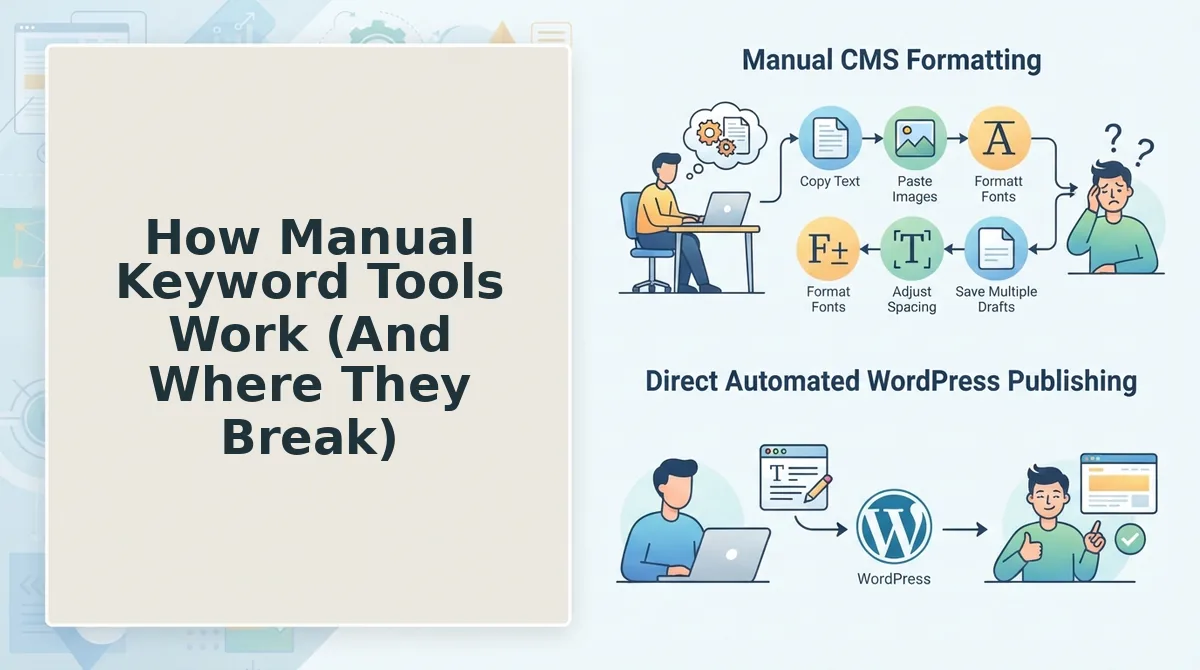
How Manual Keyword Tools Work (And Where They Break)
A manual keyword tool is a software interface that queries a cached database of search metrics, keyword volume, competition scores, cost-per-click data, and related-term suggestions, and presents those metrics as a filterable list for content planning. It does not query the live search engine at the moment you use it.
Think of a manual keyword tool like a weather forecast from last Tuesday. It tells you what the conditions were when the data was collected, and it's directionally useful for planning. But if you're deciding whether to hold an outdoor event today, you look out the window, you don't trust a six-day-old forecast.
The standard workflow looks like this: you enter a seed keyword, the tool returns hundreds of related terms, you filter by volume and difficulty, and you export a shortlist into a spreadsheet. SE Ranking's guide describes this process as emphasizing relevancy, competition, and SERP analysis as separate steps, meaning the practitioner must manually stitch together three disconnected data sources before making a decision. Mangools frames SERP analysis as a feature within the keyword tool, not a standalone validation step, which means the live results page gets compressed into a summary score rather than examined directly.
That compression is where the tool breaks. Three failure modes appear consistently:
- Cached data lag. Keyword databases refresh on schedules the user doesn't control. A topic that spiked three weeks ago may show inflated volume; a topic rising this week may not appear at all. You're optimizing for a search landscape that no longer exists.
- Difficulty score opacity. Most tools calculate difficulty from backlink counts and domain authority of current ranking pages, historical proxies, not live content-quality signals. A page with weak backlinks but strong topical coverage can outrank a high-authority page, and the difficulty score won't tell you that.
- No content-gap visibility. A difficulty score tells you how hard it might be to rank. It doesn't tell you what the current winners are missing, the unanswered questions, thin sections, and structural gaps you could exploit. That information only exists on the live results page.
Difficulty scores are lagging indicators, not decision inputs. They describe the past competitive environment; they cannot predict whether your specific article will win in the current one. If you manage target keywords in a static file and validate them only against cached metrics, you're making publishing decisions on stale evidence. An AI SEO content engine that crawls the live SERP before drafting removes this blind spot automatically.
Here's what the live results page actually shows you.
What Live SERP Research Actually Shows You
Live SERP research reveals the ranking URLs, content structures, and unanswered questions Google currently rewards for a query, data no static keyword database can surface.
- Ranking URLs and their content structure, what Google currently rewards. A live query shows exactly which pages hold positions 1-10, their word count, heading hierarchy, media usage, and internal linking patterns. This matters because Google's algorithm updates shift ranking factors faster than any tool's database refreshes. Use this by reverse-engineering the top three results' structure before drafting, matching depth and format to what already earns clicks.
- Competitive gaps, questions no ranking page answers. Scanning the live SERP exposes subtopics, objections, and long-tail queries that every ranking URL ignores. This matters because unanswered questions are your fastest route to featured snippets and AI citations. Use this by extracting those gaps into H2s and FAQ blocks, then verifying them against People Also Ask and autocomplete data.
- Intent shifts, when the SERP changes faster than your tool's database. A keyword that returned product pages last quarter may now surface comparison posts or video results, signaling a change in what searchers actually want. This matters because writing for stale intent wastes every optimization effort downstream. Use this by re-checking live results immediately before drafting, not relying on a keyword tool's cached intent label.
- Content format dominance, video, listicle, or long-form guide. The live SERP tells you whether Google is favoring video carousels, numbered lists, or 3,000-word pillar posts for a query. This matters because matching the dominant format is a prerequisite for ranking, regardless of keyword difficulty scores. Use this by selecting your article format based on what occupies the top five positions, not on personal preference.
- Authority patterns, who ranks and why. Live results reveal whether the SERP is dominated by forums, niche blogs, or enterprise domains, along with their domain authority signals. This matters because competing against Reddit threads requires a different strategy than competing against HubSpot. Use this by calibrating your content depth and internal linking strategy to the authority level Google already trusts for the query.
- Freshness requirements, when recency beats authority. A live SERP shows date stamps, "updated" labels, and whether Google is prioritizing content published in the last 30 days. This matters because some queries demand freshness signals that evergreen content cannot satisfy. Use this by adding update dates, current-year data points, and recent examples when the SERP rewards recency.
- SERP feature real estate, snippets, PAA, and AI overviews. The live page reveals which SERP features occupy space above the fold, from featured snippets to People Also Ask boxes to AI-generated answers. This matters because winning a featured snippet or PAA placement can deliver more clicks than the #1 organic result. Use this by structuring content to directly answer the questions appearing in those features, with concise 40-60 word answer blocks.
BloGoose operationalizes this workflow automatically: a publisher drops their domain into the setup wizard, the engine crawls the XML sitemap, runs live SERP queries against the target keyword set, and surfaces competitive gaps alongside a rank-ready content brief. The result is a research loop that captures intent shifts and structural opportunities before a single word is drafted, without manual tab-switching between a keyword tool, a SERP checker, and a spreadsheet. For a deeper breakdown of how to extract these signals systematically, see our guide to competitor analysis.
Decision Matrix: When to Use Live SERP Research vs Manual Keyword Tools
Live SERP research and manual keyword tools solve different problems: keyword tools accelerate discovery at scale, while live SERP research validates what actually ranks before you commit to writing.
Neither approach is universally superior. Manual keyword tools like Ahrefs, Semrush, and Google Keyword Planner remain the fastest way to generate hundreds of topic candidates, filter by volume and difficulty, and map keyword clusters across a site architecture. Their strength is breadth and speed, you can scan an entire niche in an afternoon. Their weakness is staleness: databases refresh on cycles, not in real time, so intent shifts and algorithm updates lag behind what Google currently rewards.
Live SERP research is slower per query but delivers depth that no cached database can match. It shows you the exact pages winning right now, their structural choices, and the gaps they leave open. The tradeoff is scale, manually checking SERPs for 200 keywords is impractical, which is why integrated engines like BloGoose automate the crawl-and-query loop.
| Scenario | Best Approach | Why | Best For |
|---|---|---|---|
| Initial keyword discovery across a new niche | Manual keyword tools | Fast, broad filtering by volume and difficulty at scale | Content strategists building a topic inventory from scratch |
| Validating a shortlist before writing | Live SERP research | Confirms current intent, format dominance, and ranking feasibility | Writers and editors who need rank-ready briefs, not guesses |
| Quarterly content refresh decisions | Live SERP research | Detects freshness requirements and newly emerged competitors | Growth leads auditing existing posts for decay |
| Pillar content and competitive teardowns | Live SERP research (deep) | Full structural analysis of top 10 results informs comprehensive coverage | SEO leads building cornerstone assets that must outrank entrenched pages |
Think of it as a 2×2 matrix with research speed on one axis and data depth on the other. Quadrant 1, fast and shallow, is manual keyword tools for initial discovery. Quadrant 2, fast and deep, is live SERP research for validation before writing, which is where automated engines excel. Quadrant 3, slow and shallow, is manual SERP checking by hand, a time sink to avoid. Quadrant 4, slow and deep, is the full competitive teardown reserved for pillar content. Most teams need Quadrant 1 for breadth and Quadrant 2 for precision. If you are building a validation workflow, start with a structured SEO content brief that captures live SERP findings before drafting begins.
The Tool Sprawl Tax: Manual Workflow vs Integrated Engine
The hidden cost of manual topic research is not the subscription fees, it is the context-switching tax across four or more disconnected tools before a single word gets written.
A manual stack typically chains together a keyword tool for discovery, a SERP checker for validation, a spreadsheet for gap tracking, and a CMS upload step for publishing. Each handoff introduces friction: data gets copied, columns get reformatted, and priorities get lost between tabs. The spreadsheet is where topics go to die.
An integrated engine like BloGoose collapses that chain into a single flow: crawl the existing site to extract brand voice and topical context, run live SERP queries against the target keyword set, surface competitive gaps, draft the article, and publish directly to WordPress or a custom API. No spreadsheet handoff, no manual SERP checking, no copy-paste between tools.
| Workflow Step | Manual Stack | Integrated Engine (BloGoose) |
|---|---|---|
| Keyword discovery | Keyword tool (Ahrefs, Semrush, GKP) | Site crawl + sitemap analysis |
| SERP validation | Manual SERP checker or browser tabs | Automated live SERP queries |
| Gap tracking | Spreadsheet (manual entry) | Auto-surfaced competitive gaps |
| Drafting | Separate writing tool or chat window | Built-in AI drafting with brand voice rules |
| Publishing | Manual CMS upload | Direct push to WordPress or API |
Manual stacks remain a legitimate choice for teams with dedicated SEO operations staff who want granular control over every data point. Best for agencies managing bespoke client reporting. Integrated engines are best for founders, solo operators, and lean content teams who need publish-ready output without hiring a research coordinator. For a deeper comparison of how integrated engines differ from piecemeal AI workflows, see our breakdown of AI content engines vs chat window workflows.
If the tool sprawl tax sounds familiar, the answers below address the most common questions about live SERP research and keyword validation.
FAQ: Live SERP Research and Keyword Validation
Live SERP research checks what currently ranks for a query in real time, while keyword validation confirms a topic has enough search demand and a realistic path to page one before you invest in writing.
Are keyword difficulty scores accurate?
Keyword difficulty scores are estimates based on backlink counts and domain authority of ranking pages, not guarantees. A "low difficulty" score can hide a SERP dominated by fresh, intent-matched content that outranks older domains, so always verify with a live SERP check before committing.
How do I validate a blog topic before writing?
Run the query in an incognito window and inspect the top 10 results. Check whether the intent matches your planned angle, whether any page fully answers the question, and whether the ranking domains are beatable for your site's authority level. Then confirm search volume exists.
What is a SERP checker tool?
A SERP checker tool pulls the current top-ranking pages for a keyword and displays metrics like domain authority, page age, content length, and SERP features. It shows the competitive landscape you must beat, rather than historical averages from a keyword database.
Can AI content engines do live SERP research?
Yes. An AI content engine like BloGoose can crawl live search results during topic validation, extract what ranking pages cover, and align drafts with current SERP intent before publishing. This removes the manual step of switching between keyword tools and SERP checkers.
Why does my keyword tool say a topic is easy but nothing ranks?
Keyword tools often score difficulty from backlink profiles alone, missing SERP features like featured snippets, People Also Ask boxes, or AI-generated overviews that push organic results down. A live SERP check reveals these features, which is also essential if you want to get cited in AI answers.
Stop Validating Blog Topics on Stale Data
Manual keyword tools pull from snapshots that are weeks or months old. Live SERP research shows what Google and AI answer engines surface today. The gap between those two views is where wasted content budgets live.
The synthesis is simple: use manual tools for discovery and volume estimates, then validate every shortlisted topic against the live SERP before drafting. Anything less means optimizing for a search landscape that no longer exists.
Next steps: pick one topic from your backlog, run it through a live SERP check, and compare the ranking pages against what your keyword tool predicted. If the mismatch is large, your validation workflow needs an upgrade.
Stop validating topics on stale data. BloGoose runs live SERP research, writes the draft, and ships it to WordPress, one engine, no sprawl.
Your content calendar should reflect the SERP you are publishing into, not the one your tool last indexed.