
Sectional AI Writing Workflow for Consistent Blog Articles

You've read the AI-generated draft three times, and something still feels off. The intro rambles, the middle section drifts off-brand, and the conclusion sounds like a different writer entirely. You're not alone, Surfer Academy found that one-click AI output consistently produces what practitioners now call "AI slop": grammatically correct but tonally hollow content that fails to rank or get cited.
You're right to be frustrated. Tiago Forte puts it bluntly: training AI to capture your voice requires a system, not a single prompt. A sectional AI writing workflow is that system, drafting each blog section with its own prompt, context, and quality check before assembly.
In this guide, you'll learn the four-step Sectional Writing Loop, how to audit each section before moving on, and how to enforce brand voice without rewriting everything by hand. One step in particular, the section audit, reveals why most AI content fails in AI answer engines, and it's not the reason you think. Platforms like BloGoose bake this loop into their publishing pipeline so the system runs without manual stitching.
What Is a Sectional AI Writing Workflow?
A sectional AI writing workflow is a drafting system where each blog section, intro, body, FAQ, conclusion, gets its own prompt, context window, and quality check before the article is assembled. Instead of asking one prompt to produce 2,000 words, you break the article into discrete units and treat each as a separate writing task.
Think of it like building a house room by room. A one-shot AI draft is like asking a contractor to build the entire house in a single afternoon, walls go up, but the plumbing doesn't connect, the electrical is guesswork, and the paint color drifts from room to room. A sectional workflow is framing the kitchen, inspecting it, then moving to the living room with the kitchen's decisions locked in.
Here's how the two approaches compare:
| Factor | One-Shot AI Draft | Sectional AI Workflow |
|---|---|---|
| Voice consistency | Drifts after ~500 words | Locked per section with voice slices |
| Revision cost | Full rewrite often required | Isolated fixes per section |
| SEO targeting | Keyword stuffing or omission | Intent mapped per section role |
| AI citation readiness | Unstructured, hard to quote | Self-contained passages per section |
At the intermediate level, you're assigning each section a specific job: the intro hooks and previews, the body sections answer one query each, and the FAQ targets long-tail questions. At the advanced level, you're feeding each section its own context, the keyword, the voice rules, the internal link target, and the CTA role, so the AI never has to guess what a section is for.
A sectional AI writing workflow is a loop-based drafting system that assigns each blog section its own prompt, context, and quality gate before assembly. The workflow breaks a full article into discrete units, introduction, body sections, FAQ, and conclusion, and treats each as a separate writing task with a defined job. The introduction hooks the reader and previews the roadmap. Each body section answers one specific query with a self-contained passage that AI answer engines can quote directly. The FAQ section targets long-tail questions that support the primary keyword. The conclusion reinforces the main takeaway and points to the next action. Because every section is drafted against its own requirements and audited before the next section begins, voice drift is caught early, revision costs stay low, and the final assembled article reads as if one writer produced it from start to finish. This approach replaces the one-shot prompt with a repeatable system that produces consistent, rank-ready content without manual rewriting.
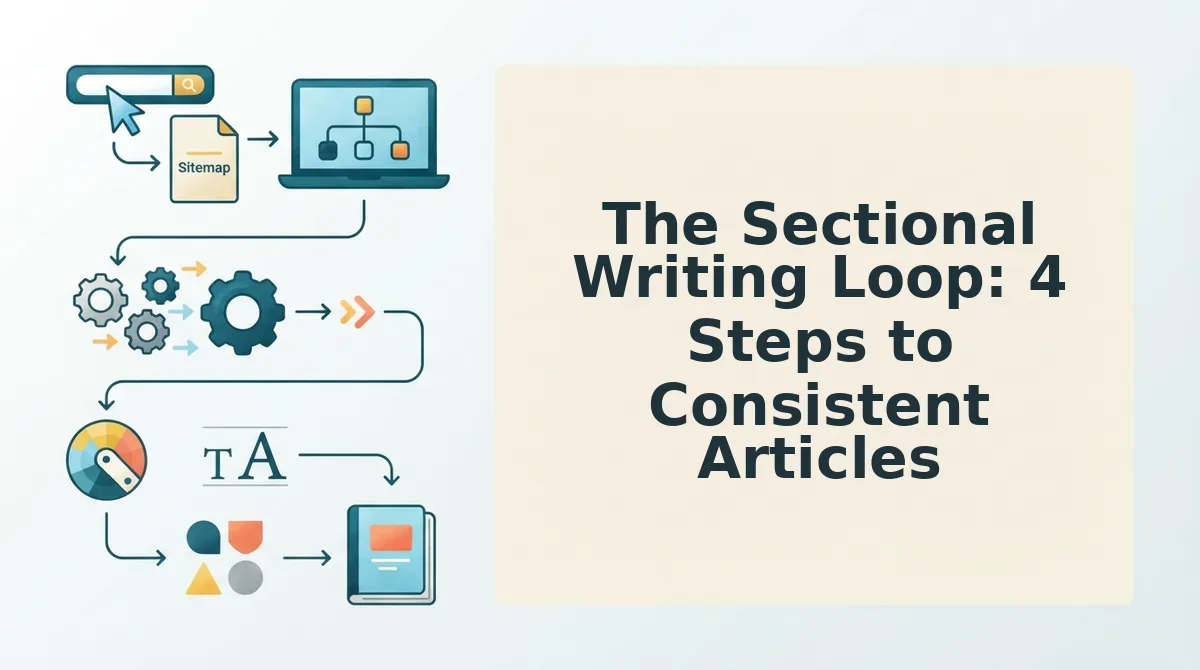
The Sectional Writing Loop: 4 Steps to Consistent Articles
The Sectional Writing Loop is a four-step process that turns fragmented AI drafts into consistent, rank-ready articles. You'll need your target keyword, your brand voice rules, and a section-level outline before you start.
- Extract Section Requirements. Open your outline and assign each section a job: the intro hooks and previews, each body section answers one query, the FAQ targets long-tail variations, and the conclusion drives the CTA. For every section, write down three things: the search intent it serves, the primary or secondary keyword it must include, and the voice slice it must match, formal for product pages, conversational for listicles, authoritative for how-tos. You should end this step with a one-line requirement sheet per section, not a vague topic list.
- Draft with Section-Specific Prompts. Type a separate prompt for each section that includes the requirements from step one. A body section prompt might read: "Write a 150-word explanation of [topic] for a growth lead who knows SEO basics. Use a direct, no-fluff tone. Include the keyword [term] once in the first sentence. End with a transition to the next section." A FAQ prompt might read: "Answer '[question]' in 40-60 words. Lead with the direct answer. Use plain language a non-technical founder can follow." You should see each draft stay on-task because the AI never has to infer what the section is for.
- Audit Each Section Before Moving On. Before you draft the next section, run a checklist on the one you just produced. Check that the keyword appears naturally, not stuffed. Check that the voice matches your brand rules, read it aloud if you're unsure. Check that the section answers exactly one query and doesn't wander into the next section's territory. Check that any claim is verifiable and any stat has a source. If a section fails, rewrite just that section, not the whole article. This is the step most writers skip, and it's the one that separates consistent output from AI slop. For a fuller audit framework, use this SEO guidelines checklist as your reference.
- Assemble and Publish. Paste the audited sections into your CMS in order. Run one final pass for transitions between sections, each section should end with a sentence that sets up the next. Add internal links where they support the reader's next step. Set your meta title and description using the primary keyword. Platforms like BloGoose automate this assembly step, shipping audited sections directly to WordPress or your API without manual copy-paste. You should see a finished article that reads as one continuous piece, not five stitched-together drafts.
Once the loop is running, the next challenge is making sure every section sounds like you, not like the AI's default voice.
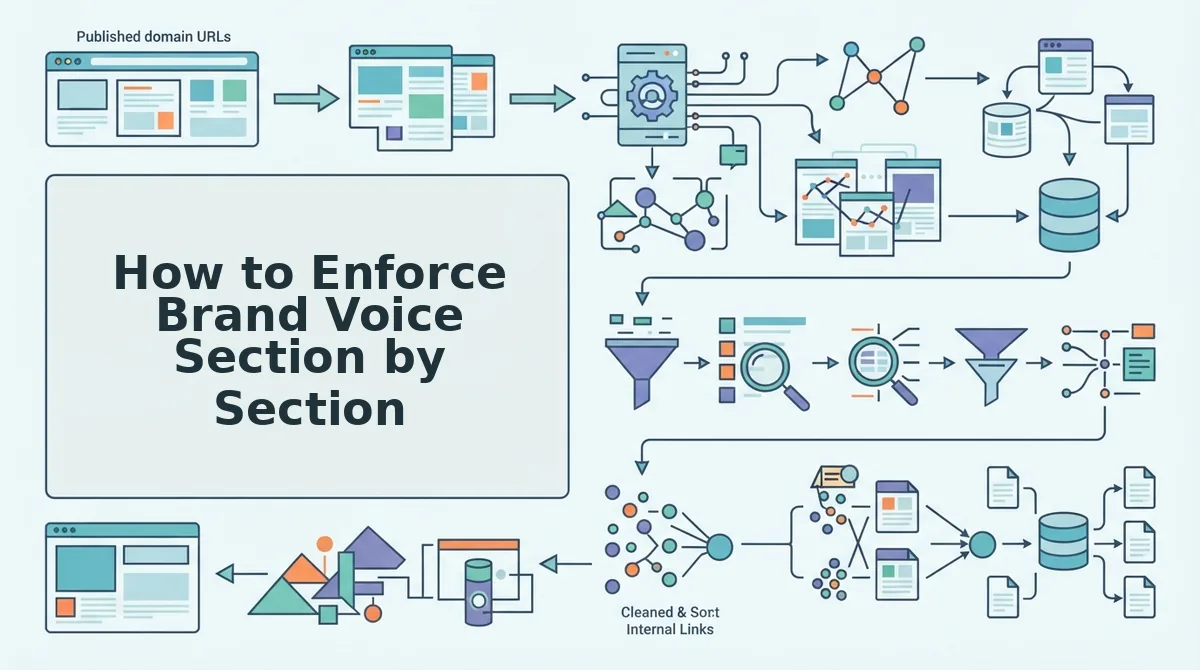
How to Enforce Brand Voice Section by Section
Enforcing brand voice section by section means injecting a different slice of your style rules into each article block, intros get tone rules, body sections get formatting constraints, and CTAs get conversion language; instead of feeding one generic voice prompt to the whole draft.
Prerequisites: A published website with an XML sitemap, a markdown brand context file, and access to a sectional AI writing tool that supports per-section prompts.
- Upload your domain and let the tool crawl the XML sitemap. Open your AI writing platform's setup wizard, enter your site URL, and run the crawl. You should see a list of detected pages and a confirmation that style patterns were extracted from your published content.
- Open the brand context file and split rules by section type. Click the brand settings panel and create separate rule blocks for intros, body paragraphs, listicles, and CTAs. Pull tone markers like sentence length, banned phrases, and transition style from your brand voice writing examples. You should see each section type mapped to its own rule set.
- Select the section template and paste the matching voice slice. Choose the section you're drafting (e.g., "H2 body paragraph"), then paste only that section's rules into the prompt field. The AI should produce copy that matches the tone of that specific block without drifting into other sections' styles.
- Run a consistency check before publishing. Click the review button and compare the generated section against your brand context file. You should see a green checkmark for tone match, sentence length compliance, and banned-phrase absence. Repeat for each section type until the full article passes.
Tiago Forte's full walkthrough on training AI to capture voice confirms this: a system of layered, section-specific rules outperforms any single master prompt. The crawl extracts the rules; the per-section injection enforces them where they matter most.
Ready to stop hand-checking every paragraph? BloGoose crawls your sitemap, builds your brand context files, and injects the right voice slice into every section automatically, start your first sectional workflow today.
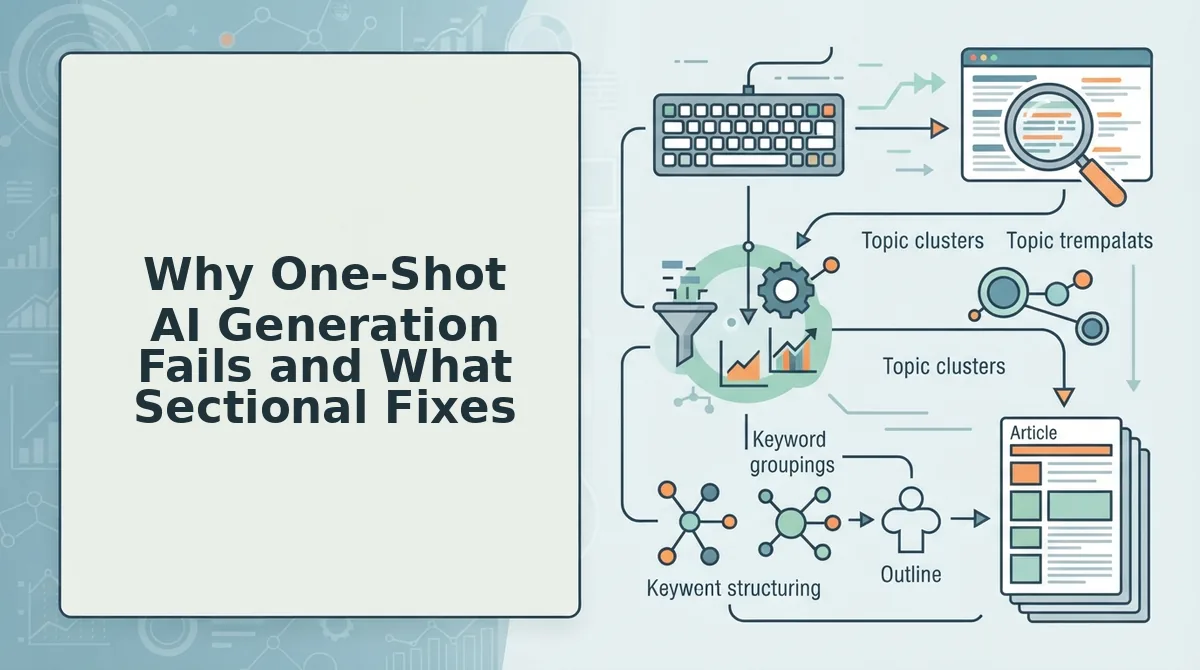
Why One-Shot AI Generation Fails and What Sectional Fixes
One-shot AI generation fails because a single prompt cannot hold enough context to maintain voice, structure, and conversion intent across a 1,500-word article, the model drifts by paragraph three. Sectional writing fixes this by resetting context at every block boundary.
Surfer Academy's tested methods show that one-click output produces what readers recognize as "AI slop": generic transitions, repetitive phrasing, and weak endings. That doesn't mean one-shot tools are useless, they're fast for short-form drafts and brainstorming. But for publish-ready blog articles, the failure rate climbs with length.
| Problem | Sectional Fix | Best For |
|---|---|---|
| Mid-article voice drift | Per-section voice slices injected at each block | Publishers with strict brand guidelines |
| Generic transitions between H2s | Section-specific transition prompts | Content teams scaling output |
| Weak or missing CTAs | CTA role assigned per section type | DTC brands optimizing conversions |
| One-shot full draft | Fast, but drifts after ~300 words | Short-form brainstorming only |
One-shot generation is best for solo operators who need a quick idea dump and will heavily edit afterward. Sectional workflows are best for founders and growth leads who publish weekly clusters and can't afford a manual rewrite pass on every article. The tradeoff is setup time: sectional requires a brand context file and section templates upfront, while one-shot needs nothing. But that upfront cost pays back on article three, when you stop fixing the same drift patterns manually.
If you've been patching one-shot drafts with manual edits, you're already doing sectional writing, just slowly. See how an AI content engine vs chat window workflows automates the reset loop for you.
How Sectional Writing Improves AI Answer Citations
Sectional writing improves AI answer citations by producing self-contained, quotable passages that answer engines can extract and attribute without surrounding context. Each section stands alone as a complete answer to a specific query.
Think of a sectional article like a well-organized toolbox: every drawer holds one complete tool, labeled and ready to grab. AI answer engines, the systems behind ChatGPT, Google AI Overviews, and Perplexity, pull from passages that work in isolation. A paragraph that references "as mentioned above" or depends on the previous section gets skipped. A paragraph that defines its term, states its claim, and closes its loop gets quoted.
Sectional writing naturally produces passages in the 80-120 word range that answer engines prefer for answer-box snippets. The definition from Section 2 of this article, a standalone explanation of sectional AI writing workflows, is already optimized for citation because it requires zero surrounding context to make sense. That's the pattern to replicate: every H2 section should contain at least one self-contained passage that answers a specific query on its own.
At the intermediate level, this means writing each section as if it were the only section a reader sees. At the advanced level, it means structuring sections to match the question formats AI answer engines parse most often: definitions, step lists, comparisons, and cause-effect explanations. For a deeper breakdown of how this works, see getting cited in AI answers and the full AEO optimization guide.
Next, the most common questions about sectional AI writing workflows, answered directly.
Frequently Asked Questions About Sectional AI Writing
Sectional AI writing answers the most common workflow questions publishers ask before switching from one-shot generation to a loop-based drafting method.
What is a sectional AI writing workflow for blogs?
A sectional AI writing workflow breaks an article into discrete parts, outline, intro, body sections, FAQ, conclusion, and generates, audits, and refines each part separately before assembly. This lets you enforce brand voice per section and catch weak output early instead of rewriting an entire draft.
How long does sectional writing take compared to one-shot generation?
Sectional writing typically adds 15-30 minutes per article versus one-shot generation, but cuts total editing time by roughly half because each section is validated before the next is drafted. The loop trades raw speed for fewer full-draft rewrites.
Does sectional writing work with any AI tool?
Yes, sectional writing works with any AI tool that accepts structured prompts, including ChatGPT, Claude, and API-based models. The workflow is tool-agnostic; what matters is feeding each section the same brand rules, outline context, and audit criteria before generation.
Is sectional writing slower than one-shot generation?
Slower in generation time, faster in total publishing time. One-shot drafts often require 2-3 full rewrites to fix tone drift and weak sections. Sectional writing front-loads quality control so the assembled draft needs only light copyediting before publish.
Why does sectional writing produce more consistent articles?
Because each section gets the same brand voice rules, target keyword context, and structural template applied independently. Consistency comes from repetition of constraints, not from hoping a single long prompt holds across 1,500 words of generation.
Start Writing Section by Section
The sectional loop, extract, draft, audit, publish, turns AI content from a gamble into a repeatable system. You are not prompting harder; you are structuring smarter, and that structure is what search engines and AI answer engines reward with citations.
Start with one article. Extract your brand voice rules, draft the outline section by section, audit each block against your style guide, then publish. Once the loop feels natural, automate it with an AI blog writer for WordPress that handles the sectional workflow end to end.
BloGoose applies this exact loop automatically, crawling your site for voice rules, drafting section by section, and publishing finished articles without manual stitching. Your next step is to run one article through the sectional loop and compare the edit time against your last one-shot draft. The difference is measurable.