A Reliable SERP Research Checklist for High Ranking Articles
You open twelve browser tabs to dissect a single query, bouncing between scrapers, spreadsheets, and databases without a standardized intake protocol. This manual research sprawl stalls drafting workflows while competing sites capture the top positions. Operating without a unified process leaves your content vulnerable to mismatched search intent.
Adopting the structured framework of an AI SEO content engine eliminates the guesswork, helping you build rank-ready outlines in minutes. In this guide, you will master a repeatable SERP research checklist that shifts your team from classic link-based ranking audits to meeting dual search and AI citation requirements. You will also uncover why matching top-ranking word counts often backfires when targeting AI answer engines.
Consider how a standardized intake protocol transforms execution:
- Situation: An operator collects disjointed notes across several keyword tools, resulting in generic outlines that miss live ranking features.
- Action: The publisher executes a structured live SERP analysis, systematically cataloging user intent patterns, competitor gaps, and structural page formats.
- Outcome: The writer receives an exact structural blueprint that secures organic placement and satisfies citation engines.
This checklist covers organic and informational content production workflows. It does not address paid search ad configurations or enterprise indexing infrastructure.
What Is a SERP Research Checklist and Why Is It Necessary?
A SERP research checklist is a standardized operational framework used to analyze live search engine results pages, diagnose search intent, and identify content gaps before writing an article. It is necessary because targeting raw keyword volume without reverse-engineering real-time ranking patterns produces content that search engines and AI answer engines routinely ignore.
Most publishers treat search optimization as a guessing game focused strictly on search volume metrics. Ranking does not start with volume.
A SERP research checklist is a systematic audit process that evaluates search intent classification, competitor page structure, and topical gap extraction across live organic listings. Instead of guessing what search algorithms reward, this checklist inspects the exact pages holding top positions to identify necessary subtopics, user intent patterns, and current ranking signals. Analyzing these factors prevents publishers from creating unfocused drafts that fail to satisfy search queries. By cataloging primary SERP features and structural layouts ahead of production, the checklist ensures every planned section directly answers search requirements and aligns with answer engine optimization standards.
Think of this checklist like an architect studying the bedrock and neighboring buildings before drafting blueprints. Designing a skyscraper on loose sand guarantees structural failure regardless of how attractive the exterior looks.
At a basic level, the checklist verifies format alignment by showing whether readers expect a step-by-step tutorial, a software comparison, or a short definition. Moving deeper, it shifts your workflow from surface-level keyword discovery to live SERP feature mapping. This means documenting which competitors capture featured snippets, what questions appear in People Also Ask elements, and how answer engines extract citations from top pages.
At an advanced operational level, running this checklist manually across dozens of articles creates severe workflow bottlenecks. Platforms like BloGoose streamline this research phase by executing live SERP queries to extract competitive gaps, ranking signals, and intent patterns automatically before drafting begins.
Once you understand the operational value of a live search audit, the first execution step is diagnosing the query's underlying intent. Systematically qualifying that intent allows you to dissect competitor outlines without falling into the trap of copying their exact sections.
How to Qualify Search Intent and Extract Competitor Headings
Qualifying search intent and extracting competitor headings requires validating SERP format patterns against query intent and translating top-ranking section headers into distinct, original subtopics. This dual process ensures you match what Google rewards without replicating thin, copycat outline structures.
Imagine targeting a high-value search phrase, drafting 2,000 words based on competitor outlines, and discovering post-publish that the SERP ranks interactive utilities rather than standard guides. The Header Hierarchy Deconstruction Model is an extraction process that identifies the underlying thematic jobs-to-be-done in competing H2 and H3 tags so you can address the core subject matter using differentiated phrasing.
Before starting this 15-minute manual audit, open an incognito browser window and prepare a document or your competitor analysis markdown file to log structural findings.
- Type the target keyword into Google Search (Time: 2 minutes): Enter your phrase in an unauthenticated browser tab to strip personalized history. You should see an unbiased SERP displaying the organic top ten results alongside active SERP features like AI Overviews and People Also Ask modules.
- Apply the Robbie Richards 5-step keyword qualification methodology (Time: 4 minutes): Evaluate the top five results against intent type, business value, content format, domain authority alignment, and ranking trajectory. You should confirm that your site profile matches the SERP's prevailing commercial or informational intent.
- Inspect competitor structural headers (Time: 3 minutes): Open the top three organic articles and extract every H2 and H3 tag using your browser developer tools or document view. You should see a list of structural subtopics covering common topical angles.
- Deconstruct the underlying entity intents (Time: 3 minutes): Group recurring competitor headers by their essential subtopic jobs rather than their exact wording. You should see a high-level taxonomy of necessary thematic concepts without borrowing competitor language.
- Map distinct section titles to your draft (Time: 3 minutes): Rewrite each identified core subtopic into a unique heading tailored to your brand voice and proprietary angles. You should see a complete, citation-ready outline that covers all baseline thematic entities without producing duplicate structures.
An operator planning a guide for an organic growth query audited the top three ranking posts. The competitors shared almost identical headings covering tool definitions, generic benefit lists, and basic setup checklists. The operator deconstructed those sections into core informational entities, documented them in a Markdown context file, and renamed the sections into step-driven operational workflows. The resulting outline met comprehensive topical requirements while maintaining original phrasing across every H2.
Structuring unique subtopics addresses organic text competition, but modern search result pages demand more than standard paragraphs. To maximize your search surface area, you must identify and capture the rich SERP features that search engines prioritize above traditional organic listings.
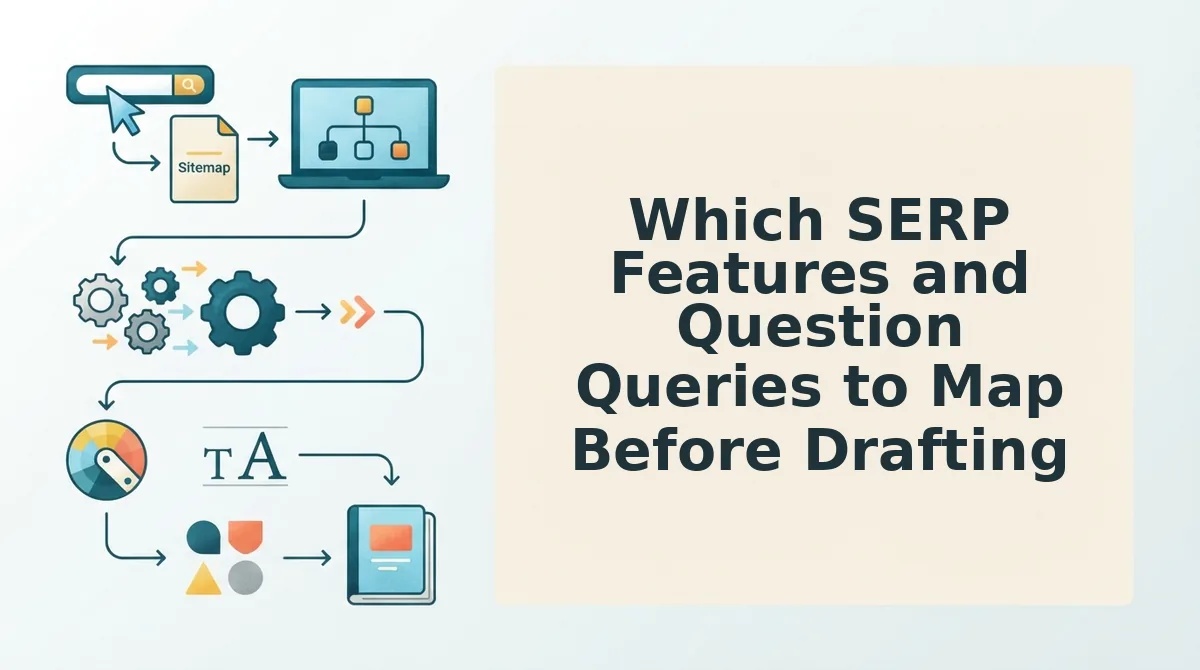
Which SERP Features and Question Queries to Map Before Drafting
Mapping SERP features requires auditing People Also Ask accordions, featured snippets, video carousels, and forum discussions so your content mirrors current search intent. An Intent-Feature Mapping Matrix is a structured blueprint that pairs visible SERP elements directly with designated outline modules.
Which elements actually dictate your article's structural framework?
- People Also Ask Accordions: These dynamic question modules reveal real-time follow-up queries that users execute after their initial search. Dissecting People Also Ask expansion triggers shows the exact secondary subheadings search engines expect your draft to address. Click two levels deep into relevant questions and convert those exact semantic phrases into dedicated H3 subsections.
- Featured Snippet Blocks: A featured snippet is a highlighted summary box that Google positions above standard organic results to satisfy intent instantly. Securing this block maximizes zero-click exposure and guarantees quotation inside generative AI summaries. Draft a self-contained 50-word direct answer immediately beneath your corresponding H2 to capture the target definition.
- Community Forum Discussions: Search modules displaying Reddit or dedicated forum threads reflect areas where editorial guides fail to solve real user friction. Their presence indicates searchers require authentic peer troubleshooting rather than polished commercial copy. Extract the highest-voted problems from ranking threads and transform them into a counterintuitive FAQ section.
- Video Carousels and Timestamps: These multimedia SERP placements appear when Google detects that searchers require visual, step-by-step demonstrations. Ranking without addressing these visual cues limits organic reach for procedural informational queries. Review the key moments marked across ranking videos and translate those timestamps into sequential, numbered action steps.
- Related Search Clusters: This bottom-of-page SERP module highlights adjacent topics search algorithms programmatically bind to the core subject. Mapping these entities preserves topical depth and protects your article from semantic keyword gaps. Collect these algorithmic suggestions and integrate them as contextual anchor points within your supporting arguments.
Managing these SERP signals manually across multiple search queries creates operational bottlenecks. BloGoose replaces disconnected stacks by automating live SERP research and publishing structured drafts directly to WordPress on the $199 flat Pro plan.
Mapping rich features guarantees that your content matches visible search layouts, but visibility alone will not keep readers on the page. True ranking durability requires moving beyond surface-level gaps to deliver original information gain that competitors completely lack.
Competitor Content Gap Analysis vs Information Gain
Competitor content gap analysis identifies missing subtopics across existing search results, whereas information gain injects original findings, fresh angles, and structural validation that rival pages lack. Standard gap analysis often pushes writers into the consensus trap by synthesizing what already ranks, while search engines and AI models prioritize net-new perspective.
Information gain is the measurable addition of novel data, unique viewpoints, or specialized workflows beyond existing SERP consensus. When every competitor parrots identical checklist steps, regurgitating the average guarantees search obscurity. Learning how to get cited in AI answers and chatbots requires breaking away from standard summaries and delivering verifiable substance.
Consider a practical workflow example: rather than manually auditing ten browser tabs and copying meta tags into a spreadsheet, modern workflows inspect XML sitemaps and conduct live SERP crawl validation. Automated crawls capture competitor headings alongside missing technical execution steps, surfacing high-value omissions in seconds.
| Approach | SERP Research Model | Information Gain Strategy | Execution Workflow | Best For |
|---|---|---|---|---|
| Manual SERP Auditing | Manual tab opening and spreadsheet tracking | Dependent entirely on human research depth | Manual drafting and CMS pasting | Solo operators with zero software budget |
| NLP Content Optimization Tools | Entity extraction and keyword density scoring | Refining existing drafts against ranking averages | Guided writing inside standalone text editors | Writers optimizing existing enterprise copy |
| Integrated AI SEO Engines | Live SERP crawling and brand context extraction | Automated identification of competitive gaps | Direct publishing to WordPress or custom APIs | Publishers eliminating multi-tool stack sprawl |
How do you decide which SERP research approach fits your publishing pipeline?
- Choose manual auditing if you publish fewer than two articles per month and require no recurring software investments.
- Choose NLP content editors if you have dedicated in-house writers who need real-time suggestions on term frequency within a standalone document.
- Choose integrated AI SEO engines if you manage ongoing editorial calendars and need live SERP intelligence converted directly into publish-ready articles.
Our recommendation: For growing content operations, an integrated AI content engine provides the strongest balance of speed and structural depth. Combining live SERP competitive extraction with automated CMS publishing prevents the consensus trap while eliminating the friction of stitching disconnected tools together.
With unique data points and gap-filling arguments identified, the next step is assembling these elements into an actionable draft structure. Finalizing an outline that satisfies traditional search crawlers and AI answer engines simultaneously requires a deliberate, modular architecture.
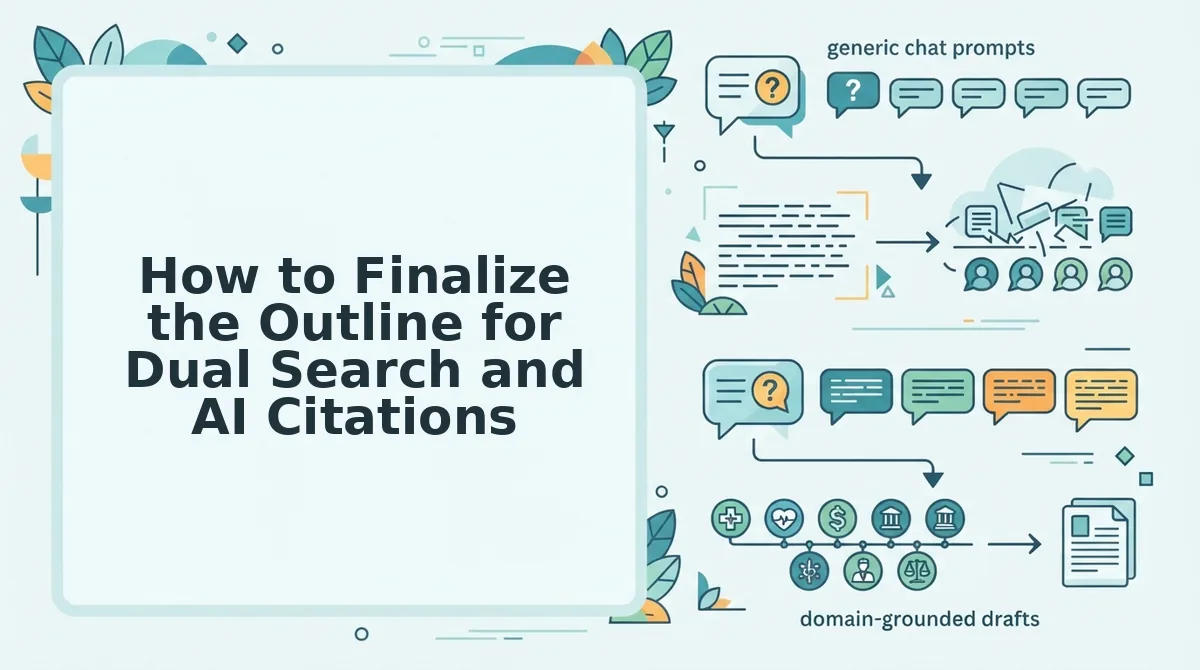
How to Finalize the Outline for Dual Search and AI Citations
Finalizing an outline for both Google rankings and AI citations requires pairing target entity declarations across your subheadings with self-contained, 90-word direct-answer blocks. Structuring your outline this way provides the exact factual density search engines need for passage indexing while giving large language models quotable definitions to extract into generated answers.
Picture this scenario: your competitor holds position one on Google, yet AI chatbots consistently cite a third-party directory instead of their guide. The competitor failed to isolate their answers into extractable units. A dual-optimized outline resolves this discrepancy by explicitly organizing answers for both crawler algorithms and generative response engines.
Before you begin, ensure you have your competitive gap notes ready and access to your Markdown document editor. Completing this process takes approximately 15 minutes.
- Draft each H2 heading as an explicit entity declaration (estimated time: 4 minutes). Write descriptive subheadings that state the exact topic rather than vague titles. You should see a table of contents populated with concrete entity names and direct questions.
- Insert an empty 90-word direct-answer passage placeholder beneath every heading (estimated time: 5 minutes). Configure this block to deliver a comprehensive summary that resolves the heading without requiring external context. You should see a clear structural framework ready for passage indexing and answer engine retrieval.
- Append a quantitative validation list beneath each direct-answer block (estimated time: 4 minutes). Outline bulleted requirements, sequential steps, or measurable specifications that support the opening claim. You should see an outline that pairs immediate conceptual definitions with structured data points.
- Map post-publish distribution hooks directly into the document footer (estimated time: 2 minutes). Note the technical steps required to ask Google to crawl new posts via search indexing protocols immediately after going live. You should see a finished blueprint connecting content structure to indexation mechanics.
Consider an operator structuring a guide on search indexing automation. The operator defines an H2 titled "How Search Indexing APIs Work," adds a self-contained 90-word explanatory paragraph defining API endpoint calls, and lists three concrete server response codes below it. Upon publishing, search engines parse the structured list for rich results, while generative answer engines lift the opening 90-word paragraph directly into conversational summaries.
Even with a dual-optimized outline ready for production, specific technical edge cases frequently emerge during search analysis. Addressing these common operational hurdles clarifies how to handle shifting search landscapes.
Frequently Asked Questions About SERP Research
SERP research establishes search intent, content gaps, and ranking feasibility before outlining begins.
How do I do SERP research without paid tools?
You conduct free SERP research by analyzing live Google results in an incognito window. Review the top three ranking URLs, map their heading structure, and harvest queries from People Also Ask boxes, autocomplete, and related searches to define user intent without subscription software.
How do I identify a brand-dominated SERP?
A SERP is brand-dominated when navigational intent claims top organic positions. Look for official corporate homepages, login portals, or support hubs occupying spots one through five. If users want a specific company portal rather than analysis, standard editorial guides cannot dislodge those domains.
Why does SERP volatility matter before drafting content?
SERP volatility indicates search engines are actively testing search intents or reweighting ranking signals. When results fluctuate between forum discussions, commercial tools, and informational guides, user intent remains unstable. Delaying production until rankings stabilize prevents allocating capital toward formats that search systems may deprioritize within 14 to 30 days.
Beyond intent stability, publishers must also evaluate the sheer competitive weight of ranking domains before committing editorial resources. Knowing how to calculate a reliable difficulty score ensures you invest effort only where your domain has a realistic path to position one.
How do you calculate a definitive SERP difficulty score?
A definitive SERP difficulty score evaluates the median URL rating, average referring domains, and content type alignment across the top 10 organic positions rather than relying on automated single-metric domain scores.
To quantify competitive difficulty without black-box metrics, audit the first page using a weighted 100-point rubric:
- Page-Level Backlink Threshold (40% Weight): Calculate the median number of unique referring domains pointed directly to the ranking URLs. If the median exceeds 85 referring domains, ranking a fresh URL within 90 days requires aggressive digital PR and manual link building.
- Search Intent Alignment (30% Weight): Classify the format of all 10 results. If 8 or more URLs share the identical template (e.g., free calculators, programmatic directories, or product comparison matrices), publishing an alternative format reduces first-page probability to below 15%.
- Domain Equity and Brand Dominance (20% Weight): Count how many ranking domains maintain an established authority baseline (typically characterized by over 50,000 monthly organic sessions and national brand recognition). If more than 6 results are institutional entities (e.g., Wikipedia, government portals, publicly traded software vendors), organic click-through potential drops by up to 60%.
- Freshness and Content Velocity (10% Weight): Review the published and modified dates of the ranking set. If 70% of the URLs have maintained top-five placement for over 24 months without structural updates, the SERP indicates high topical entrenchment, requiring comprehensive coverage to disrupt.
| SERP Classification | Median Referring Domains (Page Level) | Primary Intent Concentration | Recommended Action |
|---|---|---|---|
| Low Competition | 0 - 5 | Fragmented (mixed blog posts, forums) | Publish targeted long-form content immediately. |
| Moderate Competition | 6 - 35 | Consistent (standard informational guides) | Match format; exceed depth and media assets by 25%. |
| High Competition | 36 - 100+ | Rigid (interactive tools, major brand landing pages) | Target secondary long-tail variants before tackling head term. |
Scoring competitive difficulty prevents wasted writing effort, but long-term organic success hinges on consistent pre-publish quality control. Validating your completed strategy ensures that every planned page executes on search intent before entering the production queue.
How to Verify Your SERP Strategy and Automate Execution
Verifying your SERP research requires auditing your draft outline against live search patterns before generating content. When an exhaustive draft stalls on page four despite matching target keywords, the breakdown stems from mimicking existing consensus without providing fresh perspective.
Run every outline through a three-point pre-flight verification before writing:
- Format parity: Ensure your layout matches what current rankings favor, whether the query demands modular tables, process steps, or concise definitions.
- Question coverage: Confirm your subheadings answer secondary search queries and AI engine prompts directly within the opening lines.
- Distinct information gain: Validate that your outline introduces concrete data, practical angles, or proprietary findings absent from competing URLs.
Manual SERP checklists expose search gaps, but repeating spreadsheet audits across full topic clusters introduces unsustainable friction. You can replace that manual overhead by submitting your domain to the BloGoose setup wizard, letting an autopilot content engine extract your brand context, analyze live search landscapes, and publish citation-optimized articles directly to your CMS.
Sustainable organic visibility belongs to publishers who resolve search intent immediately while supplying the critical information competitors overlooked.