Single Dashboard Content Engine vs Point Solution Stack
Every article you publish through a five-tool stack quietly loses hours to copy-paste, tab-switching, and version drift, and the YouTube landscape proves the market hasn't consolidated yet. Creators still rack up 26K views teaching full-stack DIY AI agent builds because teams are desperate to stitch together what a single dashboard content engine should do natively. If you've felt the drag of point solution fatigue. SERP data in one tab, brand voice prompts in another, drafts in a third, and a CMS login waiting at the end, you're not imagining it.
This article gives you a decision framework for choosing between a single dashboard content engine vs point solutions, including the hidden costs nobody quantifies and the exact workflow a unified platform replaces. You'll learn the five-part Tool Stack Tax, what a consolidated engine actually automates, and how to evaluate your current setup before adding another subscription. Stick around for the surprising finding on research staleness, it's the cost most teams never notice until rankings slip.
What Is the Difference Between a Single Dashboard Content Engine and a Point Solution Stack?
A single dashboard content engine combines SERP research, brand voice extraction, drafting, AEO optimization, and CMS publishing in one interface, while a point solution stack chains separate tools for each function and requires manual data transfer between them.
Think of the difference like a restaurant kitchen versus a potluck dinner. In a restaurant kitchen, one team works from the same prep station, the same recipe board, and the same plating line, ingredients move forward without anyone re-reading instructions. A potluck, by contrast, relies on five cooks in five kitchens, each guessing how their dish should match the others, then assembling everything on one table at the last minute. The meal might come together, but the coordination cost is invisible until someone brings the wrong course.
How a Single Dashboard Content Engine Works
A single dashboard content engine starts when you drop your domain into a setup wizard. The platform crawls your XML sitemap, inspects published pages, and extracts brand voice rules automatically. From there, it builds a pillar-focused content calendar, drafts articles with SEO and AEO baked in, generates images, and publishes directly to WordPress or a custom API, all without leaving one interface.
The defining trait is context continuity: the same system that reads your site also writes your articles, so tone, entity usage, and structural patterns stay consistent from research to publish. No prompt rewriting, no copy-paste, no manual upload step.
How a Point Solution Stack Works
A point solution stack typically chains a SERP research tool, a separate AI chat window for drafting, a standalone editor like Google Docs, an image generator, and a CMS, often with a spreadsheet calendar holding the whole thing together. Each tool performs one function well, but the workflow between them is manual.
The hidden cost is integration debt: every handoff is a place where tone drifts, data goes stale, or a version conflict emerges. Teams that run this stack for six months usually discover they've built an unpaid part-time job around moving content between tools.
For teams evaluating AEO specifically, the gap widens further. A point solution stack rarely includes AEO content optimization as a native step, meaning citation-ready formatting becomes yet another manual pass. A single dashboard engine treats AEO as a built-in layer, not an add-on.
The Tool Stack Tax: 5 Hidden Costs of Point Solutions
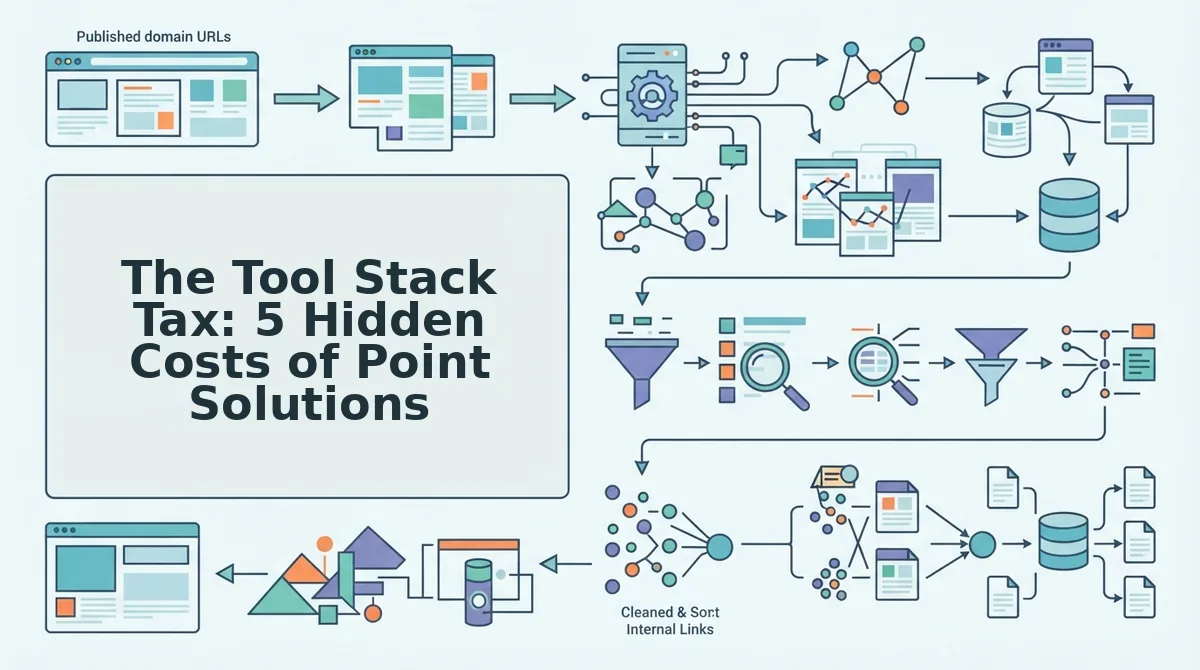
The Tool Stack Tax is the cumulative productivity, consistency, and ranking loss a team absorbs when content moves through five or more disconnected tools. Each cost below compounds the others, and none of them appear on a subscription invoice.
- Context switching cost. Every jump between a SERP research tool, a chat prompt window, a document editor, and a CMS upload screen forces your brain to reload context. Teams lose 10-20 minutes per article just reorienting between tools, time that scales linearly with every post in your calendar.
- Tone drift. Brand voice consistency breaks when prompts get rewritten in different tools. The phrasing you tuned in one chat window rarely survives a copy-paste into a doc editor, and by the time an article reaches the CMS, the voice has drifted from the original brand rules.
- Data re-entry and version conflicts. Copying content between tools creates stale versions. The draft in your editor, the outline in your spreadsheet, and the published page in your CMS can all disagree, and someone has to reconcile them before the next update cycle.
- API maintenance and integration debt. Chaining five or more tools requires ongoing upkeep. Every API key rotation, pricing change, or feature deprecation breaks a link in the chain, and the person who built the integration is usually the only one who knows how to fix it.
- Research staleness. SERP data goes stale between the research and publishing steps. If you pull keyword and competitor data on Monday but don't publish until Thursday, you're optimizing against a search landscape that has already shifted, a gap a single dashboard engine closes by keeping research and drafting in the same session.
Each of these costs quietly taxes every article you ship. The next section shows exactly what a single dashboard replaces.
What a Single Dashboard Actually Replaces
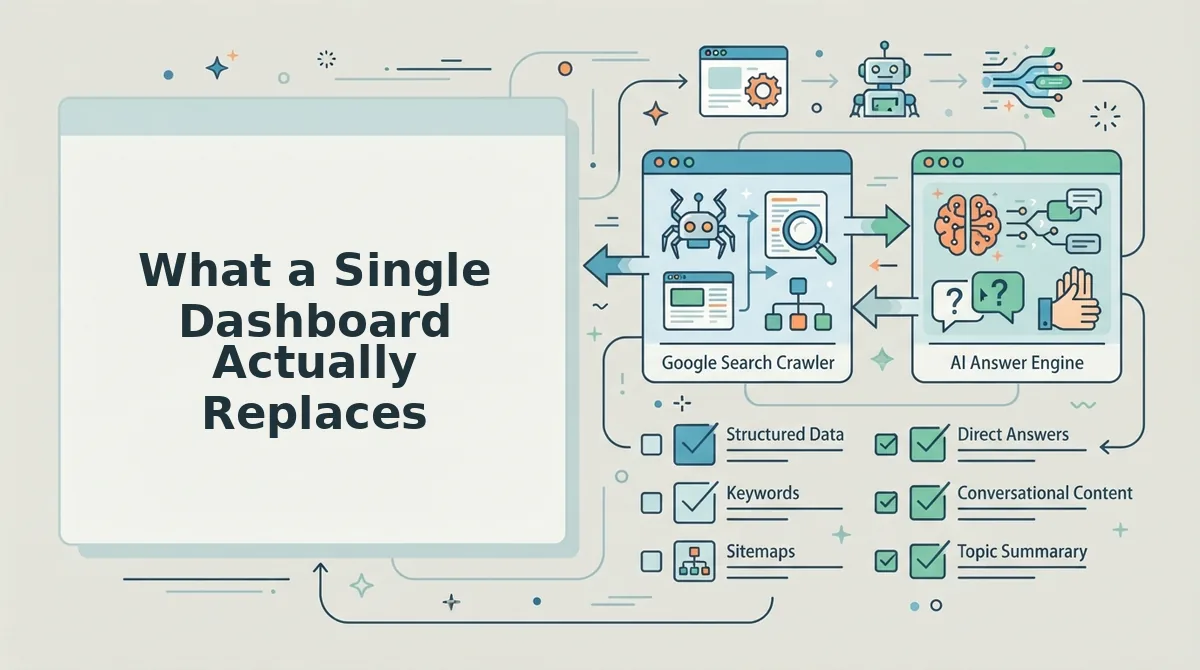
A single dashboard content engine consolidates four or more disconnected point solutions. SERP research, brand voice extraction, content drafting, and CMS publishing, into one workflow that starts with a sitemap crawl and ends with a live WordPress post.
The table below maps each point solution to its BloGoose counterpart, so you can see exactly what gets absorbed when you consolidate.
| Point Solution You Currently Use | What It Does in Isolation | Single Dashboard Replacement |
|---|---|---|
| SERP research tool (e.g., keyword tracker, rank monitor) | Shows keyword positions and competitor rankings, but leaves you to interpret the data manually. | Live SERP research baked into the drafting step, so intent signals inform the article before a word is written. |
| Chat prompt window (e.g., generic AI chat) | Generates text from your prompt, but has no memory of your site's tone, audience, or existing content. | Brand context extraction that crawls your published pages and applies your voice rules to every draft automatically. |
| Content editor (e.g., Google Docs, Notion, Surfer-style optimizer) | Provides a blank page or on-page checklist, but you still write, optimize, and fact-check manually. | Sectional drafts with AEO content optimization baked in, so each section is structured for both search rankings and AI answer citations. |
| CMS upload workflow (e.g., copy-paste into WordPress, manual image sourcing) | Requires exporting from your editor, reformatting, uploading images, and setting metadata by hand. | Direct WordPress or custom API publishing that ships the finished article, images included, without leaving the dashboard. |
Here is the workflow from start to finish: you drop your domain into the setup wizard, BloGoose locates your XML sitemap and inspects your published pages to extract brand voice rules, then it builds a pillar-focused 30-day content calendar. Each draft is generated with SEO and AEO signals already applied, images are created automatically, and the finished article is published directly to WordPress or your custom API. No copy-paste, no spreadsheet handoff, no prompt re-engineering between steps.
Best for solo operators and small content teams: a single dashboard engine, because every manual handoff you eliminate is an hour you get back for actual strategy.
Best for agencies managing multiple client sites: a single dashboard engine, because brand voice extraction per client means you stop rebuilding tone guidelines from scratch every time.
Point solutions are not bad tools. Many are excellent at their one job. The question is whether stitching them together is still the best use of your publishing hours.
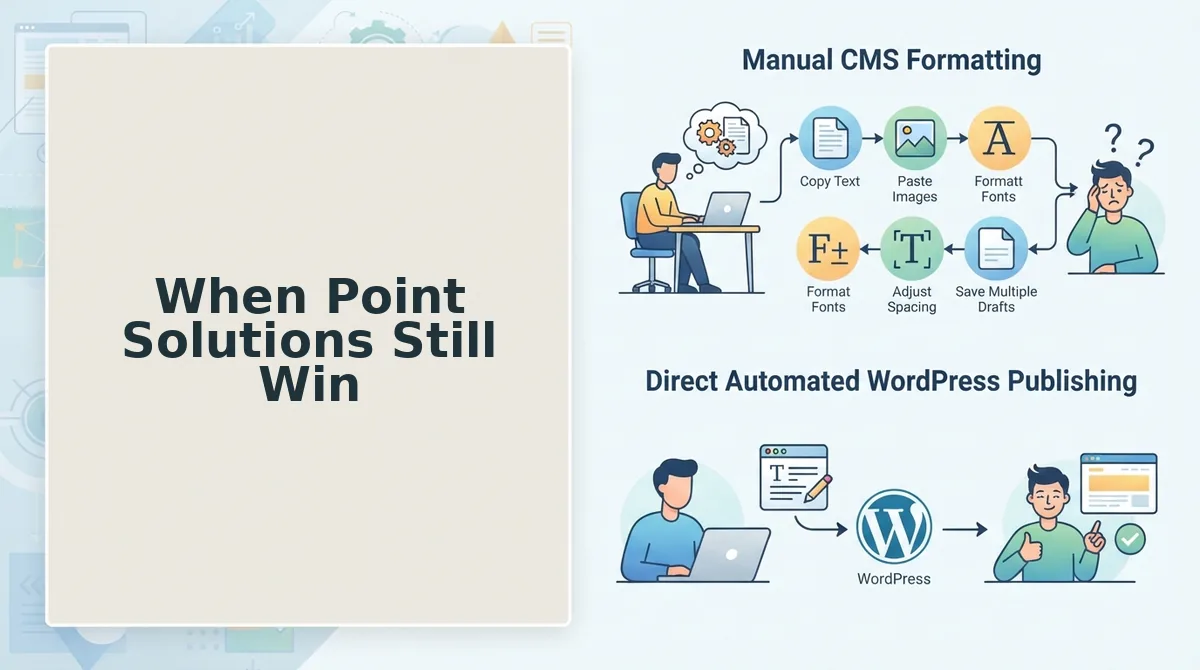
When Point Solutions Still Win
A point solution stack is a collection of specialized, best-in-class tools where each one handles a single function, keyword research, rank tracking, content optimization, or CMS management, and you connect them manually or through integrations.
Think of it like a professional kitchen versus a food processor. A food processor does many things adequately, but a chef who needs a perfect julienne still reaches for a dedicated mandoline. The same logic applies to content operations.
Enterprise teams with dedicated tooling budgets and specialized needs often keep point solutions. If your SEO lead needs granular rank-tracking APIs, your editorial team needs a specific collaborative editor, and your dev team has built custom CMS integrations, replacing all of that at once is expensive and disruptive.
Teams needing best-in-class single features may also stay put.
Finally, teams with existing deep integrations that would be costly to replace should think twice. If your analytics, CRM, and email automation already talk to your current stack through custom APIs, ripping that out for a dashboard you have not tested is a real risk.
The honest take: point solutions still win when specialization, integration depth, or organizational inertia outweighs the time savings of consolidation.
Decision Matrix: Single Dashboard vs Point Solutions
The right choice depends on three variables: team size, publishing volume, and tool budget. Small teams publishing frequently on a limited budget get the most from a single dashboard engine, while large enterprises with low publishing volume and deep pockets can justify a point solution stack.
| Scenario | Team Size | Publishing Volume | Tool Budget | Recommendation |
|---|---|---|---|---|
| Lean content operation | 1-3 people | High (daily or near-daily) | Limited | Single dashboard engine. Best for solo operators and small teams who need consistent output without hiring more hands. |
| Enterprise publishing arm | 10+ people | Low (weekly or less) | Large | Point solutions may still work. Best for enterprises with specialized roles, compliance requirements, and existing tooling contracts. |
| Growing mid-size team | 4-9 people | Moderate (2-4 posts per week) | Moderate | Hybrid or phased migration. Best for teams that can consolidate drafting and publishing first, then evaluate whether to retire legacy research tools later. |
If you are still unsure which camp you fall into, the FAQ below covers the most common questions readers ask before making the switch.
FAQ: Single Dashboard Content Engine vs Point Solutions
A single dashboard content engine consolidates research, drafting, optimization, and publishing into one workflow. A point solution stack spreads those same tasks across five or more disconnected tools. Here are the questions teams ask most when deciding between the two.
How much time do teams actually lose switching between content tools?
Teams lose 2-3 hours per article on context switching, re-entering data, and reformatting between tools. A single dashboard eliminates those handoffs by keeping research, briefs, drafts, and publishing in one interface, which compounds into days saved across a monthly content calendar.
Can a single dashboard replace SERP research and publishing?
Yes. A content engine like BloGoose crawls your site, extracts brand voice rules, builds a keyword-mapped calendar, drafts SEO- and AEO-optimized articles, and publishes directly to WordPress or a custom API. It replaces the research-to-publish loop without manual spreadsheet coordination or prompt engineering.
When should I keep my point solutions?
Keep point solutions when you need deep specialization: enterprise-grade rank tracking, advanced heatmap analytics, or custom editorial workflows with multiple approval layers. A single dashboard covers the core publish loop, but specialized tools still win for niche reporting and compliance-heavy review processes.
Why does my AI content rank inconsistently across tools?
Inconsistent ranking usually comes from fragmented context. Each tool sees only part of your brand voice, keyword data, or site structure. A single dashboard passes one consistent context file through every stage, so drafts, metadata, and internal links align with the same optimization targets.
How do I migrate from a point solution stack without losing momentum?
Start by crawling your existing site through the setup wizard. The engine extracts your brand voice and published content patterns automatically, then generates a 30-day calendar. Run one publishing cycle in parallel with your current stack, compare output quality, then retire redundant tools.
The Real Cost of Staying Fragmented
Every point solution you keep is a decision you have to make again tomorrow. The tool stack tax isn't just the subscription fees, it's the 2-3 hours per article spent re-entering data, the brand voice drift from disconnected prompts, and the publishing bottlenecks that quietly cap your output. A single dashboard content engine removes those decisions by carrying one context file from crawl to publish.
The decision matrix from earlier resolves to a simple test: if your publishing volume is under four articles per month and you have a dedicated SEO specialist, point solutions remain viable. Above that threshold, the compounding cost of coordination outweighs the flexibility of specialized tools.
Your next step is to crawl your site and see your brand context files. One publishing cycle with a single dashboard will show you exactly what you've been paying to do manually, and what happens when you stop.