
How to Turn Social Research into Blog Topic Ideas

You've published 14 posts this quarter, and the well is dry. Meanwhile, your audience is asking the exact questions you should be answering, in comment threads, subreddit replies, and YouTube comment sections you never read. The fastest way to turn social research into blog topic ideas is to stop brainstorming alone and start mining conversations your audience is already having.
You're right to feel stuck: topic droughts are the most common publishing killer, and the blank page is a terrible starting point. This guide gives you a repeatable four-step loop. Listen, Extract, Validate, Publish, that converts raw social chatter into rank-ready article briefs. You'll learn which platforms produce the highest-signal questions, how to transform a complaint into a candidate topic, and the validation step most creators skip entirely.
One surprising finding: the YouTube landscape for "finding blog topics" is wildly uneven, five videos on the subject range from 24 views to 112,557, which tells you most advice is either too shallow or too scattered to operationalize. The step that separates consistent publishers from ghost blogs isn't idea volume; it's the discipline of checking whether a topic has real search demand before you write it. If you're currently juggling a chat window, a keyword tool, and a spreadsheet, you're doing the work an AI content engine vs chat window workflow comparison makes painfully clear: fragmented processes kill publishing momentum.
Step 1. Listen: Where Real Blog Topics Hide in Social Data
Social listening for blog topics means systematically collecting the questions, complaints, and repeated phrases your audience posts across platforms, then mapping each signal to a topic you can validate. Most competitors jump straight to keyword tools or generic brainstorming, which is why their content sounds like everyone else's.
Prerequisites: A spreadsheet or note-taking tool, 30-45 minutes per platform, and access to at least two of the following: Reddit, X (Twitter), YouTube comments, Facebook Groups, or LinkedIn. No paid tools required for this step.
- Open Reddit and search your niche term. Type your core topic into the search bar, then filter by "Top" and "Past year." Read the top 10 threads and copy every question phrased as "How do I…" or "Why does…" into your spreadsheet. You should see at least 15-20 raw questions in under 20 minutes.
- Click into YouTube comments on competitor videos. Select three videos in your niche with over 10,000 views. Sort comments by "Newest" and scan for unanswered questions and repeated complaints. Copy the exact phrasing, verbatim quotes matter more than paraphrases because they preserve real search language.
- Select X (Twitter) Advanced Search. Enter your niche term plus a question word ("how," "why," "best," "vs") and filter by "Latest." Collect 10-15 tweets where people ask for recommendations or express frustration. You should see patterns emerge within 15 minutes.
- Type your niche into Facebook Group search. Join two active groups in your space, search your topic, and note which posts get the most comments. High-comment threads signal unresolved pain points worth writing about.
Each signal type maps to topic potential differently: questions map to how-to posts, complaints map to comparison or alternative posts, jargon maps to glossary or definitional content, and repeated phrases map to listicles or roundups. The Howfinity video on blog topic ideas (1,132 views) leans on HubSpot's Blog Ideas Generator as a starting point, but it skips this social listening layer entirely, which is why its suggestions feel generic. The Ahrefs video (51,278 views) covers SERP-side research only, leaving the social-to-SERP gap unaddressed. That gap is where your differentiation lives.
For a deeper look at how SERP data complements social signals, see this guide to live SERP analysis. If you'd rather not manually crawl five platforms, an autopilot SEO content platform can crawl your site, extract your brand voice, and build a topic calendar from the signals you've collected, without the spreadsheet stitching.
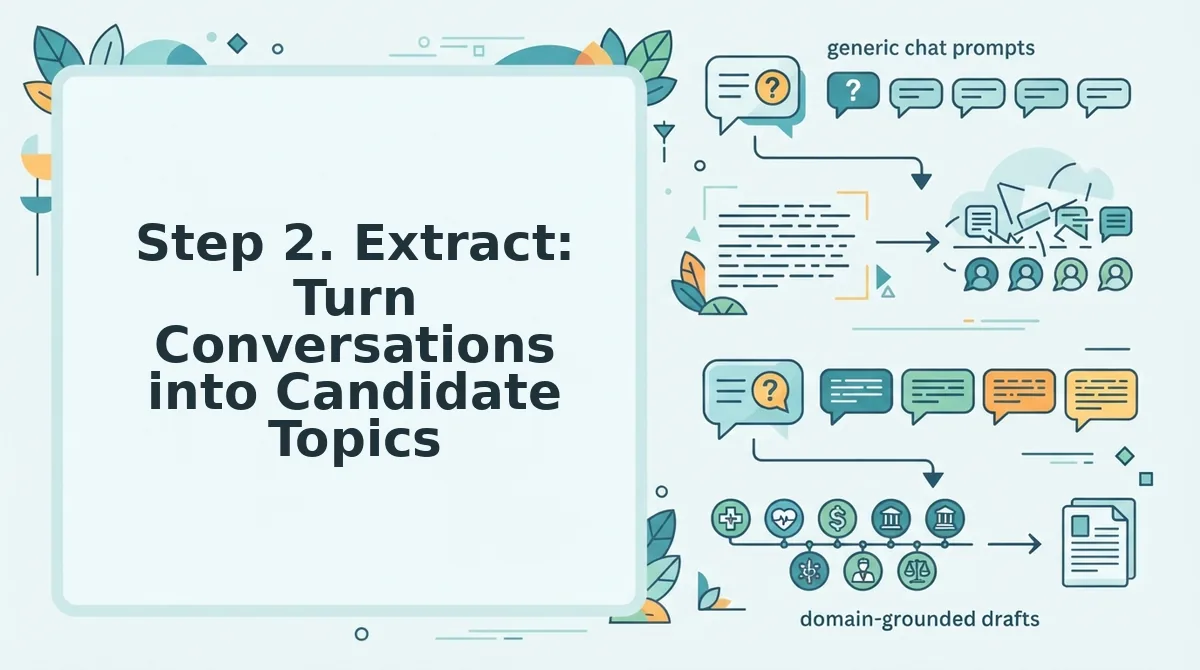
Step 2. Extract: Turn Conversations into Candidate Topics
Topic extraction is the process of converting a raw social quote into its underlying question, then reframing that question as a candidate blog topic with clear search intent. Think of it like mining: social posts are the ore, and extraction is the smelting process that separates usable metal from rock.
Start simple: take one verbatim quote from your listening spreadsheet and ask, "What is this person actually trying to solve?" The answer is the underlying question. Then reframe that question as a working title using the language your audience already uses. The Cereal Entrepreneur video (1,284 views) demonstrates the personal-brand angle well, but it stops at inspiration, it never shows a repeatable extraction method, which is why viewers leave with motivation but no system.
Here's an extraction table built from the YouTube landscape data on finding blog topics:
| Social Quote (Verbatim) | Underlying Question | Candidate Topic |
|---|---|---|
| "I never know what to write next after my first 10 posts" | How do I sustain a content calendar past the initial burst? | How to Build a 12-Month Blog Content Calendar Without Burning Out |
| "All these topic generators give me the same 20 ideas" | Why do generic tools fail, and what's the alternative? | Why Blog Topic Generators Fail (And What to Use Instead) |
| "My posts get views but zero comments or shares" | How do I write content that triggers engagement, not just clicks? | How to Write Blog Posts That Get Comments, Not Just Clicks |
At the intermediate level, group extracted questions by theme. If five people ask variations of "how do I price my service," you have a pillar post with multiple sub-topics. At the advanced level, cross-reference extracted questions with search volume data to prioritize, but that's the next step.
One self-contained workflow worth internalizing: to extract a candidate topic from any social thread, copy the three most-liked comments verbatim, strip out emotional language and personal details, identify the shared underlying question, and rewrite it as a "How to [outcome] without [pain point]" title. This 10-minute routine converts one thread into three testable topic candidates and works across Reddit, X, and YouTube comments. Once you've built a repeatable extraction habit, documenting your brand's voice rules in a markdown style guide generated from your website keeps every extracted topic on-brand before you invest in writing.
Extraction is where raw listening becomes a pipeline, but a candidate topic is still just a guess until you check whether anyone is searching for it. That's where Step 3. Validate: The SERP Check That Separates Winners from Ghost Posts, turns your spreadsheet into a publishing calendar.
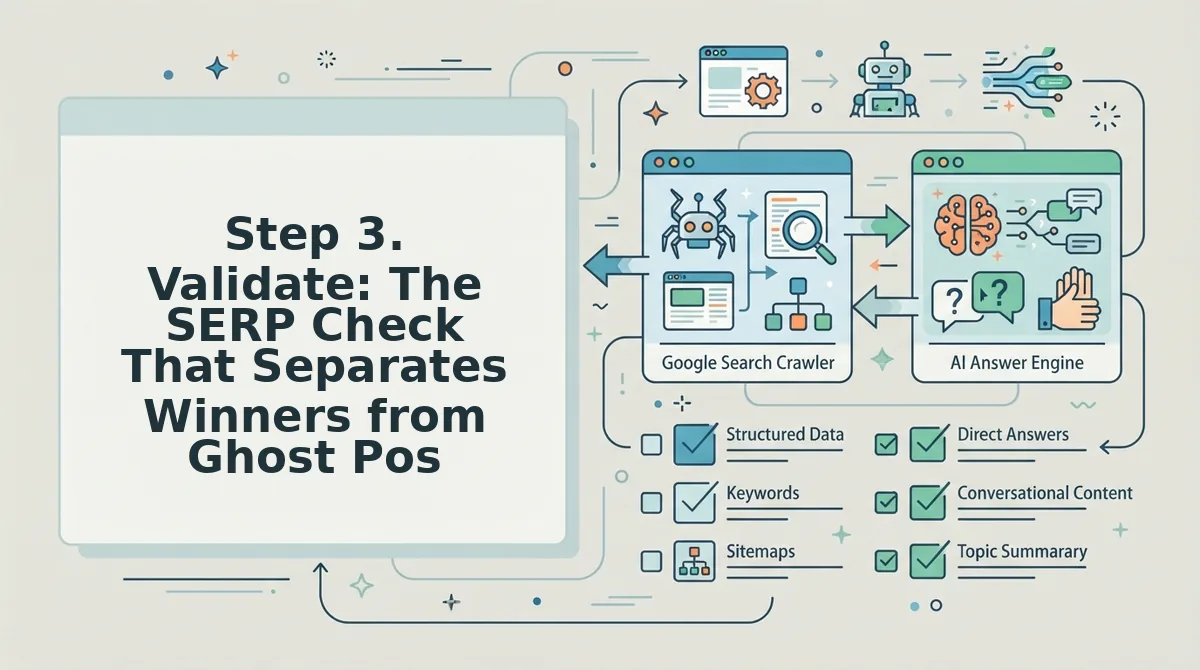
Step 3. Validate: The SERP Check That Separates Winners from Ghost Posts
Validation is the step that separates blog topics that earn traffic from posts that sit unread. Social buzz measures engagement, not search demand, and the two rarely overlap perfectly.
Social platforms optimize for emotional reaction, controversy, and novelty. Search engines optimize for intent match, query clarity, and authority. A viral TikTok comment about a niche frustration may have zero monthly search volume, while a boring-sounding query like "how to export WordPress posts to CSV" quietly drives thousands of clicks. The contrarian take is simple: social research alone produces blog posts nobody searches for, because social platforms reward engagement, not intent.
The Signal-vs-Demand Validation Table
Before committing a topic to your calendar, run it through a three-question filter: search volume, intent match, and cluster fit. Here is how social signals compare against SERP data across the dimensions that matter:
| Validation Dimension | Social Signal Reveals | SERP Data Reveals | Best For |
|---|---|---|---|
| Pain point existence | Real complaints, exact language, urgency | Whether people search for solutions | Founders validating a niche before building content |
| Language and phrasing | How real users describe the problem | Which phrasings have query volume | Content publishers matching reader vocabulary |
| Demand size | Engagement count (likes, comments, shares) | Monthly search volume and trend direction | Growth leads prioritizing high-ROI topics |
| Competition level | How many creators discuss the topic | Domain authority of ranking pages | Solo operators finding winnable SERPs |
| Content format fit | Preferred medium (video, thread, meme) | Dominant SERP format (list, guide, tool) | Agencies matching client content to intent |
Each validation source has strengths. Social data excels at surfacing pain points and authentic language; SERP data excels at quantifying demand and competition. The winning workflow uses both, in sequence.
Three Validation Options Compared
| Validation Approach | What It Checks | Strengths | Limitations | Best For |
|---|---|---|---|---|
| Manual SERP review | Search volume, intent, ranking pages for each candidate topic | Full control, zero cost, deep qualitative insight | Slow at scale; requires SEO judgment per query | Solo operators validating 5-10 topics per month |
| Keyword tool filtering | Volume, difficulty, and trend data across bulk topic lists | Fast bulk screening; consistent metrics | Volume data can mislead on intent; tool costs add up | Growth leads screening 50+ candidates per quarter |
| Automated content engine validation | Volume, intent, and cluster fit applied during topic generation | Validation built into the workflow; no manual step | Less granular control over individual query judgment | Publishers running continuous content calendars |
Manual SERP review remains the gold standard for judgment-heavy decisions, and keyword tools are honest workhorses for bulk screening. Neither is wrong, they serve different volumes and team sizes.
If you maintain a target keywords markdown file for your content pipeline, validation becomes a repeatable checklist rather than a gut call. And when you document competitor positioning in a competitor analysis markdown file, you can spot which validated topics your rivals have already claimed, and which gaps remain open.
Here is the passage-indexed answer to the question "how do I validate blog topic ideas from social media": Validation requires checking three things for every candidate topic: monthly search volume above your minimum threshold, search intent that matches the content format you plan to publish, and topical fit within an existing content cluster on your site. Social engagement metrics like likes, comments, and shares do not predict search demand, they measure platform-native engagement. A topic with high social buzz but zero search volume will produce a ghost post that earns no organic traffic, regardless of writing quality.
BloGoose applies this validation filter automatically during topic generation, so every candidate that reaches your calendar has already passed the volume, intent, and cluster checks, no manual spreadsheet coordination required.
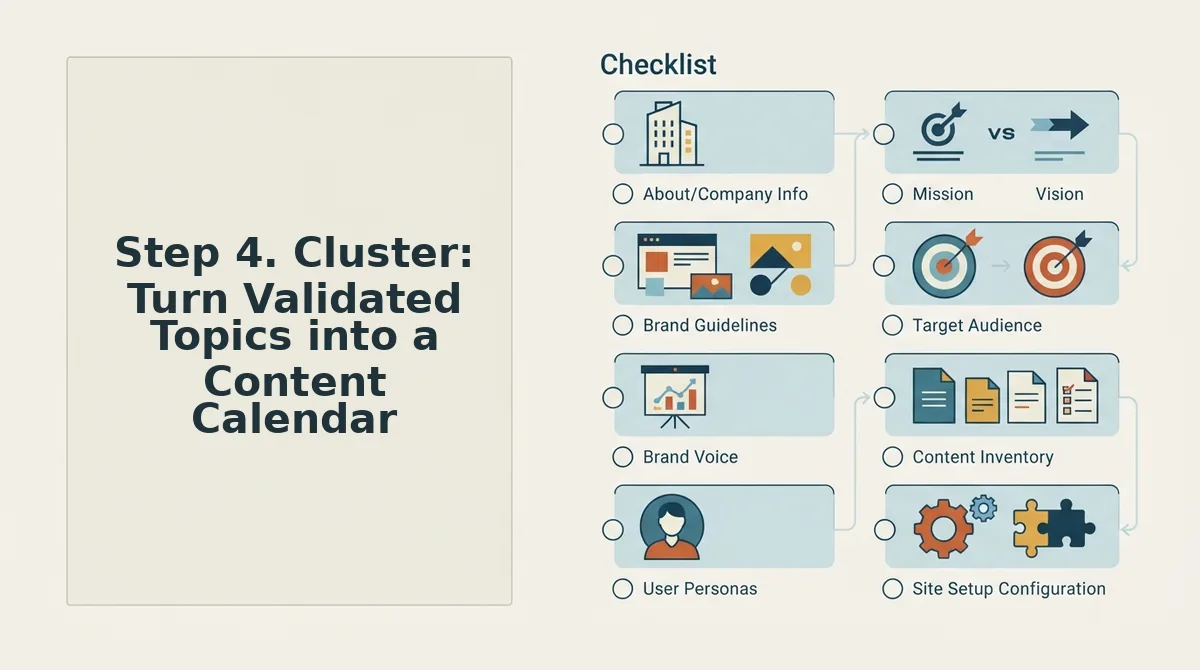
Step 4. Cluster: Turn Validated Topics into a Content Calendar
Validated topics become compounding assets when you organize them into pillar-and-cluster structures. A cluster signals topical authority to search engines and gives readers a clear path through related content.
Here is the clustering workflow, using the five YouTube videos from the research brief as a worked example. From those five videos, three topics pass validation. Those three become one pillar post and two supporting posts.
- Map validated topics to a pillar page. The broadest, highest-volume validated topic becomes the pillar, a comprehensive guide that links out to every supporting post. In the worked example, the pillar covers the overall workflow, while the two supporting posts drill into specific sub-topics. This structure tells search engines which page is the authority hub.
- Assign supporting posts to fill intent gaps. Each remaining validated topic becomes a supporting post that answers a specific question the pillar cannot cover in depth. The two supporting posts from the example target narrower intents, one practical how-to, one conceptual explainer. Supporting posts link back to the pillar, reinforcing the cluster's internal authority.
- Sequence publication by dependency, not convenience. Publish the pillar first so supporting posts have a live hub to link into. Then publish supporting posts in order of search demand, highest first. This sequencing maximizes internal link equity from day one and prevents orphan pages.
- Schedule the cluster across a 30-day window. A three-post cluster fits naturally into a monthly publishing rhythm: pillar in week one, supporting posts in weeks two and three, with week four reserved for promotion and updates. Consistent cadence signals freshness to search engines and builds reader expectation.
- Document the cluster in your calendar tool. Each entry needs a target keyword, internal link targets, and a publish date. Without this documentation, clusters drift into isolated posts. A structured calendar turns topic research from a one-off task into a repeatable system.
The LMS AI video with 24 views demonstrates this exact workflow, from research to a published article, which BloGoose automates end-to-end. Instead of manually building topic clusters in a spreadsheet, the platform generates the pillar-and-support structure from your validated topics automatically.
For teams that want the calendar built without manual sequencing, the autopilot 30-day content calendar generator turns validated clusters into a publish-ready schedule in one pass.
FAQ: Social Research and Blog Topic Ideas
Four questions that come up repeatedly in social research threads, Reddit, and YouTube comments, each answered for featured snippet extraction.
How do I find blog topics when I have no audience yet?
Start with competitor social channels and niche communities. Read the comment sections on competitor YouTube videos, scan subreddits in your niche, and note recurring questions. These conversations reveal demand even when you have zero followers, because the audience already exists, it just belongs to someone else.
What's the best free tool for blog topic research?
Combine Reddit search, YouTube comment mining, and Google autocomplete before paying for any tool. Reddit surfaces unfiltered pain points, YouTube comments reveal language and urgency, and autocomplete shows what people actually type into search. These three free sources cover discovery, phrasing, and demand validation.
How many blog topics should I research before writing?
Research at least 10-15 candidates per cluster to ensure enough validated options. Social research produces many false positives, topics with engagement but no search demand. A pool of 10-15 candidates typically yields three to five validated topics after the volume, intent, and cluster-fit filter, which is enough for one pillar cluster.
Can AI turn social media posts into blog topics automatically?
Yes. Tools like BloGoose automate the Listen-Extract-Validate-Cluster loop: they crawl social signals, extract candidate topics, validate against SERP data, and organize winners into clusters. This removes the manual spreadsheet step while preserving the validation filter that separates search-worthy topics from ghost posts. For more on how AI surfaces your content, see how to get cited in AI answers.
Validation Is the Step That Turns Social Noise into Ranked Content
Social research alone produces ghost posts, articles that feel timely but never earn a click from search. The missing step most creators skip is validation, and by now you've seen exactly how to run it: check the SERP before you write, not after.
That single habit changes everything. A topic with real search demand and weak competition becomes a compounding asset. A topic without it becomes another unpublished draft.
Here's the payoff from the intro: the one step most creators skip is not listening, not extracting, not clustering. It's checking whether anyone is actually searching for the idea. Resolve that, and your social research stops producing ghost posts.
Your next action is straightforward: take the top three candidate topics from your social listening and run them through the validation check. Then let the engine handle the rest, BloGoose's AI blog generator with direct WordPress publishing turns validated topics into optimized, published posts without the manual assembly line.
Social platforms tell you what people are talking about. Search engines tell you what they're looking for. The creators who win are the ones who refuse to publish until both agree.