Why Do Blog Briefs Built on Stale Keyword Data Fail to Rank?
You pulled a keyword export last quarter, built the brief, and handed it off. The writer followed it exactly, and the post still sits on page four.
That frustration is fair. Most stale keyword data blog briefs fail quietly: the brief was right once, then the search results shifted. A keyword export is a dated snapshot of terms, volumes, and difficulty scores, and a content brief turns that snapshot into instructions on angle, format, and headings.
The classic case starts when the export implies a listicle. The brief locks in a numbered roundup, and the writer publishes without checking the current results.
Below, you will learn the four ways briefs decay, a five-signal audit that catches them, and the fields to fix. One hint: the stale field that hurts most isn't volume. This gap is why an AI SEO content engine should plan from live context instead of old spreadsheets.
A brief inherits the SERP it was built from. When that SERP moves, every instruction aims at a page Google has stopped rewarding. Re-query the keyword at the moment you write the brief.
Why Do Blog Briefs Built on Stale Keyword Data Fail to Rank?
Blog briefs built on stale keyword data fail to rank because the search results they were written for no longer exist. Four mechanisms cause the gap: intent drift, format drift, new SERP features such as AI Overviews, People Also Ask, and video, and a changed set of competitors now ranking for the keyword.
A stale keyword brief is a content plan built on search data exported before the current results took shape. It locks in the assumptions of the moment its data was exported, not the moment it was written, so every target it sets, from search intent to page format to rival pages, may already be outdated. Think of it like driving with a printed map: the roads were accurate the day it was printed, but it cannot show this morning's detour, so writers who follow it head toward results that have already moved.
Each mechanism is harder to spot than the one before:
- Intent drift: Search intent is the goal behind a query. When that goal shifts from learning to buying, an informational draft misses what searchers now want.
- Format drift: The winning page type changes, but the brief still prescribes the old shape.
- New SERP features: SERP features are results-page blocks beyond standard links, such as AI Overviews, People Also Ask, and video. They reward different structures.
- Changed competitor set: The pages ranking now are not the ones the brief benchmarked, so its depth targets aim at the wrong rivals.
Our SEO content brief method starts from the live results page. The guide to topic research mistakes covers related traps.
To catch these problems before a draft ships, audit the brief itself.
How to Run the 5-Signal Brief Decay Audit
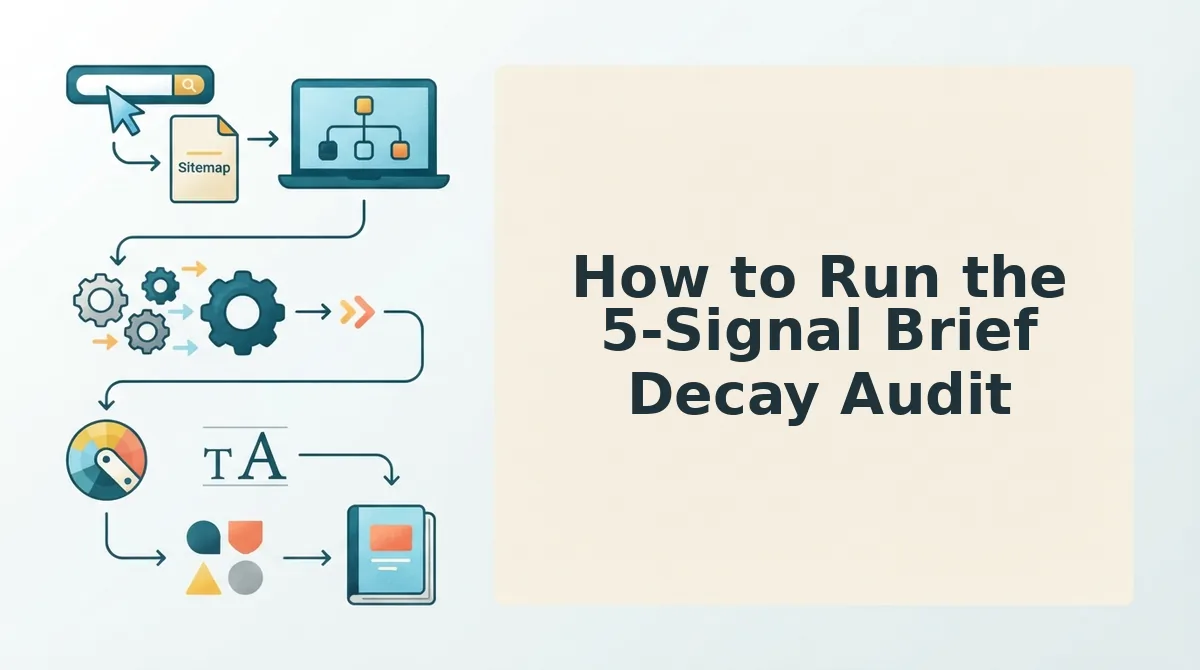
Run the audit by checking five live SERP signals against your brief: dominant intent, content format, SERP features, ranking competitor set, and live questions. When a signal no longer matches, you rewrite the brief field it maps to.
A brief decay audit is a field-by-field check that confirms a brief still reflects today's search results.
Before you start: have the original keyword export or brief open, and be ready to run a live query of the target keyword.
Here's where it gets expensive.
- Search the keyword and label the dominant intent. Classify page one as informational, commercial, or transactional. If the label differs from your brief, rewrite the search intent and angle fields. The brief's stated intent should now match what page one rewards.
- Compare the content format. Note whether the top results are guides, listicles, comparisons, or tool pages. If the format differs, edit the format and outline fields.
- Log the SERP features. Record any People Also Ask block, AI Overview, or featured snippet. If a feature is new since the export, update the required sections field.
- Check the competitor set. List the domains ranking now and replace departed names in the competitor references field.
- Collect live questions. Expand People Also Ask and swap stale entries in the questions to answer field.
How do you check if search intent changed? Search the target keyword live and compare page one with the intent recorded in your original brief or export. Ask what the top results reward: explanations, product comparisons, or pages built to convert. Then check format and SERP features. A shift from long guides to comparison pages, or a newly visible AI Overview, means intent moved even though the keyword stayed the same. If the live results no longer match, rewrite the brief's intent, angle, and outline fields before drafting. Export data alone cannot tell you current intent.
Worked example: A brief built from an older export lists no SERP features. A live query now shows a People Also Ask block and an AI Overview. The fix takes two edits: add an FAQ section built from the live questions, and add a self-contained answer passage near the top. For the passage side, see AEO content optimization.
Pro tip: Re-query when you write the brief, not when you plan the calendar. The SERP can change in the gap between the two.
| Signal | How to check live | Brief field to change |
|---|---|---|
| Dominant intent | Label page one's purpose | Search intent, angle |
| Content format | Note top result types | Format, outline |
| SERP features | Log PAA, AI Overview, snippets | Required sections |
| Competitor set | List ranking domains | Competitor references |
| Live questions | Expand People Also Ask | Questions to answer |
Some stale fields do more damage than others.
Which Stale Fields Hurt Most, and When Is an Export Still Safe?
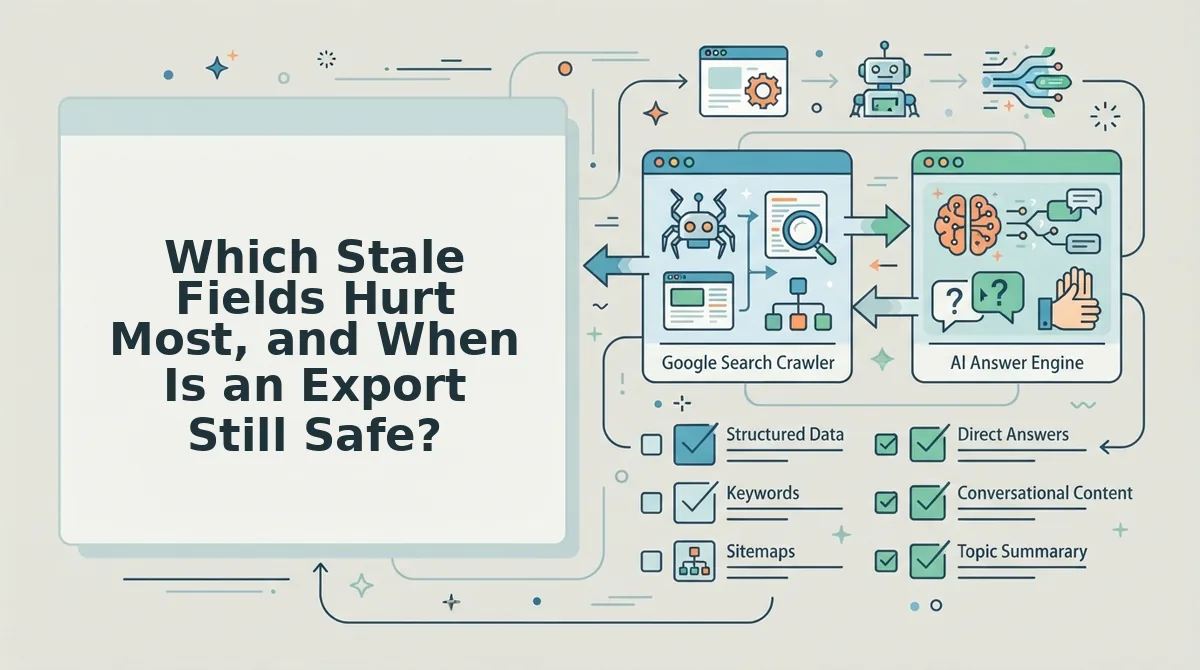
Stale intent and format do the most damage, while stale search volume and CPC do the least. A brief with an accurate volume but the wrong format still fails, because Google ranks the answer type searchers want, not the number in your spreadsheet.
- Intent: If a query shifted from informational to commercial, every section answers the wrong question.
- Format: A listicle brief cannot win a SERP that now rewards step-by-step guides or tool pages.
- SERP features: A new AI Overview, video pack, or snippet changes what earns the click and the citation.
- Competitor set: New top results reset the H2 consensus you have to match before you can beat it.
- Live questions: Fresh People Also Ask and forum threads reveal gaps an old export never captured.
- Volume and CPC: These are useful for prioritizing and rarely fatal when they are slightly off.
Is search volume reliable? It is reliable enough to rank topics against each other. It is still a modeled estimate, and it says nothing about what the page should look like.
| Topic type | Export OK or re-query? | Action | Best for |
|---|---|---|---|
| Evergreen definitions | Export usually OK | Spot-check intent and format, then reuse the volume data | Solo operators clearing a backlog |
| Tool and pricing topics | Re-query required | Re-pull the top results and verify every feature and price claim | DTC brands and SaaS growth leads |
| AI-affected queries | Re-query required | Check for AI Overviews and add quotable direct answers | SEO leads chasing AI citations |
| News-adjacent queries | Re-query required | Rebuild the brief from current results on the day you write | Publishers on fast-moving beats |
Keyword tool exports remain a fast, inexpensive way to size a market, and they work fine for evergreen work. If re-querying every other brief is your bottleneck, BloGoose runs live research inside its content engine, so briefs start from current results instead of an old export.
How Do You Know the Rebuilt Brief Worked?
A rebuilt brief worked if it passes three checks against the live SERP before drafting and then holds its position after publishing.
- Format matches the dominant result type. Compare your planned format to the format most top results use. If they are guides and you planned a list, fix the brief before anyone writes.
- H2s reflect the current competitor consensus. Map the subtopics most top pages share against your outline. Covering them first earns you the right to add your own angle.
- Every live question has a home. Assign each current People Also Ask or forum question to a specific H2. Any question left unassigned is a citation you hand to a competitor.
Troubleshooting: Ranked, Then Slipped
Symptom: The post ranked and then slid down. Stale signal: The competitor set changed after you published. Fix: Re-pull the top results, rebuild the H2 consensus, and run a content refresh.
How often should you refresh keyword research? Refresh it every time you create a brief and again whenever a published post slips. A fixed calendar interval misses both moments.
Build the Next Brief From Live Results
A brief inherits the SERP it was built from, so the fix for stale rankings starts before the first draft, not after traffic drops. Volume tells you whether a topic matters, but only the live results tell you how to win it.
- Re-query when you write the brief. Treat the export date as the brief's expiry date.
- Run the 5-signal audit on any brief that is older than its SERP.
- Triage with the matrix when you can't re-query everything.
Want to drop the manual loop? Point the BloGoose AI SEO content engine at your site. It reads your pages, learns your brand voice, plans your calendar, drafts with SEO and AEO built in, and publishes to WordPress or your custom API. Your next brief can start from today's results instead of last quarter's spreadsheet.