
How to Structure Factual Content Outlines from SERP Data
You pull the top 10 results for your target query, copy every H2 into a spreadsheet, and call it an outline. Then you publish the article and watch it sit on page three while thinner, less "optimized" pages outrank you. Here's the uncomfortable truth: most SERP outlines are just competitor heading lists with better formatting. If you want to structure factual content outlines from SERP data that actually rank and get cited in AI answers, you need a different approach entirely.
You're right to feel frustrated. The standard playbook, scrape headings, match word count, sprinkle keywords, produces content that looks complete but says nothing new. The difference comes down to one rule most tools never tell you, and it changes which headings you keep, which you discard, and which you invent from scratch.
In this guide, you'll learn what a factual content outline actually is, how to extract structure from SERP data beyond surface-level headings, and how to apply a verification rule that filters out noise before you write a single sentence. Along the way, you'll see why the most reliable SERP signals are the ones competitors ignore, and how an autopilot SEO content engine can automate this extraction so you're not manually cross-referencing ten tabs at once.
What Is a Factual Content Outline?
A factual content outline is a content blueprint where every section heading maps to a verifiable claim, a primary source, or a consensus pattern visible across the top-ranking pages for a query. Unlike a keyword-stuffed outline built from competitor headings alone, it organizes information around what can be proven, not what happens to appear most often.
Think of a factual content outline like a building inspector's checklist versus a real estate listing. The listing tells you how many bedrooms a house has because the seller says so. The inspector's checklist verifies the wiring, foundation, and load-bearing walls against measurable standards before anyone moves in. A factual outline does the same for your article: every H2 is load-bearing because it's tied to evidence, not decoration.
At a basic level, this means replacing vague headings like "Benefits of X" with claim-backed headings like "How X Reduces Load Time by Removing Render-Blocking Scripts." At an intermediate level, you map each heading to at least one primary source, a study, official documentation, or raw data, rather than another blog post repeating the same claim. At an advanced level, you rank SERP features by reliability and build your outline hierarchy around the strongest evidence tier first.
Here's a three-question test most outline guides never give you. Before you keep any heading, ask: (1) Can I name a primary source that supports this claim? (2) Do at least three top-10 pages agree this topic belongs in the article? (3) Does this heading answer a question real searchers ask, or is it filler I inherited from a competitor's table of contents? If a heading fails any of these, it doesn't belong in a factual outline, no matter how many ranking pages include it.
Step 1: Extract Structure from the SERP, Not Just Headings
Start by treating the search results page as a ranked evidence source, not a heading library. You'll need a browser with an incognito window, a spreadsheet for tracking, and roughly 20-30 minutes per query. The goal is to identify which structural signals deserve a place in your outline and which are just noise.
- Open an incognito window and run your target query. Incognito mode strips personalization so you see a closer approximation of the neutral SERP. Scroll through all of page one and note every SERP feature present: People Also Ask boxes, featured snippets, video carousels, knowledge panels, and image packs. You should see a mix of result types, not just ten blue links.
- Copy every People Also Ask (PAA) question into your spreadsheet. Click each question to expand it, which generates two to three follow-up questions. Capture those too. PAA questions are the highest-reliability structural signal because they represent queries Google has already observed real users asking. You should end up with 8-15 questions for a typical informational query.
- Open the top 10 organic results and extract their H2s into separate columns. Use a browser extension or manually copy each H2. Do not copy H3s yet, you're looking for consensus at the section level first. You should see clear overlap on 3-5 core topics across most pages.
- Mark each H2 with a tally of how many top-10 pages include it. Create a column for frequency. Any H2 appearing on 3 or more pages is a consensus heading. Any H2 appearing on only one page is likely a differentiator or a tangent, flag it for later review rather than discarding it immediately.
- Rank your extracted signals by reliability using this hierarchy: PAA questions first, then featured snippet text, then top-10 H2 consensus, then social language from forums and Reddit threads that appear in the SERP. This ordering matters because PAA questions reflect verified user demand, while social language often surfaces objections and edge cases that ranking pages miss.
Apply one filter before building your outline: include a heading only if 3 or more top-10 pages share it or it answers a PAA question. This single rule eliminates roughly half of the headings you'd otherwise inherit from competitor tables of contents. For a faster way to run this extraction at scale, live SERP analysis automates the crawl and consensus tally so you start with ranked evidence instead of raw heading dumps. Once you have your filtered heading list, the next step is verifying each one against primary sources before it earns a place in your outline.
Step 2: Apply the 3-Source Rule to Every Heading
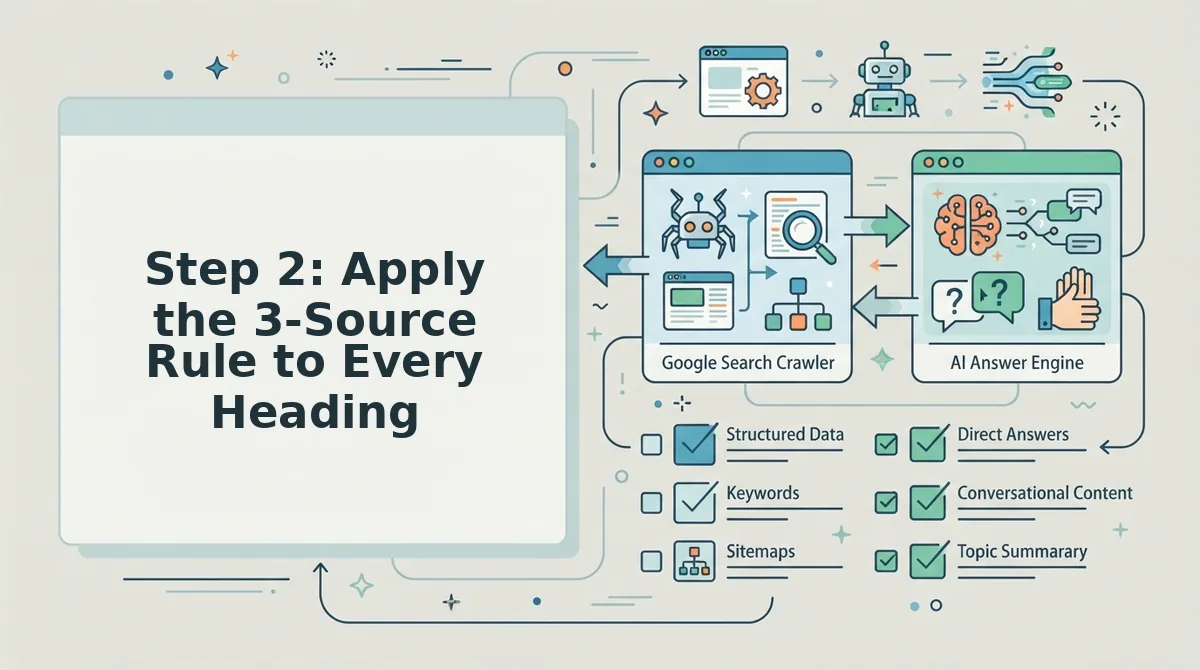
Promote a heading into your outline only when it appears in 3+ independent top-10 results or 1 authoritative primary source. This rule prevents you from chasing isolated facts that no one else validates.
Prerequisites: A completed SERP extraction sheet from Step 1, a spreadsheet or note-taking tool, and access to the top 10 results for your target query.
- Open your SERP extraction sheet and create a new column labeled "Source Count." List every heading you extracted from the top 10 results in Step 1. You should see each heading appear once per row, ready for tallying.
- Scan each top-10 result and mark which headings appear in that page. Work through all 10 results one by one, placing a checkmark in the row for every heading that page contains. Expect this to take 10-15 minutes per query.
- Count the checkmarks per heading and sort by highest count. Headings with 3 or more checkmarks pass the 3-Source Rule and belong in your outline. You should see a clear cluster of 5-8 validated headings rise to the top.
- Flag any heading backed by a single authoritative primary source. Government databases, peer-reviewed studies, or official documentation count as one authoritative source even if no other result repeats the fact. Mark these with a "P" for primary.
- Delete headings with 1-2 checkmarks and no primary source. These are likely site-specific quirks or thin content. Your final outline should contain only headings that pass the rule.
SurgeGraph's Context Infuser surfaces SERP facts inside the editor, but it never tells you which facts deserve promotion. The 3-Source Rule fills that gap: it converts raw SERP noise into a defensible hierarchy.
Tools like an AI SEO content engine can automate the tallying step by crawling SERPs and cross-referencing heading frequency across results, so you skip the manual spreadsheet work.
Step 3: Fill Gaps with Questions, Not Keywords
Keyword research shows what people type, but real questions reveal what they actually need answered. Mine People Also Ask boxes, Reddit threads, and YouTube comments to find gaps your SERP extraction missed.
- People Also Ask (PAA) questions. PAA boxes surface the exact phrasing searchers use after their initial query, which reveals follow-up questions your outline must answer. Pull every PAA question from your target SERP and map each one to the heading it belongs under.
- Reddit thread questions. Reddit captures unfiltered user language, including objections, confusion points, and edge cases that keyword tools never surface. Search your topic on Reddit and extract the top 5-10 questions with the most upvotes or replies.
- YouTube comment questions. Comments on high-ranking videos for your topic show what viewers still don't understand after watching, which signals content gaps in existing coverage. Sort comments by "Top" and collect questions that appear more than once.
- Quora and forum threads. Niche forums and Quora threads contain long-tail questions from users who couldn't find answers elsewhere, making them prime candidates for new outline headings. Look for questions with multiple answers but no clear consensus.
Promptmate's AI outline writer performs content gap analysis on SERPs, but it stops at keyword-level gaps and never validates against real user questions. Adding the question layer catches what SERP-only tools miss.
Step 4: Validate Before You Write
Run every heading through a 3-question test before drafting: Does this heading map to a verifiable claim? Does a primary source exist? Would a reader actually ask this question? A heading that fails any test gets cut or rewritten.
Prerequisites: Your completed outline from Steps 2-3 and 10-15 minutes per article for the validation pass.
- Open your outline and review the first heading. Read it as a standalone statement. You should be able to identify the specific factual claim it makes.
- Ask the 3-question test for that heading. Check for a verifiable claim, a primary source, and reader intent. Mark any heading that fails with a red flag in your document.
- Repeat for every heading in the outline. Work top to bottom without skipping. Expect to flag 1-3 headings per outline that need rewriting or removal.
- Rewrite or delete flagged headings. Convert vague headings into specific, answerable ones. Your final outline should contain zero red flags before drafting begins.
This validation pass acts as a quality gate that separates factual outlines from opinion-driven ones. Pair it with an SEO guidelines checklist to lock in structure, sources, and voice rules before a single word gets drafted.
Next: FAQ, Structuring Factual Content Outlines from SERP Data.
FAQ: Structuring Factual Content Outlines from SERP Data
These answers address the most common questions from People Also Ask boxes, Reddit threads, and YouTube comments about building factual outlines from search results.
How do I scrape Google SERP data for content outlines?
Use a SERP API like DataForSEO, SerpAPI, or Valueserp to pull top-10 results, PAA questions, and featured snippets for your target query. Export headings, answer text, and ranking URLs into a spreadsheet, then cluster them by search intent before drafting your outline.
What is the difference between a content outline and a content brief?
A content outline is the structural skeleton: H2s, H3s, and the facts or sources assigned to each section. A content brief adds writer instructions, target word count, tone guidelines, and internal links. Outlines define what to cover; briefs define how to write it.
Can AI build factual outlines from SERP data automatically?
Yes. Tools like BloGoose crawl live SERPs, extract heading patterns and PAA questions, then generate outlines with source-backed claims per section. The output is citation-ready content that skips manual spreadsheet work.
How many competitor pages should I analyze before building an outline?
Analyze the top 5 to 10 ranking pages for your primary query. Three pages reveal shared structure; five to ten expose gaps competitors miss. Cross-reference at least three sources per heading to confirm facts rather than copying one dominant page.
Why does my outline rank but my article doesn't?
Outlines capture structure, not substance. If headings mirror the SERP but each section lacks verified facts, examples, or unique data, Google sees thin content. Apply the 3-Source Rule to every heading and validate claims before drafting.
What should I do when SERP results contradict each other?
Check the publication date, author expertise, and primary sources behind each conflicting claim. Prefer recent data from authoritative domains, and note the discrepancy in your outline so the writer addresses it explicitly rather than silently picking one side.
Build Factual Outlines That Rank and Get Cited
The 3-Source Rule is the difference between a factual outline and a competitor heading list. Anyone can copy H2s from page one; only outlines built from verified, cross-referenced claims survive algorithm updates and earn AI chatbot citations.
Your validation checklist is now complete: extract structure from live SERPs, confirm every heading with three independent sources, fill gaps with real user questions, and validate before writing. The remaining bottleneck is execution speed.
BloGoose turns live SERP queries into factual, citation-ready article outlines automatically, then pushes finished drafts through your publishing pipeline without manual coordination. Start by dropping your domain into the setup wizard and letting the crawler map your first content cluster.
Outlines built on verified data compound: each factual article strengthens your site's authority for the next query you target.