Keeping Tone Aligned Across Every Section of a Long Blog Post

Section three is where drafts go flat. The intro lands sharp, the first body block holds, and then around the 600-word mark the contractions thin out, the sentences even off, and by the CTA you are reading something that sounds like three different writers took shifts. That is tone drift, and it is why tone aligned blog sections are a process problem rather than a talent you either have or don't.
You already believe voice matters. You probably already have a style guide. What most drafts lack is a handoff â a rule for what brand context gets loaded before each block is written, plus a fast way to confirm the block landed in the same register as the one before it.
This is a workflow, not a personality trait. Below you get two things: a file-to-section handoff you run before typing, and a five-signal audit you run after, in about four minutes. The collapse itself is not random, and it is not fixed by writing a longer style guide â it happens in the seams between sections, which is exactly where most guides never look.
If you want that handoff generated for you, the AI SEO content engine crawls your site and extracts your voice rules into editable context files before a single section is drafted.
Why Does the Middle of a Long Post Sound Like a Different Writer?
Voice drift is the loss of cadence and register between consecutive sections of the same draft, and register is how close a passage stands to the reader. Drift is a transition problem, not an opening problem â it surfaces at the seams.
Simple version first: somewhere after the first thousand words, the writer stops re-reading the previous block and starts drafting from a memory of the brand voice instead of from the file. Memory compresses. Cadence flattens first, then pronouns drift, then hedging creeps in.
Think of it like a bucket brigade. Nobody drops the bucket mid-line â the water is lost at the handoff, when one person assumes the next already has it. Tone behaves the same way. It does not collapse inside paragraphs; it collapses in the two seams every long post crosses: intro into body, and body into conclusion. The intro seam breaks when the writer switches from addressing the reader to briefing them. The conclusion seam breaks when the writer switches from explaining to selling.
Intermediate fix: read your line pairs and pattern-match. A flat seam reads "Now let's look at the audit." An aligned seam reads "The draft is not broken â it is leaking at the seams, so start there." Same destination, different register. The second one carries the previous section's stance forward instead of restarting.
Advanced layer: each H2 type has its own drift direction. Technical sections drift toward jargon, because the source material is jargon. Conclusion sections drift toward hype, because the CTA is doing emotional work the body never did. Placement logic matters here too â the inline images in long-form posts guidance makes the same argument about visuals: put them at the seam and they carry continuity; drop them mid-paragraph and they interrupt it.
Pro tip: before drafting the next section, re-read only your final paragraph out loud â never the whole draft. One paragraph is enough to re-establish cadence, and it costs 20 seconds instead of ten minutes.
How Do You Keep the Same Voice in Every Section With Brand Context Files?
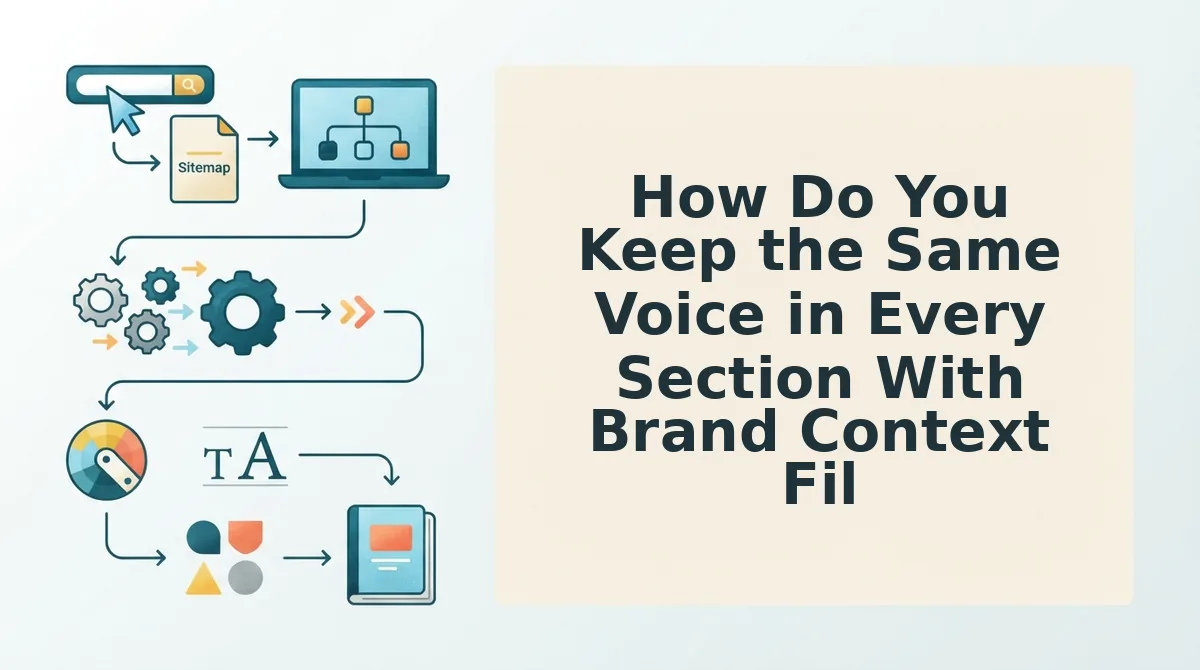
You keep voice consistent by loading a specific context file before drafting a specific section, rather than pasting one style document at the top of the job and hoping it holds for 1,700 words. Each file governs a narrow decision, and the handoff happens between sections, not before the first one.
Load style-guide.md for cadence and register in every section. Load writing-examples.md for intro openers and transition lines. Load target-keywords.md before you phrase any heading, never after. That three-file rotation, re-run at each seam, is the whole method â the remaining files exist to stop specific drifts rather than to set overall voice.
Prerequisites: a crawled domain with brand context extracted, or your own Markdown files in a repository. Setup takes about 10 minutes; the per-section reload takes under a minute.
- Open Settings, then Brand Context. Confirm eight editable Markdown files are listed. Expected outcome: you can see and edit each file individually. (~2 min)
- Edit style-guide.md and paste three passages you consider on-voice. Specify a sentence-length range, a register level, and banned constructions. Expected outcome: the file states cadence and register in words a writer can follow without judgment calls. (~4 min)
- Populate writing-examples.md with five to eight openers and five transition lines pulled from published posts. Expected outcome: the file contains reusable phrasing, not descriptions of phrasing. (~3 min)
- Draft section one. Before section two, re-read only the last paragraph of section one out loud, then reload style-guide.md and writing-examples.md. Expected outcome: the new block opens in the prior block's cadence. (~1 min per seam)
- Load target-keywords.md before writing headings and internal-links-map.md before placing body links. Expected outcome: heading phrasing and link placement stay inside their files' rules.
- Log the seam. Note in one line whether the transition needed a rewrite. Expected outcome: patterns surface after four or five sections.
| File | Section it governs | What it controls |
|---|---|---|
| style-guide.md | Every section | Cadence and register |
| writing-examples.md | Intro openers, transition lines | Rhythm and phrasing |
| target-keywords.md | Headings only | Heading phrasing |
| internal-links-map.md | Body | Link placement |
| seo-guidelines.md | Intro and conclusion | Promises made to the reader |
| competitor-analysis.md | Body sections | Angle and differentiation |
Worked example: a body section drafted after a two-day break. Instead of drafting cold and rewriting after, the writer reloads style-guide.md and writing-examples.md first. The reload eliminates the rewrite pass on the second and third body sections, so the draft reaches the audit stage already in one register.
The extraction step is what makes the files worth loading â sitemap context extraction reads published pages rather than asking you to describe your own voice from scratch. Pair that with live SERP analysis and the angle file stops being guesswork.
Troubleshooting the three recurring patterns
- Register whiplash into the conclusion CTA. Reload writing-examples.md and steal a transition line verbatim.
- Jargon creep in technical H2s. Define the term inline on first use; style-guide.md should list the terms that always need it.
- Hedging after a cited claim. Cut "it seems" and "arguably" â cited claims carry their own weight.
One boundary worth stating plainly: tone alignment is not a ranking factor, and nothing here implies it is. It affects whether readers finish the post.
Files cannot fix a voice the site never had, so extract before you enforce. Once they are loaded, the remaining question is verification â and that takes five signals, not a full read-through.
How Do You Check Tone Without Reading the Whole Draft Aloud?
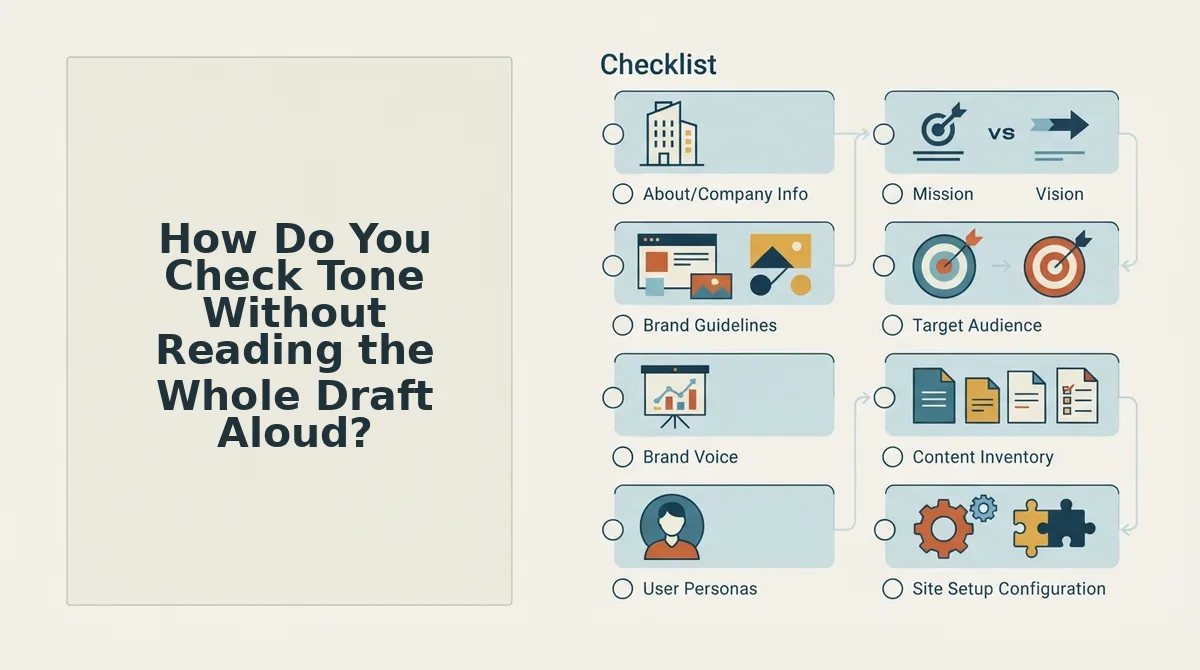
Run a five-signal audit on the finished draft instead of reading it aloud: sentence-length spread, pronoun shift, contraction rate, jargon density, and CTA mood. Each check takes under a minute and shows exactly which section broke the voice.
- Sentence-length spread. A sudden run of same-length sentences marks a different drafting mode, usually a writer or model defaulting to neutral. Splice in the shortest sentence from the style guide's writing examples and keep that rhythm.
- Pronoun shift. "You" through the body flipping to "we" in the conclusion splits the reader from the brand. Pick the pronoun your guide specifies, then search the draft for the other one and rewrite every hit.
- Contraction rate. Contractions in the intro and none in the technical section read as two authors. Count them per H2 and normalize until the rate is flat across the whole draft.
- Jargon density. Three or more unexpanded terms inside one H2 signals the writer switched audiences mid-piece. Expand the first use of each term only, then leave the rest alone.
- CTA mood. A hedged body followed by a hard-sell close is the most visible seam in the post. Match the close to the body's confidence level instead of escalating it at the end.
Tone drift carries a search cost as well as a reading cost. When one paragraph answers a question in a formal register and the next shifts to conversational, the liftable passage gets shorter and harder for an answer engine to quote without stitching. Keeping register flat across an H2 gives AEO content optimization something clean to work with: a self-contained block that survives extraction intact. That is not a ranking guarantee, but it removes one reason for a machine to skip your passage and pull the same answer from a competitor whose section reads in one voice.
Tone Alignment Questions Writers Actually Ask
How do I keep the same tone across every section of a long blog post?
Load the same context files before every section, re-read the previous paragraph first, and run the five-signal audit on the finished draft. Consistency comes from the handoff between sections, not from willpower or one long editing pass at the end.
Do I need a separate style guide for every author on the team?
Only when their published samples differ in register. If two writers already sound alike on the live site, the site guide governs both and the author file holds examples only â sample sentences that writer can pull from when splicing rhythm back in.
Does tone alignment still work when AI drafts the sections?
Yes, with one change in order. Load the context files before generation as usual, but run the audit before you edit rather than after, because generated sections drift toward a neutral register and the drift is easier to catch before human rewrites mask it.
What if several people edit the same post?
Name one voice owner and have them re-read the previous paragraph before touching a section. Audit the seams where two people's work meets, since most multi-editor drift shows up at those handoffs rather than inside one writer's paragraphs.
Ship the Draft in One Voice
The takeaway worth keeping is that voice rarely breaks inside a section; it breaks at the seams between them. So the rule is: the file governs the section, and the seam gets the audit.
Load the brand context file before you write each heading, not after the draft exists. That single change in order separates a post that reads in one voice from one that reads like three writers sharing a login.
If you are still publishing by hand, start with the mechanics: how long Google takes to crawl a new post tells you how much runway sits between finished and ranking. Then take your worst-performing post and run the five-signal audit on its two transitions â most drafts fail somewhere between the second H2 and the close. When you would rather not maintain those files yourself, BloGoose crawls your site, generates the editable context files, and publishes finished sections to WordPress or your API.
Your next draft can hold one voice from the first H2 to the last line, and it can do that without you reading a word of it out loud.