How to Validate Blog Topics Without a Keyword Research Team
You've spent six hours drafting a post, only to watch it sink to page four, and you're not alone. The real question isn't "how do I find keywords?" It's "how do I validate blog topics without keyword research team support and still publish with confidence?"
You're right to feel the friction. Hiring a dedicated keyword researcher is expensive, and stitching together five different tools creates more busywork than insight. Here's the promise: by the end of this article, you'll have a repeatable, three-signal validation system you can run in under 30 minutes per topic, no team, no spreadsheet sprawl, no guesswork.
We'll walk through demand (is anyone searching?), competition (can you actually beat page 1?), and fit (does this topic serve your site's authority?). Along the way, you'll see why most "keyword research" advice is really just prioritization theater, and one surprising finding about competitor recency that changes how you should read any SERP. If you're already running an AI SEO content engine, you can automate parts of this workflow; if not, the manual protocol works just as well.
Why Keyword Research Teams Are Overkill for Most Publishers
Topic validation is a yes/no decision about whether a single idea deserves your writing time. Keyword research, by contrast, is a prioritization exercise that ranks dozens of candidate topics against each other. Most publishers need the first, not the second.
Think of it like deciding whether to cook dinner at home versus planning a month of meals for a family of six. A keyword research team builds the full meal plan, volume forecasts, difficulty scores, seasonal trends, cannibalization maps. A solo operator just needs to know: is this one recipe worth making tonight?
That distinction matters because the cost structure is wildly different. A dedicated researcher or agency retainer runs $2,000 - $8,000 per month. The validation decision you actually face, "should I write this post?", can be answered with three checks that take under 30 minutes total.
Here's the workflow in practice. Start with a simple recency test: if three or more competitors have published on your topic in the last 12 months, demand likely exists and the SERP is active. If nobody has touched it in two years, you're either looking at a dead query or a blue-ocean opportunity that needs extra scrutiny. Then run a live SERP analysis to see what Google currently rewards for that query, listicles, how-tos, or product comparisons.
If you're publishing at scale, an AI SEO content engine can crawl your site, extract your brand voice, and validate topics against live SERP data automatically, collapsing what used to be a team function into a configuration step. But the underlying logic is the same whether you automate it or run it by hand: validation is a gate, not a research project.
Signal 1: Demand, Is Anyone Actually Searching for This?
Demand validation answers one question: does a real audience type this query into Google? You can confirm this manually in under 10 minutes using free signals before touching any paid tool.
Prerequisites: A Google browser session (logged out or incognito for cleaner results), your candidate topic phrased as a query, and 10-15 minutes.
- Type your topic into Google and watch autocomplete. Start typing your core phrase and pause after each word. If Google suggests your exact phrasing or close variants, that's direct evidence of search volume. You should see at least 3-5 autocomplete suggestions that match your topic's intent.
- Scroll to the "People Also Ask" box. Open the first three questions and note whether they match your topic's angle. If the questions are active (expanding to reveal more), the query cluster has ongoing search interest. You should see your topic's core question appear within the first two PAA entries.
- Check the bottom of page 1 for "Related searches." These are queries Google has statistically linked to your topic. If 4+ related searches align with your angle, demand is confirmed. You should see at least one related search that uses your exact phrasing.
- Open Google Trends and enter your topic phrase. Set the timeframe to "Past 12 months" and region to your target market. Look for a stable or rising line, not a single spike. You should see interest above 25 on the 0-100 scale for at least 6 of the last 12 months.
- Open Keyword Planner (free with a Google Ads account) and enter your phrase. Click "Get search volume and forecasts." You should see a monthly volume range, even "100-1K" confirms directional demand. Treat this as a floor, not a ceiling; Keyword Planner rounds down for non-advertisers.
If you want a deeper read on who's already winning this query, run a competitor analysis on the top three ranking pages and note their publish dates. Fresh content on page 1 is the strongest demand signal of all, it means Google keeps refreshing the SERP because people keep searching.
That recency check sets up the next gate perfectly: knowing people search is only half the battle. Now you need to see whether page 1 is actually beatable.
Signal 2: Competition, Can You Actually Beat Page 1?
Competition analysis tells you whether ranking is realistic, not just whether demand exists. You need a browser, a private or logged-out search window, and roughly 20 minutes per topic.
- Open a private browsing window and search your target keyword. Logged-in results skew toward your history, so incognito mode gives you the neutral SERP a new visitor sees. You should see the same organic layout Google shows most users, including ads, AI Overviews, and video carousels.
- Click through the top five organic results and note each page's publish date. Look for dates older than 18 months or clearly stale statistics. If three or more top results are outdated, you have a realistic opening.
- Run the 4-point SERP weakness scan on each competitor. Check for thin content under 800 words, outdated dates, missing sections the query clearly demands, and no first-hand experience such as screenshots or original data. Document every weakness in a simple spreadsheet.
- Count how many page-one results are forums, video, or AI-generated summaries. AI Overviews, Reddit threads, and YouTube carousels change what "beatable" means in 2026, they compress organic click-through but also signal that Google wants diverse answer formats, not just traditional blog posts.
- Score the SERP from 1 to 10, where 10 means every competitor has two or more weaknesses. A score of 7 or higher means you can realistically target the keyword. Below 5, move to the next topic on your list.
For a faster version of this workflow, run a live SERP analysis that flags weaknesses across the top ten results automatically.
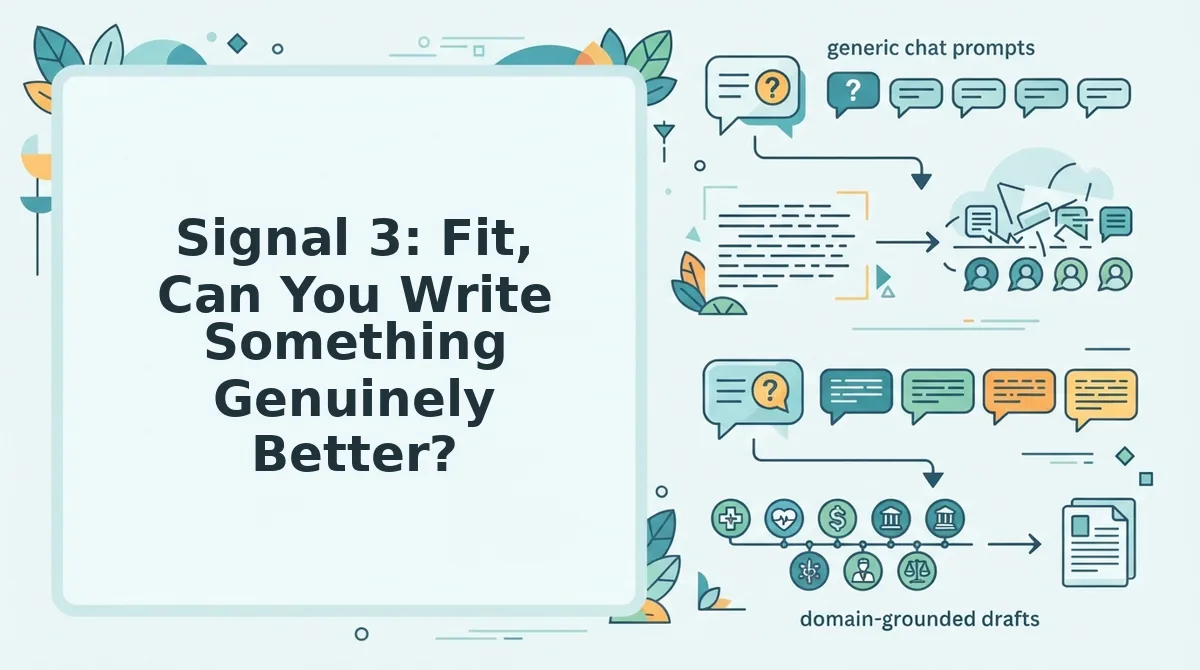
Signal 3: Fit, Can You Write Something Genuinely Better?
Topic fit is the measure of whether a keyword aligns with your site's existing authority, internal structure, and unique experience. Fit answers the question demand and competition cannot: should you write this, not just could you.
Think of fit like choosing a recipe for a dinner party. You can find a dish everyone is searching for and confirm no local restaurant serves it well, but if you have never cooked that cuisine and your pantry lacks the core ingredients, the result will disappoint. Fit is your pantry.
Start simple: run the internal link test. Does the topic connect naturally to your existing topic clusters, or would it sit orphaned on your site? A topic that links to three published posts signals topical authority to Google. An orphan topic signals nothing.
Then run the experience test. Can you bring first-hand knowledge competitors cannot, original screenshots, customer data, process documentation, or a unique workflow? If the answer is no, you are competing on prose quality alone, which is the weakest possible moat in 2026.
At the intermediate level, map the topic to a pillar page and at least four supporting posts before you write a single word. At the advanced level, use BloGoose to crawl your existing site, extract your brand voice, and confirm the topic fits your cluster architecture before drafting begins.
The AEO Readiness Score: Will This Topic Win AI Citations?
AEO readiness measures whether a topic can earn citations in AI Overviews, ChatGPT, and voice assistants, not just rank in traditional blue links. Score each topic on these four points before committing to a draft.
- Featured snippet presence. Search the keyword and check whether Google displays a featured snippet at the top of results. If one exists, the query has structured-answer intent, which means AI systems are already extracting direct answers from pages. If no snippet exists, the topic may be too broad or navigational for AI citation potential.
- 80-120 word answer passages. Write one self-contained paragraph that directly answers the core question in 80 to 120 words, with the answer in the first sentence. AI answer engines extract passages of roughly this length, so a topic you cannot answer concisely is a topic AI will skip.
- People Also Ask questions. Check the PAA box on the SERP for related questions. Each PAA question is a ready-made subheading and a secondary AI citation opportunity. Topics with five or more PAA entries give you a structured outline for free.
- Entity-definable topic. Confirm the topic can be defined in one sentence as a clear entity, such as "AEO optimization is the practice of structuring content so AI answer engines cite it as a source." Topics that resist a clean definition are harder for AI systems to parse and attribute.
AI Overviews reward concise, structured answers over sprawling prose, which changes which topics are worth pursuing. A topic scoring 3 or 4 on this checklist is worth writing; anything below 2 needs rethinking. For a deeper workflow on structuring content for AI citations, see our guide to AEO optimization.
With all three signals checked, you are ready to validate your next topic in 30 minutes.
Validate Your Next Topic in 30 Minutes
The three signals, demand, competition, and fit, form a repeatable system, not a one-time exercise. Run them manually on your next five topic ideas and you'll build a validation instinct no keyword research team can replicate. The AEO readiness check adds a fourth layer: will this topic earn citations in AI answers, not just clicks from Google?
Here's the payoff from the intro: you don't need a team, a tool budget, or a data science background to stop publishing content nobody reads. You need a 30-minute habit.
- Pick one topic from your backlog and run the three-signal check right now.
- Score it against the AEO readiness criteria before you write a single word.
- Repeat weekly until validation becomes faster than your old guessing process.
When manual validation starts eating hours you'd rather spend writing, BloGoose automates the live SERP and social research behind all three signals, so your 30-minute framework becomes a 30-second one.
Validation isn't a gate that blocks good ideas. It's a lens that turns vague hunches into rank-ready topics.