How to Use Social Research to Validate SERP Content Gaps

Your team published 14 articles last month. Twelve never cracked page two. The gap analysis said the keywords were there, but the demand wasn't. Here's the uncomfortable truth most content managers discover too late: identifying a keyword gap and validating that real humans actually want that content are two completely different jobs. You already know gap analysis matters. That's why Ahrefs' content gap analysis video has racked up 41,690 views, mainstream adoption is real. But that video teaches keyword gap identification, not demand validation. This article gives you the missing step: a 3-source method to validate SERP content gaps with social research before you spend a single hour drafting. You'll learn the Demand Triangulation framework, see a worked example, and get a scorecard for deciding which gaps deserve your calendar. Along the way, you'll discover the one signal most SEOs ignore entirely, and it's not social volume. If you're already running live SERP analysis but still publishing articles that flatline, the framework ahead changes your workflow from guesswork to evidence. BloGoose automates the research layer so you can apply this validation loop at scale, not just for one-off audits.
What Is a SERP Content Gap and Why Most Gap Analyses Fail
A SERP content gap is a topic, question, or angle that the current top 10 results fail to cover adequately. But a gap is a hypothesis, not a strategy, and treating every identified gap as a publishing mandate is where most content programs go wrong.
Think of a SERP content gap like an empty shelf in a grocery store. The shelf space exists, and the store's inventory system flags it as unfilled. But before you order a pallet of a new product to fill that shelf, you need to know whether shoppers actually want that product, or whether the shelf is empty because nobody buys that category. Most gap analyses stop at the inventory report. They never walk the store floor to ask shoppers what they're looking for.
The mainstream approach reinforces this blind spot. Ahrefs' video "How to Do an Effective Content Gap Analysis for SEO" has 41,690 views and teaches a rigorous process, but it's a process for finding keyword gaps between your site and competitors, not for validating whether real demand exists behind those keywords. The tooling shows you what's missing. It doesn't tell you whether anyone cares.
Here's the progression most teams experience. At the simple level, a gap analysis means exporting competitor keywords and filtering for terms you don't rank for. At the intermediate level, you cluster those keywords by intent and map them to your existing SEO content audit findings. At the advanced level, you're layering in SERP feature data, click-through curves, and topical authority mapping. But at every level, the underlying assumption is the same: if a keyword has search volume and competitors rank for it, the gap is worth filling.
That assumption is fragile. Search volume measures query frequency, not satisfaction. A keyword can have steady volume precisely because existing results are so bad that users keep re-searching, or because the query is a dead end that no content can satisfy. Social research is the missing validation layer: it tells you whether the gap represents a real, articulated need that people express outside of search engines, in their own words, with their own urgency.
To validate a SERP content gap with social research, you must confirm three things: that the gap is real (users ask about it), that the gap is persistent (users ask repeatedly over time), and that the gap is satisfiable (users describe a specific answer they're seeking, not a vague frustration). A gap that passes all three checks is a content opportunity. A gap that fails any one of them is a trap.
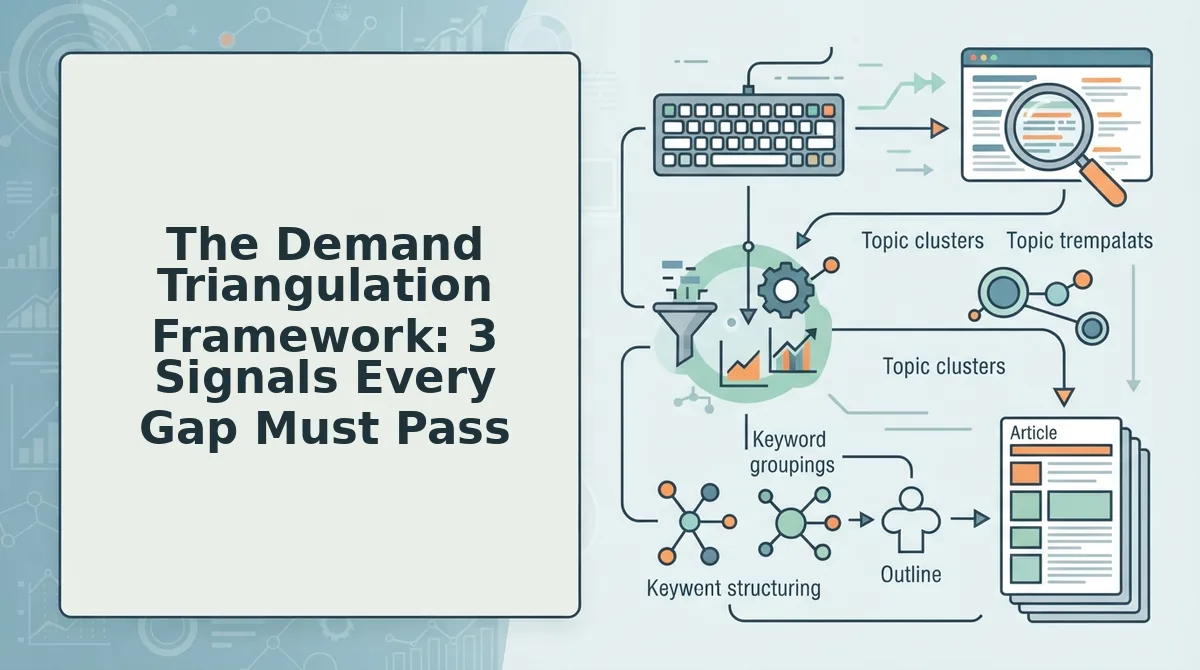
The Demand Triangulation Framework: 3 Signals Every Gap Must Pass
The Demand Triangulation framework is a 3-signal validation method that confirms a SERP content gap represents real, persistent, and satisfiable user demand before you commit resources to content creation. Each signal pulls from a different evidence source, so no single data point can mislead you.
Before you start, you'll need: a list of candidate gaps from your keyword research or live SERP analysis, access to Reddit and YouTube search, and a spreadsheet for scoring. Budget 20-30 minutes per gap for full validation.
- Extract SERP evidence from the current top 10. Open the SERP for your target query and scan the H2 and H3 headings of the top five ranking pages. Note which sub-topics appear repeatedly and which are absent. Then check the People Also Ask box for questions that no ranking page answers directly. Expected outcome: You should see a list of 5-10 specific sub-questions or angles that the current results either ignore or address superficially. If the top 10 already covers every angle thoroughly, the gap is weaker than your keyword tool suggested.
- Harvest social language from Reddit threads and YouTube comments. Search your target topic on Reddit and open the top three threads from the past 12 months. Copy the exact phrases users use to describe their problem, not your paraphrased version. Then open the top three YouTube videos on the topic and read the comment sections for questions that go unanswered. For example, one Reddit user in a thread about local SEO tools noted they needed "a way to see which citations actually move rankings, not just a list of directories", phrasing no keyword tool would ever surface. Expected outcome: You should collect 10-15 verbatim user phrases that describe the gap in the user's own vocabulary. This is the signal most SEOs ignore: social language, not just social volume.
- Match intent by cross-referencing search behavior with social urgency. Return to your keyword data and check whether the query has consistent volume over 12 months, not a single spike. Then compare the emotional intensity of the social language you collected: are users asking casually, or are they describing a recurring frustration with specific consequences? Expected outcome: A gap that shows steady search volume plus repeated, specific social complaints is validated. A gap with spiky volume and vague social mentions fails the persistence test.
To validate a SERP content gap with social research, you need evidence from three independent sources: the SERP itself, social platforms where users speak unprompted, and search behavior data showing persistence over time. A gap that passes all three signals is worth publishing; a gap that fails any one signal should be deprioritized or re-scoped.
Once a gap passes all three signals, you're ready to move from validation to execution. The next section walks through the exact step-by-step process for running this validation on your own candidate gaps.
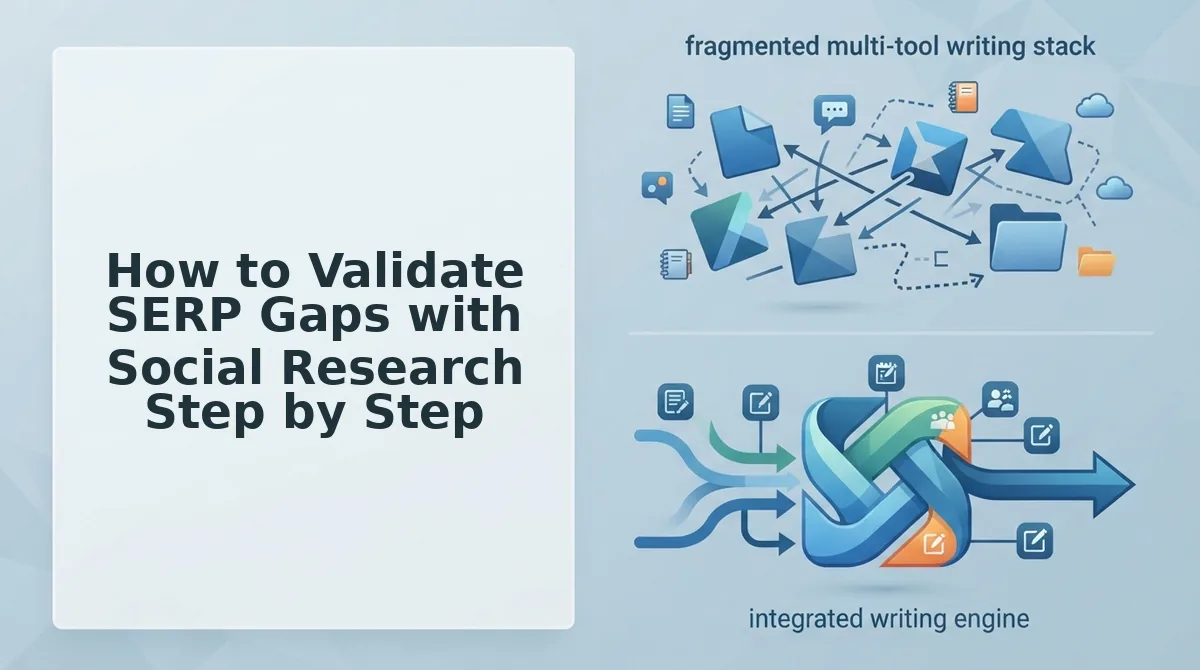
How to Validate SERP Gaps with Social Research Step by Step
Social validation turns a keyword-shaped assumption into a demand-backed content decision. This workflow requires a SERP gap list from your keyword tool, a Reddit account, and YouTube search access, budget 90 minutes per gap you validate.
Prerequisites: Export your gap keywords from Ahrefs or Semrush, open your competitor analysis markdown file for reference, and create a simple three-column spreadsheet: Gap Keyword | Social Evidence | Verdict.
- Open Reddit search and type your gap keyword without modifiers. Filter results by "Past year" and sort by "Top." Read the first 10 threads, not just titles. You should see recurring pain phrases like "I don't want to learn prompt engineering" or "how do I automate this without Zapier." Copy 5-10 exact phrases into your spreadsheet.
- Click into the 3 highest-engagement threads and expand every collapsed comment. Look for questions that go unanswered or answers that get pushback. You should see at least one thread where users argue about a workaround, that friction is your content angle. Record the thread URL and the specific unresolved question.
- Open YouTube search and type the same gap keyword, then sort by view count. Note the top 5 videos, their view counts, and their publish dates. You should see a pattern: established topics have high-view videos, while emerging gaps show low views or no dedicated coverage. For example, Rank Math covers SERP analysis at 9,524 views and Ahrefs covers gap analysis at 41,690 views, but no video teaches cross-validation, that absence is itself social proof of an unfilled gap.
- Type your gap keyword plus "site:reddit.com" into Google and scan the People Also Ask box. Compare PAA questions against the Reddit phrasing you collected. You should see overlap on 3-5 questions when demand is real. If PAA and Reddit diverge completely, flag the gap as low-confidence.
- Select the validation verdict using the contradiction rule. If SERP data says "listicle opportunity" but Reddit threads ask how to automate publishing without prompt engineering, trust the social phrasing for your angle and the SERP data for your format. You should end with a one-sentence content brief: the exact question to answer, the format to use, and the social phrases to mirror.
BloGoose applies this same triangulation automatically when it crawls your site and builds your content calendar, so validated gaps move straight into drafting without a manual handoff.
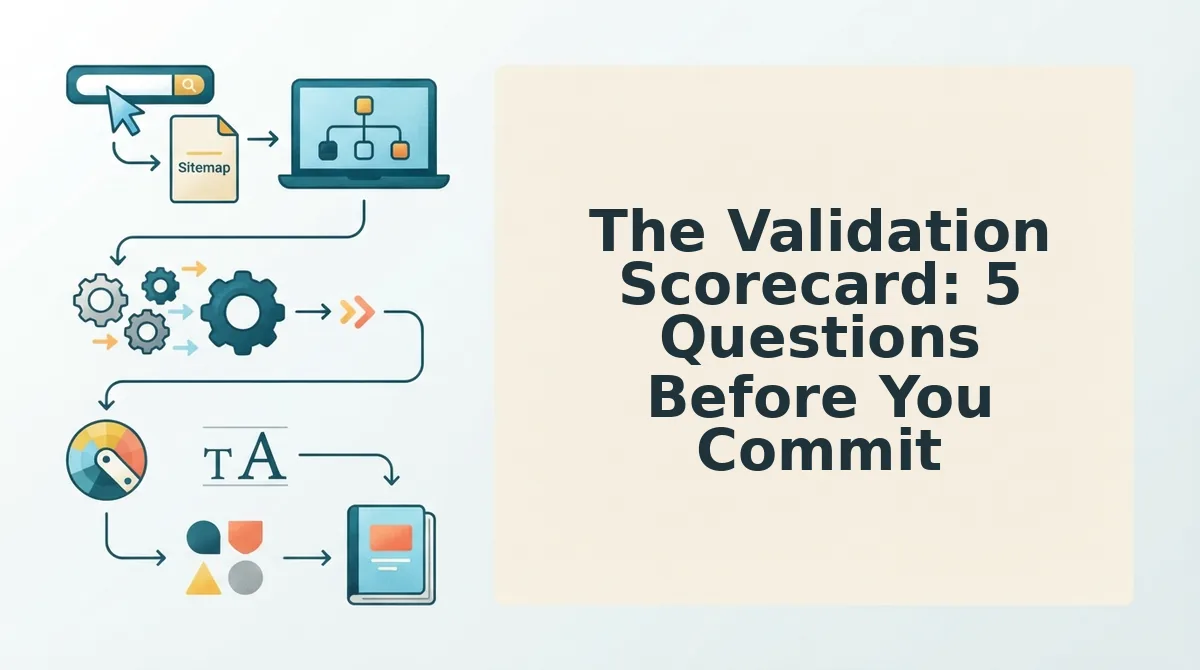
The Validation Scorecard: 5 Questions Before You Commit
Not every SERP gap is a content opportunity. Some gaps exist because demand is too weak or too fragmented to justify a dedicated page. Run every candidate through these five checks, fail two or more, and the gap is not worth filling.
- Demand evidence. Does the gap show up in at least two social channels. Reddit threads, YouTube comments, X posts, or niche forums, within the last 12 months? One channel can be a fluke; two channels with matching phrasing indicate a persistent, cross-platform need.
- Language match. Do the social phrases match the SERP keyword, or do users describe the problem differently? If Reddit says "auto-publish my blog without touching ChatGPT" but your keyword is "AI content engine," you must write for the social phrasing or the page will feel tone-deaf.
- Competition weakness. Are the ranking pages missing the specific angle social users demand? A listicle that ranks but ignores the top Reddit complaint is a beatable target. If a ranking page already answers the social question directly, the gap is closed.
- Cluster fit. Does this gap strengthen an existing topic cluster on your site, or would it create an orphan page? A validated gap that connects to two or more existing pages compounds authority; a standalone gap dilutes it.
- Information gain. Can you add something the SERP and social threads both lack, original data, a workflow, a decision framework? If you can only summarize what already exists, the gap is not an opportunity; it is a citation echo.
Score each item pass or fail, then commit only to gaps that pass at least four. BloGoose's content engine runs this same filter when it maps your site structure to a 30-day calendar, so weak gaps never reach your publishing queue.
FAQ: Social Research for SERP Content Gap Validation
Direct answers to the questions publishers and SEO leads ask most when combining social listening with keyword gap analysis.
How do I use social research to validate SERP content gaps?
Social research validates a SERP gap by confirming that real people actively discuss the problem behind the keyword. Start by exporting gap keywords from your SEO tool, then search each one on Reddit, YouTube, and X. Collect exact phrases users write when describing the problem, not the keyword itself. Compare those phrases against the ranking pages: if the top results use different language than real users, you have a validated angle. Cross-check with YouTube view counts to see whether creators have already covered the topic. A gap passes validation when at least two social channels show recurring demand in the past 12 months and the SERP does not answer the social question directly. This triangulation prevents you from writing content that ranks for a keyword but answers a question nobody is asking in that form.
What if my SERP gap has no social footprint?
A SERP gap with no social footprint is usually a low-priority opportunity. If no one discusses the topic on Reddit, YouTube, X, or niche forums, demand is either too weak, too new, or too fragmented to justify a dedicated page. Apply a decision framework: check whether the keyword has stable search volume for 6+ months, whether adjacent topics show social activity, and whether the gap connects to an existing cluster on your site. If two of those three checks fail, skip the gap and reallocate effort to a validated one.
Why does Reddit phrasing matter more than keyword volume?
Reddit phrasing reveals the actual problem users want solved, while keyword volume only shows what they type into Google. When the two diverge, writing for the social phrasing improves engagement and AI citation likelihood because answer engines extract content that mirrors natural question patterns.
How many social sources do I need to validate one gap?
Two independent social channels showing matching demand within 12 months is the minimum threshold. One channel can reflect a niche echo chamber; two channels with similar phrasing indicate a persistent, cross-platform need worth building content around.
Can YouTube comments validate a gap that Reddit misses?
Yes. YouTube comments often surface what creators skip, setup steps, edge cases, and integration failures. When a high-view tutorial generates comments asking "how do I do this without X," that unanswered question is a validated gap, especially if no follow-up video addresses it.
Only Validated Gaps Deserve Your Content Resources
Demand Triangulation isn't a nice-to-have filter. It's the difference between publishing into a real audience and publishing into silence. Every gap that passes the three-signal test, search demand, social resonance, and competitive white space, earns its place on your calendar. Every gap that fails gets cut before it consumes a single writing hour.
The scorecard closes the loop you opened at the start: most SERP gaps aren't content opportunities, they're content traps. Social research is the signal that separates the two.
Here's your next move:
- Score your next gap. Run the five-question scorecard before you brief a writer or open a draft.
- Kill anything under threshold. A 2-out-of-5 gap doesn't get "fixed with better headlines." It gets deleted.
- Automate the research loop. Apply the scorecard to your next gap, or let the BloGoose AI SEO content engine automate the research and publishing workflow, from crawl to calendar to CMS, so validation happens before a single article is drafted.
Content teams don't lose rankings by writing too little. They lose by writing for gaps that were never validated. The scorecard turns that risk into a repeatable decision.
"A SERP gap is only a content opportunity when search demand, social proof, and competitive weakness all point the same direction."