Byword vs BloGoose for Sectional Drafting With Brand Context
Thirty drafts are queued and one editor is available. That gap â not writing speed â is where most content calendars stall.
The one-line verdict on Byword vs BloGoose sectional drafting: bulk generation wins when weekly volume outruns editing capacity, while sectional drafting wins when a single page has to carry a brand voice across a cluster.
You already solved generation; the constraint moved to review throughput, and draft granularity is what sets it. This comparison covers how each drafting model changes your editing queue, what inputs a model actually needs for voice fidelity, and where BloGoose's crawl-and-publish pipeline fits â plus the factor that quietly decides it, which isn't draft quality at all.
- In scope: draft granularity, brand-context inputs, publish pipeline.
- Out of scope: pricing and undocumentated Byword features â verify those on Byword's own site.
Worked example: A publishing team drops its domain into BloGoose, which locates the XML sitemap, inspects published pages, and extracts brand voice rules. Rather than requesting a full article, the team drafts one section at a time against that extracted context. The editor approves or rejects each bounded unit on its own, leaving the rest of the page untouched instead of discarding a finished draft over one bad paragraph.
The criteria that actually separate the two tools come next.
What Separates Byword and BloGoose, Criterion by Criterion
Five criteria decide which tool costs you less editing: drafting unit, what governs voice, review scope per pass, publish destination, and setup before the first draft. Score both against that rubric before either gets a verdict.
Byword generates complete articles from keyword inputs in bulk; BloGoose drafts one section at a time against editable brand context files extracted from your sitemap. Almost everything below follows from that one difference.
| Criterion | Byword | BloGoose |
|---|---|---|
| Drafting unit | Full article per keyword | Single section against a fixed outline |
| What governs voice | Instructions you supply per prompt (verify current voice controls on Byword's site) | Context files distilled from your crawled sitemap and published pages, editable |
| Review scope per pass | Whole article | One bounded block |
| Publish destination | Confirm current integrations on Byword's site | WordPress or custom API, direct |
| Setup before first draft | Keyword list plus prompts | Domain crawl, then voice and calendar review |
Locality of failure is what actually sets editing cost: an error on page one of a bulk draft propagates into every downstream section, because each later section is written on top of it. Sectional drafting confines that same error to one block you can reject alone.
| Rejection scenario | Bulk draft (~1,500 words) | Sectional draft (8 Ã ~200 words) |
|---|---|---|
| Unit sent back | Entire article | One section |
| Surviving work after a bad opening | None guaranteed | Seven sections kept |
| Rework trigger | Any structural error | Local error only |
Byword's bulk model is genuinely efficient when a keyword maps to a formulaic page you would not rewrite anyway â location pages, glossary entries, thin roundups. Voice fidelity also turns on inputs, not adjectives: a model needs examples, style rules, and a link map. Byword lets you supply those per prompt; BloGoose extracts them from pages you already published.
Our recommendation: match drafting unit to review capacity. Choose Byword if your bottleneck is volume on templated page types and one editor can absorb full-article rewrites â best for solo publishers shipping formulaic pages at speed. Choose BloGoose if your bottleneck is editorial rework on a site with an established voice â best for content leads running a monthly cluster who cannot afford tone drift across posts.
Structure also decides which passages get quoted, which is why our guide to AEO optimization starts with section boundaries rather than keywords.
Byword's bulk model has its own logic, and it begins before the first draft.
How Does Byword Handle Bulk Article Generation?
Bulk article generation is a production model that turns a keyword list into a batch of full-length drafts in one run, and that keyword-in, article-out batch behavior is Byword's documented category level. For input formats, batch limits, and export options, check current docs on Byword's site â those details shift, and this article will not assert what it cannot verify.
Think of it as a printing press rather than a writing desk. A press is judged in pages per hour, and an operator who re-plates for every single sheet would never keep up. So the batch model pushes every constraint into one setup.
That setup is where the workflow takes its shape. A single prompt has to carry everything at once: tone, structure, target keyword, and â if you want it â the internal link plan for the cluster. One style rule survives that compression well. A cluster-level link map does not, because the model has no view of which sibling pages exist or what they cover.
Treating one prompt as the entire brief is a known failure mode, and we covered the mechanics in single-prompt blog post quality. Bulk generation does not escape that limit. It multiplies it across the batch.
The economics are the honest argument for bulk. Per-page generation cost falls as batch size rises, since research and setup amortize. Editing cost per page does not fall with it. A tone drift introduced in the shared prompt lands in every draft at once, and a structural miss on page one is still a miss on page forty.
What is bulk article generation? Bulk article generation is a drafting method in which one keyword list is processed into many complete articles per run rather than one article at a time. Each draft is generated whole â headline, sections, close â from a shared instruction set. The advantage is throughput: setup work is paid once and spread across the batch. The disadvantage is coupling. Because every article inherits the same prompt, an ambiguity in that prompt appears in all of them, and a reviewer meets the same mistake repeatedly instead of once.
So the workflow fits a specific shape of job:
- Large page sets where per-page economics dominate the decision.
- Topics uniform enough that one style rule covers the whole batch.
- A review pass that is genuinely uniform, not page-specific judgment.
Where the review has to be page-specific, the batch stops paying for itself â which is the case sectional drafting is built for.
How Does BloGoose Draft Section by Section With Brand Context?
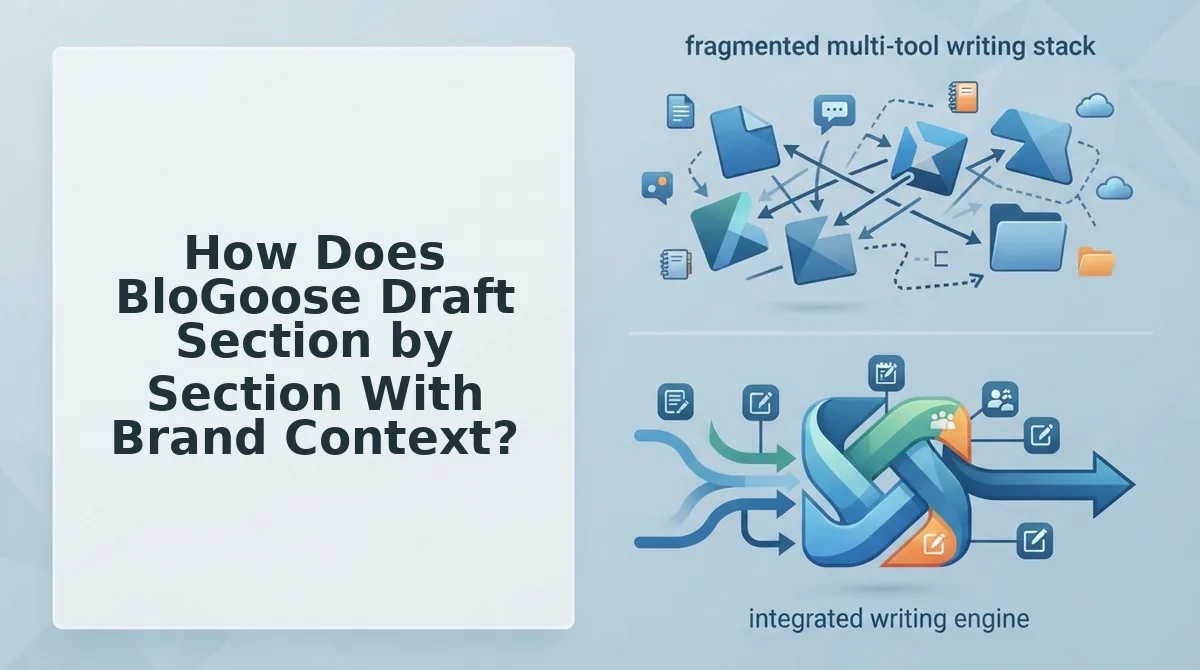
BloGoose converts a domain into a set of persistent, editable context files, then drafts each section as a bounded unit that inherits those files automatically. Voice rules, keyword coverage and the internal link plan get applied to every section rather than re-pasted into a prompt each time.
- Paste the domain into the setup wizard. BloGoose locates the XML sitemap and inspects your published pages, so setup starts from what you actually publish instead of a description of it. Run this once, before the first calendar exists.
- Edit the brand-voice file. This file holds the tone rules â how the brand sounds and what it never says. Rewrite it in your own words before drafting, because every section reads from it and loose tone rules are where tone drift begins.
- Set seo-context and seo-guidelines. Together they carry the audience, business facts, format rules and metadata conventions. They prevent the section that reads well but ships with the wrong title pattern or a missing structural block.
- Map intent in target-keywords. This file holds keyword coverage and the intent each target belongs to, so a section knows which query it answers. Fill it per pillar, not per article.
- Confirm the internal-links map. The link plan each section has to satisfy lives here, derived from the sitemap. Check it before drafting, since retrofitting links after publication is the most common source of editorial rework.
- Pull in style-guide, writing-examples and competitor-analysis. These supply formatting precedent, voice samples, and the framing competitors use in the same comparison set. The BloGoose docs list the current full file set, which changes over time.
- Draft the first section with files already in force. Drafting starts against those files, so there is no prompt chaining and no restating of rules between sections. Use the docs builder to revise a file mid-article and have later sections pick up the change.
Why do persistent context files reduce tone drift more than per-prompt instructions? A model drafting a section only knows what sits in front of it. When tone rules arrive as a fresh prompt each time, they get compressed from memory, and small deviations compound across twenty sections. When the rules live in a file the drafting step reads every time, a line like "we never use exclamation marks" is written once and applied identically to section one and section forty. The fix is structural, not editorial.
Where Byword Wins and Where BloGoose Falls Short
Byword wins on volume, and it is worth saying plainly: bulk generation is not worse content, it is a different review contract. You accept one pass over a longer draft in exchange for a lower cost per page, and for large programmatic page sets that trade is usually correct. BloGoose's honest limit runs the other direction â sectional drafting costs more review passes than a bulk batch, which is the wrong trade for thin pages that exist only to cover a query nobody reads closely.
The four questions that settle it:
- How many pages per week? High volume favors a bulk batch, because throughput matters more than per-page polish.
- What is one page worth? If a page is expected to earn links or get quoted in an AI answer, review it section by section.
- How much editing time exists? Thin editing capacity pushes toward one long pass; generous editing capacity rewards bounded sections.
- Where does the draft have to publish? A CMS pipeline with voice requirements favors the workflow with files already in force.
In one line each: high volume, low page value, tight editing time â bulk batch. Low volume, high page value, brand voice on the line â section by section.
The finding worth carrying out of this comparison is that the model is rarely the variable; draft granularity is, because it decides where a failure stays contained. If that points to the second path, the next step is one setup run: paste your domain into the wizard, generate the context files, and draft a single section you would normally rewrite twice. For stack-replacement comparisons, see our publishing breakdown, and check BloGoose pricing before you commit to a volume target.