Sectional AI Drafting vs One Shot Article Generation

Your draft opened strong, sagged around section four, and closed on a thesis it had abandoned in paragraph two. You blamed the model.
Scope is the likelier culprit. One prompt asked to hold an entire article at once â thesis, eight sections, a single voice â burns its context budget before the middle arrives. That fault line runs through the whole sectional AI drafting vs one shot generation debate, and it shows plainly in what a single prompt actually produces.
One definition first, since it muddles the argument: zero-shot, one-shot, and few-shot prompting describe how many examples sit inside a single prompt â never how the writing gets divided.
One mental model covers all four criteria below â editing cost, seam visibility, factual drift, voice consistency â and flags the one scenario where a single prompt still wins, which is not the scenario most teams guess.
Illustrative scenario, not a measured result: a team points the setup wizard at its domain, BloGoose crawls the sitemap and extracts brand voice rules from published pages, then drafts each section against those rules instead of one mega-prompt before publishing to WordPress or a custom API. The edit left over is seam repair, not a global rewrite.
If you'd rather inspect that crawl step than take it on faith, it's the first thing BloGoose runs on a new site.
Which leaves the question the next section takes up: which method actually wins for long-form articles?
Which Method Wins for Long-Form Articles
Sectional AI drafting wins on long-form articles. Above roughly 1,200 words, with a fixed outline and claims that need individual sourcing, a section-by-section run costs less to finish than a single prompt; below that threshold, or while a brand voice is still being discovered, one-shot generation is the faster route.
Sectional AI drafting is writing an article in planned blocks, each drafted against a frozen outline and its own source set, then assembled. One-shot generation asks for the whole piece in a single prompt.
| Criterion | Sectional drafting | One-shot generation |
|---|---|---|
| Structure control | Locked by the outline; headings survive | Drifts as the draft lengthens |
| Tone consistency | Voice rules restated per section | Even, but only if the prompt holds |
| Factual grounding | Narrow sources per claim | Wide context, thinner attention |
| Edit surface | Small repair zones at each seam | One large rewrite |
| Setup effort | Higher; outline and brief required | Minutes |
Read the last two rows together. Sectional drafting trades setup effort for a smaller surface area to repair; one-shot generation trades rerun cost for zero setup, because a failed draft usually means starting over.
Best for each method
- Sectional: the SEO lead publishing pillar pages that must rank and be quoted.
- One-shot: the solo operator testing angles or drafting a 700-word update.
Choose sectional if the piece exceeds 1,200 words, carries per-claim sourcing, or feeds a cluster. Choose one-shot if it is one short, single-intent page or you have not yet settled the voice.
Our recommendation: sectional for anything that will be updated, because reworking one section beats re-prompting an article. The method depends on a frozen outline â the same discipline described in building the frozen outline a sectional run depends on. BloGoose applies that structure automatically: it crawls your domain, extracts voice rules, and publishes finished sections to WordPress or a custom API.
One-shot generation still earns its place in narrower cases â and those cases are where its limits become visible.

What One-Shot Article Generation Gets Right, and Where It Breaks Down
One-shot generation is the stronger choice for short pieces and exploratory drafts, and the weaker one for anything long. Its failure has one mechanical cause: the model builds the outline while writing, so every sentence negotiates against sentences that do not exist yet.
One-shot article generation is the practice of sending a model a single prompt, brief and audience included, and getting the finished article back in one response, with no outline step and no section-level checkpoints. The model plans and writes in the same pass, deciding the shape of paragraph nine while already committed to paragraph four. That holds while the piece is short enough for the whole instruction set to stay in view. Past a few sections it strains, because the plan is never written anywhere the model can re-read.
Think of a chef who starts cooking before choosing the menu: the first plate is excellent, the fifth is whatever was in the pan.
That collapse produces four named failure modes:
- Structural drift: each section solves its own local problem, so the article's shape is whatever the final paragraphs argued for.
- Section starvation: late sections were never planned in detail, so they collapse into a summary paragraph while the intro gets disproportionate depth.
- Mid-document constraint decay: rules stated once at the top lose force as distance grows, since nothing restates them at the point of use.
- Tone plateau: with no checkpoint, the model settles into one register early and holds it.
The memorable opener in a one-shot draft is not luck. It is the one place where the entire instruction set was still fully in view. A one-shot article's quality curve is really a curve of distance from its own prompt.
The method still owns real ground: pieces under a few hundred words, single-intent pages, exploratory drafting, and voice discovery, where a single pass is the fastest way to hear what a brand sounds like. On those jobs, splitting the work buys nothing. See what changes when the same brief is run section by section.
The payoffs only hold, though, if the seams between sections stay invisible.
How Do You Draft Section by Section Without It Sounding Stitched Together
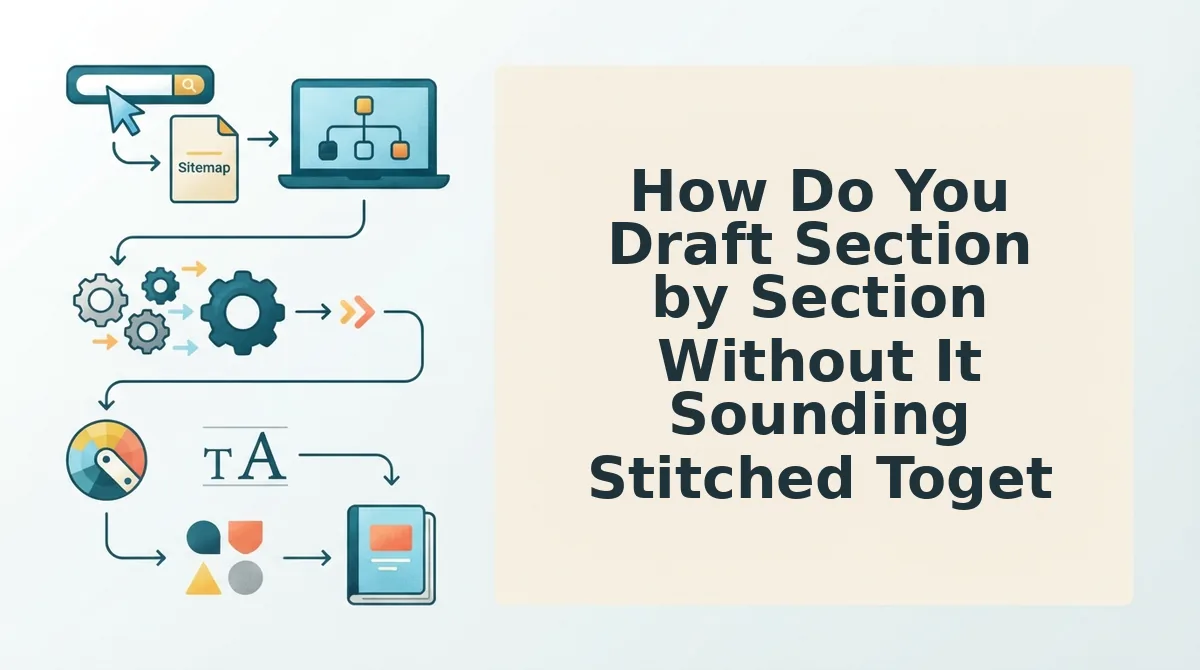
You prevent the stitched-together feel by freezing the outline first, re-injecting identical brand rules and sources into every section, and running a five-item seam audit before assembly. The seams people blame on sectional drafting usually come from chained prompting, which is a different method.
Sectional drafting is writing a frozen outline one block at a time, with every prompt restarting from the same full brief rather than from the previous section's output. Chained prompting inverts that: each new prompt inherits the last generated block, drift included. Re-injection resets drift at every boundary; chaining compounds it. The same discipline is what lets each block survive being quoted on its own, which is the premise behind writing sections for AI answers.
Prerequisites: a frozen outline, a brand voice document, per-section source notes, and somewhere to assemble the draft. Setup runs about 25 minutes.
- Freeze the outline (15 minutes). Open your planning doc and lock the heading order, one thesis sentence, and the single claim each section must prove. Write the forward references you intend to make into the outline now. You should end with a doc you have no reason to edit mid-run.
- Build one reusable context block (10 minutes). Paste voice rules, audience, banned phrases, source URLs, and formatting rules into a single block. You should be able to drop it into any section prompt unchanged.
- Draft section one with the full block (5 to 10 minutes). Send the block, that section's claim, and its sources. You should see the claim stated within the first two sentences.
- Draft each later section from the block, never from the previous output (5 to 10 minutes each). Add only that section's claim, its sources, and any forward reference it must pay off. Voice should hold steady without a separate style pass.
- Run the seam audit, then assemble in order (15 minutes). Read top to bottom against the five checks below, and fix failures by rerunning the offending section rather than hand-patching sentences. You should close with zero flags.
- Read the last line of section N against the first line of section N+1 and cut any idea that appears in both.
- Confirm the opening move differs from the neighbour's; two blocks that both open with a question read as template output.
- Verify every forward reference set up earlier has now been paid off.
- Sweep for repeated hinge phrases across sections.
- Confirm the thesis sentence is still true at the end of the piece.
How Much Editing Time Does Each Method Actually Cost
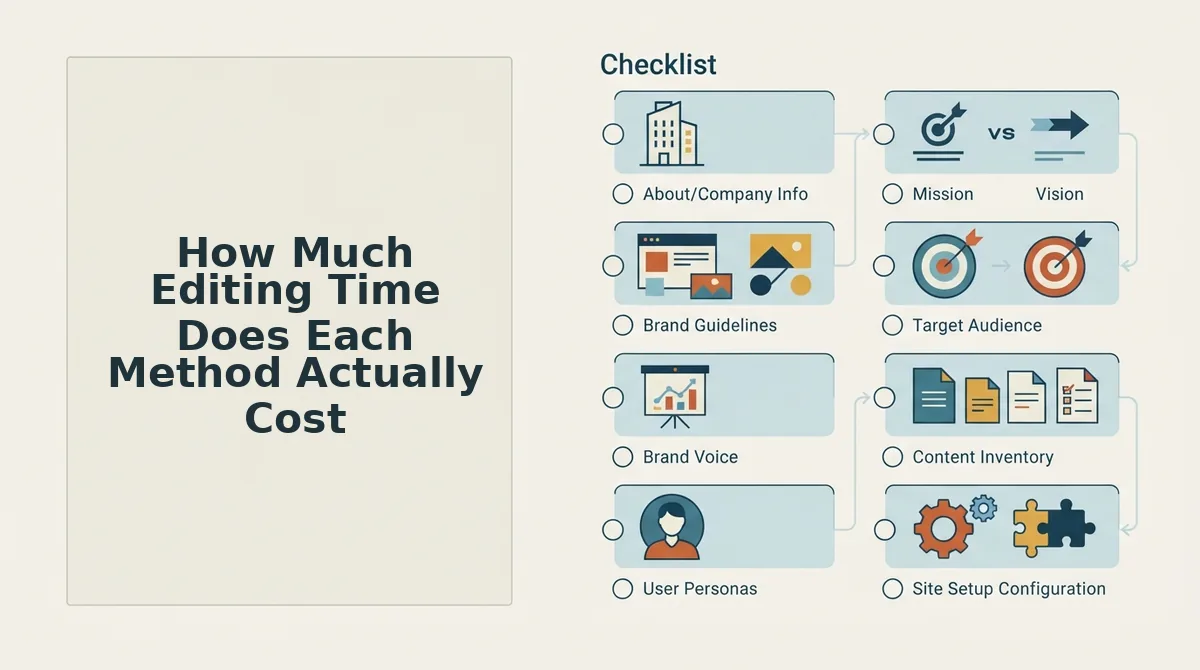
Editing time is roughly the surface area a failure touched, multiplied by the cost of rerunning whatever produced it. One-shot generation fails globally, so a single bad premise means repairing the whole draft. Sectional drafting fails locally, so a weak block costs one rerun.
Written as a formula, editing time â surface area to repair à rerun cost. Neither term is a measured benchmark â published figures for minutes-per-draft do not exist in any usable form â so the useful move is to reason about which term each method inflates.
Think of one-shot generation as spraying a whole house in a single pass: one missed masking job means recoating the entire exterior. Sectional drafting is painting room by room, where a wrong colour costs one room and the rest of the house stays untouched.
Take a clearly illustrative case. A 1,900-word article split into eight sections, drafted at 10 minutes per section. If one-shot output arrives with a soft thesis running through five sections, the repair is a full redo â 80 minutes of drafting plus 30 of editing, because every fix cascades into sentences that depended on the old framing. If sectional output arrives with one vague block, the repair is a 10-minute rerun plus a 10-minute seam pass. The sectional method relocates editing rather than eliminating it, but it relocates it into units you can redo cheaply.
Two variables decide whether that trade holds. Constraint decay â instructions drifting in weight across a long single pass â inflates the tone-fix share of the bill, because late paragraphs need rewriting to match early ones. Grounding inflates the fact-fix share: per-section retrieval windows keep each source next to the claim it supports, while a broad context forces every claim to compete for attention. The sectional-specific risk is cross-section contradiction, not single-section vagueness, which is why the seam audit above weighs thesis drift rather than wording polish.
Where BloGoose's Sectional Pipeline Stops Helping
BloGoose's sectional pipeline stops paying off when a piece is too short to amortize re-injection, when there is no documented voice for it to learn, or when publishing sits outside WordPress and a custom API endpoint.
Five boundaries worth knowing before you commit:
- Short posts. On a 500-word note, re-injecting context per section costs more than the block itself, so one prompt is the cheaper path.
- Brands with no published voice yet. Voice extraction reads existing pages; a site with three thin pages gives the crawl very little to model.
- One-off pieces. A single article that will never repeat rarely justifies building persistent site context around it.
- Human decisions between sections. Where a person must choose the argument, approve a claim, or clear legal review mid-draft, the automation waits.
- Non-standard publishing targets. Anything that is not WordPress or a custom API endpoint means a manual handoff at the last mile.
All five reduce to one variable: rerun cost. Sectional overhead pays for itself only when a failed section is cheap to regenerate and a failed whole draft is not â the same arithmetic that decides the editing bill, applied to your production loop.
If your workflow clears those boundaries, start by dropping your domain into the setup wizard: it crawls the sitemap, extracts voice rules, and drafts a 30-day calendar before anything publishes. If you are weighing that against a research-then-write stack instead, the comparison of the sectional pipeline with a research-first workflow covers the trade directly.
Pick the pieces where reruns are expensive, run them sectionally, and let the cheap ones stay single-shot â that split is a sustainable content operation, not a compromise.