
Brand voice calibration from site crawl for better articles
Your last AI draft read like a Wikipedia summary with your logo pasted on top. That's not a writing problem, it's a calibration problem. The model was tuned on the entire internet, not on the 200 pages you've already published. Brand voice calibration from site crawl fixes this by extracting measurable writing patterns from your live content before a single word is generated.
You're right to be frustrated. You've spent years developing a voice your readers recognize, and generic AI output erases it in seconds. This guide will show you how to crawl your own site, extract the signals that define your voice, and turn them into rules any AI writer can follow. You'll learn what signals matter, how many pages you need, and how to structure the output so drafts sound like you, not like a chatbot.
Along the way, you'll discover why most "brand voice" tutorials fail: they start from memory and style guides, not from data. The crawl-first method produces a AI SEO content engine output that's measurably closer to your published voice. And there's one counterintuitive finding about page count that changes everything, we'll get to it in Step 1.
What Brand Voice Calibration Actually Means
Brand voice calibration is the process of measuring the linguistic patterns in your published content and converting those measurements into rules an AI writer can apply consistently. Instead of asking a model to "sound professional but friendly," you give it data: your average sentence length, your punctuation habits, your vocabulary range, and how you structure arguments.
Think of it like tuning a guitar to a reference pitch. You don't describe the note, you measure it, then adjust the instrument until it matches. A site crawl does the same for writing: it samples your published pages, detects recurring patterns, and produces a reference profile your content engine tunes against.
The output is a voice fingerprint, a set of five measurable dimensions: sentence length distribution, punctuation density, vocabulary tier, transition style, and stance markers. Sentence length tells you whether you write in short bursts or long, layered clauses. Punctuation density reveals how often you use dashes, colons, and semicolons. Vocabulary tier measures whether you favor everyday words or specialized terms. Transition style captures how you connect ideas, with explicit markers like "however" or implicit jumps. Stance markers show how often you hedge ("might," "perhaps") versus assert ("is," "must").
Here's the myth this method kills: the idea that a style guide written from memory is enough. A style guide describes what you intend to sound like. A voice fingerprint measures what you actually sound like across dozens of published pages. The gap between those two is where generic AI drafts come from.
How does brand voice calibration from a site crawl work? A crawler visits your published pages, extracts text samples, and runs them through pattern analysis. The system measures the five voice fingerprint dimensions across every sampled page, then aggregates the results into a reference profile. That profile becomes the calibration target: every new draft is checked against it, and deviations are corrected before publication. The result is content that matches your existing voice because it was measured from your existing voice, not guessed from a prompt.
Step 1: Crawl Your Site and Extract Voice Signals
Before you can calibrate anything, you need raw material: a crawl of your published pages and a systematic extraction of the writing patterns they contain. You'll need access to your site's XML sitemap and at least 20 published articles or pages. Fewer than 20, and you're calibrating to outliers, one unusually formal post or one casual listicle will skew the entire profile.
- Locate your XML sitemap. Open your browser and go to
yourdomain.com/sitemap.xml. If you don't see a sitemap there, check your CMS settings. WordPress generates one automatically at/sitemap_index.xmlwhen you install an SEO plugin. You should see a list of URLs for all your published pages. - Select 20 or more published pages for the crawl. Choose pages that represent your core content: blog posts, pillar pages, and service pages. Skip landing pages, legal pages, and anything written by a different author or agency. The goal is a sample of your voice, not every word on your domain.
- Run the crawl and extract text content. Use a crawler that pulls the main body text from each URL, stripping navigation, footers, and sidebars. BloGoose's setup wizard does this automatically when you drop in your domain, it locates the sitemap, inspects published pages, and extracts brand context into eight Markdown files covering voice, structure, and terminology. You should see a set of text files, one per crawled page, with clean article content.
- Extract the five voice fingerprint signals. For each page, measure sentence length distribution, punctuation density, vocabulary tier, transition style, and stance markers. You can do this manually with a text analyzer, or let the crawl tool handle it. Success looks like a spreadsheet or report where every page has a row and every signal has a column.
- Aggregate the signals into a single reference profile. Average the measurements across all crawled pages. Flag any page that deviates sharply from the mean, it may be an outlier that shouldn't influence the profile. You should end up with one set of numbers that describes your voice across the entire sample.
This crawl-first approach is what separates real calibration from guesswork, and it's the same sitemap context extraction method BloGoose uses to build voice-accurate drafts automatically. Once you have the raw signals, the next move is turning them into rules.
Now that you've extracted the signals, it's time to cluster them into voice rules your AI writer can actually follow.
Step 2: Cluster the Signals into Voice Rules
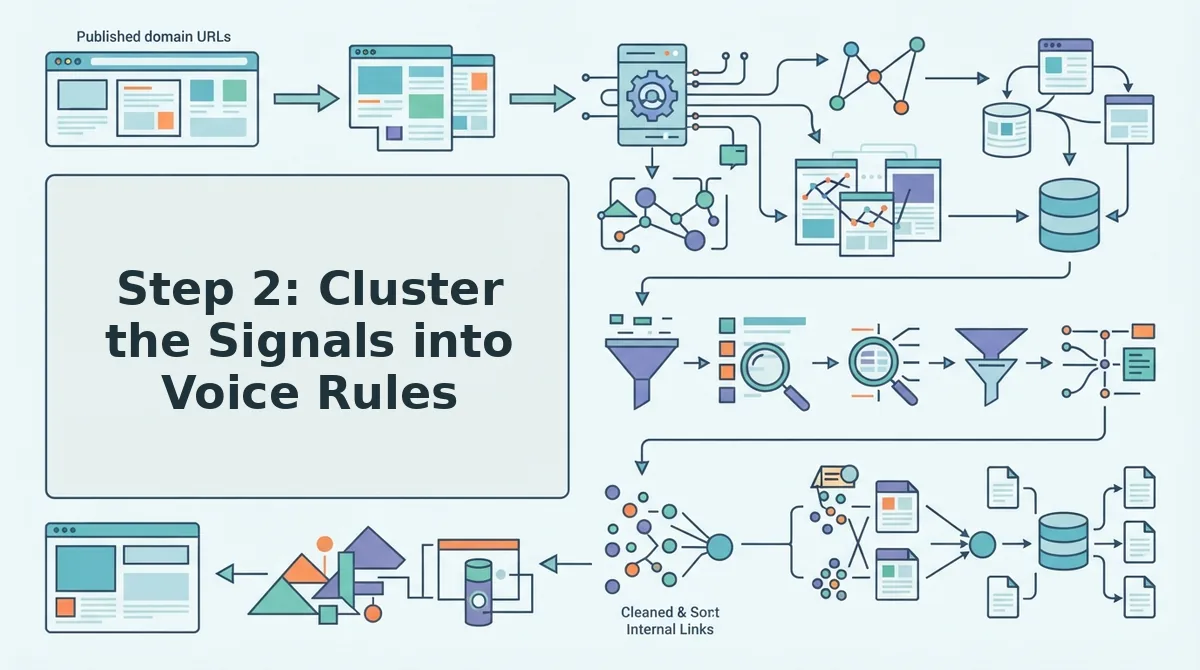
Clustering turns raw crawl output into a short list of enforceable rules your writers or AI prompts can follow. You'll need the crawl data from Step 1, a spreadsheet or text editor, and about 45 - 60 minutes.
- Open your crawl export and create three columns labeled Lexical, Syntactic, and Tonal. Sort every extracted phrase, sentence pattern, and punctuation mark into one of the three buckets. You should see a rough 40/30/30 split across most sites.
- Tag each lexical item with a vocabulary tier: technical, plain, or branded. Count the frequency of each tier. If technical terms appear in under 10% of sentences, your rule becomes "default to plain vocabulary, reserve jargon for product pages."
- Measure syntactic patterns by calculating average sentence length and punctuation density per page type. A blog averaging 14 words per sentence with one em-dash per 200 words reads very differently from a docs page at 22 words with zero em-dashes. Write the number down, it becomes a hard rule, not a vibe.
- Highlight tonal markers: stance words (honestly, frankly), hedging (might, tends to), and transition style (but vs. however). Count how often each appears per 1,000 words. You should end with a one-page list of "always / never / sometimes" tonal rules.
Here's where most teams get stuck: they stop at adjectives like "friendly" or "professional." Those words mean nothing to a model or a new hire.
Step 3: Codify the Rules into a Calibration Reference
A calibration reference is the single artifact every draft gets checked against, without it, voice rules live in someone's head and drift within weeks. You'll need your clustered rules from Step 2 and roughly 30 minutes.
- Create a new folder named
voice-calibrationin your content repository. Inside, add one Markdown file per rule category:style-guide.md,target-keywords.md,writing-examples.md,tone-rules.md,syntax-rules.md,lexicon.md,forbidden-phrases.md, andformatting.md. You should have eight files total. - Paste your clustered rules from Step 2 into the matching file. Convert every observation into an imperative: "Keep sentences under 18 words" instead of "sentences tend to be short." You should see each file read as a checklist, not a description.
- Add two before/after examples to
writing-examples.mdpulled directly from your crawl, one sentence rewritten from generic to on-brand, one left generic as a warning. This gives any reviewer or AI prompt concrete anchors. - Save the folder and link it from your content brief template. Every future draft must reference it before submission.
If building eight files by hand sounds heavy, BloGoose's crawl-and-extract capability generates this structure automatically from your live site, you can generate a Markdown style guide from your website in one pass, then edit the rules rather than write them from scratch.
Step 4: Check Every Draft Against the Fingerprint
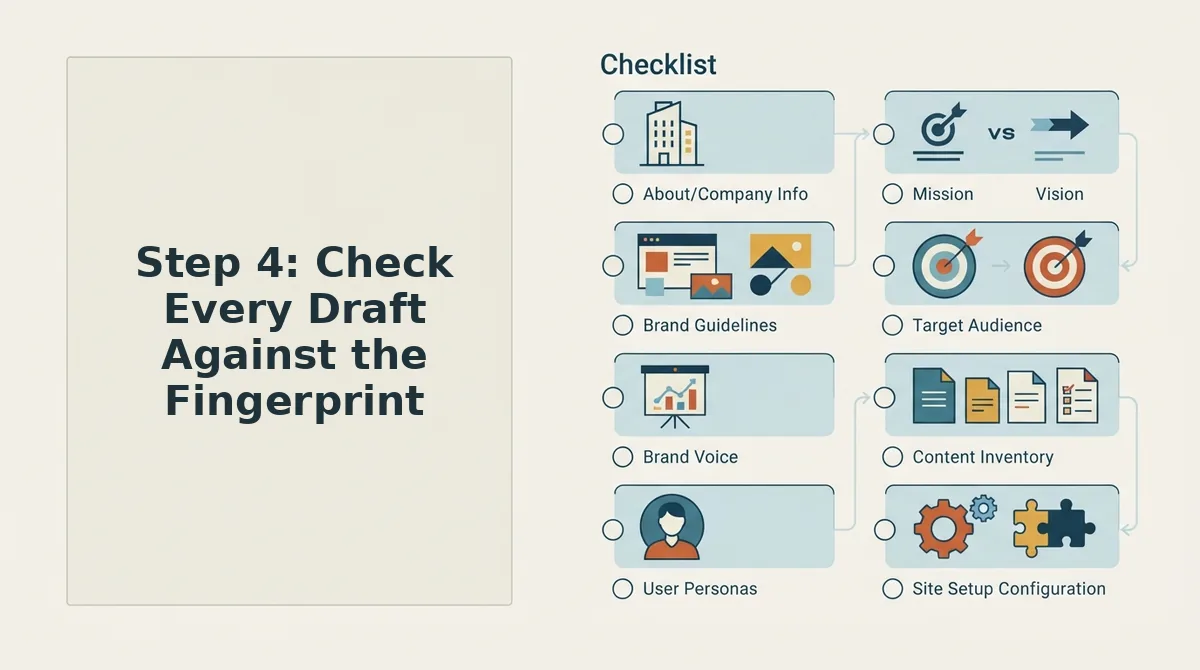
Checking drafts against your calibration reference is the step that separates consistent publishing from voice drift. You'll need your eight-file reference from Step 3 and 10 - 15 minutes per draft.
- Open the draft alongside
syntax-rules.mdandtone-rules.md. Run a quick pass: count sentences over your length cap and flag any stance marker that violates your tonal rules. You should catch 80% of voice breaks in under five minutes. - Paste one paragraph into a readability checker and compare the score against your crawl baseline. A blog averaging grade 7 that suddenly reads at grade 12 signals a calibration miss.
- Rewrite any flagged sentence using a crawl-derived example from
writing-examples.mdas the template. For instance, a generic draft line like "Our platform helps teams publish content faster" becomes, under BloGoose's own crawl rules, "Drop your domain in, and BloGoose ships rank-ready articles to WordPress without a prompt chain." The second version carries the lexical tier, sentence rhythm, and directness the crawl extracted.
To make this loop run without manual passes, you can automate brand voice in AI blog posts by feeding the calibration files directly into your generation workflow. The same mistakes show up in every manual calibration attempt, and crawl data fixes most of them.
Common Calibration Mistakes (and How Crawl Data Fixes Them)
Most brand voice failures trace back to three preventable calibration errors. Crawl data fixes each one by replacing assumption with evidence.
- Calibrating from memory instead of crawl data. Writers and editors reconstruct "how we sound" from a handful of remembered posts, which silently drifts toward their own preferences. A full site crawl surfaces the actual dominant patterns, sentence length, punctuation habits, vocabulary tiers, across hundreds of pages, not the three you remember.
- Ignoring inconsistent voice across authors. Multi-author sites often publish a patchwork of tones because each contributor calibrates to a different mental model. Crawl data exposes the variance: which pages cluster together stylistically, where the outliers sit, and what the statistical center of your voice actually is, so you can codify one reference instead of five.
- Treating voice as static instead of evolving. Brand voice shifts as products, audiences, and writers change, but manual style guides rarely get updated. Re-crawling your site on a schedule, quarterly or after major content pushes, catches drift early and keeps the calibration reference aligned with what you actually publish today.
FAQ
How does brand voice calibration from a site crawl work?
A crawler scans your published pages and extracts recurring stylistic signals: sentence length, vocabulary level, punctuation patterns, formatting habits, and tonal markers. Those signals get clustered into rules, such as "short declarative sentences, no exclamation marks, second-person address", which form a calibration reference every new draft is checked against.
Can I calibrate brand voice without a style guide?
Yes. A site crawl reverse-engineers your voice from what you already publish, so a formal style guide is optional. The crawl becomes the style guide: it captures the patterns your best-performing pages share, even when no one wrote them down. This is especially useful for teams that grew without documentation.
What if my site has inconsistent voice across authors?
Crawl data quantifies the inconsistency instead of leaving it to subjective debate. You can identify which author clusters dominate, which outliers dilute the brand, and what the statistical center of your voice is. Then you codify that center as the calibration reference and route every draft through it, including articles built for automated blog publishing workflows. Over time, consistency compounds and your content becomes easier to get cited in AI answers.
Conclusion
Brand voice calibration is not a creative exercise, it is a measurement problem. The sites that sound unmistakably like themselves are not staffed by more talented writers; they are run by teams that extracted their voice from evidence and enforced it systematically. The four-step method in this article, crawl, cluster, codify, check, turns voice from a vague aspiration into a repeatable quality gate.
Start with the manual version: crawl your site, build a fingerprint, and run your next five drafts through it. When that process proves its value, automate the crawl and calibration with BloGoose, which extracts brand voice rules from your domain and applies them to every article in your automated blog publishing pipeline. Your voice stops being a debate and becomes a data point.