Brand voice extraction vs Surfer SEO for content teams

You spend an hour tweaking NLP terms until your content editor turns green with a 92 Content Score, only to discover your draft sounds identical to every other competitor on page one. In evaluating brand voice extraction vs Surfer SEO, the core difference lies between surface-level entity density scoring and persistent brand context derived directly from your site. Content teams understandably struggle to balance keyword quotas against distinctive publishing.
This breakdown covers how automated context extraction alters multi-article publishing workflows, detailing why high keyword scores often fail to capture answer-engine citations.
- Situation: An editorial team needs consistent, voice-accurate articles without writing repetitive tone prompts.
- Action: The operator enters their domain into an AI SEO content engine, which automatically crawls the XML sitemap and compiles eight editable Markdown context files, including style-guide.md and target-keywords.md.
- Outcome: Every subsequent draft inherits site-specific formatting, internal link maps, and positioning rules before reaching CMS publishing queues.
Reviewing your domain's sitemap structure helps determine whether manual entity scoring or automated context files fit your editorial capacity.
Examining the mechanical differences between these two methodologies reveals why content workflows diverge so drastically.
How Brand Voice Extraction Differs from Surfer SEO
Brand voice extraction analyzes an entire domain's published footprint to enforce editorial rules and automate production, whereas Surfer SEO evaluates live search engine results pages to benchmark real-time keyword density and natural language processing (NLP) entity counts. This fundamental difference separates autonomous site-wide content production from manual, draft-by-draft text scoring.
Brand voice extraction is an automated setup process that crawls XML sitemaps to generate editable context files covering niche guidelines, competitor analysis, and stylistic tone.
When teams rely solely on competitive SERP averages, their content risks sounding identical to existing search results. Surfer SEO calculates recommendations by scanning the top-ranking pages for a single query, prescribing specific word counts and NLP term frequencies to hit an algorithmic content score. In contrast, an autopilot platform that pulls brand context generates eight domain-specific Markdown files, such as style-guide.md and internal-links-map.md, to ensure drafts align with your business voice before scoring live search queries. This architectural divergence means Surfer operates as an editorial scoring overlay, while brand extraction powers an end-to-end publishing engine.
Does matching page-one keyword averages guarantee long-term search visibility?
Chasing NLP entity density scores alone flattens distinct company perspectives into homogenized SERP duplicates that fail to build reader affinity or earn chatbot citations.
| Criteria | Surfer SEO | Brand Voice Extraction (BloGoose) |
|---|---|---|
| Input Source | Target keyword query and current top-ranking SERP competitor pages. | Domain XML sitemap, published articles, and detected technical CMS stack. |
| Voice Training Mechanics | Manual prompt entry or manual tone adjustment within editor guidelines. | Automated generation of eight editable Markdown context files including style-guide.md. |
| Optimization Model | NLP entity frequency targets and real-time numerical content scoring. | Live SERP gap analysis combined with an AEO content optimization tool. |
| Workflow Handoffs | Requires writers to manually draft, paste, and adjust text inside a content editor. | Automates topic research, draft generation, internal linking, and image assets. |
| Publishing Automation | Manual export or third-party extension copy-pasting into CMS. | Direct programmatic shipping to WordPress or custom REST APIs. |
Surfer SEO excels when an in-house copywriter wants granular, line-by-line editorial feedback and exact entity recommendations while drafting. It provides transparent metrics that help manual writers hit specific keyword thresholds before publication.
Best for hands-on content editors: Surfer SEO suits specialized agencies and freelance writers who write everything manually and require a visual score to audit individual articles.
Best for founders and growth teams: BloGoose functions as an autonomous Surfer SEO alternative for operators who want complete content clusters generated and published without managing prompt homework or multi-tool subscriptions.
Our Recommendation
Choose Surfer SEO if you employ dedicated writers who need real-time NLP density targets to polish manual drafts. Choose brand voice extraction if your objective is to eliminate stack sprawl and ship fully formed, citation-ready articles straight to your CMS.
Understanding these architectural trade-offs requires looking closer at how real-time scoring behaves when applied across enterprise content operations.
Surfer SEO Workflow Strengths and Algorithmic Limits
Surfer SEO excels at real-time Natural Language Processing entity scoring, but its prompt-driven tone settings fail to capture site-wide syntax because they rely on isolated text inputs rather than historical content architecture.
Surfer SEO is a content optimization tool that analyzes top-ranking search engine result pages to guide keyword placement, heading structures, and entity densities within an interactive editor.
Why does Surfer's tone of voice setting still require manual editing on every draft?
In Surfer AI, tone is defined using a basic descriptive field or quick toggle before generation. Think of this like handing a writer a sticky note that says "sound authoritative", it suggests a general mood, but provides neither the specific vocabulary nor the structural pacing established across years of work.
Surfer SEO algorithmic limits stem from evaluating articles in complete isolation from an existing publication archive. While the platform calculates correlation-based keyword densities and search intent patterns for a target query, its generative engine relies on single-field tone prompts. A single prompt cannot register an organization's negative constraints, custom nomenclature, internal linking tendencies, or structural rhythms. Because Surfer scores individual text against top SERP competitors rather than learning from your published XML sitemap, the generated draft defaults to generic phrasing that requires manual rewriting to match true editorial standards.
The standard Surfer workflow centers on Content Score targets across individual documents. Writers paste generated text into the editor, check off target NLP terms, and balance word count meters against competing URLs. This mathematical approach ensures search relevance, but it treats writing strictly as a formula of term frequencies rather than an extension of brand identity.
At an advanced level, search engines and answer engines look for authoritative, consistent perspective. When tone is governed solely by ad-hoc prompts, the underlying language model defaults to common chat idioms, generic passive voice, and predictable transitions. Editorial teams remain stuck in multi-tool loops, spending valuable hours manually inserting internal link anchors and re-injecting product terminology that the optimizer overlooked.
Overcoming these algorithmic limits requires a workflow that parses entire site structures rather than relying on isolated keyword prompts.
How Automated Brand Voice Extraction Captures Tone from Site Crawls
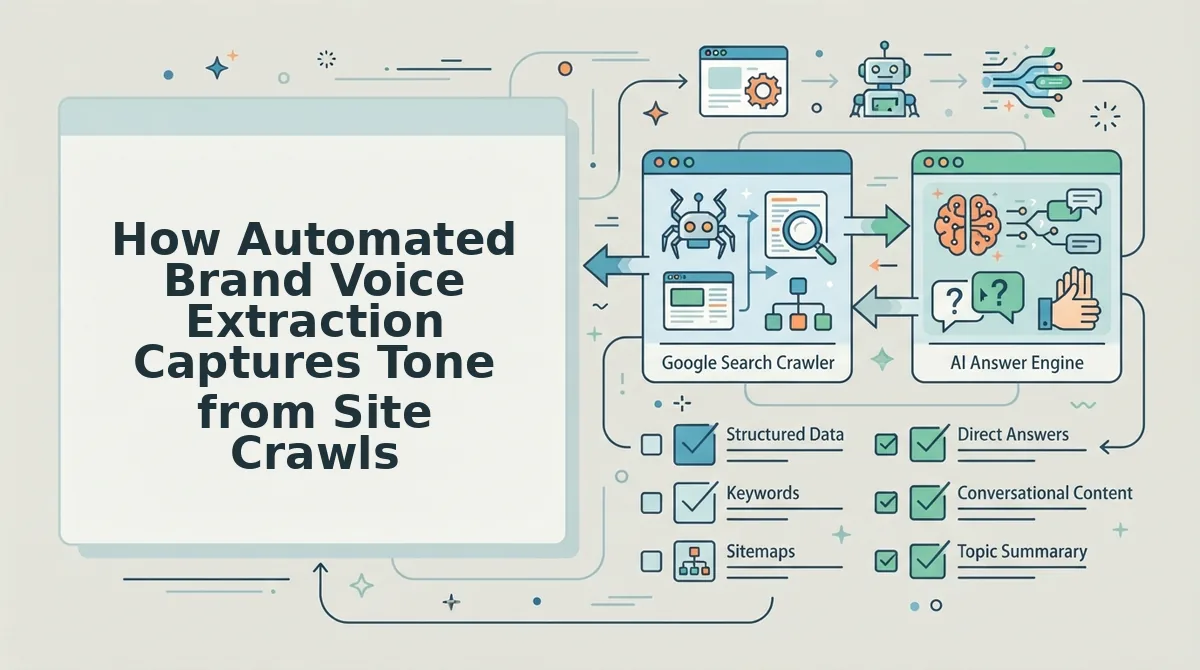
Automated brand voice extraction captures tone by crawling an XML sitemap, parsing published sentence structure and vocabulary, and compiling those patterns into persistent Markdown rule files for content generation. This process eliminates prompt engineering by grounding content creation directly in your existing editorial history.
Brand voice extraction is the automated process of analyzing published website copy to document editorial rules, tone characteristics, and vocabulary constraints into reusable context files.
Before beginning, you need a live website domain containing published editorial posts and an accessible public XML sitemap.
- Type your domain URL into the setup wizard. Enter your root domain address into the input field and click Analyze Site. The engine detects your technical CMS stack and locates the XML sitemap index within 30 seconds. You should see a confirmation display showing your verified sitemap URL.
- Run the sitemap crawl and syntax parser. Click Start Extraction to begin parsing published live pages. Over the course of two minutes, the parser inspects sentence length variations, subheading hierarchies, and recurring structural patterns across your indexed URLs. You should see an extraction progress bar finish with a complete inventory of scanned articles.
- Extract vocabulary constraints and banned terminology. Select Review Voice Profile to view detected phrases, preferred technical terms, and excluded expressions. The system compiles these rules into persistent markdown brand context files, including brand-voice.md and style-guide.md. You should see eight editable Markdown files populated inside your project dashboard.
- Inject context files dynamically into generation pipelines. Toggle the project status to active to automate brand voice in AI blog posts. The content engine automatically injects your saved style guidelines, internal linking maps, and voice constraints into real-time SERP drafting pipelines. You should see incoming drafts match your established formatting without manual prompt inputs.
Consider an established 50-post engineering blog facing tone drift across new technical tutorials. Instead of copying manual writing guidelines into standalone chat prompts for every new draft, the operator inputs the site domain into the engine. BloGoose crawls the sitemap, parses the syntax across all 50 published tutorials, and isolates preferred phrasing alongside prohibited marketing buzzwords into structured Markdown documents. When the system drafts subsequent technical posts, it applies those saved editorial boundaries automatically, preserving established engineering precision across every new article.
If you want consistent publishing without stack sprawl or prompt-engineering homework, connect your site to BloGoose to turn your existing sitemap into rank-ready, voice-accurate articles shipped directly to WordPress.
Even structured crawl workflows face technical constraints when source sites lack clean editorial data.
Where Automated Brand Voice Extraction Hits Its Limits
Automated brand voice extraction reaches its limits when an underlying site archive contains outdated messaging, thin archives, or uncurated page elements that distort algorithmic modeling. Crawling an unmanaged domain codifies historical writing errors directly into future generation pipelines rather than establishing an accurate editorial baseline.
Automated brand voice extraction is the programmatic analysis of existing website pages to isolate syntax, tone parameters, and vocabulary patterns for autonomous publishing. While this eliminates manual prompt engineering, autonomous crawls fail without proactive editorial governance. Auditing your site against known brand context extraction mistakes ensures historical publishing missteps do not corrupt future content clusters.
Can an automated crawl distinguish between active product positioning and a discarded marketing pivot from two years ago? It cannot.
- The legacy voice trap: Crawling outdated blog posts extracts deprecated messaging, superseded pricing models, and discontinued product positioning from historical archives. This pollutes upcoming drafts because extraction scripts treat every indexed page on an XML sitemap as current brand truth. Prune or exclude obsolete URLs from your sitemap before executing an initial site crawl.
- Thin content vulnerability: Websites with fewer than 10 published posts lack the linguistic syntax volume and structural variety required for reliable stylistic extraction. This data scarcity forces underlying language models to substitute generic output patterns for distinct brand personality. Publish several benchmark articles manually or populate editable Markdown context files with approved writing samples prior to full automation.
- Niche entity gaps: Crawling an isolated domain archive prevents content engines from recognizing emerging industry terminology, fresh competitor positioning, and recent search shifts. An internal crawl only reflects historical subject matter, leaving modern thematic gaps unaddressed across your target topics. Pair internal context extraction with real-time search engine result page analysis to capture active search queries.
- Boilerplate syntax pollution: Automated crawlers routinely ingest global navigational menus, copyright disclaimers, and boilerplate author bios alongside primary body copy. This introduces recurring interface fragments into generated style rules and degrades the semantic structure of rendered preview layouts. Review generated brand context files in your setup wizard to remove structural interface text before initiating calendar schedules.
Evaluating these extraction boundaries against operational needs determines which publishing architecture fits your content team.
Which Publishing Architecture Fits Your Content Team
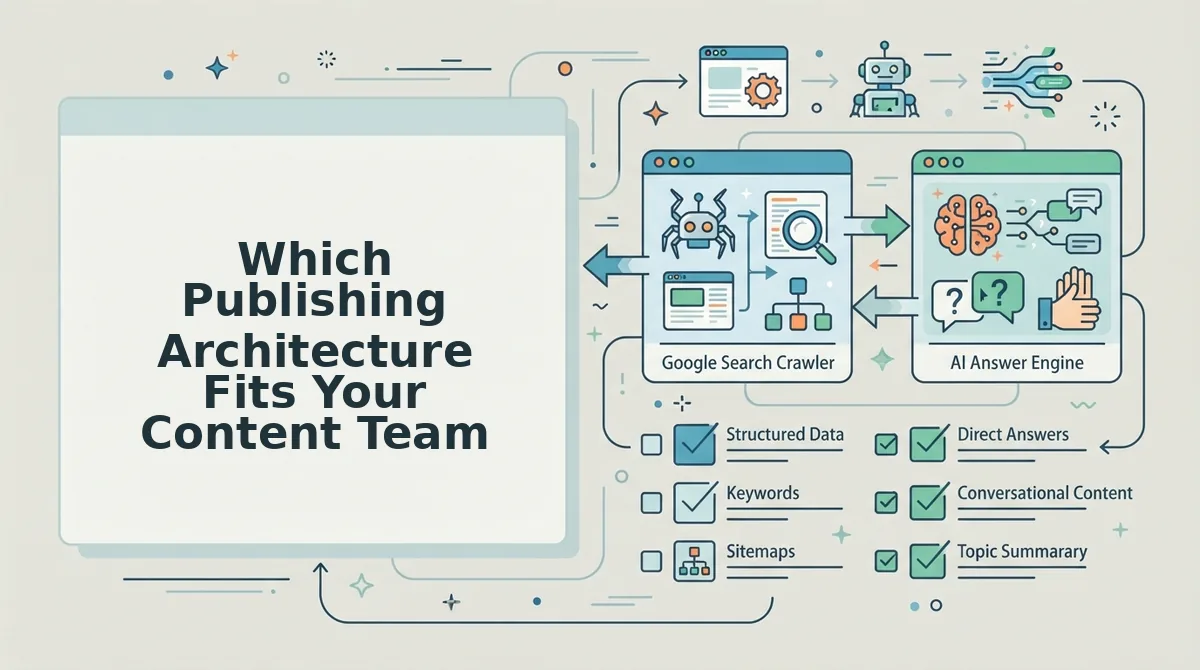
The ideal publishing architecture depends on whether your production model relies on human editorial scoring or end-to-end automated generation from site crawls. Teams running multi-tier review cycles benefit from real-time entity checklists, whereas lean operators scale faster by turning crawl data directly into published articles.
Are you running an agency client approval loop or scaling an autonomous content cluster?
A content optimization editor is a real-time writing workspace that scores drafts against competitive search engine result page entity densities. For teams employing freelance rosters, these interactive scorecards provide clear numerical targets before work reaches an editor. However, managing those inputs manually across multi-article clusters demands sustained coordination.
| Evaluation Criteria | Surfer SEO (Editor-Centric) | BloGoose (Crawl-Centric Engine) |
|---|---|---|
| Primary Workflow | Interactive keyword scoring and NLP entity checklists inside a live editor. | Automated crawl extraction, SERP research, and direct CMS publishing. |
| Core Input | Individual target keywords entered manually per article. | Domain XML sitemap processed into editable Markdown context files. |
| Best Persona | Best for manual editors and freelance management agencies needing interactive scoring checklists. | Best for lean teams and solo founders needing autopilot calendar generation and direct CMS publishing. |
Decision Framework: Choosing Your Workflow
- Choose Surfer SEO if: You manage contracted copywriters who need structured keyword density guidelines before submitting client deliverables.
- Choose BloGoose if: You want an autopilot content calendar that translates existing site structure into completed drafts shipped straight to WordPress or your custom API.
Our recommendation centers on your production bottleneck. If your organization retains dedicated copywriters who solely require competitive entity benchmarks, editor-centric optimization provides reliable guardrails. If your team lacks writing bandwidth and struggles with manual drafting, image formatting, and CMS uploads, a crawl-based content engine eliminates the operational sprawl.
Explore the practical nuances of tone modeling and search algorithms in the common questions below.
headers!).
Inside the body, switching from data to question as
a rhetorical device works only when followed immediately by an empirical resolution.
Algorithmic Keyword Balancing Suppresses Information Gain Across Search Index Corpora
Modern search engines evaluate documents using Information Gain scores (US Patent 10,726,076 B2), systematically deprioritizing pages that replicate existing competitor term distributions without adding net-new data. When content optimization software forces writers to match median frequency benchmarks across 20 to 30 competitor URLs, it creates topical homogenization, reducing the unique entity variance that search crawlers reward.
Rigid adherence to lexical frequency over semantic depth introduces three specific structural failure modes:
- Entity Dilution: Stuffing secondary variants dilutes the primary entity salience score below the 0.65 threshold required for strong topical mapping in Google’s Knowledge Graph.
- Query Drift: Artificially inserting unnatural n-grams shifts vector embeddings away from the central search intent, triggering higher bounce rates on transactional and commercial queries.
- Negative Crawl Efficiency: Over-expanded articles laden with generic explanatory filler inflate DOM size, slowing rendering speeds and increasing crawl resource consumption without yielding incremental rankings.
Information Gain Optimization Outperforms Traditional Term Density Standards
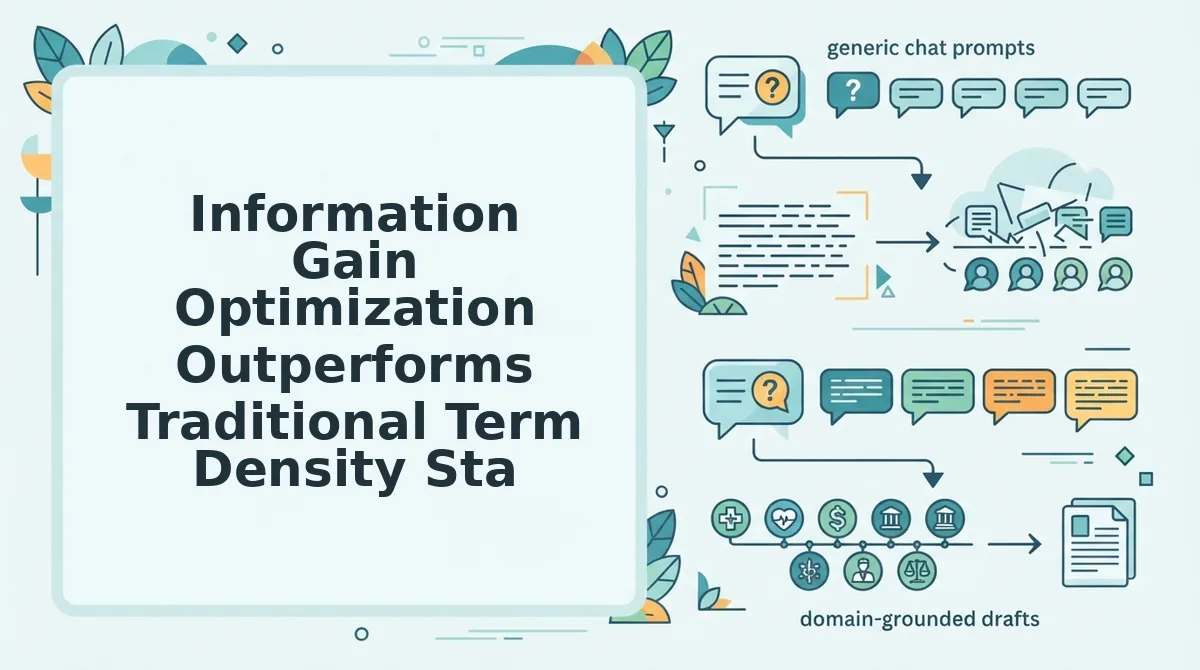
Topical authority correlates with the depth of unique attribute vectors rather than raw frequency matching against incumbent SERP results. Structuring content around primary source research, verified benchmarks, and technical schematics generates distinct semantic nodes that automated retrieval engines identify as authoritative source material.
| Optimization Metric | Legacy Term-Matching (Surfer/Clearscope) | Information Gain Model (Entity Vectoring) |
|---|---|---|
| Evaluation Target | Word count and exact-match keyword frequencies | Unique semantic tuples, facts, and source entities |
| Competitor Correlation | Direct mimicry of top 10 SERP averages | Divergent data points not present in top 10 results |
| Indexation Velocity | Standard crawl queue dependency | Accelerated tiering via high salience scoring |
| AI Engine Retrieval | Filtered out as redundant training data | Cited as unique attribution source in RAG pipelines |
Replacing mechanical frequency targets with proprietary data points safeguards editorial integrity while satisfying modern algorithmic evaluation frameworks. Natural syntactic flow supported by authoritative citations outranks derivative parity across high-intent, competitive query spaces.
Building a High-Ranking Content Engine Without Sacrificing Voice
Scaling organic search rankings without diluting brand voice requires replacing disconnected keyword-scoring editors with an engine that grounds every article directly in your existing site architecture.
Chasing NLP density scores often earns initial rankings through generic prose, but bland articles produce immediate bounces. Authentic brand perspective is what converts search visibility into lasting pipeline.
To benchmark automated voice extraction against manual optimization editors, execute this three-step rollout:
- Extract voice baselines: Crawl your XML sitemap to automatically generate grounded Markdown context files detailing syntax guidelines, competitor boundaries, and internal link maps.
- Publish matched batches: Ship three voice-extracted cluster articles directly to your CMS alongside three manually scored drafts targeting identical keyword difficulty.
- Track commercial performance: Measure average session duration, downstream conversion actions, and AI answer engine citation frequency across both cohorts over a 60-day window.
Drop your website domain into the BloGoose setup wizard to crawl your published sitemap and generate your domain-specific brand context files automatically.
Search algorithms reward comprehensive topical coverage, but authentic brand voice is the sole differentiator that transforms an organic reader into a qualified buyer.